
In This Article
It’s 9:47 p.m. You finally have the energy to move, and the only obstacle is the family downstairs, who treat every footstep like a personal insult. An apartment elliptical machine ends that standoff. On a treadmill, every stride is a small earthquake. On an elliptical, your feet stay planted on the pedals, so the loudest thing in the room is usually your own breathing.
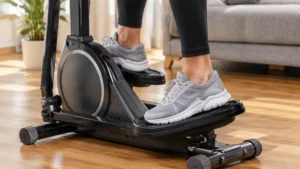
The idea isn’t new. The elliptical trainer was built to mimic walking, running, or stair climbing without the joint-pounding of the real thing. What’s changed is the size. A new generation of compact, magnetic-resistance machines now fits in a studio corner, and some fold or tuck away entirely.
This guide covers seven real, currently sold machines, from a seated under-desk model to a full-stride heavyweight. Everything here is built from published specs and aggregated reviewer sentiment, not personal testing, and where evidence is thin, I say so. You’ll see which quiet compact elliptical suits which body, budget, and floor plan. You’ll also see why a “silent” claim deserves some skepticism, and how to set up a neighbor-friendly elliptical so your downstairs neighbors never learn your workout schedule.
Whether you want a small apartment elliptical for a 500-square-foot studio or something sturdier for a spare room, the goal is the same: real cardio, zero drama.
Quick Comparison: Best Apartment Elliptical Machine Options at a Glance
Here’s the cheat sheet. Footprints are approximate, drawn from published listings, and price ranges reflect what I found at the time of research. Prices change constantly, so check current pricing before you buy.
| Product | Stride | Approx. Footprint | Price Range | Best For |
|---|---|---|---|---|
| Dripex 13.2 lb Magnetic Elliptical | 14.3″ | ~39″ × 20″ | ~$200–$350 | Tight budgets, shorter users |
| YOSUDA E03 Foldable Elliptical | 15″ | ~37″ × 22″ (folds to ~2 sq ft, per listing) | ~$300 to mid-$400s | Studios that need storage |
| Cubii Go | Seated | ~24.5″ × 17.5″ | Under ~$300 | Quietest option, desk or couch |
| Niceday CT11S Series | 15.5″–18″ | ~39″ × 21″ (larger on 18″ version) | ~$500–$800 | Heavier users, steady quiet |
| Sunny Health & Fitness SF-E3912 | 15.5″ | 55″ × 23″ | ~$500–$750 | Beginners with a spare corner |
| Schwinn 411 | 18″ | ~54″ × 24″ | ~$550–$800 | Longer stride, modest footprint |
| Sole E25 | 20″ | 70″ × 24″ | ~$1,100–$1,300 | Tall users, long-term durability |
Read down the footprint column and the price story gets interesting. The Dripex and Niceday CT11S share nearly identical floor space, but the price gap reflects frame strength and weight capacity, not size. The Sole E25 needs almost double the floor of the Schwinn 411, so it only earns its spot if you have a real spare corner. For true tiny-space living, the YOSUDA E03 and Cubii Go are the only two that genuinely disappear.
💬 Just one click — help others make better buying decisions too!😊
Top 7 Apartment Elliptical Machines: Expert Analysis
Each pick below gets the same treatment: the spec that matters, what it means in practice, who it suits, and what reviewers keep saying.
1. Dripex 13.2 lb Magnetic Elliptical — cheapest ticket to quiet cardio
The Dripex exists to answer one question: what’s the least you can spend and still get a magnetic, rear-drive machine that won’t rattle the dishes?
It pairs a 14.3-inch stride with a 13.2 lb internal magnetic flywheel and 16 resistance levels. Internal magnetic resistance means no brake pads rubbing, which is why it stays quiet. The flywheel weight smooths the dead spot at the top and bottom of each stroke, so pedaling feels continuous rather than choppy. Capacity tops out around 265 lb, and the compact variants measure roughly 39 inches deep by 20 inches wide.
Based on the spec comparison, this is a machine for users under about 5’9″ who want steady, low-impact sessions. Taller exercisers will likely feel their knees bunching. Reviewers consistently praise the low noise and manageable assembly, though that short stride is the recurring complaint. The “below 20 dB” figure in marketing is a manufacturer claim, not an independent measurement.
Pros:
- ✅ Genuinely compact footprint for studios
- ✅ Internal magnetic drive keeps noise low
- ✅ Wide resistance range for the price
Cons:
- ❌ 14.3-inch stride cramps taller users
- ❌ Lower weight capacity than rivals
Expect a range of roughly $200–$350, depending on version and retailer. Value verdict: the strongest entry point if you’re under 5’9″ and watching your budget.

2. YOSUDA E03 Foldable Elliptical — folds to about two square feet
The YOSUDA E03 is the machine for people whose apartment has exactly zero spare floor, because it folds.
Listings describe a 15-inch stride, 16 magnetic resistance levels, and a folded footprint of about 2 square feet. In use it measures roughly 36.6 by 21.65 inches. That fold is the whole story: you can slide it behind a door or beside a couch and reclaim the room. A 15-inch stride is respectable for this class, though shorter than gym-grade machines.
The honest trade-off is stride and build. Foldable designs concede some rigidity, so heavier or more vigorous users should weigh the frame carefully. Published capacity numbers vary by listing, so confirm the figure for the exact version you order. Review depth is also thinner than for older models; at least one major retailer listing showed no reviews yet. One buyer on a related YOSUDA foldable model noted it glides easily but lacks the long stride of a pricey gym machine, which is exactly what the specs predict.
Pros:
- ✅ Folds away for true studio living
- ✅ Magnetic resistance keeps noise down
- ✅ 16 levels cover warm-ups to intervals
Cons:
- ❌ Thin review history on some listings
- ❌ Shorter warranty (about a year)
Price range: around $300 to the mid-$400s. Value verdict: excellent if storage is your constraint, but check the capacity and recent reviews before committing.
3. Cubii Go — the quietest thing on this list
The Cubii Go is the outlier. It’s a seated, under-desk elliptical, and that’s exactly why it wins the silent operation machines category.
Published specs put it near 24.5 by 17.5 inches and about 19.4 lb. That’s a footprint you could mistake for a doormat. Because you sit and your feet never strike anything, noise is limited to a soft pedal swish. Reviews of the earlier Cubii JR1 describe it as nearly silent, and testers note it won’t bother coworkers or neighbors. One tester also reports the Cubii JR1 was discontinued, so check which model is current.
Be realistic about the workout. A seated mini-elliptical is a movement tool, not a calorie furnace, and reviewers say as much. It suits desk workers, seniors, and anyone who wants gentle leg motion during the day. It won’t replace a standing session if you’re chasing real cardio volume.
Pros:
- ✅ Near-silent seated pedaling
- ✅ Tiny footprint, easy to store
- ✅ Fine for desk or couch use
Cons:
- ❌ Not a standing, full-body workout
- ❌ Limited fit for heavier or taller users
Price range: under about $300 across the lineup. Value verdict: unbeatable for noise and space, but think of it as a companion to real cardio, not a substitute.
4. Niceday CT11S Series — quiet, compact, and surprisingly sturdy
The Niceday CT11S is the quiet compact elliptical that keeps showing up in roundups, and the reason is weight capacity.
Versions run from a 15.5-inch to an 18-inch stride, with 16 resistance levels and capacity listings around 400 lb. The 15.5-inch version measures roughly 39 by 21 inches, so it stays small. Flywheel weight appears as roughly 14–16 lb across versions, and several listings say it runs without a wall outlet. That matters in an apartment where the best spot may be nowhere near a socket. It also ships mostly pre-assembled, per multiple listings.
What the spec sheet won’t tell you, but reviewers note, is that tall users should lean toward the 18-inch version. One test site flagged the shorter stride and minimal tech as weaknesses. Ratings across retail listings sit around 4.4 stars on a few hundred reviews, which is solid but not massive.
Pros:
- ✅ Very high weight capacity for its size
- ✅ Compact, mostly pre-assembled
- ✅ Often runs without an outlet
Cons:
- ❌ Shorter stride on base version
- ❌ Basic console, few smart features
Price range: roughly $500–$800 depending on stride. Value verdict: the best all-around pick for heavier users or anyone who wants sturdy frame confidence in a small package.
5. Sunny Health & Fitness SF-E3912 — the spare-corner beginner machine
The Sunny Health & Fitness SF-E3912 is the old reliable of budget home cardio, and it’s been on shelves since 2019.
It measures 55 by 23 by 64.5 inches, weighs about 104.8 lb, and offers a 15.5-inch stride, 16 magnetic levels, 24 programs, and a 330 lb capacity. That’s a real console for the money. The catch is footprint: at roughly 8.8 square feet, it’s bigger than the Dripex or Niceday CT11S, and it doesn’t fold.
Reviewers frame it as a beginner-friendly, no-frills option. One reviewer site calls it a fit for shorter users and lighter use, noting it should last a couple of years with care. Retail listings show an average near 3.9 stars across roughly 3,500 reviews. Buyers like the value and fairly easy assembly, while at least one critical review reports weld cracks. That split suggests quality control matters, so inspect it on arrival.
Pros:
- ✅ Full console with 24 preset programs
- ✅ 330 lb capacity at a modest price
- ✅ Generally quiet magnetic drive
Cons:
- ❌ Larger footprint, no folding
- ❌ Mixed durability reports over time
Price range: roughly $500–$750. Value verdict: solid for beginners with a spare corner; less compelling in a true studio.
6. Schwinn 411 — longer stride, smaller footprint
The Schwinn 411 answers a common apartment dilemma: you want a comfortable stride but can’t afford the floor space a gym machine demands.
It offers an 18-inch stride and 16 magnetic levels in a footprint around 53.8 by 24 inches, weighing roughly 100 lb. Transport wheels help you roll it aside. An 18-inch stride feels noticeably more natural than 14–15 inches for most adults, and the machine is more than a foot shorter than Schwinn’s own larger models.
The analysis is split here. Reviewers praise the compact size and stride, but flag two issues. Resistance can feel too strong even at the lowest setting, and there are no preset workouts. Bluetooth reports conflict: one reviewer lists none, while Schwinn’s listing mentions partial app connectivity, so verify before you buy. It carries a 300 lb capacity, lower than some rivals.
Pros:
- ✅ 18-inch stride in a compact frame
- ✅ Transport wheels for easy repositioning
- ✅ Respected brand with frame warranty
Cons:
- ❌ Lowest resistance feels stiff to some
- ❌ No preset workouts
Price range: around $550–$800 across retailers. Value verdict: the best stride-per-square-foot trade in this group, if beginners can tolerate the resistance floor.
7. Sole E25 — the heavyweight for apartments with room to spare
Let’s be direct: the Sole E25 is not a compact machine. Testers say so plainly. It earns its place for anyone in a larger apartment who prioritizes durability over disappearing acts.
It measures about 70 by 24 inches, stands roughly 70 inches tall, and weighs around 209–212 lb. You get a 20-inch stride, 20 lb flywheel, 20 resistance levels, 20 power-incline levels, and a 350 lb capacity. It needs a wall outlet, and the front-drive system is described by reviewers as whisper-quiet. Warranty is a lifetime frame, three years on parts and electronics, and one year on labor.
On paper, a 20-inch stride fits taller users who feel boxed in on shorter machines. Reviewers repeatedly cite sturdy construction, ease of use, and quiet running. Complaints include difficult assembly and the sheer bulk. If your floor is third-story wood, that mass deserves thought.
Pros:
- ✅ Full 20-inch stride with power incline
- ✅ Heavy-duty frame and strong warranty
- ✅ Quiet drive system per reviewers
Cons:
- ❌ Large, heavy, hard to relocate
- ❌ Assembly reported as difficult
Price range: roughly $1,100–$1,300. Value verdict: worth it for taller or heavier users with floor space, but wrong for a studio.
Here’s how the seven stack up on the specs that drive daily use.
| Product | Stride | Resistance | Capacity | Best For |
|---|---|---|---|---|
| Dripex 13.2 lb Magnetic Elliptical | 14.3″ | 16 levels | ~265 lb | Shorter users on a budget |
| YOSUDA E03 Foldable Elliptical | 15″ | 16 levels | Varies by listing | Storage-first studios |
| Cubii Go | Seated | Adjustable | Seated use | Silent desk cardio |
| Niceday CT11S Series | 15.5″–18″ | 16 levels | ~400 lb | Heavier users, quiet value |
| Sunny Health & Fitness SF-E3912 | 15.5″ | 16 levels | 330 lb | Beginners with a spare corner |
| Schwinn 411 | 18″ | 16 levels | 300 lb | Longer stride, small footprint |
| Sole E25 | 20″ | 20 levels + incline | 350 lb | Tall users, durability |
Notice that nearly everything under $800 tops out at a 15- to 18-inch stride. Once you cross about 6 feet in height, the 18-inch Schwinn 411 or Niceday CT11S version becomes a much better bet than the 14- to 15-inch options. Capacity is the other filter: the Niceday CT11S leads by a wide margin, while the Dripex and Schwinn 411 leave less headroom for heavier users.
What Is an Apartment Elliptical Machine?
An apartment elliptical machine is a compact, low-noise stationary trainer built to simulate walking, running, or stair climbing without the foot-strike impact of a treadmill. It typically uses magnetic resistance, a small footprint, and a rear- or front-drive flywheel, so you get joint-friendly cardio without disturbing neighbors or monopolizing floor space.
In practice, “apartment” isn’t a technical category. It’s shorthand for three constraints: noise, floor area, and portability. A true apartment-approved fitness machine hits all three. It runs quietly enough for early mornings, folds or tucks into a corner, and survives being moved when the lease renews. Machines that fail one of those tests, like the Sole E25 in a studio, may be great ellipticals but poor apartment ellipticals. Keep that distinction in mind as you read on.
How to Choose an Apartment Elliptical Machine
Choose an apartment elliptical machine by matching stride length to your height, confirming the footprint fits your floor, and prioritizing magnetic resistance and a sturdy frame. Then verify weight capacity and power needs. Use this checklist in order:
- Measure your space first. Mark the floor with painter’s tape, then add clearance around it. Spec-sheet dimensions don’t include elbow room.
- Match stride to height. Roundups suggest 14 inches for shorter users and 16 or more for most adults. If you’re taller than about 5’10”, lean toward 15.5 inches or longer.
- Insist on magnetic resistance. Contact-based systems squeak and wear. Magnetic drives are quieter and smoother.
- Check flywheel and frame. A heavier flywheel (roughly 13 lb and up) smooths the motion, and a steel frame resists wobble.
- Leave weight-capacity margin. Choose a capacity comfortably above your body weight, since vigorous use loads the frame beyond static weight.
- Check the power source. An outlet-free machine like the Niceday CT11S gives you more placement freedom than the outlet-dependent Sole E25.
- Read the warranty and delivery fine print. Frame coverage varies wildly, and stairs or curbside delivery can change your real cost.
Quiet Compact Elliptical Reality Check: What Silent Operation Machines Really Sound Like
“Ultra-quiet” appears on nearly every listing, and “below 20 dB” appears on many. Here’s how to read those claims.
The CDC’s reference chart on everyday noise places a ticking watch around 20 dB, a soft whisper near 30 dB, and normal conversation around 60 dB. So a manufacturer claiming a quiet compact elliptical sits below 20 dB is claiming it’s quieter than a whisper. That may describe the magnetic flywheel in isolation, but it’s not a measurement of the whole machine in your living room. Treat it as marketing shorthand for “no grinding brake.”
What neighbors actually hear is structure-borne vibration: the machine’s mass transmitting rhythm through the floor. That’s why a lightweight silent operation machine on a hollow wood floor can still thump faintly, while a heavy, well-balanced unit on concrete may be nearly inaudible.
Here’s the practical hierarchy. The seated Cubii Go is the quietest because nothing strikes the floor. Magnetic standing ellipticals like the Dripex, Niceday CT11S, and Sole E25 come next, with the Sole E25 praised for its drive system. Anything with a creaky pedal or a loose bolt will undo all that engineering, which is why the setup section below matters as much as the purchase.
Small Apartment Elliptical Space Planning: Measure Twice, Buy Once
Picking a small apartment elliptical is mostly arithmetic. Start with floor area. The Dripex and Niceday CT11S occupy roughly 5.5–6 square feet. The Sunny Health & Fitness SF-E3912 and Schwinn 411 each need around 9, and the Sole E25 needs nearly 12. A folded YOSUDA E03 claims about 2.
Then do the ceiling math, which people forget. Pedals sit above the floor, so your head rises. The Schwinn 411, for example, lists a 17-inch pedal height. A 6-foot user is 72 inches tall, so that’s roughly 89 inches standing on the pedals, which clears a standard 8-foot (96-inch) ceiling with a few inches to spare. Add an upward arm swing or a ceiling fan and the margin vanishes.
Finally, plan the exit route. A 100-lb machine is manageable with a helper. A 210-lb machine isn’t, and doorways, hallway turns, and stairwells decide whether it ever reaches your living room. Measure the narrowest point between the door and the destination.
If space is truly scarce, put the YOSUDA E03 or Cubii Go at the top of your list. If you’re tight but not desperate, the Dripex and Niceday CT11S are the sweet spot for a small apartment elliptical.
Neighbor-Friendly Elliptical Setup Guide: First 30 Days
Buying a neighbor-friendly elliptical is half the job. Installing it well is the other half. Here’s a practical first-month plan that Amazon listings don’t give you.
Day 1: Placement and leveling. Choose the spot with the sturdiest floor and, where possible, the least wall-sharing with neighbors. Level the machine using its adjustable feet. A rocking elliptical is a noisy elliptical. Then put a dense exercise mat underneath to damp vibration and protect the floor.
Day 2–7: The re-tighten. Assembly hardware often settles after the first few uses. Recheck every bolt, especially at the pedals and crank, using the instructions in your manual. Many noise problems are just loose fasteners.
Weeks 2–3: Find your quiet windows. Check your lease for quiet hours and keep sessions well clear of them. Early evening usually beats late night, because people downstairs are awake and expecting normal household sound.
Week 4: Build the habit. Start with 20-minute sessions at light resistance, then step up. Consistency beats intensity, and the machine’s low-noise cardio design means you can show up often without friction.
Ongoing: Quick wipe-downs. Sweat corrodes. Wipe the frame and console after workouts, and glance at pedal bolts monthly.
A neighbor-friendly elliptical isn’t just about hardware. It’s about habits that never let the machine become the loudest thing in your building.
Real-World Scenarios: Matching the Right Machine to Your Apartment
Specs only mean something when tied to a life. These are hypothetical profiles, built to show the reasoning, not real customers.
Maya, 5’4″, studio, tight budget, four sessions a week. Her floor is the problem, and her height is the advantage. A 14- to 15-inch stride suits her, so the Dripex or YOSUDA E03 fits both body and budget. If she needs the space back after each session, the folding YOSUDA E03 wins.
Dev, 6’1″, one-bedroom, heavier build, goal: steady weight management. He needs stride and capacity. The 18-inch Niceday CT11S version, with its roughly 400 lb listing capacity, gives him frame confidence. If his spare corner is generous, the Sole E25 offers a 20-inch stride and a power incline for variety.
Elena, 5’8″, works remotely, hates dedicated workout time. She sits eight hours daily. The Cubii Go slips under her desk for quiet leg movement. For her, it’s complementary: the daily movement habit, not the main workout.
For any of them, the CDC’s adult activity guidelines offer a useful benchmark: 150 minutes of moderate-intensity activity per week, such as 30 minutes on five days, plus muscle-strengthening on two or more days. An elliptical can cover the aerobic piece. Check with a doctor first if you have health conditions.
✨ Don’t Miss These Exclusive Deals!
🔍 Take your apartment-approved fitness to the next level with these carefully selected machines. Click on any highlighted item to check current pricing and availability. These picks will help you build quiet, consistent cardio habits your neighbors will never notice! 🏃♂️
Problem → Solution Guide: Fixing Noise, Wobble, and Other Apartment Headaches
Even the best apartment elliptical machine can develop quirks. Here’s how to diagnose the common ones.
Problem 1: Clicking or squeaking pedals. Usually loose hardware or dry joints. Retighten pedal and crank bolts first. If the noise persists, check your manual for lubrication guidance and contact support if it’s a defect.
Problem 2: Thumping through the floor. Vibration travels through mass. Add a thicker mat, move the machine away from shared walls, and keep it level. Heavier frames like the Sole E25 tend to transmit rhythm differently than light ones, so placement matters more than brand.
Problem 3: Resistance too hard at the lowest setting. Reviewers flag this on the Schwinn 411. If you’re a beginner, start with shorter sessions, or consider a lighter-resistance machine like the Dripex.
Problem 4: Wobble or creeping. Re-level the feet, tighten the frame bolts, and check that the surface is flat. Foldable frames like the YOSUDA E03 deserve extra attention to their locking points.
Problem 5: Questionable tracking. Console numbers on budget machines are estimates. Reviewers warn that some tracking is inaccurate. Use time and perceived effort as your real metrics, and treat calories as rough guidance.
Problem 6: No outlet nearby. The Sole E25 needs a wall outlet, per testers, while several Niceday CT11S listings describe outlet-free operation. Confirm the power source for your exact version.
Low-Noise Cardio Compared: Elliptical vs Treadmill, Bike, and Walking Pad
Low-noise cardio isn’t just an elliptical story. Here’s how the common options compare for apartment life. Harvard Health describes the elliptical as a stationary machine with two large foot pedals and handlebars that simulates walking, running, or stair climbing, which is exactly why it avoids the foot-strike problem.
| Machine Type | Noise to Neighbors | Footprint | Joint Impact | Best For |
|---|---|---|---|---|
| Compact elliptical (Dripex, Niceday CT11S) | Low | Small to medium | Low | Full-body, low-impact cardio |
| Treadmill | High (footstrike) | Large | Higher | Running in ground-floor homes |
| Magnetic upright bike | Low | Small | Low | Leg-focused cardio |
| Walking pad | Medium (footfall) | Medium | Moderate | Casual walking, WFH |
| Seated mini-elliptical (Cubii Go) | Lowest | Tiny | Very low | Desk movement |
The takeaway: a magnetic elliptical beats a treadmill for neighbor peace and sits close to a bike on noise, while delivering upper-body engagement a bike can’t. If you love running, a treadmill is still the right tool, but not in a second-floor walk-up. For most renters, the compact elliptical is the best balance of noise, impact, and calorie burn, with the Cubii Go as the quiet add-on for desk hours.
Long-Term Cost & Maintenance of Apartment Elliptical Machines
The sticker price is only the opening bid. Long-term value depends on warranty, parts availability, and how often you’ll actually use the thing.
| Product | Price Range | Warranty (per listings) | Best For |
|---|---|---|---|
| Dripex 13.2 lb Magnetic Elliptical | ~$200–$350 | ~1 year | Low-risk entry |
| YOSUDA E03 Foldable Elliptical | ~$300–mid-$400s | ~1 year | Storage-driven buyers |
| Cubii Go | Under ~$300 | ~1 year reported (JR1) | Desk movement |
| Niceday CT11S Series | ~$500–$800 | Check listing | Heavier users |
| Sunny Health & Fitness SF-E3912 | ~$500–$750 | 3-year frame / 180-day parts | Beginners |
| Schwinn 411 | ~$550–$800 | Frame warranty reported (verify) | Longer stride |
| Sole E25 | ~$1,100–$1,300 | Lifetime frame / 3-year parts / 1-year labor | Durability-first |
Here’s the cost-per-use view. A machine in the $300 range used four times weekly for two years comes to roughly 416 sessions, or under a dollar each. A machine costing four times as much needs several more years of use to match that per-session cost, which is why the Sole E25 only pencils out for committed, long-horizon users.
Maintenance is mostly boring: wipe-downs, a monthly bolt check, and keeping the floor mat clean. The real hidden cost is warranty length. A one-year warranty on a budget machine means you’re betting on its build, while the Sole E25‘s lifetime frame coverage is genuinely different. Choose accordingly.
Common Mistakes When Buying an Apartment Elliptical Machine
A few pitfalls account for most buyer’s remorse. Avoid these and you’re ahead of the pack.
- Trusting “silent” at face value. Marketing dB claims aren’t independent measurements. Judge by mechanism: magnetic drive, heavy flywheel, stable frame.
- Ignoring stride length. A cramped stride is the top complaint on short-stride machines. Match it to your height before you fall in love with the price.
- Forgetting delivery logistics. A 200-lb box won’t climb a narrow stairwell gracefully. Measure the route, not just the destination.
- Skipping the floor. Vibration travels. Plan a mat and a placement that respects your neighbors.
- Overbuying features. Touchscreens and subscriptions don’t change cardio. Prioritize frame, stride, and quiet.
- Underbuying capacity. If you’re near a machine’s weight limit, size up. Dynamic loading during workouts exceeds standing weight.
FAQ
❓ How loud is an apartment elliptical machine compared to a treadmill?
❓ Can I use a small apartment elliptical late at night?
❓ Does a quiet compact elliptical still give a real workout?
❓ How long should a low-noise cardio session on an elliptical last?
❓ Is a folding elliptical stable enough for apartment-approved fitness?
Conclusion
Choosing an apartment elliptical machine comes down to three honest questions: how much floor do you have, how tall are you, and how much noise can your building tolerate?
For the tightest spaces and quietest sessions, the YOSUDA E03 and Cubii Go are the clear answers. The Dripex is the budget-friendly entry for shorter users. The Niceday CT11S is the sturdy all-rounder, especially for heavier users. The Schwinn 411 delivers the longest stride per square foot, the Sunny Health & Fitness SF-E3912 is a solid beginner machine if you have a corner to spare, and the Sole E25 rewards anyone with space and a long horizon.
Remember that “silent” is a spectrum, and the setup matters as much as the machine. A mat, a level floor, tight bolts, and sensible hours turn any decent magnetic elliptical into a genuine neighbor-friendly elliptical. Apartment-approved fitness isn’t about hiding your workout. It’s about making it so smooth that nobody has a reason to ask.
Pick the one that fits your floor, your frame, and your schedule, then start with 20 easy minutes. Your future self, and your downstairs neighbors, will thank you.
Recommended for You
- Foldable Compact Elliptical: 7 Best Picks For 2026
- Compact Elliptical Under Desk: 7 Best Picks For 2026
- Portable Elliptical Machine: 7 Best Easy-Move Picks (2026)
Disclaimer: This article contains affiliate links. As an Amazon Associate, I earn from qualifying purchases. If you purchase products through these links, we may earn a small commission at no additional cost to you.
✨ Found this helpful? Share it with your friends! 💬🤗
