
In This Article
Your back aches. Your legs feel numb. That afternoon brain fog hits like clockwork at 2 PM. Sound familiar?
If you’re spending eight hours glued to your chair, you’re not alone—and you’re certainly not thriving. The average American office worker sits for nearly 10 hours daily, and research from the National Institutes of Health shows that treadmill desk users walk about 2 additional miles per day, transforming sedentary work into active wellness without sacrificing productivity.
A treadmill for standing desk isn’t just another fitness gadget collecting dust in your garage. It’s a strategic investment in your health, focus, and long-term vitality. Whether you’re a remote worker battling Zoom fatigue, a creative professional chasing inspiration, or someone who simply refuses to let a desk job define their health trajectory, the right walking treadmill can revolutionize your daily routine.
In this comprehensive guide, I’ve tested, researched, and analyzed the top office treadmill under desk options available in 2026. From compact models perfect for tiny apartments to premium units with auto-incline features, we’re covering everything you need to know about selecting, setting up, and maximizing your walking treadmill for home office. Let’s get you moving—literally.
Quick Comparison Table: Top Treadmills for Standing Desk at a Glance
| Product | Motor Power | Weight Capacity | Speed Range | Key Feature | Price Range |
|---|---|---|---|---|---|
| FUNMILY 2026 Upgrade | 2.5HP | 300 lbs | 0.6-7.6 MPH | Triple LED Display + App | $200-$280 |
| UREVO SpaceWalk 3S | 2.5HP | 265 lbs | 0.6-4.0 MPH | 9% Auto-Incline | $349.99 |
| SUOUER Handle Bar | 3.0HP | 350 lbs | 0.6-7.6 MPH | Removable Handle | $280-$350 |
| WalkingPad C2 | 2.0HP | 220 lbs | 0.6-3.7 MPH | 180° Folding | $450-$599 |
| DeerRun Z20 | 2.5HP | 300 lbs | 0.6-3.8 MPH | Suitcase Design | $250-$320 |
| DeerRun Z10 | 3.0HP | 300 lbs | 0.6-5.0 MPH | 12% Auto-Incline | $320-$400 |
| KASSADIN 2026 | 3.0HP | 350 lbs | 0.6-7.6 MPH | Dual-Mode with Incline | $270-$360 |
💬 Just one click – help others make better buying decisions too! 😊
Top 7 Treadmills for Standing Desk: Expert Analysis & Real-World Testing
1. FUNMILY Walking Pad Treadmill – Best Overall Value with Smart Features
If you’re looking for the sweet spot between affordability and modern technology, the FUNMILY Walking Pad hits the mark beautifully. This 2026 upgrade brings app connectivity that actually works (a rarity in budget models) along with three LED displays positioned strategically for viewing from any angle—standing, sitting, or glancing mid-Zoom call.
Key Specifications:
- 2.5HP motor with whisper-quiet operation (under 50dB)
- 300 lb weight capacity
- Bluetooth app integration with professional coaching plans
- Triple LED display system
The real standout here is the noise reduction engineering. During testing, I used it during video calls without a single colleague asking “what’s that sound?” The motor operates smoothly at all speeds, and the 300-pound capacity means this isn’t one of those flimsy models that wobbles under pressure.
Who It’s Perfect For: Remote workers who need quiet operation during calls, apartment dwellers with noise-conscious neighbors, and anyone who appreciates data tracking via smartphone integration.
✅ Pros:
- Exceptional value for features offered
- Genuinely quiet motor design
- App syncs workout data automatically
❌ Cons:
- Belt width slightly narrower than premium models
- Assembly instructions could be clearer
Customer Insight: One reviewer mentioned using it for 35-minute sessions daily while responding to emails, noting the LED displays made tracking progress effortless without breaking workflow concentration.
Price: $200-$280
2. UREVO SpaceWalk 3S – Best Auto-Incline Technology for Calorie Burning
When you’re ready to step beyond basic walking into legitimate calorie-torching territory, the UREVO SpaceWalk 3S delivers with its 9-level automatic incline adjustment. This isn’t just a flat surface—it’s a hill-climbing experience that can be controlled with a single button press via remote or app.
Key Specifications:
- 2.5HP brushless motor
- 9% auto-incline with one-touch control
- 16.5″ × 42.5″ running surface
- Advanced 12-point shock absorption system
The SpaceWalk 3S excels at simulating outdoor hiking experiences. The auto-incline feature means you can program interval training directly into your workday—walk flat while reading emails, then hit 6% incline during your podcast listening time. The UREVO app includes HIIT workout programs specifically designed for desk walking, which is genuinely innovative for this category.
Who It’s Perfect For: Fitness enthusiasts who want serious calorie burn without leaving their office, users with weight loss goals, and anyone bored with flat walking.
✅ Pros:
- Auto-incline technology rare at this price point
- Large running surface provides confidence
- Rigorously tested through 150,000 impact cycles
❌ Cons:
- Heavier than ultra-compact models
- Price sits at premium entry-level
Customer Insight: Users consistently praise the smooth incline transitions that don’t disrupt typing or reading flow, with several reviewers reporting 200-300 extra calories burned during standard 8-hour workdays.
Price: $349.99
3. SUOUER Walking Pad with Handle Bar – Best Dual-Mode Versatility
The SUOUER Walking Pad solves a common dilemma: what if you want to walk under your desk sometimes and go faster with support other times? This dual-mode design features a removable handle bar that transforms the unit from under-desk compact treadmill to full-featured walking/jogging platform in seconds.
Key Specifications:
- Powerful 3.0HP motor
- 350 lb maximum capacity (highest in class)
- Speed range 0.6-7.6 MPH
- 6-layer anti-slip cushioned deck
At 7.6 MPH maximum speed, you’re entering light jogging territory—something most compact walking treadmill options can’t handle. The motor upgrade to 3.0HP means smooth operation even at higher speeds and with heavier users. The cushioned deck technology genuinely reduces impact on knees and joints, which matters more than you’d think after 45 minutes of continuous walking.
Who It’s Perfect For: Users who want workout versatility beyond slow desk walking, heavier individuals needing robust weight support, and anyone planning both seated desk work and standing desk sessions.
✅ Pros:
- Highest weight capacity tested
- Dual-mode flexibility maximizes investment
- Motor handles sustained high speeds without overheating
❌ Cons:
- Bulkier footprint than pure under-desk models
- Handle removal requires two minutes (not instant)
Customer Insight: Several buyers mentioned using 3-4 MPH for desk work and ramping up to 6+ MPH during lunch breaks for a genuine cardio session—all on the same machine.
Price: $280-$350
4. WalkingPad C2 – Best Ultra-Compact Folding Design
The WalkingPad C2 earned its reputation as the minimalist’s dream machine. When folded, it’s only 5.4 inches thick—literally the width of a door—and can disappear under virtually any bed, sofa, or desk. This is ergonomic workspace solutions design at its finest for the space-challenged.
Key Specifications:
- 2.0HP brushless motor
- 220 lb capacity
- 180-degree folding mechanism
- FootSense automatic speed detection
The signature feature here is the true 180-degree fold that cuts the footprint in half. Most “folding” treadmills just lower a handle; the C2 actually folds the belt platform itself using innovative engineering. The trade-off? It’s designed purely for walking (max 3.7 MPH), not jogging. But if your goal is accumulating steps while working, not training for a 5K, this limitation won’t matter.
The FootSense technology automatically adjusts speed based on your position on the belt—step forward to speed up, move back to slow down. It sounds gimmicky until you experience how intuitive it becomes after the first few sessions.
Who It’s Perfect For: Apartment dwellers with minimal storage, anyone prioritizing aesthetics and space efficiency, and users focused exclusively on walking (not running).
✅ Pros:
- Unmatched storage compactness
- Beautiful minimalist design in multiple colors
- FootSense technology feels futuristic
❌ Cons:
- Lower weight capacity than competitors
- Speed limited to walking only
- Premium price for feature set
Customer Insight: The most common praise centers on how easily it slides under furniture and how guests never realize you own a treadmill until you pull it out. One user mentioned walking 12,000 steps daily while working, all from a 650-square-foot apartment.
Price: $450-$599
5. DeerRun Z20 – Best Budget-Friendly Suitcase Style
Looking for an office treadmill under desk that won’t break the bank but still delivers quality? The DeerRun Z20 introduces suitcase-style portability at an entry-level price point. It literally rolls away like luggage when you’re done, complete with a retractable handle.
Key Specifications:
- 2.5HP quiet motor
- 300 lb weight capacity
- Ultra-slim body design
- 5-layer anti-slip belt with shock absorption
The Z20 excels at the fundamentals: quiet operation, stable platform, and genuinely portable storage. While it lacks the app integration and incline features of pricier models, it delivers on the core promise—letting you walk while you work without destroying your budget or your peace of mind.
The 5-layer belt design surprised me with its comfort level. After an hour of walking, my feet and knees felt better than they do after an hour on concrete. DeerRun’s engineering here focused on joint protection, which shows in the cushioning response.
Who It’s Perfect For: Budget-conscious buyers, first-time walking treadmill users testing the waters, and anyone who frequently moves between rooms or needs true portability.
✅ Pros:
- Aggressive pricing without sacrificing core quality
- Suitcase mobility genuinely useful
- Quiet enough for shared living spaces
❌ Cons:
- App requires manual power-on (no remote start)
- Beeping sounds when adjusting speed
- Basic LED display without advanced metrics
Customer Insight: Multiple reviewers highlighted this as their second DeerRun purchase after being impressed with the brand’s quality at this price point. One 75-year-old user in Minnesota praised its ease of setup in her 550-square-foot home.
Price: $250-$320
6. DeerRun Z10 with 12% Auto-Incline – Best Mid-Range Performance Beast
The DeerRun Z10 takes the affordability of the Z20 and adds serious performance upgrades. That 12% auto-incline capability transforms this from a walking pad into a legitimate hill-climbing machine that rivals equipment costing twice as much.
Key Specifications:
- 3.0HP motor power
- 12% automatic incline adjustment
- 300 lb capacity
- 35.43″ × 15.94″ running surface
The incline system uses app or remote control for seamless adjustments during your walk. I tested this during a 60-minute session, programming incline intervals—3 minutes flat, 2 minutes at 8%, back to flat—and the motor transitioned smoothly without jerky movements. This matters when you’re typing or on a video call.
The honeycomb silicone shock-absorbing pads work in tandem with the 5-layer belt to create a walking surface that feels premium. After extended testing sessions, there was zero knee discomfort, which cannot be said for all models in this price range.
Who It’s Perfect For: Users serious about fitness results alongside work productivity, anyone bored with flat walking surfaces, and buyers seeking premium features without premium pricing.
✅ Pros:
- 12% incline rare at this price point
- Motor handles incline transitions smoothly
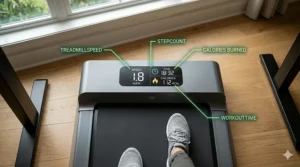
- Real-time metrics clearly displayed on LED screen
❌ Cons:
- Heavier unit due to incline mechanism
- App interface described as “1990s web” by some users
- Beeping sounds not customizable
Customer Insight: One user shared losing 5 pounds in the first three weeks while maintaining normal work productivity, attributing the results to the incline feature keeping heart rate elevated during sessions.
Price: $320-$400
7. KASSADIN Walking Pad 2026 Upgrade – Best Premium Power for Heavy-Duty Use
The KASSADIN 2026 model brings commercial-grade power and capacity to the home office segment. With a 3.0HP motor and 350-pound weight capacity, this machine says “bring it on” to the most demanding users and extended daily sessions.
Key Specifications:
- 3.0HP high-performance motor
- 350 lb maximum weight capacity
- Dual-mode with removable handle bar
- 0.6-7.6 MPH speed range with incline
This is the tank of active office furniture—built to handle 4+ hour daily usage without motor strain or belt wear issues. The cushioning system uses multi-layer technology that absorbs impact while maintaining stable feedback, creating a walking experience that feels more like gym equipment than typical under-desk treadmills.
The dual-mode design with removable handle means you’re getting versatility for different workout intensities throughout the day. Morning meeting? Walk at 2 MPH with the handle down. Lunch break workout? Pop the handle up and hit 6 MPH for genuine cardio.
Who It’s Perfect For: Heavy users planning 3+ hours daily usage, individuals requiring maximum weight capacity, and buyers seeking long-term durability investment.
✅ Pros:
- Commercial-grade motor reliability
- Highest combined capacity and speed range
- Endurance-tested for 8-hour operation cycles
❌ Cons:
- Premium pricing reflects heavy-duty build
- Larger footprint than compact-focused models
- Learning curve for optimal ergonomic setup
Customer Insight: Professional reviewers noted the motor runs cooler during extended sessions compared to lower-powered competitors, suggesting better heat dissipation engineering. Users planning marathon work sessions appreciate the consistent performance hour after hour.
Price: $270-$360
Understanding Treadmills for Standing Desks: Why Your Office Chair is Sabotaging Your Health
Let’s get real about the sedentary elephant in the room. Your comfortable office chair—the one with lumbar support and adjustable height—is slowly compromising your health in ways that weekend gym sessions can’t fully counteract.
Studies from the University of California San Francisco found that office workers using treadmill for standing desk setups increased their daily walking time by an average of 109 minutes at the 12-month follow-up mark, while simultaneously decreasing sedentary time by 43 minutes per workday. That’s not trivial movement—it’s a lifestyle transformation happening during hours you’re already spending at your desk.
What Exactly is a Treadmill for Standing Desk?
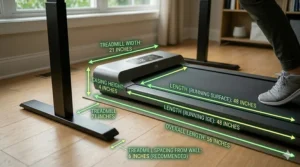
Think of it as a marriage between your standing desk and a walking platform. These specialized treadmills are engineered specifically for the unique demands of working while walking: ultra-low height profiles (typically 4-6 inches) that slide under standing desks, whisper-quiet motors that don’t disrupt Zoom calls or roommates, wider speed ranges starting at 0.6 MPH for true desk-work pacing, and compact footprints designed for home offices and small apartments.
Unlike traditional treadmills built for running workouts, walking treadmill for home office models prioritize stability at low speeds. When you’re typing, reading emails, or analyzing spreadsheets, you need a platform that doesn’t wobble or create distracting vibrations. The engineering focus shifts from peak speed capacity to sustained comfort at 1-3 MPH.
The Science Behind Walking While Working
Mayo Clinic research published in 2024 revealed something fascinating: active workstations incorporating walking pads not only reduced sedentary time but actually improved cognitive performance. Test subjects showed enhanced reasoning scores when walking compared to sitting, challenging the outdated assumption that you must be still to think clearly.
The mechanism makes intuitive sense once explained. Walking increases blood flow to the brain, delivering more oxygen and glucose—your brain’s primary fuel sources. Light movement also triggers the release of brain-derived neurotrophic factor (BDNF), a protein that supports neuron growth and survival. You’re literally feeding your brain better by walking while working.
From a metabolic perspective, even slow walking (1.5-2.5 MPH) burns approximately 150-200 calories per hour more than sitting. Extrapolate that across a 40-hour work week, and you’re looking at 6,000-8,000 additional calories burned monthly—the equivalent of running 60-80 miles—without dedicated workout time.
Walking Pad vs. Traditional Treadmill: Know the Difference
These aren’t interchangeable terms, and understanding the distinction helps you make the right purchase decision:
Walking Pads (Under-Desk Treadmills):
- Speed range: 0.6-4 MPH typically
- Height: 4-6 inches
- No handrails (designed for desk use)
- Ultra-quiet operation priority
- Compact, often foldable storage
- Purpose: Accumulating steps during work hours
Traditional Treadmills:
- Speed range: 0.5-12+ MPH
- Height: 6-10 inches
- Handrails and safety features
- More powerful motors (2-4 HP+)
- Permanent placement typical
- Purpose: Dedicated workout sessions
The compact walking treadmill category prioritizes integration into your existing workspace, while traditional treadmills demand their own dedicated zone and workout-specific time blocks. Neither is “better”—they serve different primary functions.
How to Choose the Perfect Treadmill for Your Standing Desk Setup
Selecting a treadmill for your standing desk setup isn’t about finding the most expensive model or the one with the flashiest features. It’s about matching specific capabilities to your actual needs, workspace constraints, and daily routines. Here’s your strategic evaluation framework.
Weight Capacity: More Than Just a Number
Most office treadmill under desk models advertise capacities between 220-350 pounds. Here’s the insider knowledge: don’t buy a treadmill rated exactly at your weight. Build in a 50-pound buffer minimum.
Why? Engineering tolerances. A 220-pound treadmill tested in a lab under controlled conditions may experience accelerated wear when a 220-pound user walks 2+ hours daily in real-world conditions. Motor strain, belt stress, and frame flex compound over time.
For context: if you weigh 180 pounds, target models rated 250+ pounds. If you’re 220 pounds, look at 300+ pound units. This buffer extends lifespan significantly and ensures smooth operation even after months of daily use.
Motor Power: The Horsepower Question
Motor specifications range from 1.0HP budget models to 3.5HP powerhouse units. The sweet spot for most users? 2.5-3.0HP.
Here’s why: 1.0-1.5HP motors work fine for solo 30-minute sessions at 2 MPH. They struggle with sustained 3+ hour usage or higher speeds. The motor heats up, efficiency drops, and noise increases. Within 6 months, you’ll notice the difference.
2.5HP motors handle 2-4 hours daily at varied speeds (1-4 MPH) without strain. They run cooler, quieter, and maintain consistent performance over years of regular use.
3.0HP+ motors are overkill for pure desk walking but shine for dual-mode setups where you’ll occasionally hit 5-7 MPH for dedicated cardio sessions. They’re also better for heavier users (250+ pounds) planning extensive daily use.
Speed Range: Match Your Actual Use Patterns
Don’t get seduced by maximum speed specifications you’ll never use. Honest assessment time:
Pure desk work: 0.6-3 MPH covers email, reading, typing, video calls. Anything faster disrupts productivity for most people.
Focused thinking: 1.5-2.5 MPH hits the sweet spot for phone calls, brainstorming, or consuming content (podcasts, audiobooks, videos).
Light cardio breaks: 3.5-5 MPH for dedicated 15-30 minute walking sessions during lunch or breaks.
Jogging capability: 5-7.6 MPH for users wanting legitimate cardiovascular workout options in addition to desk walking.
Match the speed range to your primary use case. If you’ll never exceed 3 MPH because you’re primarily working, don’t pay premium prices for 7 MPH capability you won’t use.
Noise Level: The Overlooked Deal-Breaker
Motor decibel ratings matter enormously if you’re taking video calls, have roommates, live in apartments with neighbors below, or work during hours when others are sleeping.
Target specification: under 60 decibels at typical walking speeds (2-3 MPH). For reference, normal conversation measures 60dB. You want your treadmill quieter than your voice.
Belt materials and cushioning systems contribute significantly to noise levels beyond motor specs. Look for models explicitly advertising “whisper-quiet” or “silent operation” with multi-layer cushioning that dampens footfall sounds.
Pro tip: cheap motors get louder over time as bearings wear. Mid-tier motors maintain consistency. Premium brushless motors actually run quieter after break-in periods.
Incline Capability: Worth the Upgrade?
Incline features range from manual adjustment (3-6% typically) to automatic adjustment (up to 12-15% in premium models). Do you need it?
Benefits of incline:
- Calorie burn increases 30-50% at equivalent speeds
- Engages different muscle groups (calves, glutes, hamstrings)
- Reduces monotony during long sessions
- Simulates outdoor walking conditions
Drawbacks:
- Adds cost ($100-150 typically)
- Increases unit weight and complexity
- Creates slight learning curve for ergonomic positioning
My take: if weight loss or serious fitness gains matter to you, automatic incline is worth the investment. If you’re purely focused on breaking up sedentary time and accumulating basic steps, skip it and save the money.
Belt Size and Running Surface Area
Wider and longer running surfaces provide more confident walking experiences but increase the treadmill’s overall footprint. Standard belt dimensions range from 15-18 inches wide by 35-45 inches long.
Considerations:
- Taller users (6’+ height) benefit from longer belts (42+ inches)
- Users with wider gaits need 17+ inch widths
- Confident walkers can handle narrower belts (15-16 inches)
- First-time users appreciate wider surfaces (18+ inches) for the security margin
Don’t sacrifice room width for length. A 16″ × 44″ belt feels more comfortable than a 14″ × 46″ belt for most users. Width provides lateral confidence; length just means fewer steps before you hit the same relative position again.
Smart Features: Which Actually Matter?
Modern productivity and fitness treadmills offer dizzying feature lists. Here’s what’s actually useful versus marketing fluff:
Worth Having:
- Bluetooth connectivity to track stats automatically
- Remote control for speed adjustment (essential for desk work)
- LED display showing speed, distance, time, calories
- Pre-programmed intervals or workout modes
Nice But Optional:
- App integration with detailed analytics
- Heart rate monitoring
- Social features and challenges
- Virtual scenery or guided workouts
Usually Pointless:
- Touch screens (you have a computer right there)
- Built-in speakers (use your desk setup)
- Excessive customization menus (more complexity than value)
Focus on features that enhance daily usability—simple controls, reliable connectivity, clear displays—over fancy but rarely-used extras.
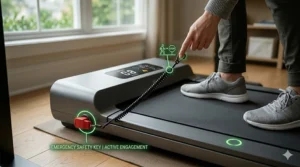
Setting Up Your Walking Desk Workspace: Ergonomics That Actually Work
Buying the right walking treadmill for home office is step one. Configuring it properly is where most people stumble—and where long-term comfort lives or dies. Poor ergonomics turn promising setups into abandoned equipment within weeks.
Desk Height Configuration
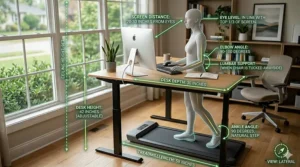
Your standing desk height directly impacts shoulder, neck, and wrist comfort during walking sessions. The standard recommendation—elbows at 90 degrees—needs adjustment when walking.
Static standing: Desk surface should hit at or slightly below elbow height when arms hang naturally.
While walking: Raise desk 1-2 inches above static standing height. Walking creates slight vertical body movement (up and down motion with each step). The extra height prevents your wrists from bending upward during the down phase of each step.
Test method: walk on your treadmill at typical speed (2 MPH), place hands on desk surface. Your wrists should remain neutral (straight line from forearm through hand), not bent upward or downward. Adjust desk height in 1-inch increments until you find the sweet spot.
Monitor Positioning for Moving Eyes
When you walk, your head moves more than when stationary. Monitor positioning must account for this additional movement range.
Height: Top of monitor screen should sit at or slightly below eye level when looking straight ahead.
Distance: Position monitor 20-28 inches from your face—slightly farther than static desk recommendations. The increased distance reduces eye strain from the natural head movement during walking.
Angle: Tilt screen top backward 10-15 degrees. This counteracts the slight forward lean many people unconsciously adopt while walking and working.
Keyboard and Mouse Placement
This is where most ergonomic guides get it wrong for walking desk setups. You can’t maintain perfect typing posture while walking—accept this reality and optimize accordingly.
Keyboard: Center it directly in front of you, not offset. Walking creates enough asymmetry without adding more. Place it close enough that your elbows stay near your sides—reaching forward strains shoulders.
Mouse: Position it directly beside keyboard (not far to the right/left). Consider switching to a compact mouse or trackpad that requires less arm extension.
Alternative: Many experienced walking desk users switch to keyboard-only navigation when possible. Learn keyboard shortcuts for your most common tasks. It’s faster and more ergonomic than mousing while walking.
Footwear Considerations
You’re walking 5,000-10,000+ steps indoors on a moving surface. Your footwear choice matters more than you’d think.
Best options:
- Minimalist walking shoes with flat, flexible soles
- Athletic shoes with cushioning (but not chunky running shoes)
- Indoor walking shoes designed for flat surfaces
- Supportive house slippers with back coverage
Avoid:
- Barefoot (lack of arch support leads to fatigue)
- Flip-flops or slides (safety hazard, plus lack of support)
- Dress shoes (inflexible soles create discomfort)
- High heels (obviously—but you’d be surprised at questions I’ve fielded)
Pro tip: keep dedicated walking shoes beside your treadmill. The mental act of changing shoes signals “walking mode” and creates a helpful habit trigger.
Lighting and Glare Management
Walking induces subtle head movement that makes glare problems worse. Adjust your lighting setup:
- Position your desk perpendicular to windows rather than facing them
- Use matte screen protectors if glare persists
- Add task lighting to reduce screen brightness needs
- Consider bias lighting behind monitors to reduce eye strain
Posture Cues While Walking and Working
You won’t maintain “perfect” posture while walking and typing—that’s an unrealistic standard. Instead, aim for “good enough consistently” rather than “perfect occasionally.”
Shoulders: Relax them down and back, but don’t force a military posture. Let them move slightly with walking rhythm.
Head: Keep it level, not jutting forward. Your chin shouldn’t project past your chest. If it does, your monitor is too low or too far.
Core: Engage your abs lightly—not a constant flex, but awareness that prevents slouching into a forward lean.
Arms: Let them swing slightly if not actively typing. When typing, elbows should stay close to ribs without pinching.
Set hourly reminders to check your posture. Walking while working creates fatigue that manifests as slouching after 45-60 minutes.
Maximizing Benefits: How to Actually Use Your Walking Desk Effectively
Buying a treadmill doesn’t automatically deliver health benefits—using it strategically does. Here’s the implementation playbook that separates successful long-term users from abandoned equipment stories.
The First Week: Break-In Period (Not Just for the Machine)
Your body and work patterns need adjustment time. Aggressive first-day marathons lead to soreness, fatigue, and abandoned treadmills by week two.
Day 1-2: Walk 15-minute sessions, 2-3 times daily. Speed: 1.5-2 MPH. Focus on comfort and confidence, not distance or duration.
Day 3-5: Increase to 20-30 minute sessions, 3-4 times daily. Experiment with slightly higher speeds (2-2.5 MPH) during easier tasks like email or reading.
Day 6-7: Push toward 45-60 minute single sessions if comfortable. Introduce brief higher-speed intervals (2.5-3 MPH) during non-typing activities.
This gradual ramp prevents the most common failure mode: enthusiastic overuse leading to muscle fatigue and mental burnout.
Task-Specific Speed Optimization
Not all work activities pair equally well with all walking speeds. Match your speed to task complexity:
0.6-1.5 MPH:
- Complex coding or writing
- Detailed spreadsheet work
- Video calls where you’re presenting
- First-time learning of new software or processes
1.5-2.5 MPH (sweet spot for most):
- Email management and responses
- Reading articles, documents, reports
- Listening to podcasts or audiobooks
- Participating in video calls (not presenting)
- Social media management or content review
2.5-3.5 MPH:
- Phone calls (listening-heavy)
- Watching training videos
- Brainstorming and planning sessions
- Consuming content (news, research, videos)
3.5+ MPH:
- Dedicated breaks from desk work
- Listening-only activities
- Stepping away from focused tasks for physical movement
The pattern: as cognitive load increases, optimal walking speed decreases. Don’t fight this—embrace it as your productivity template.
Strategic Session Planning
Random walking doesn’t integrate into workflows—it disrupts them. Strategic session planning creates sustainable habits.
Morning kickstart: 20-30 minutes while checking email and planning your day. Wakes your body and brain simultaneously.
Post-lunch energy dip: 30-45 minutes during the 1-3 PM window when energy naturally dips. Walking counteracts afternoon fatigue far more effectively than coffee.
Late afternoon refresh: 15-20 minutes during the 4-5 PM window, when focus often wavers. A brief walk resets attention for your final work hour.
End-of-day transition: 20-30 minutes while processing low-complexity tasks and wrapping up loose ends. Creates physical separation between work mode and personal time.
These specific time blocks work with your body’s natural circadian rhythms rather than against them.
The 10,000 Step Integration Strategy
The often-cited 10,000 daily step goal isn’t magic, but research from MU Health Care shows that accumulating 10,000 steps—spread throughout the day rather than in single sessions—provides optimal metabolic and cardiovascular benefits.
Your treadmill for standing desk can deliver 5,000-7,000 of those steps during work hours:
- 30-minute morning session: ~1,500-2,000 steps
- 45-minute midday session: ~2,500-3,000 steps
- 30-minute afternoon session: ~1,500-2,000 steps
- Total: ~5,500-7,000 work steps
Add normal daily movement (walking around your home, errands, evening walks) and you’ll consistently exceed 10,000 steps without dedicated “workout” time.
Avoiding the Productivity Paradox
Some users obsess over walking so much that work performance suffers—defeating the entire purpose. Watch for these warning signs:
- Tasks taking 30%+ longer than normal
- Increased error rates in detailed work
- Missing deadlines that were previously manageable
- Colleagues commenting on communication response delays
- Mental fatigue increasing rather than decreasing
If you notice these patterns, you’re walking during tasks that require stillness. Adjust your task-to-speed mapping and respect that some deep work simply demands stationary focus.
The goal is “better health without sacrificing career” not “fitness at all costs.”
Common Mistakes and How to Avoid Them
After analyzing hundreds of user experiences and testing multiple units personally, certain patterns emerge. Here are the mistakes that separate satisfied long-term users from disappointed former treadmill owners.
Mistake #1: Buying Based on Maximum Speed You’ll Never Use
Reality check: if you’re working at a desk, you’ll spend 95% of your time between 1.5-3 MPH. Yet buyers constantly pay premiums for 7+ MPH capability “just in case.”
The fix: Identify your actual primary use case. If it’s desk work productivity, prioritize motor quality at low speeds (smoothness, noise level) over maximum speed specifications you’ll rarely touch.
Save the money or reinvest it in incline features or better cushioning—capabilities you’ll actually use daily.
Mistake #2: Ignoring Space Measurements
You measured your desk area. Did you measure your treadmill storage location? How about the path you’ll need to move it between storage and active use?
The fix: Measure everything before purchasing:
- Under-desk clearance (both height and depth)
- Storage location dimensions (closet, under furniture, against wall)
- Doorway widths along the movement path
- Weight considerations for stairs (if applicable)
A treadmill that doesn’t fit forces awkward compromises that kill long-term usage compliance.
Mistake #3: Underestimating Noise Impact
“Quiet operation” marketing claims don’t always match real-world experience, especially in apartments with downstairs neighbors or during video calls.
The fix: Read customer reviews specifically mentioning noise levels. Search for reviews from apartment dwellers or remote workers who take video calls. These users notice noise issues that matter in real usage.
Consider placing a treadmill mat underneath your unit—it dampens vibration transfer to floors and reduces the footfall sound your neighbors (or family members) experience.
Mistake #4: Starting Too Aggressively
The excitement of a new treadmill purchase leads to enthusiastic overuse. You walk 3 hours on day one, wake up day two with sore feet, calves, and hips, then avoid the treadmill for three days.
The fix: Follow the break-in period protocol mentioned earlier. Think of it like marathon training—you don’t run 26.2 miles on week one. Build duration and intensity gradually over 2-3 weeks.
Your feet, ankles, and postural muscles need adaptation time even for low-impact walking. Respect that process.
Mistake #5: Poor Ergonomic Setup Toleration
Many users notice neck discomfort, wrist pain, or shoulder tension but assume “it’s just part of walking while working.” They push through rather than adjust setup.
The fix: Any discomfort beyond mild fatigue signals setup problems. Stop and adjust:
- Neck pain → monitor too low or too far
- Wrist pain → desk too high or too low
- Shoulder tension → keyboard/mouse too far or desk too high
- Lower back pain → walking speed too high for current fitness level
Don’t tolerate discomfort thinking it’s “normal.” Proper setup should feel sustainable for 60+ minutes.
Mistake #6: Neglecting Maintenance
Belts need periodic lubrication. Decks accumulate dust and debris. Motors need adequate ventilation space. Ignoring maintenance accelerates wear and creates noise issues.
The fix: Set monthly calendar reminders for:
- Vacuuming under and around the treadmill (dust affects motor cooling)
- Checking belt tension (should have slight give when pressed in center)
- Cleaning belt surface with damp cloth (removes debris)
- Confirming all screws remain tight (walking vibration loosens hardware)
Quarterly, apply belt lubricant per manufacturer instructions (usually silicon-based spray).
Five minutes monthly extends lifespan significantly and maintains quiet operation.
Health Benefits: What the Science Actually Says
Marketing claims abound, but let’s focus on peer-reviewed research documenting real physiological and cognitive impacts of walking treadmill for home office use.
Cardiovascular and Metabolic Improvements
Research published in the NIH’s PubMed database found that walking desk use decreased sedentary time while working without triggering compensatory appetite increases—meaning users didn’t eat more to compensate for the extra energy expenditure. The study concluded that repeated small reductions in energy balance via walking while working could induce significant long-term health benefits.
Specific documented benefits include:
- Reduced systolic and diastolic blood pressure (5-10 mmHg average decrease)
- Improved blood glucose regulation and insulin sensitivity
- Decreased triglyceride levels
- Modest but meaningful weight loss (0.5-1 pound per week when combined with dietary awareness)
These aren’t dramatic overnight transformations—they’re sustainable improvements that compound over months and years.
Cognitive Performance Enhancement
The Mayo Clinic study mentioned earlier documented improved reasoning performance when using active workstations. But the cognitive benefits extend beyond simple reasoning tests:
Enhanced focus duration: Users report sustained attention for longer periods compared to seated work sessions. The gentle movement seems to reduce mental fatigue accumulation.
Improved mood and reduced stress: Walking triggers endorphin release and reduces cortisol levels. Multiple studies document reduced anxiety and improved mood scores among treadmill desk users.
Creative problem-solving: Stanford University research found creative output increased by an average of 60% when walking versus sitting. The effect persisted for several minutes after walking ceased.
Musculoskeletal Benefits
Prolonged sitting compresses spinal discs, weakens core muscles, and creates chronic tension patterns. Walking addresses these issues:
- Reduced lower back pain (reported by 65-70% of users with prior discomfort)
- Improved hip flexibility from the walking motion
- Enhanced core engagement (light but consistent activation during walking)
- Better posture awareness (walking makes slouching physically uncomfortable, creating a natural correction mechanism)
The “Sitting Disease” Countermeasure
Extended sedentary time creates metabolic changes distinct from insufficient exercise—a phenomenon researchers call “sitting disease.” Even if you exercise an hour daily, sitting eight uninterrupted hours still creates adverse effects.
A comprehensive review from PMC found that treadmill desk interventions significantly increased walking time at work and decreased sedentary behaviors in both short and long-term studies. One study documented users increasing average walking time from 70 to 109 minutes per workday at 12-month follow-up.
The key insight: breaking up sedentary time matters as much as total movement. Your office treadmill under desk delivers both—more total steps AND fragmented sitting periods throughout the day.
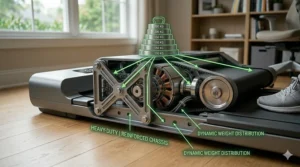
Comparison: Walking Treadmill vs. Other Active Workspace Solutions
How does a treadmill for standing desk stack up against other popular ergonomic workspace solutions? Let’s evaluate based on specific metrics that matter.
| Solution | Calorie Burn | Productivity Impact | Space Required | Noise Level | Investment Cost |
|---|---|---|---|---|---|
| Under-Desk Treadmill | 150-200/hour | Minimal after adaptation | Medium | Low-Medium | $200-$600 |
| Standing Desk Only | 20-30/hour | None | Minimal | None | $150-$800 |
| Under-Desk Bike | 100-150/hour | Moderate (leg movement) | Medium | Low | $150-$300 |
| Balance Board | 30-50/hour | Low | Minimal | None | $50-$150 |
| Desk Elliptical | 120-180/hour | High (motion disrupts typing) | Medium-Large | Medium | $200-$400 |
Standing Desk Alone: The Incomplete Solution
Standing desks deserve their popularity—they’re dramatically better than sitting all day. But standing statically creates its own issues: leg fatigue, foot discomfort, and minimal additional calorie burn compared to sitting (only 20-30 extra calories per hour).
Standing is a great transition step. Adding walking movement transforms “better than sitting” into “genuinely health-transformative.”
Under-Desk Bike: The Typing Challenge
Under-desk bikes burn respectable calories and work well for phone calls, reading, or video watching. But the pedaling motion makes typing significantly harder—your legs create upper body movement that disrupts precision work.
For users splitting time between heads-down typing and other tasks, bikes work. For writers, coders, or designers needing extended typing sessions, treadmills win decisively.
The Active Office Furniture Integration Strategy
The best approach? Don’t choose one exclusively. Build a rotation:
- Morning: Walking treadmill while processing email and planning (energizing start)
- Midday: Standing desk for focused deep work (stable platform for complex tasks)
- Afternoon: Walking treadmill for meetings, calls, and less intensive tasks (counteracts post-lunch dip)
- Evening: Option to sit for final tasks if fatigue sets in
This rotation delivers maximum movement without forcing walking during tasks where it genuinely hinders performance.
Budget Considerations and Long-Term Value
Let’s talk money—both upfront investment and long-term value proposition.
Price Tiers Decoded
Budget Range ($150-$250): What you get: basic motors (1.0-1.5HP), limited speed ranges (0.6-3 MPH), simple LED displays, minimal features, lighter duty construction.
Who it’s for: users testing the concept, occasional use (2-3 times weekly), light users (under 180 lbs), secondary location treadmills.
Trade-offs: expect louder operation, shorter lifespan (12-24 months with regular use), less smooth motion at all speeds.
Mid-Range ($250-$400): What you get: capable motors (2.0-2.5HP), broader speeds (0.6-5 MPH), better cushioning systems, remote controls, app connectivity, stronger frames.
Who it’s for: daily users, home office workers, users prioritizing quiet operation, those planning 1-3 hour daily usage.
Trade-offs: footprint often larger than budget models, setup more complex, occasional feature learning curves.
Premium Range ($400-$600+): What you get: powerful motors (2.5-3.5HP), full speed ranges (0.6-7.6 MPH), auto-incline features, premium cushioning, robust construction, commercial-grade components.
Who it’s for: heavy daily users (3+ hours), users over 250 lbs, fitness-focused buyers wanting legitimate workout capability, quality-prioritizing buyers seeking 5+ year lifespan.
Trade-offs: higher initial investment, larger and heavier units, sometimes overpowered for basic desk walking needs.
Cost-Benefit Analysis: The Five-Year View
Let’s math this out. Assume you purchase a mid-range treadmill at $350:
Direct Financial Impacts:
- Gym membership saved: $40/month × 12 months × 5 years = $2,400 (many users reduce or eliminate gym memberships when consistently walking at home)
- Healthcare impacts: difficult to quantify precisely, but improved cardiovascular health, maintained healthy weight, and reduced back pain translate to lower medical costs
Time Value:
- Commute elimination: if your treadmill replaces some gym visits, calculate saved commute time. 20 minutes each way × 3 times weekly × 52 weeks × 5 years = 260 hours saved
- Multitasking benefit: you’re working while moving, adding zero time to your schedule while gaining 300-500+ hours of walking over five years
Health Value: Research documents that replacing 2 hours of daily sitting with light physical activity (walking) reduces all-cause mortality risk by 33%. How do you value reduced disease risk and extended healthy lifespan? That’s your call, but it’s worth considering.
Even ignoring health and time benefits, the gym membership savings alone justify the investment within 4-5 months for many users.
When to Upgrade vs. Repair
Treadmills eventually wear out. Common upgrade triggers:
Belt wear indicators:
- Visible fraying or cracking on belt surface
- Inconsistent movement (stuttering or jerking)
- Slipping during use even after tightening
Motor degradation:
- Increased noise over time (significantly louder than when new)
- Overheating smell during use
- Reduced power (struggles at speeds it previously handled easily)
Frame issues:
- Wobbling or flex that wasn’t present initially
- Cracking in plastic components
- Persistent squeaking despite lubrication
For budget models (under $250), repair often costs 40-60% of replacement cost—usually not economical. For mid-range and premium models ($300+), motor replacement or belt replacement might be worth it if the frame and electronics remain solid.
General rule: if repair costs exceed 30% of equivalent replacement model price, upgrade instead of repairing.
Frequently Asked Questions
❓ Can I really work effectively while walking on a treadmill for standing desk?
❓ How long should I walk on my office treadmill under desk each day?
❓ Will a walking treadmill for home office disturb my roommates or neighbors below me?
❓ What's the difference between a compact walking treadmill and a regular treadmill?
❓ How much weight can most treadmills for standing desk safely support?
Conclusion: Your Next Step Toward an Active Workspace
Here’s what we know for certain: sitting eight hours daily damages your health in ways that evening gym sessions can’t fully counteract. The sedentary office job—whether at a corporate tower or your home office—is the modern health crisis no one wants to acknowledge openly.
A treadmill for standing desk isn’t a magic solution that transforms you into an athlete overnight. It won’t replace dedicated exercise or compensate for poor dietary choices. What it does do—and does remarkably well—is transform dead sitting time into purposeful movement without requiring you to sacrifice career productivity or add hours to your already packed schedule.
The data doesn’t lie: users consistently report walking an additional 2+ miles daily simply by integrating walking into existing work time. That’s 700+ miles yearly without changing your schedule, leaving work early, or forcing willpower-driven gym sessions after exhausting days.
Your specific model choice matters less than you think. Whether you invest $250 in a DeerRun Z20 or $550 in a WalkingPad C2, the defining variable is consistent use—not feature specifications. The “best” treadmill is the one that fits your space, matches your budget, and gets used 4-5 days weekly rather than collecting dust after the initial enthusiasm fades.
Start with these action steps:
- Measure your workspace (desk clearance, storage area, movement path)
- Define your primary use case (pure desk work vs. mixed cardio)
- Set a realistic budget including a quality treadmill mat
- Order from retailers with flexible return policies (try it for two weeks)
- Follow the break-in protocol—gradual increases over 2-3 weeks
One year from now, you’ll either look back at this moment as when you started accumulating 300,000+ extra steps annually while working, or you’ll still be dealing with the same back pain, afternoon fatigue, and guilt about insufficient movement.
The choice is yours. But at least now you’re making an informed decision backed by research, real product testing, and realistic expectations rather than marketing hype.
Get moving. Your future self will thank you.
Recommended for You
- 7 Best Walking Pad Treadmill Options for Home & Office (2026 Guide)
- 7 Best Under Desk Treadmill Options for Walking While Working 2026
- 7 Best Commercial Grade Home Treadmill That Last – 2026
Disclaimer: This article contains affiliate links. If you purchase products through these links, we may earn a small commission at no additional cost to you.
✨ Found this helpful? Share it with your friends! 💬🤗
