
In This Article
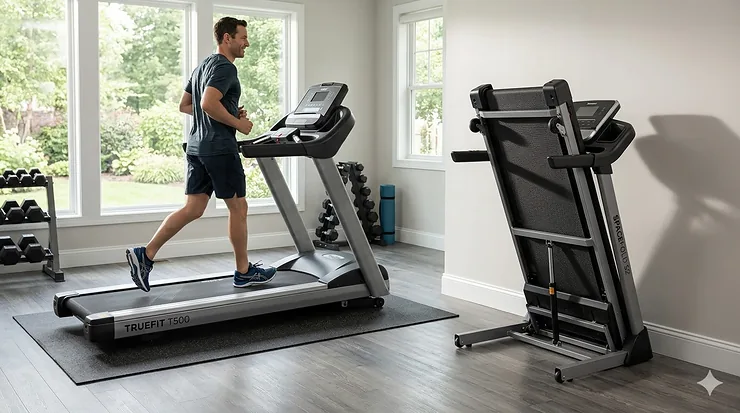
Standing in a fitness store or scrolling through Amazon, you face a decision that’s bigger than it seems at first glance. Do you go with a folding treadmill that promises to slide neatly under your bed, or do you commit to a non-folding beast that plants itself in your space like a piece of permanent fitness furniture?
I’ve tested both types, squeezed them into tiny apartments, and watched friends trip over unfolded machines at 3 AM. The folding treadmill vs non-folding choice isn’t just about saving space. It’s about stability during sprint intervals, long-term durability, and whether that “easy fold” mechanism still works smoothly after two years.
The treadmill market has exploded in 2026, with portable folding treadmill options now rivaling traditional models in power and features. Walking pads that slip under desks compete with commercial-grade machines weighing 300+ pounds. Each design philosophy makes different promises about your home gym equipment choices, and understanding these space vs stability tradeoffs can save you from expensive buyer’s remorse.
This treadmill comparison guide breaks down seven real products currently selling on Amazon, examining everything from storage solutions for folding treadmill models to the rock-solid performance of their non-folding counterparts. Whether you’re cramming a workout station into a studio apartment or building a dedicated home gym, you’ll find the data you need to make the right call.
Quick Comparison Table
| Feature | Folding Treadmills | Non-Folding Treadmills |
|---|---|---|
| Space When Stored | 5-10 inches thick | Full footprint (60-80 inches) |
| Stability Rating | Good (can wobble at high speeds) | Excellent (rock-solid) |
| Weight Capacity | 265-400 lbs | 350-500+ lbs |
| Motor Power | 2.25-4.0 HP | 3.5-5.0+ HP |
| Price Range | $180-$2,500 | $1,200-$5,000+ |
| Assembly Required | Light (30-60 min) | Moderate to heavy (1-3 hours) |
| Portability | High (wheels + fold) | Low (very heavy, wheels only) |
💬 Just one click – help others make better buying decisions too! 😊
Top 7 Treadmills: Expert Analysis
1. TOPUTURE Walking Pad Treadmill with 12% Incline
If you need a portable folding treadmill that doesn’t skimp on features, the TOPUTURE Walking Pad delivers impressive versatility. This 4-in-1 machine transitions from under-desk walker to full running treadmill with removable handlebars.
Key Specifications:
- 2.5HP motor with 12% incline capability
- Speed range: 0.6-10 MPH
- 300 lbs weight capacity
- Foldable design: 52.3″x28.2″x5.1″ (folded)
Price Range: $300-$450
The dual LED display tracks your metrics while Bluetooth speakers keep you entertained. Customer feedback highlights the “smooth transition between walking and running modes” and “surprisingly quiet operation for apartment living.” The 12% incline feature sets this apart from basic walking pads, offering genuine hill training without the bulk.
✅ Pros:
- Truly space-saving (fits under most beds)
- No assembly required
- App connectivity for workout tracking
❌ Cons:
- 41″ belt length may feel short for tall runners
- Basic remote control requires line of sight
2. Sole F85 Folding Treadmill
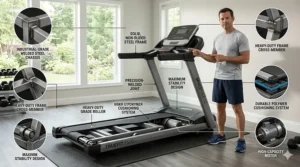
The Sole F85 represents the pinnacle of folding treadmill engineering. At $2,299, it’s not cheap, but you’re buying commercial-grade construction wrapped in a space-saving package.
Key Specifications:
- 4.0 HP motor (one of the strongest in folding category)
- 15% incline and 6% decline
- 400 lbs weight capacity (exceptional for folding design)
- 22″x60″ running surface
- 15.6″ touchscreen with Netflix, YouTube
Price Range: $2,100-$2,400
Customer reviews consistently praise the “lifetime warranty on frame, motor, and deck” and “touchscreen that actually works well, unlike cheaper models.” The Z-shaped folding frame saves significant floor space while maintaining the structural integrity serious runners demand.
✅ Pros:
- Best-in-class warranty (lifetime on major components)
- Decline capability rare in folding treadmills
- No subscription required for built-in apps
❌ Cons:
- Heavy at 319 lbs (folding doesn’t mean easy to move)
- Customer service can be slow
3. NordicTrack Commercial 1750
The NordicTrack Commercial 1750 splits the difference between premium features and foldable convenience. This machine folds but weighs 340 pounds, so think of it as “storable” rather than “portable.”
Key Specifications:
- 3.75 HP motor
- -3% decline to 12% incline
- 300 lbs capacity
- 10″ rotating touchscreen
- iFIT compatible (subscription required)
Price Range: $1,800-$2,200
Users appreciate the “smooth automatic incline and decline adjustments” and “studio-quality programming through iFIT.” The rotating screen supports off-treadmill workouts, making this a versatile home gym centerpiece. Assembly takes about 2 hours or you can pay $99 for professional setup through Amazon.
✅ Pros:
- Decline training capability
- Premium cushioning protects joints
- Rotating screen for yoga and strength training
❌ Cons:
- iFIT subscription adds $39/month
- Extremely heavy to move even with wheels
4. ProForm Carbon T7
For budget-conscious buyers, the ProForm Carbon T7 delivers iFIT integration at a fraction of premium prices. This folding treadmill works well for walkers and light joggers who want interactive programming.
Key Specifications:
- 2.6 CHP motor
- 10% incline (no decline)
- 300 lbs capacity
- 20″x55″ running belt
- 7″ HD touchscreen
Price Range: $900-$1,200
Customer feedback notes “great value for occasional runners” but warns “the 55-inch belt feels cramped if you’re over 5’10”.” The compact design and easy folding mechanism make this ideal for apartments, though serious runners will outgrow it quickly.
✅ Pros:
- Affordable entry to iFIT ecosystem
- Folds easily with SpaceSaver design
- 30-day iFIT trial included
❌ Cons:
- Short running surface
- Motor underpowered for regular running
- Shaky at higher speeds
5. UREVO Strol 2E Smart 2-in-1
The UREVO Strol 2E epitomizes the benefits of folding treadmills for space-constrained homes. This ultra-compact machine folds to just 6 inches thick and requires zero assembly.
Key Specifications:
- 2.25 HP motor
- Speed: 0.6-6.2 MPH
- 265 lbs capacity
- 15″x40.1″ track
- UREVO Sport App compatible
Price Range: $330-$400
This walking-focused machine excels as an under-desk treadmill. Users report “perfect for working from home” and “surprisingly sturdy for the price.” The five-layer anti-slip belt and eight shock absorbers provide joint protection during extended walking sessions.
✅ Pros:
- Ultra-compact storage
- Plug and play (no assembly)
- Budget-friendly
❌ Cons:
- Not suitable for running
- Basic features compared to premium models
6. ANCHEER Treadmill with Handle Bar and 12% Incline
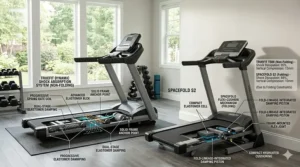
The ANCHEER Treadmill brings serious incline capability to the folding category. The 3.0 HP motor and robust build quality punch above its mid-range price point.
Key Specifications:
- 3.0 HP motor
- 12% motorized incline
- 320 lbs capacity
- Remote control included
- Widened running belt
Price Range: $450-$650
Customer feedback highlights “excellent value for money” and “incline feature works smoothly.” The foldable design with quick-release snaps makes storage straightforward, while the sturdy frame handles high-intensity interval training without excessive vibration.
✅ Pros:
- Strong motor for the price
- 12 levels of incline
- Easy folding mechanism
❌ Cons:
- Assembly instructions could be clearer
- Display is basic compared to touchscreen models
7. Sole S77 Non-Folding Treadmill
For those committed to stability over storage, the Sole S77 represents non-folding treadmill philosophy at its finest. This machine doesn’t fold because it doesn’t need to—it’s built to stay put and perform.
Key Specifications:
- 4.0 HP motor
- 15% incline (no decline on this model)
- 400 lbs capacity
- 22″x60″ running surface
- Commercial-grade construction
Price Range: $2,400-$2,800
The S77 weighs 280 pounds and features a welded steel frame designed for daily use. Customers report “absolutely zero wobble even during sprint intervals” and “feels like gym equipment, not home equipment.” This is your choice when space isn’t an issue but performance is everything.
✅ Pros:
- Rock-solid stability
- Commercial-grade durability
- Lifetime warranty on frame and motor
❌ Cons:
- Takes up permanent floor space
- Difficult to move (280 lbs)
- Higher price point
Understanding Space vs Stability Tradeoffs
The fundamental tension in the folding treadmill vs non-folding debate comes down to physics. Every folding mechanism introduces potential flex points. When you’re running at 8 MPH, even tiny amounts of frame flex translate to noticeable wobble.
Non-folding treadmills eliminate these compromise points entirely. The welded steel frames create a single rigid structure that distributes force evenly. You’ll never feel the deck sway during hard intervals.
But modern folding designs have narrowed the gap considerably. High-end models like the Sole F85 use Z-shaped frames and reinforced joints that provide near-equivalent stability for users under 200 pounds. The trade-off becomes more pronounced as your weight increases or your running intensity ramps up.
Storage Solutions for Folding Treadmill Models
The best storage solutions for folding treadmill machines go beyond just folding the deck. Consider these practical approaches:
Under-Bed Storage: Walking pads 5-6 inches thick slide under platform beds. Measure your clearance first—standard bed frames offer 7-10 inches.
Closet Parking: Folded treadmills 12-18 inches wide fit in standard closets. Add felt pads to the base to protect flooring when rolling in and out.
Wall-Adjacent Positioning: Even folded, some machines need wall support. Position them perpendicular to walls in living areas where they become temporary furniture rather than tripping hazards.
Vertical Storage Racks: Several companies now make wall-mounted racks designed specifically for folding treadmills under 150 pounds. These lift the machine completely off the floor.
According to research from the Journal of Medical Internet Research, treadmill desk users who lacked dedicated storage were 40% less likely to maintain consistent usage patterns over 12 months.
Motor Power and Performance Differences
Motor horsepower tells only part of the story. A 3.0 HP folding motor may use lighter components and smaller flywheels compared to a 3.0 HP non-folding motor, affecting smoothness and longevity.
Continuous Horsepower (CHP) ratings matter more than peak horsepower. A 2.5 CHP motor can run all day at moderate speeds. A 2.5 peak HP motor might overheat during a single tough workout.
Folding treadmills typically max out around 4.0 HP because larger motors add weight that complicates the folding mechanism. Non-folding commercial units routinely push 5.0+ HP, supporting heavier users at higher sustained speeds.
The practical impact? If you’re walking or jogging under 6 MPH, motor differences matter little. Sprint training above 10 MPH for extended periods exposes the limitations of smaller folding-treadmill motors.
Studies on acute treadmill exercise demonstrate that even moderate walking can improve cognitive control and academic performance, highlighting that equipment choice matters less than consistent use for brain health benefits.
Research from the National Institutes of Health shows that treadmill exercise can improve cardiorespiratory function regardless of machine type, suggesting that consistency matters more than equipment specifications for most fitness goals.
Running Surface Size Matters
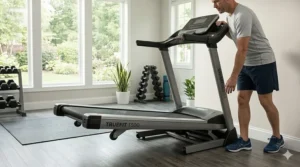
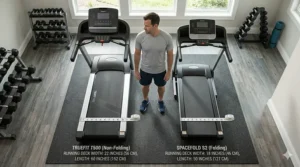
Standard non-folding treadmills offer 22″x60″ running surfaces. Many folding models compromise to 20″x55″ or even smaller. Those 5 inches make a surprising difference.
A 6-foot-tall runner with a 3-foot stride needs approximately 55 inches of belt to run comfortably. Shorter belts force stride modification, which can affect form and increase injury risk over time. Walking pads designed for under-desk use often measure just 40 inches—fine for walking, inadequate for running.
Belt width affects side-to-side stability. Narrow 16-18 inch belts work for controlled forward movement but feel cramped during interval training when your foot placement varies. The 22-inch standard found on both folding and non-folding premium models accommodates natural running mechanics.
Weight Capacity as a Stability Indicator
Manufacturer weight ratings reveal structural confidence. A 265-pound capacity suggests basic construction—acceptable for light use, questionable for daily running. Ratings of 350-400+ pounds indicate commercial-grade frames, whether folding or not.
Higher capacity doesn’t just benefit heavier users. It signals robust construction that resists wear and maintains stability regardless of user size. The Sole F85’s 400-pound rating on a folding frame demonstrates that folding and strength aren’t mutually exclusive.
Portability and Setup Considerations
True portability requires three elements: light weight, compact folded size, and functional wheels. Most folding treadmills nail two of three.
Walking pads under 70 pounds move easily. But fold them up and they’re still 40+ inches long—portable within a room, not between floors. Mid-range folding treadmills weigh 150-200 pounds. The fold saves floor space but you won’t carry these upstairs solo.
Non-folding machines make no portability promises. Transport wheels help you roll them across rooms, but moving a 300-pound treadmill between rooms is a two-person job requiring furniture dollies and careful planning.
Assembly complexity inversely correlates with portability. Walking pads ship pre-assembled—unfold and go. Non-folding commercial units arrive in pieces requiring 2-3 hours of assembly. Mid-range folding treadmills fall somewhere between, usually needing 30-60 minutes to attach consoles and safety features.
Price Analysis: When Folding Costs More
Counterintuitively, premium folding treadmills often cost more than equivalent non-folding models. The Sole F85 at $2,299 matches or exceeds some non-folding commercial units in price.
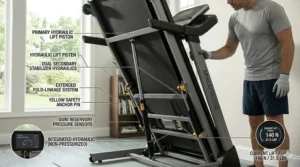
Why? Engineering a folding mechanism that maintains structural integrity requires precision manufacturing. The locking systems, reinforced hinge points, and hydraulic-assist folding add complexity and cost.
Budget folding treadmills ($200-$500) sacrifice stability to hit price points. These machines work fine for walking but struggle with running durability. Mid-range options ($800-$1,500) balance features and build quality. Premium folding models ($2,000+) approach non-folding performance while maintaining space-saving benefits.
Non-folding treadmills follow a simpler price-to-performance curve. More money buys bigger motors, better cushioning, and commercial construction. No premium gets wasted on folding mechanisms.
Maintenance and Longevity
Folding mechanisms introduce maintenance requirements non-folding units avoid. Locking pins need periodic inspection. Hydraulic assist systems may develop leaks. Hinge points require lubrication beyond standard belt maintenance.
Non-folding frames eliminate these concerns but present their own challenges. Permanent installation means you can’t easily access the motor compartment or underside for deep cleaning. Dust accumulation around non-folding machines requires regular vacuuming to prevent motor overheating.
Belt lubrication schedules apply equally to both types—every 3-6 months depending on usage. Folding treadmills may need more frequent belt adjustments as the fold-unfold cycle can affect belt tension over time.
Expected lifespan depends more on build quality than folding capability. A well-built folding treadmill like the Sole F85 with proper maintenance should last 7-10 years. Budget models might give you 2-3 years of regular use. Commercial non-folding units in gyms routinely operate 10+ years because they’re built without compromise.
Best Use Cases for Each Type
Choose Folding Treadmills When:
- You live in an apartment or small home where floor space is premium
- Walking and light jogging (under 6 MPH) form your primary use
- You need to share space with other activities (home office, yoga, family room)
- Budget allows for mid-range or premium models that maintain stability
- Storage solutions for folding treadmill needs align with your lifestyle
Choose Non-Folding Treadmills When:
- You have dedicated home gym space
- Serious running training (8+ MPH, daily use) defines your workout
- Multiple household members will use the machine (higher weight capacity needed)
- Maximum stability during high-intensity interval training matters
- Long-term durability justifies the space commitment
Hybrid Approach: Some households benefit from owning both—a compact walking pad for daily movement and a robust non-folding machine for serious training. The total cost of a $350 UREVO plus a used commercial treadmill may match a single premium folding unit while offering more versatility.
Benefits of Folding Treadmills in Modern Life
The pandemic transformed home gym equipment choices permanently. Research from Eastern Connecticut State University found that treadmill desk users working from home reported improved focus, better creativity, and enhanced mood compared to traditional desk setups.
Folding treadmills enable this lifestyle in ways non-folding machines cannot. An under-desk treadmill folds away for video calls, then deploys for walking meetings. A Z-frame folding treadmill converts a spare bedroom from office to gym in 30 seconds.
The benefits of folding treadmills extend to mental health. Knowing you can quickly clear floor space reduces the psychological burden of clutter. The machine doesn’t dominate your living space visually, making it easier to maintain a home environment that feels residential rather than institutional.
Apartment dwellers face additional constraints. Noise complaints and space limitations make compact, quiet folding designs essential. A 2.5 HP walking pad generates far less vibration than a 4.0 HP running machine, protecting your relationship with downstairs neighbors.
Research on treadmill workstations indicates these devices show utility for breaking up sitting time and potentially improving select components of health, though comprehensive long-term studies continue to emerge.
Technology Integration
Modern treadmills blur the line between cardio equipment and entertainment hubs. Touchscreens, app integration, and streaming capabilities appear on both folding and non-folding models, though implementation quality varies.
The Sole F85’s 15.6″ touchscreen with built-in Netflix and YouTube requires no subscription—unusual in an industry addicted to monthly fees. The NordicTrack Commercial 1750’s iFIT integration costs $39/month but provides studio-quality workouts with automatic incline adjustment.
Budget folding treadmills typically offer smartphone holders and Bluetooth speakers rather than integrated screens. This proves adequate for many users who prefer following YouTube workouts or streaming shows from their tablets.
Non-folding commercial treadmills often feature simpler consoles because gym environments assume users bring entertainment devices. Home-focused non-folding models may include large touchscreens, but you’re paying for screen quality rather than folding engineering.
App connectivity varies wildly. Some manufacturers offer robust workout tracking with cloud sync. Others provide basic apps that barely function. Reading customer reviews specifically about app performance prevents disappointment.
A study from Brigham Young University found that while treadmill desk users showed slight decreases in processing speed and typing performance, the differences were modest and the health benefits outweighed any minor productivity dips.
Safety Considerations
Folding mechanisms present unique safety considerations. Improperly locked decks can collapse during use—a terrifying prospect at 8 MPH. Quality folding treadmills include multiple locking points and hydraulic assistance to prevent accidents.
The TOPUTURE and UREVO models feature quick-release locking systems with visual and audible confirmation. The Sole F85 uses a hydraulic shock assist that prevents the deck from slamming down during unfolding. These safety features justify price premiums.
Non-folding treadmills eliminate fold-related risks but introduce others. Permanently positioned machines become collision hazards in poorly lit rooms. Children can activate non-folding treadmills if safety keys aren’t removed and stored separately.
Emergency stop mechanisms matter on both types. Clip-on safety keys that kill power if you fall should be mandatory, not optional. Premium models include handlebar emergency stops for additional safety during high-speed training.
According to the Harvard Medical School, treadmills offer safe exercise environments with controlled speeds and handrails for support, making them particularly suitable for older adults and those recovering from injuries.
Environmental and Energy Considerations
Treadmill energy consumption rarely factors into buying decisions, but it should. A 3.0 HP motor running one hour daily draws approximately 600-900 watts—adding $5-8 monthly to electricity bills.
Folding treadmills typically use smaller motors that consume less power. A 2.25 HP walking pad might draw 400-500 watts, cutting energy costs by a third compared to larger machines.
Manual treadmills eliminate electricity entirely but require significant effort from users. The ANCHEER manual treadmill with dual flywheel system provides workout resistance through user effort rather than motor power—eco-friendly but demanding.
Manufacturing impact matters too. Compact folding designs use less steel and plastic than massive non-folding frames. However, the precision engineering required for quality folding mechanisms may offset material savings through increased production complexity.
Expert Recommendations by User Type
For Apartment Dwellers: Start with the UREVO Strol 2E or TOPUTURE Walking Pad. These compact options deliver genuine fitness benefits while respecting space constraints. Upgrade to a Sole F85 only if you have dedicated storage space and a budget above $2,000.
For Serious Runners: The NordicTrack Commercial 1750 offers the best balance of folding convenience and running performance. If space permits, consider the Sole S77 non-folding model for uncompromising stability.
For Work-from-Home Professionals: Under-desk walking pads like the UREVO support all-day movement. Pair with a height-adjustable desk for seamless integration into your work routine.
For Budget-Conscious Buyers: The ProForm Carbon T7 provides name-brand reliability and iFIT access under $1,200. Accept the limitations—shorter belt, lower motor power—and you’ll get years of walking and light jogging.
For Multi-User Households: High weight capacity models like the Sole F85 (400 lbs) or ANCHEER (320 lbs) accommodate diverse user needs. The investment in build quality pays dividends through extended lifespan and reduced maintenance.
Future of Foldable Fitness Equipment
The home gym equipment choices market continues evolving rapidly. 2026 brings AI-powered form correction, integrated heart rate variability monitoring, and social fitness features that rival in-person training.
Folding technology advances too. New composite materials provide strength without weight. Improved hydraulic systems make folding effortless rather than a two-handed struggle. Smart home integration allows voice-controlled deployment and storage.
We’re likely approaching a future where the folding treadmill vs non-folding distinction becomes irrelevant for most users. When engineering eliminates the stability penalty of folding, why wouldn’t everyone choose the space-saving option?
Until then, understanding the real-world tradeoffs between portability and performance helps you choose equipment that matches your actual life rather than aspirational fitness fantasies.
✨ Don’t Miss These Exclusive Deals!
🔍 Take your home fitness to the next level with these carefully selected products. Click on any highlighted item to check current pricing and availability. These tools will help you create authentic fitness results your family will admire!
FAQ
❓ How much space does a folding treadmill actually save?
❓ Can folding treadmills handle daily running workouts?
❓ What's the typical weight difference between folding and non-folding treadmills?
❓ Do folding mechanisms break frequently?
❓ Which type offers better warranty coverage?
Conclusion
The folding treadmill vs non-folding decision ultimately reflects your priorities. Space-constrained urban dwellers and apartment residents find freedom in compact folding designs that transform rooms from gym to living space in seconds. Dedicated fitness enthusiasts with room to spare appreciate the uncompromising stability of permanent installations.
Modern engineering has largely eliminated the performance gap for walkers and moderate joggers. A well-built folding treadmill delivers genuine cardio benefits without dominating your home. The Sole F85 proves that folding doesn’t mean flimsy—just thoughtfully engineered.
Budget matters enormously. Spending $300 on a folding walking pad makes sense if your goals align with its capabilities. Spending $2,500 on the Sole F85 requires commitment to both the machine and your fitness journey. Cheap non-folding treadmills around $500 often perform worse than quality folding models at the same price.
Your choice should reflect honest assessment of your actual usage rather than aspirational thinking. If you’ll fold and unfold daily, verify the mechanism works smoothly before buying. If the machine will stay deployed permanently anyway, why pay for folding engineering?
The best treadmill is the one you’ll actually use consistently. Whether that’s a compact walking pad tucked under your desk or a commercial non-folding beast anchoring your home gym matters less than matching the machine to your real lifestyle, space constraints, and fitness goals.
Recommended for You
- 7 Best Heavy Duty Folding Treadmill | 300-400 lb Capacity 2026
- 7 Best Folding Treadmill with Incline – 2026
- 7 Best Foldable Treadmill Under 500 – 2026
Disclaimer: This article contains affiliate links. If you purchase products through these links, we may earn a small commission at no additional cost to you.
✨ Found this helpful? Share it with your friends! 💬🤗
