
In This Article
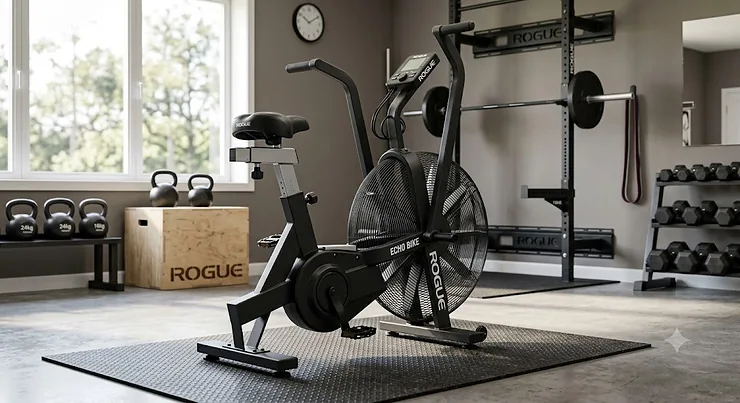
A rogue echo bike is a belt-driven air resistance exercise bike built by Rogue Fitness, designed to generate unlimited, effort-scaled resistance through a large steel fan rather than a preset tension dial…the harder you push and pull, the harder it pushes back. That single sentence explains why this machine dethroned the once-untouchable Assault Bike as the official conditioning tool of CrossFit gyms nationwide, and why so many garage gym owners land here first when they start shopping.
Here’s the thing nobody tells you before you buy your first air bike: they’re all going to hurt. That’s not a bug, it’s the entire point. But “hurt in a way that builds real conditioning” and “hurt because the bike itself is rattling apart under you” are two very different experiences, and the gap between a well-engineered fan bike and a bargain-bin knockoff shows up exactly when you need reliability most — three minutes into an all-out interval, lungs burning, legs screaming. This guide breaks down the rogue echo bike alongside six legitimate competitors so you can figure out which one actually deserves a spot in your training space, not just which one has the flashiest marketing copy.
We’ll dig into real specs and what they mean for your actual workouts, not just spec-sheet bragging rights. We’ll walk through aggregated review sentiment from owners who’ve logged hundreds of sweaty hours on these machines. And because a chunk of this decision comes down to money, we’ll talk price ranges, total cost of ownership, and where corners get cut at the lower end of the market. According to the CDC’s Physical Activity Guidelines for Americans, most adults need 150 minutes of moderate or 75 minutes of vigorous aerobic activity weekly — and a well-built air bike is one of the most time-efficient ways to bank those vigorous minutes without leaving your garage.
Quick Comparison: Rogue Echo Bike vs Top Air Bike Alternatives
Before we go deep on all seven machines, here’s the fast version for anyone who just wants the gist before their coffee gets cold.
| Bike | Drive Type | Price Range | Best For |
|---|---|---|---|
| Rogue Echo Bike | Belt | $850–$950 | Overall durability and resale value |
| Assault AirBike Classic | Chain | $699–$760 | Tightest budget, no-frills training |
| Schwinn Airdyne AD7 Pro | Belt | $999–$1,099 | Quietest ride, best warranty |
| Titan Fitness Fan Bike | Chain | $650–$700 | Most included accessories per dollar |
Look at that table for more than five seconds and a pattern jumps out: belt drives cost more upfront but tend to run quieter and need less upkeep, while chain-driven bikes save you money today at the cost of the occasional lube job down the road. Price alone doesn’t tell the whole story either — the Titan Fitness Fan Bike undercuts nearly everything here while still bundling accessories that cost extra elsewhere, which is exactly the kind of nuance a bare spec sheet won’t show you.
💬 Just one click — help others make better buying decisions too!😊
Top 7 Air Resistance Bikes for Garage Gym Cardio: Expert Analysis
Picking the right machine among the sea of rogue fitness air bike competitors means weighing frame durability, drivetrain type, console features, and — let’s be honest — how much abuse your wallet can take. Below are seven real, currently available bikes spanning budget, mid-range, and premium territory, each with genuine specs, honest analysis, and aggregated review sentiment.
| Bike | Drive | Weight Capacity | Price Range | Best For |
|---|---|---|---|---|
| Rogue Echo Bike | Belt | 350 lb | $850–$950 | All-around durability and resale value |
| Assault AirBike Classic | Chain | 300 lb | $699–$760 | Lowest-cost CrossFit-proven training |
| Assault AirBike Elite | Chain | 350 lb | $1,300–$1,400 | Heavier riders and commercial floors |
| Schwinn Airdyne AD7 Pro | Belt | 350 lb | $999–$1,099 | Full-body engagement and best warranty |
| Titan Fitness Fan Bike | Chain | 330 lb | $650–$700 | Most standard accessories for the price |
| Bells of Steel Blitz 2.0 | Belt | 300 lb | $700–$800 | Belt-drive smoothness on a budget |
| Xebex AirPlus Performance | Belt | 300 lb | $599–$700 | App-based structured training |
Scanning the table, weight capacity and drivetrain track together more than price does — the two bikes with the highest 350-pound capacity, the Rogue Echo Bike and Assault AirBike Elite, also happen to be the two most frequently found in commercial CrossFit boxes. Meanwhile, the three belt-drive budget-to-mid options (Rogue Echo Bike, Bells of Steel Blitz 2.0, and Xebex AirPlus Performance) show that quiet, low-maintenance operation is no longer locked behind flagship pricing the way it was a few years ago.
1. Rogue Echo Bike — gold-standard belt-drive durability
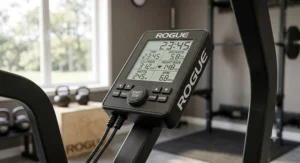
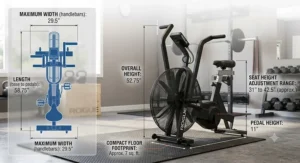
The current V3.0 version swapped the older chain-based design for a belt drive, and that single change is arguably the most important upgrade in the bike’s history. Weighing in around 127 pounds with a footprint of roughly 52.75″ H x 58.875″ L x 29.875″ W, the frame is built from heavy-gauge steel that simply doesn’t flex under hard pulls, and the belt system means you’re not periodically degreasing a chain like you would on cheaper rivals. The console tracks intervals, distance, calories, and heart rate, and a January 2026 firmware update added Garmin ANT+ connectivity on top of existing Bluetooth support, so syncing to a watch no longer requires a phone as a middleman.
Based on the spec comparison, this bike is built for people who train often enough that maintenance frequency actually matters — CrossFitters, combat athletes, and anyone doing multiple weekly HIIT sessions who doesn’t want to think about their equipment between workouts. What most buyers overlook about the rogue echo bike is that it isn’t just tough for the sake of looking tough; the overbuilt frame directly translates into a steadier, less wobbly ride during max-effort sprints, which matters more than people expect once they’re actually gasping through a 20-second all-out interval.
Reviewers consistently report that after many months of near-daily use, the frame shows zero flex, clean welds, and no rust — the kind of longevity that lets Rogue equipment hold resale value better than most competitors. A common thread in aggregated feedback is that the Echo Bike’s fan and belt system feels noticeably smoother than chain-driven alternatives, though a few owners note they’d like Rogue to add multi-grip handlebars similar to what Schwinn offers.
Pros:
- ✅ Belt drive means virtually zero chain maintenance
- ✅ Overbuilt steel frame rated for CrossFit-level abuse
- ✅ Bluetooth and Garmin ANT+ sync after 2026 firmware update
Cons:
- ❌ Direct-only purchase from Rogue limits price shopping
- ❌ Costs more upfront than most chain-driven rivals
At around $850–$950, the rogue echo bike sits in the mid-to-premium tier, but its resale value and reduced maintenance costs make a strong case that it pays for itself over a multi-year ownership window.
2. Assault AirBike Classic — CrossFit’s original no-frills workhorse
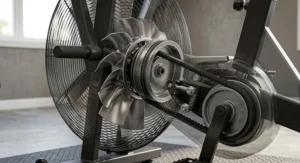
The Assault AirBike Classic is the bike that basically defined the category for a decade before belt-drive competitors caught up. At roughly 96 pounds with a 300-pound weight capacity, it’s the lightest bike on this list, and its chain-and-sprocket drivetrain, four-way adjustable seat, and steel fan blades cover the fundamentals without a single unnecessary frill — there’s not even a water bottle holder standard.
Here’s what the spec sheet won’t tell you: that stripped-down approach is a feature, not a shortcoming, for a huge swath of buyers. If your goal is simply “get on the bike and suffer,” the Classic delivers an experience nearly identical to its pricier siblings, the Pro and Elite, without their added weight, cost, or connectivity gimmicks. Coaches running group classes appreciate that the console requires zero explanation — RPM, calories, watts, and time, full stop.
Aggregated review sentiment describes the ride as durable and enjoyable “not in the traditional sense,” a phrase that shows up across multiple independent test teams — a nod to just how brutal an honest air bike session feels regardless of price point. Testers have consistently rated its construction and durability highly, while noting the chain drive does introduce more noise and periodic maintenance than belt-driven options like the rogue echo bike or the Schwinn Airdyne.
Pros:
- ✅ Lowest buy-in of any CrossFit-proven fan bike here
- ✅ Simple LCD console with zero learning curve
- ✅ Nearly identical ride feel to pricier Assault models
Cons:
- ❌ Chain drive needs periodic lubrication
- ❌ No water bottle or phone holder included standard
Priced in the $699–$760 range including shipping, the Assault AirBike Classic remains one of the best value entry points into serious air-bike conditioning.
3. Assault AirBike Elite — heaviest frame, highest weight capacity
Think of the Assault AirBike Elite as the Classic’s much bigger, much beefier sibling. The frame jumps to roughly 139 pounds (versus 96 on the Classic), the seat is wider, and the weight capacity climbs to 350 pounds thanks to an ISIS splined crank system and solid steel cranks that handle heavier loads with less flex. It also ships with an integrated windscreen and a larger, higher-contrast LCD console with Bluetooth and Comp Mode built in.
On paper this means the Elite is aimed squarely at heavier athletes, commercial gyms, or anyone who wants the reassurance of a frame that simply won’t budge no matter how hard they crank the pedals. Reviewers who’ve tested both models note the functional gap between Classic and Elite performance is smaller than the price gap suggests — the extra investment buys durability headroom and comfort more than a dramatically different workout. One tester’s value score landed at just 2.5 out of 5 specifically because the ride feel isn’t different enough to justify the upgrade for most home users, while construction and durability scored a full 5 out of 5 from the same team.
That combination — outstanding build quality paired with a middling value verdict — is honest, useful information a straight spec sheet would never surface. Reviewers consistently note the Elite makes the most sense for larger-bodied athletes or facilities running multiple daily classes rather than the average home garage gym owner.
Pros:
- ✅ 350-pound weight capacity, highest in this lineup
- ✅ ISIS splined crank for smoother power transfer
- ✅ Integrated windscreen and easier-to-read display
Cons:
- ❌ Among the priciest fan bikes on this list
- ❌ 139-pound frame makes it hard to relocate
Expect to pay somewhere in the $1,300–$1,400 range, positioning the Assault AirBike Elite as a premium pick best suited to heavier riders or commercial settings rather than casual home use.
4. Schwinn Airdyne AD7 Pro — quietest ride, best warranty in class
Schwinn essentially invented the air-resistance bike category back in the 1970s, and the AD7 Pro is the modern flagship of that lineage. Its standout feature is the belt-drive system paired with moving, multi-grip handlebars, which genuinely activates the chest, back, biceps, and triceps in a way that stationary-handle bikes like the Classic Assault simply can’t replicate. The large fan wheel with 26 rotating blades produces smooth resistance, and one independent tester called its display “the best LCD I’ve seen on any air bike.”
Based on the spec comparison, the AD7 Pro’s real advantage isn’t raw toughness — it’s total-body engagement plus refinement. The moving handlebars mean every stroke recruits your arms and core in addition to your legs, which translates into a genuinely different training stimulus than a fixed-handle fan bike, not just a marketing footnote. That’s a meaningful distinction for anyone whose goal is maximum caloric burn per minute rather than pure leg conditioning.
Reviewers consistently praise the 10-year frame warranty, 2-year mechanical parts coverage, and 1-year electronics warranty as the best in this entire category — a real differentiator when a bike represents a multi-year investment. The trade-off is price: several testers have flagged it as noticeably more expensive than comparable belt-drive competitors like the rogue echo bike or the Bells of Steel Blitz, without a functional gap wide enough to fully justify the gap for budget-conscious buyers.
Pros:
- ✅ Belt drive plus moving handlebars for true full-body reps
- ✅ Best warranty of the group — 10 years on the frame
- ✅ Console rated best-in-class by multiple independent testers
Cons:
- ❌ Most expensive bike in this entire roundup
- ❌ Sold mainly direct, so meaningful discounts are rare
At roughly $999–$1,099, the Schwinn Airdyne AD7 Pro is a long-term investment piece for anyone who values whole-body engagement and wants the peace of mind of the best warranty on the market.
5. Titan Fitness Fan Bike — most standard accessories for the money
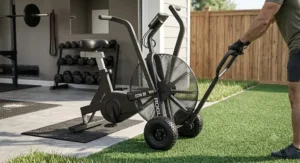
Titan built its reputation on squat racks and barbells before wading into cardio, and the Fan Bike shows the company applying that same “give people more for less” philosophy to conditioning equipment. At around 111 pounds with a 330-pound weight capacity, turf tires, a rear transport handle, a built-in wind guard, a water bottle holder, and a phone holder all come standard — items that cost extra as add-ons on the rogue echo bike and several competitors.
What most buyers overlook here is the cumulative value of those “small” inclusions. Adding a wind guard, bottle holder, and phone mount to a competitor’s bike can tack on well over a hundred dollars, so Titan’s baseline price is more competitive than it first appears once you equalize for features. The tradeoff is a chain-drive system rather than a belt, meaning slightly more noise and the occasional lube job, plus a shorter one-year frame warranty that lags behind nearly every other bike on this list.
Aggregated review sentiment is largely positive, with testers noting the bike ships mostly pre-assembled with stabilizing hardware to prevent shifting during transit — a small but appreciated detail. One reviewer summed it up well: if the Echo Bike and the Assault Bike had a baby, this would be it, combining traits from both at a lower price point.
Pros:
- ✅ Turf tires, wind guard, and phone holder included standard
- ✅ 330-pound weight capacity beats most bikes at this price
- ✅ Ships mostly pre-assembled out of the box
Cons:
- ❌ Chain drive is noisier and needs occasional lube
- ❌ Only a 1-year warranty on the frame
Frequently available in the $650–$700 range (and occasionally lower during sales), the Titan Fitness Fan Bike is arguably the best pure value pick in this entire comparison.
6. Bells of Steel Blitz Air Bike 2.0 — belt-drive smoothness at a chain-drive price
The Bells of Steel Blitz Air Bike 2.0 occupies an interesting niche: it delivers a belt-drive system, usually reserved for pricier bikes, at a price point that undercuts the rogue echo bike by roughly $100–$150. At about 118 pounds, it includes a fan guard, water bottle holder, and phone holder standard, along with 11 vertical seat adjustment positions — more granular than most competitors offer.
Here’s what the spec sheet undersells: an oversized 25-inch wind guard that testers specifically called out as meaningfully reducing the “wind chill” effect of the fan during hard efforts, which matters more than it sounds like when you’re training through a cold garage in January. Based on the spec comparison, this bike is engineered for buyers who want belt-drive smoothness and quiet operation without stretching into flagship pricing.
Reviewers consistently rate it as a strong value alternative to both the rogue echo bike and the Assault lineup, with one reviewer noting they’d still lean toward the Echo Bike given its longer market track record, but calling the Blitz “a very strong contender” on pure value. The most common complaint in aggregated feedback is the lack of Bluetooth or ANT+ connectivity, along with transport wheels that feel like something of an afterthought compared to the rest of the build.
Pros:
- ✅ Belt drive at a price usually reserved for chain drives
- ✅ Oversized wind guard blocks fan blast during hard efforts
- ✅ Eleven vertical seat positions, more than most competitors
Cons:
- ❌ No Bluetooth or ANT+ connectivity
- ❌ Transport wheels feel like an afterthought
Landing in the $700–$800 range shipped, the Blitz Air Bike 2.0 is one of the smartest value plays for anyone who wants belt-drive durability without belt-drive pricing.
7. Xebex AirPlus Performance Bike — most app connectivity per dollar
Rounding out the list, the Xebex AirPlus Performance Bike targets a specific type of buyer: someone who wants structured, app-based training rather than just raw interval suffering. Its belt-drive system feeds an LCD console with Bluetooth connectivity and ANT+/FTMS support for apps like Zwift and Kinomap, letting riders follow guided, structured workouts instead of freestyling intervals off a wall clock.
What most buyers overlook about the rogue fitness air bike category in general is that connectivity varies wildly — some competitors, including several bikes on this list, skip smart-app compatibility entirely. The Xebex closes that gap at a genuinely accessible reference price, undercutting most connected fan bikes while still delivering a four-way adjustable seat and reinforced handlebars that accommodate a wide range of body types.
Reviewers describe it as historically the value alternative to the Assault lineup, sharing a nearly identical frame architecture, with the belt-drive Performance model representing a meaningful step up from Xebex’s older chain-driven bikes. The most consistent critique in aggregated feedback is that the frame, while sturdy, isn’t quite as overbuilt as flagship commercial bikes like the Elite or the AD7 Pro, and the smaller brand footprint means a thinner secondhand resale market if you ever decide to sell.
Pros:
- ✅ Zwift and Kinomap compatible via Bluetooth, ANT+, and FTMS
- ✅ Belt drive undercuts most connected fan bikes on price
- ✅ Four-way adjustable seat fits a wide range of riders
Cons:
- ❌ Frame isn’t as overbuilt as flagship commercial bikes
- ❌ Smaller brand means a thinner secondhand resale market
Referenced around $599–$700 depending on retailer promotions, the Xebex AirPlus Performance Bike is the pick for anyone who wants structured app-based training without flagship pricing.
Rogue Echo Bike Setup, Maintenance & Your First 30 Days
Getting a rogue echo bike (or any fan bike, really) out of the box is only step one — how you set it up and maintain it in that first month determines whether it feels like a reliable training partner or a squeaky nuisance a year from now.
Start with assembly on a flat, hard surface — garage epoxy or rubber gym flooring both work fine, but avoid thick carpet, which lets the base rock slightly during max-effort sprints. Torque every bolt to spec rather than “snug,” since a loose seat post or handlebar clamp is the single most common source of rattling noise owners report in the first few weeks. Set your seat height so your knee holds a slight bend at full pedal extension — too high and you’ll rock side to side losing power, too low and you’re adding unnecessary knee stress on every rotation.
For maintenance, belt-driven bikes like the rogue echo bike, the Schwinn Airdyne AD7, the Blitz 2.0, and the Xebex AirPlus need almost nothing beyond an occasional wipe-down and periodic bolt check. Chain-driven bikes — the Assault Classic, Assault Elite, and Titan Fan Bike — benefit from a drop of chain lubricant every few weeks of regular use, plus a quick wipe to keep dust and sweat from gumming up the links. A common first-30-days mistake is skipping this entirely; a dry, gritty chain doesn’t just get louder, it also transfers power less efficiently, which subtly saps your wattage numbers over time. Also wipe down the fan blades regularly, since sweat that lands on steel components and sits overnight is the fastest path to corrosion, especially in humid garages.
Real-World Scenarios: Who Should Buy Which Air Bike
Specs only get you so far — matching a machine to your actual life circumstances is where the real decision gets made.
If you’re a CrossFit-affiliate owner replacing worn-out class equipment used by dozens of athletes daily, the durability math points toward the Assault AirBike Elite or the Rogue Echo Bike, since both are engineered for the kind of continuous, high-volume abuse a commercial floor delivers, and their higher weight capacities cover a broader range of athlete body types without a second thought.
If you’re a college student or apartment-dweller squeezing conditioning work into a small space on a tight budget, the Titan Fitness Fan Bike or the Assault AirBike Classic make more sense — both deliver legitimate air-resistance training without the premium price tag, and their lighter frames (111 and 96 pounds respectively) are easier to shuffle into a closet after your session.
If you’re training at home and want the fan bike doing double duty as a way to follow structured programming — think Zwift group rides translated into interval work — the Xebex AirPlus Performance Bike is purpose-built for that use case with its app-connectivity focus. And if you’re prioritizing pure longevity because you know you’ll be riding four or five times a week for years, the belt-drive trio of the rogue echo bike, the Bells of Steel Blitz, and the Schwinn Airdyne AD7 all reduce the maintenance burden that eventually wears on chain-drive owners.
Problem → Solution Guide for Air Bike Owners
Problem: My bike squeaks or rattles during hard efforts. This is almost always a loose bolt rather than a manufacturing defect. Re-torque the seat post clamp, handlebar mounts, and base plate bolts — this alone resolves the majority of noise complaints across every bike on this list, belt-driven or chain-driven.
Problem: My chain-driven bike feels sluggish after a few months. Apply a bicycle-specific chain lubricant, let it sit for a few minutes, then wipe off the excess. Owners of the Assault Classic, Assault Elite, and Titan Fan Bike who skip this step consistently report a gradual loss of that crisp, responsive power transfer they had on day one.
Problem: I’m plateauing on calorie output and getting bored. Interval variety matters more than raw duration on an air bike. Rotate between 20-seconds-on/10-seconds-off Tabata-style efforts, longer 1-minute-on/1-minute-off intervals, and steady 20-minute recovery-pace rides to keep both your cardiovascular system and your motivation challenged. Short, hard intervals also trigger a larger excess post-exercise oxygen consumption effect than steady-pace cardio, meaning your body keeps burning at an elevated rate for a while after you step off the bike.
Problem: The fan wind is unbearable in a cold garage. Several bikes here — the Assault Elite, Bells of Steel Blitz, and Titan Fan Bike — include a wind guard standard, while the rogue echo bike offers one as an accessory add-on. If you already own a bike without one, a simple household fan guard or cardboard shield positioned to redirect airflow can take the edge off during winter sessions.
Problem: I can’t decide between two similarly priced bikes. Default to whichever one has the drivetrain that matches your maintenance tolerance — belt drive if you’d rather not think about lubrication schedules, chain drive if you’re comfortable with occasional upkeep in exchange for a lower price.
How to Choose an Air Resistance Bike
- Decide your budget ceiling first. Air bikes here range from around $600 to over $1,300, and knowing your ceiling before you start comparing specs prevents decision fatigue.
- Pick belt drive or chain drive. Belt drives (rogue echo bike, Schwinn Airdyne, Bells of Steel Blitz, Xebex AirPlus) run quieter with less maintenance; chain drives (Assault Classic, Assault Elite, Titan Fan Bike) cost less upfront.
- Check the weight capacity against your heaviest likely rider. Capacities in this roundup range from 300 to 350 pounds — don’t cut it close if multiple people will use the machine.
- Consider console and connectivity needs. If you want to sync workouts to a watch or app, prioritize bikes with confirmed Bluetooth/ANT+ support, like the rogue echo bike or the Xebex AirPlus.
- Factor in included accessories. Wind guards, bottle holders, and phone mounts come standard on some bikes (Titan, Bells of Steel) and cost extra on others (Rogue), which changes the real out-the-door price.
- Read the warranty fine print. Coverage here spans a thin 1-year frame warranty up to a full 10 years — a meaningful difference for a piece of equipment meant to last.
- Weigh resale value if you might upgrade later. Rogue and Assault both tend to hold value better on the secondhand market than smaller or newer brands.
Rogue Echo Bike vs Assault Bike: Which Fan Bike Wins?
This is the single most searched comparison in the category, and for good reason — these two machines have effectively traded the “default air bike” crown back and forth for years. The short version: the rogue echo bike wins on build quality and ride smoothness thanks to its belt drive, while the Assault lineup wins on price and, in the Elite’s case, programmable workout options.
Digging deeper, the drivetrain difference is the crux of the decision. The rogue echo bike’s belt system produces a noticeably smoother, quieter pedal stroke and all but eliminates the periodic lubrication chain-driven bikes need. The Assault AirBike Classic counters with a genuinely lower price and nearly a decade longer market track record as the go-to CrossFit standard, which matters to buyers who value a long history of parts availability and community troubleshooting.
Frame construction tells a similar story of trade-offs. The rogue echo bike’s 127-pound frame and the Assault Elite’s 139-pound frame are both exceptionally stable, while the Assault Classic’s lighter 96-pound build sacrifices a bit of that rock-solid feel in exchange for easier portability and a lower price tag. For home gym owners who train seriously — multiple sessions weekly, high-intensity intervals, occasional shared use with a training partner — the durability and reduced maintenance of the rogue echo bike tend to win out over a multi-year ownership horizon. For anyone prioritizing the lowest possible buy-in with proven CrossFit pedigree, the Assault AirBike Classic remains a legitimately smart choice that a lot of serious athletes still swear by.
Rogue Echo Bike Review: What Owners and Coaches Actually Say
Independent testing teams that have logged extended hands-on time with the rogue echo bike consistently describe it as one of the most overbuilt exercise bikes on the market, and that sentiment holds up across multiple review outlets rather than being an outlier opinion from a single source. The recurring theme in aggregated feedback is trust in the frame — testers who’ve used the bike for eight-plus months of near-daily training report zero flex, zero rust, and zero looseness in the joints, which is a meaningfully strong endorsement for a piece of equipment that takes this much repeated abuse.
Where opinions diverge slightly is on console ergonomics. Some reviewers note Schwinn’s multi-grip handlebar design edges out the rogue echo bike’s fixed handles for upper-body variety, a fair critique given the AD7 Pro’s dedicated focus on full-body engagement. Others point to the January 2026 firmware update adding Garmin ANT+ sync as closing what used to be a real gap versus more tech-forward competitors like the Xebex AirPlus.
On value, the consensus lands favorably: testers repeatedly note the price feels lower than expected given the build quality on display, especially compared to the Schwinn AD7 Pro’s premium positioning. If you’re weighing a rogue echo bike review against your own priorities, the throughline across nearly every source is that this bike rewards buyers who train consistently and value long-term reliability over flashy extras.
Garage Gym Cardio: Where the Echo Bike Fits Your Training
Garage gym cardio has a reputation problem — a lot of home lifters treat conditioning as an afterthought bolted onto a strength-focused setup, and an air bike is often the machine that finally forces a change in that mindset. Unlike a treadmill, which needs real floor space and can be genuinely dangerous to fall off of at speed, a fan bike’s footprint is compact (most bikes here measure under five feet in length) and there’s no belt to slip on, making it one of the safer high-intensity options for a converted garage space.
| Cardio Option | Footprint | Full-Body? | Best For |
|---|---|---|---|
| Air Bike (e.g. Rogue Echo Bike) | Compact | Yes (arms + legs) | HIIT, Tabata, CrossFit-style conditioning |
| Treadmill | Large | No (legs only) | Steady-state runs, distance training |
| Rowing Machine | Long/narrow | Yes (arms + legs) | Low-impact endurance, technique-focused work |
| Upright Spin Bike | Compact | No (legs only) | Structured cycling classes, lower-impact cardio |
Compared to these traditional alternatives, an air bike’s combination of a small footprint and true full-body engagement is hard to match — a treadmill demands roughly triple the floor space for a leg-only stimulus, while a rowing machine delivers similar full-body benefits but needs a long, unobstructed pull-through zone that many garages simply don’t have. The trade-off is intensity: air bikes are built for short, brutal efforts rather than the steady 45-minute sessions a treadmill or rower handles more comfortably.
The metabolic case for making an air bike your primary garage gym cardio tool is strong: because resistance scales entirely with effort, there’s no ramp-up time fumbling with resistance dials mid-set, which makes it uniquely suited to CrossFit-style “for time” workouts and Tabata intervals where every second counts. Pairing 20-second max-effort bike sprints with barbell complexes or kettlebell work creates a hybrid conditioning-strength session that’s difficult to replicate with cardio equipment. The American Heart Association notes that vigorous aerobic activity delivers the same weekly health benefits in roughly half the time of moderate activity, which is exactly the trade a hard air bike interval session is making.
Garage conditions matter too — most air bikes here tolerate temperature swings and occasional dust fine, since there’s no motor or electronics beyond the simple LCD console, but wiping down steel components after sweaty sessions prevents the kind of corrosion that shows up in unheated, humid garages over a few winters.
Durable Fan Bikes: What “Overbuilt” Really Means for Longevity
The phrase “overbuilt” gets thrown around a lot in air bike marketing, so it’s worth breaking down what actually makes a fan bike durable rather than just heavy. Frame gauge (the thickness of the steel tubing) matters more than total weight — a thicker-walled tube resists flex under the twisting forces generated by hard pedaling and pulling, which is exactly the stress pattern that eventually cracks welds on cheaper bikes.
Bearing quality is the second, less visible factor. Sealed cartridge bearings, found in the pivots of bikes like the Assault Elite and the Xebex AirPlus, keep dust and sweat out of the moving parts far better than open bushings, extending usable life significantly before you notice play in the joints. Powder-coat thickness also plays a real role in corrosion resistance — thin, single-pass coatings chip and expose bare steel to rust within a year or two of regular sweaty use, while thicker industrial coatings, standard on the rogue echo bike and the Assault Elite, hold up for years even in a non-climate-controlled garage.
Drivetrain choice factors into perceived durability too, though in a different way than most buyers assume. A well-maintained chain drive, like the one on the Titan Fan Bike or Assault Classic, can last just as long as a belt drive — the difference is that belts simply don’t require that maintenance discipline to hit the same lifespan. What most buyers overlook is that “durable” and “low-maintenance” aren’t synonyms; a bike can be extremely durable while still needing more hands-on care to get there.
Commercial Air Resistance: Home Use vs Box-Grade Standards
There’s a meaningful gap between a bike marketed for home use and one built to commercial air resistance standards, and understanding that gap helps set realistic expectations for how any of these seven machines will hold up under your specific usage pattern. Commercial-grade equipment in a CrossFit box or globo gym setting typically sees dozens of different users daily, each with wildly different weight, technique, and effort levels — which is precisely the stress-testing scenario that separates genuinely overbuilt frames from bikes that are merely sturdy enough for occasional home use.
The Assault AirBike Elite and rogue echo bike both carry genuine commercial pedigree — you’ll find both in CrossFit affiliates and training facilities nationwide, not just home garages, which is a strong real-world durability signal beyond marketing claims. The Schwinn Airdyne AD7 Pro also sells a “Pro” commercial variant through third-party retailers using identical specs to the consumer AD7, another sign Schwinn considers the design commercial-ready.
For a typical home garage gym with one to three regular users, you genuinely don’t need commercial-grade overbuilding to get years of reliable service — bikes like the Titan Fan Bike or Bells of Steel Blitz 2.0 are more than sufficient for that lighter usage pattern, and paying a premium for commercial-rated durability you’ll never stress-test is money that could go toward other equipment. Where commercial-grade construction genuinely pays off is in shared households, small group training setups, or if you’re simply the type of athlete who trains hard enough, often enough, that “home use” starts to resemble “commercial use” in practice.
Common Mistakes When Buying an Air Bike
The most common mistake is buying based on price alone without checking weight capacity against every household member who might use it — a 300-pound-capacity bike is fine for some households and undersized for others, and that math needs to happen before checkout, not after a warranty claim.
A close second is ignoring drivetrain type entirely. Buyers who don’t realize the difference between belt and chain drive often end up surprised by noise levels or maintenance requirements they didn’t anticipate, especially in shared living spaces where a loud chain-driven bike at 6 a.m. can strain household relationships. Skipping the accessories math is another frequent misstep — comparing a base price on one bike against a bundled price on another without normalizing for wind guards, bottle holders, and phone mounts leads to apples-to-oranges comparisons that skew the perceived value.
Finally, plenty of buyers overlook warranty length entirely, focusing purely on the purchase price. A bike with a 1-year frame warranty and one with a 10-year frame warranty might sit within $50 of each other, and that coverage gap is worth far more than the price difference over a multi-year ownership period.
Long-Term Cost & Maintenance: The Real Total Cost of Ownership
Sticker price only tells part of the financial story. Chain-driven bikes like the Assault Classic, Assault Elite, and Titan Fan Bike require periodic lubricant purchases — a minor recurring cost, but one that belt-driven bikes like the rogue echo bike, Schwinn AD7, Blitz 2.0, and Xebex AirPlus simply don’t carry. Over five years of regular use, that maintenance time and minor expense adds up, even if the per-application cost is small.
Warranty coverage functions as a kind of insurance policy against total cost of ownership. A bike backed by a 10-year frame warranty, like the Schwinn AD7 Pro, effectively de-risks a large portion of your investment against a manufacturing defect showing up years down the line — coverage that a 1-year-warranty bike like the Titan Fan Bike simply doesn’t offer, even though Titan’s upfront price is lower.
Resale value is the final piece of the equation, and it favors established brands. The rogue echo bike and Assault lineup both tend to hold value well on secondhand marketplaces given their brand recognition and long track record in CrossFit communities, meaning a portion of your original purchase price is recoverable if you eventually upgrade or downsize your home gym. Smaller or newer brands like Xebex, while excellent value new, don’t yet carry the same resale liquidity — a real, if secondary, factor in weighing total cost of ownership across a multi-year horizon.
Features That Actually Matter (And Those That Don’t)
Weight capacity, drivetrain type, and warranty length actually matter — they directly affect who can safely use the bike, how much upkeep it demands, and how protected your investment is over time. Frame gauge and bearing quality matter too, even though they’re rarely front-and-center in marketing copy, because they’re the real determinants of long-term durability.
Bluetooth and app connectivity matter for a specific subset of buyers — anyone who wants structured programming through Zwift or Kinomap, or who wants workout data flowing directly to a fitness watch — but they’re genuinely non-essential for someone who just wants to do intervals off a wall clock. Similarly, flashy console graphics or novelty workout modes rarely change the actual training stimulus; the resistance mechanism (your own effort against the fan) is identical regardless of how the numbers get displayed.
What most buyers overlook is that color schemes, aesthetic details, and included branded merchandise add zero functional value, yet they’re often prominently featured in product photography because they’re easy to show off. Reviewers consistently note that after the first few weeks of ownership, buyers stop noticing the bike’s looks entirely and start caring exclusively about how smoothly it rides and how little maintenance it demands — which is exactly why this guide weighted drivetrain, frame quality, and warranty so heavily throughout.
✨ Don’t Miss These Exclusive Deals! ✨
🔍 Take your garage gym cardio to the next level with these carefully selected air bikes. Click on any highlighted product above to check current pricing and availability. These machines will help you build the kind of conditioning base that pays off in every other lift and sport you care about!
FAQ
❓ Is the rogue echo bike worth the extra money over an Assault Bike?
❓ How long do air resistance bikes typically last?
❓ Do I need Bluetooth connectivity on a fan bike?
❓ What's the difference between belt-drive and chain-drive air bikes?
❓ Can beginners use a commercial-grade air bike like the Assault Elite?
Conclusion
Choosing among these seven bikes really comes down to how often you’ll train, how much maintenance you’re willing to tolerate, and where your budget realistically sits. The rogue echo bike earns its reputation as a genuine all-rounder — durable, low-maintenance, and backed by strong resale value — which is why it keeps showing up as the default recommendation across so many independent reviews. But “default recommendation” doesn’t mean “only correct answer,” and the Assault Classic, Titan Fan Bike, and Bells of Steel Blitz all make compelling arguments for buyers prioritizing a lower entry price.
If total-body engagement and the best warranty in the category matter most to you, the Schwinn Airdyne AD7 Pro deserves serious consideration despite its premium price tag. If app-based structured training is the priority, the Xebex AirPlus closes that gap at a genuinely accessible price. And if you’re outfitting a commercial space or training partner-heavy home gym where weight capacity and abuse-resistance matter above all else, the Assault Elite remains the heavyweight champion, literally and figuratively.
Whichever machine you land on, remember that 20 focused minutes on any of these bikes, done at honest effort, delivers more real conditioning work than most people manage in an hour of casual cardio. The equipment matters, but showing up and actually pushing the pedals matters more.
✨ Ready to Build Real Conditioning? ✨
🔍 Compare the current pricing on any of these seven air bikes above and pick the one that matches your training frequency, budget, and maintenance tolerance. Your garage gym cardio setup — and your future self mid-Tabata — will thank you.
Recommended for You
- Assault Air Bike Guide 2026: 7 Picks Worth the Sweat
- Best Air Bike 2026: 7 Picks Worth Your Sweat (And Cash)
- 16 Level Magnetic Resistance Bike: 7 Best Picks for 2026
Disclaimer: This article contains affiliate links. As an Amazon Associate, I earn from qualifying purchases. If you purchase products through these links, we may earn a small commission at no additional cost to you.
✨ Found this helpful? Share it with your friends! 💬🤗
