
In This Article
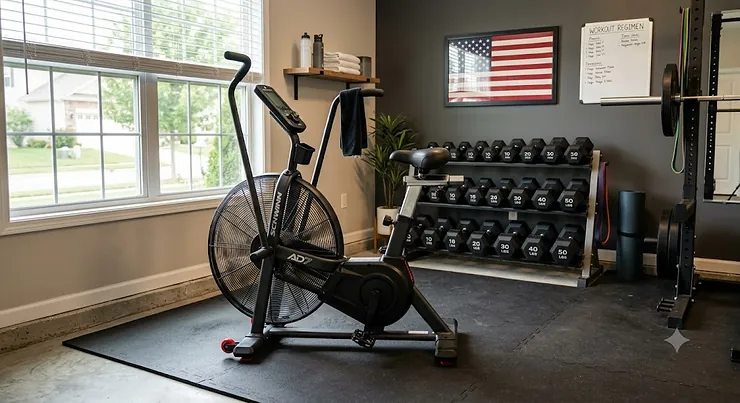
Somewhere between “I should really do cardio” and “I hate treadmills” sits the best air bike for you, quietly waiting to ruin your day in the best possible way. Air bikes don’t coast. There’s no incline button, no “fat burn” mode lulling you into a gentle pedal. You push the handles, you drive the pedals, and a fan spins up resistance in exact proportion to how hard you’re willing to suffer. Go easy, and it goes easy back. Go all-out, and it fights you like it’s personal.
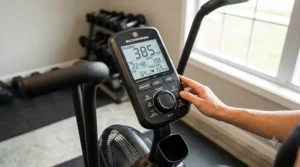
That self-regulating design is exactly why air resistance exercise bikes have become the default conditioning tool in CrossFit boxes, HYROX prep programs, and increasingly, garages and spare bedrooms across the country. There’s no motor to fail, no magnetic flywheel to wear thin — just moving air, which happens to be a nearly bulletproof way to build cardio capacity. According to the Centers for Disease Control and Prevention, adults benefit from at least 150 minutes of moderate aerobic activity per week, or 75 minutes of vigorous activity — and a 20-minute air bike interval session can knock out the vigorous end of that in a hurry.
This guide breaks down seven real, currently available air bikes spanning budget-friendly home options to CrossFit-standard workhorses, based on actual specs, verified features, and aggregated owner feedback — not marketing copy. We’ll cover assault bikes for home gyms, fan bikes built for pure cardio, and the “unlimited resistance” models that make excuses a lot harder to find.
What Is an Air Bike?
An air bike is a stationary bike that generates resistance from a fan instead of a magnet or friction pad. Pedaling and pushing the handles spins the fan faster, and the harder you work, the more air resistance pushes back — meaning there’s technically no resistance ceiling, just your own limits.
That’s the whole trick, and it’s also why these machines feel so different from a Peloton or a recumbent bike at the gym. There’s no dial to twist. The intensity lives entirely in your effort, which makes an air bike one of the most honest pieces of equipment you’ll ever sweat on.
Quick Comparison: Best Air Bike Picks at a Glance
| Bike | Drive Type | Best For | Price Range |
|---|---|---|---|
| Assault AirBike Classic | Chain | Best overall value / CrossFit standard | $650-$750 |
| Rogue Echo Bike V3.0 | Belt | Best premium build quality | $800-$900 |
| Schwinn AD7 Airdyne | Direct-drive belt | Quietest ride, best warranty | $900-$1,050 |
| Concept2 BikeErg | Belt (fixed handles) | Best for cycling-specific training | $950-$1,050 |
| Bells of Steel Blitz Air Bike 2.0 | Belt | Best Echo alternative | $700-$900 |
| Sunny Health & Fitness SF-B223018 | Belt | Best budget with app connectivity | Under $450 |
| pooboo S319 | Belt + chain | Best ultra-budget option | Under $450 |
Looking at this lineup, there’s a clean split between chain-driven bikes like the Assault AirBike Classic, which favor low upfront cost, and belt-driven bikes like the Rogue Echo Bike and Schwinn AD7, which trade a higher price for quieter, lower-maintenance operation. If you’re outfitting a shared living space, the belt-driven column is worth the premium; if you’re in a detached garage, the chain-driven Assault Classic saves real money without sacrificing durability.
💬 Just one click — help others make better buying decisions too!😊
Top 7 Best Air Bikes: Expert Analysis
1. Assault AirBike Classic — the CrossFit standard that started it all
The Assault AirBike Classic earned its reputation the hard way: years of daily abuse in CrossFit boxes with barely a squeak of complaint. It’s built around a chain-drive system, which is the first thing to know about it, because that single design choice explains almost everything else on this list.
Under the hood sits a 20-sealed-bearing chain drive and a steel frame under 100 pounds — light enough to wheel around a garage, sturdy enough to survive sprint intervals without wobbling. Based on the spec comparison against pricier belt-driven bikes, the Classic sacrifices some quietness for a lower price tag and a more “connected” pedal feel that some CrossFit athletes actually prefer, since you get direct mechanical feedback rather than the slightly smoother, more filtered sensation of a belt.
Reviewers consistently report that the ride quality holds up remarkably well over years of hard use, with the main complaint being drivetrain noise — a legitimate concern if your gym setup shares a wall with a nursery or a home office on a video call.
Pros:
- ✅ Proven CrossFit-standard durability at a lower price point
- ✅ Compact frame under 100 lbs, easy to reposition
- ✅ Simple LCD console with core workout metrics
Cons:
- ❌ Chain drive is noticeably louder than belt-driven rivals
- ❌ Requires periodic chain lubrication and maintenance
Priced around $650-$750, the Assault AirBike Classic remains one of the strongest value plays in this category — you’re paying for a decade-proven design, not for bells and whistles.
2. Rogue Echo Bike V3.0 — the premium belt-drive built for punishment
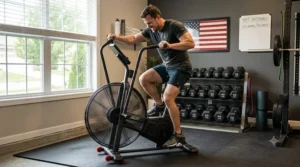
Rogue didn’t just copy the assault bike formula with the Rogue Echo Bike V3.0 — they re-engineered the fan itself. It runs 10 blades instead of the usual 6-7, with channeled, raised-edge blades measuring a full 3 inches wide, compared to the 2-2.5 inches you’ll find on most competitors.
What most buyers overlook about that fan design is that it isn’t just about looking beefier — more blades and wider surface area mean the Echo generates noticeably higher resistance at the same pedaling cadence, which is exactly why CrossFit athletes describe it as “harder” than an Assault Bike even at matched effort. The belt-drive system, paired with a 123-127 lb steel frame, also means near-silent operation apart from the whoosh of moving air — a genuine upgrade for shared spaces.
Aggregated owner sentiment is remarkably consistent: people who’ve owned both an Assault Bike and an Echo tend to prefer the Echo’s smoother, more “planted” feel, even while acknowledging the higher price.
Pros:
- ✅ Ten-blade fan design delivers noticeably higher resistance
- ✅ Belt drive is far quieter than chain-driven competitors
- ✅ Bluetooth/ANT+ console pairs with heart rate monitors and apps
Cons:
- ❌ Costs meaningfully more than chain-driven alternatives
- ❌ Tall frame can be awkward for shorter riders
At around $800-$900, the Rogue Echo Bike V3.0 is best thought of as the CrossFit-box-quality option for someone who trains often enough that the extra investment pays for itself in years of smoother, quieter mileage.
3. Schwinn AD7 Airdyne — the quiet, commercial-grade all-rounder
The Schwinn AD7 Airdyne takes a different engineering approach than the assault-style bikes above: a single-stage direct-drive belt system, paired with a powder-coated steel frame and a genuinely generous 10-year frame warranty. That warranty alone tells you something — Schwinn is betting this bike outlasts most of the competition.
Here’s what to weigh: the AD7’s console is larger and more detailed than what you get on an Assault or Echo bike, tracking time, distance, speed, calories, RPM, watts, and heart rate through a built-in telemetric sensor. Reviewers who’ve used both the AD7 and a Concept2 BikeErg tend to call the Schwinn’s console more intuitive, even if the BikeErg wins on smart-device compatibility.
A common thread in owner feedback is just how quiet this bike runs relative to its size — multiple long-term reviewers who’ve also owned older Schwinn models or Assault Bikes describe the AD7 as noticeably smoother and calmer, with the fan noise being the dominant (and only mildly noticeable) sound.
Pros:
- ✅ 10-year frame warranty signals serious build confidence
- ✅ Detailed console tracks heart rate, watts, and RPM natively
- ✅ Exceptionally quiet direct-drive belt system
Cons:
- ❌ Among the pricier options in this roundup
- ❌ Console lacks the app/smart-device depth of the BikeErg
Sitting in the $900-$1,050 range, the Schwinn AD7 Airdyne earns its keep for buyers who want commercial-gym durability without commercial-gym noise.
4. Concept2 BikeErg — the cycling-specific choice for serious engine-building
The Concept2 BikeErg breaks from the assault-bike template in one crucial way: fixed handles instead of moving arms, plus a clutch mechanism that lets the flywheel keep spinning even after you stop pedaling — much closer to how an actual road bike coasts.
Based on the spec comparison, this makes the BikeErg less of a total-body conditioning tool and more of a dedicated leg-and-cardio engine builder, which is precisely why endurance athletes and cyclists gravitate toward it over arm-driven air bikes. The adjustment range is also unusually thorough — seat height and position, plus vertical and horizontal handlebar placement — meaning it fits a wider range of body types than most fan bikes on this list.
What most buyers overlook is the Concept2 name itself: a company that’s built the gold-standard rowing ergometer for decades brings that same manufacturing pedigree here, and reviewers who’ve logged years on it describe the ride quality as essentially bulletproof.
Pros:
- ✅ Extensive seat and handlebar adjustability fits more body types
- ✅ Backed by Concept2’s proven ergometer manufacturing pedigree
- ✅ Smart-device and app compatibility for structured training
Cons:
- ❌ No moving arms means less total-body engagement per session
- ❌ Premium pricing places it above most fan bike competitors
At roughly $950-$1,050, the Concept2 BikeErg makes the most sense for cyclists, runners, and triathletes who want lower-body-focused conditioning rather than a full-body metcon tool.
5. Bells of Steel Blitz Air Bike 2.0 — the value-driven Echo alternative
The Bells of Steel Blitz Air Bike 2.0 was clearly designed with one competitor in mind: the Rogue Echo Bike. It borrows the belt-drive system and a similarly heavy-duty frame (118+ lbs) while trimming the fan blade size slightly to hit a friendlier price point.
Here’s what the spec sheet won’t tell you outright, but reviewers consistently note: the resemblance to the Echo isn’t just cosmetic. Owners who’ve tried both describe the Blitz as delivering 90% of the Echo’s smoothness and resistance feel at a noticeably lower cost — making it one of the more genuinely underrated picks in the premium-belt-drive category.
For buyers who want belt-drive quiet operation and Rogue-adjacent build quality but don’t want to pay Rogue prices, this is the bike worth cross-shopping before committing to the Echo.
Pros:
- ✅ Belt-drive quiet operation at a lower price than the Echo Bike
- ✅ Heavy-duty steel frame rivals premium competitors
- ✅ Strong resistance feel despite the smaller fan blades
Cons:
- ❌ Slightly less resistance ceiling than the Rogue Echo
- ❌ Fewer third-party accessories available compared to Rogue
Pricing generally lands in the $700-$900 range depending on configuration, positioning the Bells of Steel Blitz Air Bike 2.0 as the smart money pick for buyers chasing premium feel on a mid-range budget.
6. Sunny Health & Fitness SF-B223018 — the connected budget fan bike
The Sunny Health & Fitness SF-B223018, marketed as the Tornado Smart, targets a completely different buyer than the assault-style bikes above: someone who wants unlimited air resistance and app-guided workouts without spending CrossFit-box money.
Its Q235 steel frame supports up to 330 lbs, and the belt-drive mechanism keeps operation smooth for a bike in this price tier. What stands out based on the spec comparison is the free SunnyFit app integration — Bluetooth connectivity unlocks over 1,000 guided workouts, progress tracking, and even virtual scenic rides, features you simply won’t find bundled with the pricier assault-style bikes on this list.
Aggregated owner sentiment points to genuine satisfaction with the value proposition here, particularly among buyers who want structured, app-guided sessions rather than free-form intervals — though a common note in reviews is that the resistance ceiling, while “unlimited” in mechanism, doesn’t feel quite as brutal as the Echo or Assault Classic at max effort.
Pros:
- ✅ Free SunnyFit app with 1,000+ guided workouts included
- ✅ Dual-action design targets legs, arms, and back independently
- ✅ Strong value at a genuinely budget-friendly price point
Cons:
- ❌ Resistance feel is softer at max effort than premium rivals
- ❌ Build materials are lighter-duty than steel-heavy competitors
At under $450, the Sunny Health & Fitness SF-B223018 is the pick for buyers prioritizing guided programming and connectivity over raw CrossFit-grade toughness.
7. pooboo S319 — the ultra-budget entry point
The pooboo S319 rounds out this list as the most accessible entry point into air resistance training, combining a belt-and-chain hybrid transmission with a steel-caged fan housing that protects the resistance wheel from wear.
What most buyers overlook about hybrid-drive bikes like this one is the trade-off being made: the belt keeps the ride relatively quiet, while the chain-connected pedals aim to replicate the direct feel of an outdoor bike — a compromise that works reasonably well for casual, moderate-intensity riders but won’t fully satisfy someone chasing max-effort HIIT intervals. The steel-caged fan also produces genuine airflow, which reviewers note is a pleasant bonus during longer, sweatier sessions.
Reviewers frequently describe this as a solid “starter” air bike — a way to test whether fan-based training clicks with your routine before investing in a $700+ model.
Pros:
- ✅ Lowest price point of any bike in this roundup
- ✅ Steel cage protects the fan and adds durability
- ✅ Genuine airflow keeps rides comfortable in warm rooms
Cons:
- ❌ Resistance ceiling is noticeably lower than premium models
- ❌ Build quality feels less refined at aggressive intensities
Priced under $450, the pooboo S319 is the low-risk way to find out if you actually like air bike training before committing serious money.
How to Choose the Best Air Bike for You
Picking the right air bike comes down to matching the machine to your training style, not chasing the highest price tag. Here’s the process, step by step:
- Define your primary use case. HIIT intervals, steady-state cardio, and CrossFit-style metcons all favor slightly different bikes — arm-driven models like the Assault Classic or Echo suit metcons, while fixed-handle bikes like the BikeErg suit steady cycling-specific work.
- Set your noise tolerance. Belt-driven bikes (Echo, AD7, Blitz, Sunny SF-B223018) run quieter than chain-driven models (Assault Classic, pooboo S319) — a real factor in apartments or shared homes.
- Decide your budget ceiling first, then shop within it. Jumping from a $400 bike to an $850 bike buys you quieter operation and a higher resistance ceiling, not a fundamentally different workout.
- Check your space and weight capacity needs. Most air bikes support 300-350 lbs and need roughly a 4×3-foot footprint plus swing room for the handles.
- Consider connectivity if you want structure. App-connected models like the Sunny SF-B223018 add guided programming; bare-bones consoles like the Assault Classic keep things simple.
- Factor in maintenance tolerance. Chain-driven bikes need occasional lubrication; belt-driven bikes are close to maintenance-free.
- Read the warranty fine print. A 10-year frame warranty, like Schwinn’s on the AD7, signals long-term manufacturer confidence that’s worth factoring into total value.
Common Mistakes When Buying an Air Bike
The single biggest mistake buyers make is assuming “more expensive” automatically means “better for me.” A $1,000 Concept2 BikeErg is a poor purchase for someone who actually wants full-body metcon training, while a $700 Assault Classic is a poor purchase for someone who lives in a thin-walled apartment and needs whisper-quiet operation.
Another frequent misstep: ignoring drive-type noise differences entirely, then being surprised when a chain-driven bike sounds like a table saw at 6 a.m. Read owner reviews specifically for noise complaints before buying, not just for durability or feature lists.
Finally, buyers often skip checking weight capacity and footprint against their actual space. Most air bikes need clearance on both sides for the moving handles — a detail easy to miss when measuring only the frame’s footprint.
Air Bike vs Traditional Cardio Machines
Compared to a treadmill or a magnetic exercise bike, an air resistance exercise bike offers something neither can replicate: resistance that scales infinitely and instantly with your own effort, rather than a fixed dial of pre-set levels. On a magnetic bike, you’re locked into whatever resistance level you selected — pedal faster, and you’re just spinning through the same resistance more quickly. On an air bike, pedal faster and the resistance itself climbs, which is exactly why 20-second all-out air bike sprints feel disproportionately brutal compared to 20 seconds on a spin bike.
Treadmills, meanwhile, carry real impact stress on joints — a genuine concern for larger or older users, or anyone managing knee or hip issues. Air bikes are fully non-impact: your feet never leave the pedals, and the resistance comes from air rather than ground-strike force. The American College of Sports Medicine’s HIIT research has repeatedly highlighted interval-style cardiometabolic training — exactly the kind of work an air bike is purpose-built for — as an efficient way to build cardiovascular fitness in short sessions.
The trade-off is honesty, not deception: air bikes are simply harder to “cheat” through than a treadmill on a low incline or a bike on an easy resistance setting, which is precisely the point for anyone training for CrossFit, HYROX, or general conditioning gains.
Assault Bike for Home: What Changes When You Bring One Indoors
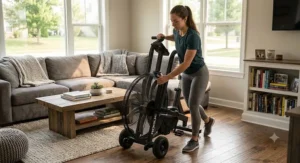
Bringing an assault bike for home use out of a commercial gym setting introduces a few practical realities gyms never have to think about. Noise is the first: a chain-driven bike that blends into background gym clatter becomes very noticeable in a quiet house at 6 a.m., which is why apartment dwellers consistently gravitate toward belt-driven models like the Echo or Blitz instead.
Floor protection is the second consideration. Home users report needing a rubber gym mat underneath their bike, both to protect flooring from the bike’s weight and to dampen vibration transfer through shared walls or floors — a non-issue on a commercial gym’s rubber flooring.
Finally, home buyers need to think about long-term maintenance access. A commercial gym has a maintenance team on-site; a home owner needs to be comfortable occasionally oiling a chain drive (on chain-based bikes) or simply wiping down a belt-driven frame, which requires essentially zero mechanical know-how.
Fan Bike for Cardio: What to Expect From Fan-Cooled Workouts
Using a fan bike for cardio delivers a genuinely different sensory experience than any other cardio machine — the harder you push, the more air blasts back at your face and torso, which is where “fan-cooled workouts” earns its name. This isn’t just a comfort perk; it’s a functional side effect of the same mechanism that creates resistance.
For hot climates or poorly ventilated home gyms, that self-generated airflow is a legitimate advantage over a stationary bike or rower, both of which offer zero cooling effect. Riders working at max intensity on bikes with larger fan blades — like the Rogue Echo’s 10-blade, 3-inch-wide design — report noticeably stronger airflow than smaller-bladed budget models, which is worth factoring in if you tend to overheat during intense sessions.
The flip side: that airflow can feel unwelcome in a cold garage in January, which is why several premium bikes, including the Echo, offer an optional wind deflector accessory sold separately.
Unlimited Resistance Bikes: Why “No Max Setting” Changes Your Training
The phrase “unlimited resistance” gets thrown around loosely in fan bike marketing, but the mechanism behind it is genuinely different from a traditional resistance dial. Instead of a fixed number of levels, air resistance scales continuously with pedaling speed — meaning there’s no ceiling to hit, only your own cardiovascular and muscular limits.
Practically, this changes how you should program workouts. Interval targets on an air bike are usually set by calories or watts within a time window, rather than by a resistance level, since the “level” is whatever effort you choose to apply. Reviewers across nearly every model in this roundup — from the budget pooboo S319 to the premium Rogue Echo — describe this as the defining feature that keeps air bike training from ever feeling “solved,” since you can always push harder and get more resistance back.
This is also why unlimited resistance bikes suit both beginners and elite athletes on the same machine: a beginner can ride gently and get gentle resistance, while an athlete alongside them can sprint into genuinely punishing territory, with zero adjustment to the dial required.
Practical Usage Guide: Your First 30 Days on an Air Bike
Setup is the easy part — most air bikes ship 80-90% assembled, needing only pedals, handlebars, and a console mount, typically a 20-30 minute job with included tools. Before your first ride, adjust seat height so your knee holds a slight bend at full pedal extension, and set handlebar reach so your arms aren’t fully locked out at the forward position.
For your first week, resist the urge to go all-out immediately. Air bikes punish poor pacing more than almost any other cardio machine — a common first-timer mistake is sprinting the first 30 seconds, then gassing out completely for the remaining interval. Start with moderate, steady efforts to learn how quickly resistance builds with your own cadence before layering in max-effort sprints.
By week two or three, introduce structured intervals: 20 seconds on, 40 seconds off, for 8-10 rounds is a proven starting template used across CrossFit programming. Wipe down the frame and seat after every session to prevent sweat corrosion on the powder coat, and if you own a chain-driven model, add a drop of chain lubricant roughly every 30-60 days of regular use. By day 30, most riders report their perceived effort at a given pace has dropped noticeably — a sign your cardiovascular base is adapting exactly as it should.
Real-World Scenarios: Which Air Bike Fits Your Life
The apartment-dwelling professional: Works long hours, wants 20-minute HIIT sessions before video calls, shares thin walls with neighbors. The belt-driven Schwinn AD7 Airdyne or Rogue Echo Bike fits best — quiet enough for early mornings, durable enough for daily short, intense sessions.
The garage-gym CrossFitter: Trains 5-6 days a week, values authenticity to box programming, doesn’t mind drivetrain noise in a detached space. The Assault AirBike Classic is the natural fit — it’s the exact bike most affiliate gyms already own, so training transfers directly.
The budget-conscious beginner: Wants to try air bike training without a major investment, exercises 2-3 times weekly, values guided programming to stay motivated. The Sunny Health & Fitness SF-B223018 delivers app-guided structure at a fraction of the CrossFit-bike price, making it the lowest-risk entry point.
Problem → Solution: Fixing Common Air Bike Frustrations
Problem: The bike is too loud for early-morning or late-night sessions. Solution: switch to a belt-driven model like the Rogue Echo or Bells of Steel Blitz, and place a rubber gym mat underneath to further dampen vibration transfer.
Problem: Resistance feels inconsistent or “notchy.” Solution: this is often a maintenance issue on chain-driven bikes like the Assault Classic — a drop of chain lubricant typically restores smooth resistance within one ride.
Problem: The seat is uncomfortable during longer sessions. Solution: most air bikes accept universal bike-seat replacements; alternatively, models like the Concept2 BikeErg offer better factory seat adjustability out of the box.
Problem: You keep skipping workouts from lack of structure. Solution: an app-connected model like the Sunny Health & Fitness SF-B223018 solves motivation gaps with guided programming most bare-bones consoles don’t offer.
Long-Term Cost & Maintenance: The Real Total Cost of Ownership
Sticker price only tells part of the story. Chain-driven bikes like the Assault AirBike Classic and pooboo S319 cost less upfront but require periodic lubrication and, over years of heavy use, occasional chain replacement — a minor but real recurring cost. Belt-driven bikes like the Rogue Echo, Schwinn AD7, and Bells of Steel Blitz cost more initially but essentially eliminate that maintenance line item, often running years without any service beyond wiping down the frame.
Warranty coverage also factors into true cost. The Schwinn AD7’s 10-year frame warranty effectively insures your investment against the most catastrophic (and rare) failure point, while budget bikes typically carry 1-2 year frame warranties — worth weighing against the lower purchase price. Reviewed against cost-per-workout over a five-year span, even the priciest bike on this list works out to well under a dollar per session for anyone training three or more times weekly — a genuinely strong value proposition compared to an ongoing gym membership.
Features That Actually Matter (And Those That Don’t)
Fan blade count and width genuinely matter — more blades and wider surface area, as seen on the Rogue Echo, translate directly into higher resistance ceilings at matched effort. Drive type genuinely matters too, since it determines both noise level and long-term maintenance needs.
What matters less than marketing suggests: flashy consoles with dozens of preset programs. Nearly every rider ends up using two or three interval templates repeatedly, making a simpler, more legible display — like the Assault Classic’s — perfectly sufficient for most training. Similarly, Bluetooth app connectivity is a genuine value-add for beginners who want guided structure, but it’s largely irrelevant to experienced CrossFit athletes who already know their interval programming cold.
Safety, Space & Setup Considerations
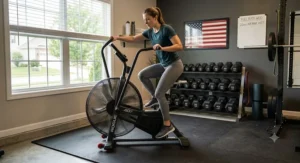
Most air bikes need roughly a 4-foot by 3-foot dedicated footprint, plus additional swing clearance on both sides for the moving handlebars found on arm-driven models. Stable, level flooring matters more than people expect — an uneven surface can introduce frame rock during hard sprints, which is why most premium bikes ship with adjustable leveling feet.
If children or pets share the space, extra caution is warranted: moving handlebars and a spinning fan blade present real pinch and impact risks around curious hands. The Children’s Hospital of Philadelphia has published specific guidance on keeping home exercise equipment separated from young children, including restricting access with a closed door or gate — advice worth following regardless of which bike you choose.
FAQ
❓ What is the best air bike for beginners?
❓ Are air bikes worth it for weight loss?
❓ What's the difference between an assault bike and a fan bike?
❓ How loud is an air bike?
❓ Do air bikes work your arms as well as your legs?
Conclusion
There’s no single best air bike — only the best air bike for your walls, your wallet, and your workout style. Buyers chasing CrossFit-authentic training and lower upfront cost should look at the Assault AirBike Classic. Anyone prioritizing quiet, premium durability should shortlist the Rogue Echo Bike or Schwinn AD7 Airdyne. Cyclists and runners wanting lower-body-specific engine work should consider the Concept2 BikeErg, while budget-conscious beginners get real value from the Sunny Health & Fitness SF-B223018 or pooboo S319.
Whichever model you choose, the core appeal stays the same: a machine that scales resistance to exactly how hard you’re willing to work, with no dial to hide behind. That kind of honesty is rare in fitness equipment — and it’s exactly why air bikes have stuck around for decades without needing a redesign.
✨ Don’t Miss These Exclusive Deals!
🔍 Take your cardio routine to the next level with these carefully selected air bikes. Click on any highlighted model to check current pricing and availability. These machines will help you build real, lasting fitness gains you’ll actually stick with!
Recommended for You
- 16 Level Magnetic Resistance Bike: 7 Best Picks for 2026
- Magnetic vs friction resistance bike: 7 Real Picks Reviewed (2026)
- Magnetic Exercise Bike 2026: 7 Quietest Picks Ranked
Disclaimer: This article contains affiliate links. As an Amazon Associate, I earn from qualifying purchases. If you purchase products through these links, we may earn a small commission at no additional cost to you.
✨ Found this helpful? Share it with your friends! 💬🤗
