
In This Article
A center drive elliptical is a cross-trainer whose flywheel sits at the middle of the frame, beside or beneath your feet, rather than out front or out back. That placement keeps your posture upright, narrows the pedal spacing, and trims the footprint, which gives you a smoother, more natural low-impact stride in less floor space.
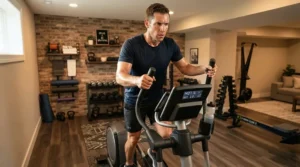
Picture the usual elliptical: a hulking flywheel pod bolted to the front, or a long tail stretching out the back like a dinosaur. Now picture one where the machinery tucks in beside your feet and the whole thing stands taller than it sprawls. That’s the pitch, and in 2026 it’s landing with more home shoppers than ever, especially anyone squeezing cardio into a spare bedroom, a garage corner, or a living-room nook they’d rather not surrender to a gym.
Here’s the honest catch. A center drive elliptical machine usually costs more than its front-drive cousins, so the details matter. This guide skips the brochure talk. You’ll get seven real models, what their specs mean in practice, aggregated sentiment from published reviews, and straight comparisons against other drive types. Whether you want a compact center drive elliptical for a small room or you’re simply hunting center drive elliptical reviews that aren’t pure hype, you’re in the right place.
Why bother with an elliptical at all? The Cleveland Clinic describes it as a low-impact, full-body option that works like walking, jogging, or stair climbing with less pressure on your joints. Fair enough. Let’s find the right one.
Quick Comparison: The Best Center Drive Elliptical Machine Options at a Glance
Here’s the 30-second version. Prices are ranges at the time of research and will shift, so check current price before you commit.
| Model | Standout Spec | Price Range | Best For |
|---|---|---|---|
| NordicTrack FS14i FreeStride Trainer | 0-32″ auto-adjusting stride, 14″ touchscreen | $2,000-$2,500 | Tech lovers who crave variety |
| NordicTrack FS10i FreeStride Trainer | Same 32″ stride, 10″ screen | $1,500-$2,000 | Value-minded hybrid fans |
| Best Fitness BFE2 Center Drive Elliptical | 21″ stride, 48″ length | $1,200-$1,500 | Tight budgets and small rooms |
| Body-Solid Endurance E5000 | Self-generating power, commercial rating | $2,700-$3,200 | Outlet-free simplicity |
| True Fitness M30 | Side steps, small footprint | $3,000-$3,800 | Compact, brand-loyal buyers |
| Landice E7 Elliptical | Side rails, 7″ step-up | $4,300-$4,600 | Stability and accessibility needs |
| True Fitness PS300 | Orthopedic Soft Step pedals | $4,500-$5,000 | Daily, heavy-duty users |
Looking at the table, the BFE2 is the budget gateway, but its lower weight rating means heavier users should look at the FS10i or E5000 instead. The two NordicTrack machines share a stride that’s roughly 10 to 12 inches longer than the typical 18-to-20-inch standard, which is the single biggest ergonomic advantage on this list. Meanwhile, the E7 and PS300 cost two to three times as much as the entry options, so they only make sense if durability or accessibility is the priority.
💬 Just one click — help others make better buying decisions too!😊
Top 7 Center Drive Elliptical Machine Picks: Expert Analysis
Each pick below gets the same treatment: what the specs mean on your floor, who it suits, and what published reviewers keep saying. Nobody here is claiming to have sweated on all seven. This is analysis built from real specs and real review data.
1. NordicTrack FS14i FreeStride Trainer — 32-inch stride that morphs mid-workout
If a center drive elliptical machine could show off, it would look like this. The NordicTrack FS14i FreeStride Trainer lets its stride slide anywhere from 0 to 32 inches, so the same frame acts like a stair stepper, a classic elliptical, or a long running-style glide.
A 32-inch stride is far beyond the 18-to-20-inch norm, which is why tall users stop feeling cramped. Add a 14-inch touchscreen, 26 resistance levels, and a -10% to 10% incline range, and it’s a playground. The trade-off is bulk: roughly 287 pounds in the box and a footprint near 58.5 by 29.5 inches, so “compact” is relative here.
Based on the spec comparison, this suits people who bore easily and will actually use iFIT’s trainer-led classes. It’s overkill if you want a steady 30-minute plod. Reviewers consistently praise the adjustable stride, the incline range, and the class library, while complaints cluster around price, size, and weight. Garage Gym Reviews’ tester concluded the machine tries to do a great deal at once.
Pros:
- ✅ Stride adjusts from stepper-short to runner-long
- ✅ 375-pound user capacity suits most households
- ✅ Incline and decline widen workout variety
Cons:
- ❌ Heavy and bulky for small rooms
- ❌ Premium price for a multi-mode feature set
Expect a price in the $2,000-$2,500 range; it’s good value only if you’ll genuinely use the versatility.
2. NordicTrack FS10i FreeStride Trainer — smart tech without the top-shelf tab
Think of the NordicTrack FS10i FreeStride Trainer as the sensible younger sibling: the same adjustable 32-inch stride and 375-pound capacity, but a smaller screen and a kinder bill.
Both siblings share a 58.5-by-29.5-inch footprint and a 20-pound flywheel, while the FS10i swaps the big display for a 10-inch HD screen and adds one-touch handle controls. That 20-pound wheel feels smooth for steady cardio, though it may feel light to a conditioned athlete chasing hard intervals, a limitation reviewers flag directly. Incline tops out at 10%, and 56 onboard workouts mean you aren’t forced into a subscription for every session.
On paper, this is the best-balanced doorway into hybrid center-drive territory for anyone who wants long-stride versatility without a cinema-sized display. Weight is the buzzkill. At about 284 pounds, relocating it solo is a negotiation, not a task.
Reviewers praise the oversized, comfortable pedals and long stride. Criticism centers on the heft, tricky mid-workout stride changes, the small screen, and missing USB or HDMI inputs. Assembly also draws grumbles.
Pros:
- ✅ Long adjustable stride at a lower price
- ✅ Oversized, comfortable pedals
- ✅ 56 onboard workouts without a subscription
Cons:
- ❌ 20-pound flywheel can feel light for athletes
- ❌ Heavy, with a small screen
At roughly $1,500-$2,000 (check current price and availability, since NordicTrack rotates its lineup), it’s among the least expensive ways into a long-stride center drive elliptical.
3. Best Fitness BFE2 Center Drive Elliptical — cheapest ticket into center drive
Most center drive ellipticals cost a small fortune. The Best Fitness BFE2 Center Drive Elliptical is about as close to a bargain as this category gets.
It packs a 21-inch stride, which beats the industry’s typical 18-to-20 inches, into a frame measuring only 48 by 30 by 66 inches and weighing about 182 pounds. That’s a genuinely compact center drive elliptical: you can fit it where a front-drive model would poke into the hallway. Twelve preset programs, a 5-inch color display, and contact heart-rate sensors cover the basics. The low center of gravity and balanced frame are designed to stop the rocking cheaper machines suffer.
Here’s what the spec sheet won’t shout: the user capacity tops out at 275 pounds. That’s the compromise, and it rules out a lot of households. Reviewers like the low step-up height, the long stride, and the 15-year frame warranty listed by retailers. They dislike the capacity limit and the lack of a touchscreen.
Pros:
- ✅ Longest stride you’ll find at this price
- ✅ Very compact footprint for the category
- ✅ Low step-up height and close pedal spacing
Cons:
- ❌ 275-pound capacity limits who can use it
- ❌ No touchscreen or streaming classes
Expect low-to-mid $1,000s. For a single user under the limit, it’s the value leader.
4. Body-Solid Endurance E5000 — self-powered, plug-free convenience
Wrestling an extension cord across your living room is nobody’s idea of fitness. The Body-Solid Endurance E5000 generates its own power internally, so it can live wherever the floor is flat.
This is a commercial-rated machine with a natural 21-inch stride, 325-pound capacity, and a footprint around 68 by 31 inches (a few inches longer in use). It’s stable rather than tiny, so don’t mistake it for a space-saver. The LED console offers a quick-start mode, preset programs, and heart-rate control programs with a wireless chest strap. Retailer listings vary on resistance levels (20 to 24) and weight (about 250 to 280 pounds), so verify before ordering.
My analysis: this is a solid pick for beginners who want presets and durability but don’t care about streaming. Reviewers praise the stride and the lifetime residential frame warranty, and the main gripes are price and the absence of a water bottle holder, which is a small but irritating omission.
Pros:
- ✅ Self-generating power means no outlet needed
- ✅ 21-inch stride with 325-pound capacity
- ✅ Lifetime residential frame warranty
Cons:
- ❌ Pricey for a basic LED console
- ❌ No water bottle holder
Expect around $2,700-$3,200; it’s fair value for durability, not for tech.
5. True Fitness M30 — small footprint with clever side steps
True’s entry-level residential model is built for people who want commercial-brand engineering without surrendering half a room. The True Fitness M30 pairs the brand’s patented Core Drive system with a footprint True describes as one of the smallest on the market.
Its signature trick is a pair of side steps, about 13 inches off the ground, which make getting on and off safer and allow an upper-body-only workout. Add Cardio 360 (guided 20-minute full-body routines) and Heart Rate Control cruise mode, and you get structure without a subscription. Consumer Reports’ lab write-up notes a shipping weight near 304 pounds and an operating footprint around 70 by 30 inches, so plan placement carefully.
What’s verifiable here is limited. Individual customer reviews are thin, so I won’t pretend there’s a consensus. Consumer Reports describes quiet operation and a tight, well-built linkage, while noting the motion at the ends of the stride lacked a continuous, flowing feel.
Pros:
- ✅ Compact footprint for a commercial-brand machine
- ✅ Side steps help entry and allow upper-body workouts
- ✅ Heart-rate control and guided programs built in
Cons:
- ❌ Premium pricing for a simple console
- ❌ Limited published user reviews to lean on
Expect roughly $3,000-$3,800. It’s worth it if brand build quality matters more than screen tech.
6. Landice E7 Elliptical — grab-rail stability and a 7-inch step-up
Some machines chase features. The Landice E7 Elliptical chases confidence, which is a different goal entirely.
It offers a 21-inch stride, 20 resistance levels, orthopedic gel pedals, and an integrated rear step that drops the step-up height to 7 inches, the lowest of any elliptical according to the manufacturer. Medical-style side rails give you something solid to hold, which is why Garage Gym Reviews calls it a strong match for seniors. The 9-inch Achieve console supports Bluetooth app connections. Footprint is about 35 inches wide by 68 to 76 inches long depending on the source, and most listings cite a 500-pound capacity, though one retailer chart shows 400, so confirm before buying.
Judging by the specs, this is the right pick for anyone prioritizing stability, joint comfort, or a very heavy-duty build. Reviewers praise the durability and lifetime parts warranty and criticize the price, heft, and lack of a touchscreen.
Pros:
- ✅ Side rails and low step-up add real stability
- ✅ 21-inch stride with comfortable gel pedals
- ✅ Lifetime parts warranty reported by reviewers
Cons:
- ❌ Very expensive for the feature set
- ❌ Heavy, with no touchscreen
At roughly $4,300-$4,600, it’s an investment in durability and accessibility, not in gadgetry.
7. True Fitness PS300 — commercial-grade comfort for daily grinders
When your elliptical will see daily use, comfort and durability stop being nice extras. The True Fitness PS300 is True’s premium residential center-drive model, built from commercial-grade materials.
Its star feature is the Soft Step orthopedic footpad system, designed to ease impact stress on joints and reduce the foot numbness some ellipticals cause. It also carries the brand’s side steps, Cardio 360 programs, and Heart Rate Control, with six workout programs in total. The honest limitation is clarity: I couldn’t verify a consistent weight capacity across listings, so confirm that with True before ordering.
Based on the spec comparison, this is for people who plan to use their center drive elliptical daily for years and would rather pay once for durability. One reviewer at Your Workout Book describes the ride as exceptionally smooth and the build as tough, but verified customer reviews are sparse, so treat that as one informed opinion rather than a consensus.
Pros:
- ✅ Orthopedic footpads reduce joint and foot stress
- ✅ Commercial-grade materials for heavy use
- ✅ Heart-rate control and guided programs
Cons:
- ❌ Top-of-category price
- ❌ Only six workout programs
Expect around $4,500-$5,000; reserve it for buyers who’ll genuinely wear it out.
Setup, Placement, and Your First 30 Days on a Center Drive Elliptical
Unboxing is where optimism meets physics. The FS14i and FS10i weigh nearly 290 pounds in the box, and the M30 ships near 304, so recruit a helper before the truck arrives.
Placement checklist:
- Measure ceiling height against the machine’s listed height, then add the inches you gain standing on the pedals.
- Leave breathing room around it; the M30 needs roughly 70 by 30 inches of clear space per Consumer Reports, plus a safety buffer.
- Level the feet, use a mat, and tighten every bolt after the first week.
Then comes the real work: building a habit. The CDC says adults need at least 150 minutes of moderate-intensity activity weekly, which works out to 30 minutes, five days a week. A practical ramp: Week 1, three sessions of 15 to 20 minutes at a pace where you can talk but not sing. Week 2, add a fourth session. Weeks 3 and 4, build toward five 30-minute sessions.
The common mistakes in the first month are predictable. People death-grip the handles, lean forward, crank resistance too early, or skip strength work. The CDC also recommends muscle-strengthening activity on two or more days a week, so don’t let the elliptical be your only exercise.
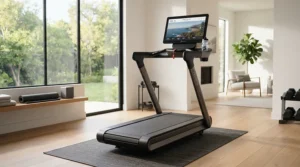
Real-World Scenarios: Matching a Compact Center Drive Elliptical to Your Life
Specs mean nothing until they meet a real room and a real budget. Here are three profiles, each matched to a model with reasoning.
The apartment renter. You’ve got a spare corner about 4 by 3 feet, a budget near $1,500, and plan to exercise four mornings weekly. The BFE2 fits the footprint and the wallet, provided you’re under 275 pounds. Check your ceiling height first, because the frame stands 66 inches tall.
The runner on the mend. You’re 6’3″, recovering from a knee flare-up, and training five days a week. Elliptical work is attractive here; Healthline summarizes a 2021 study finding less long-term knee joint and cartilage wear from elliptical training than from cycling, running, or swimming. The FS10i or FS14i gives your long legs a 32-inch stride, with the FS14i adding the larger screen.
The multigenerational household. Several people share one machine daily, including a parent who wants support. The E7‘s side rails and 7-inch step-up are built for exactly this, and the E5000 is a sturdy, less expensive alternative if rails aren’t essential.
Problem to Solution: Fixing Common Center Drive Elliptical Headaches
Even the best machine has pain points. Here’s how to solve the usual ones.
“My room is tiny.” Prioritize length over height. The BFE2 (48 inches long) and the M30 are the most space-conscious options here.
“My back aches or I’m hunching.” Keep your hands light on the handles and your eyes up. The upright posture a center drive encourages only works if you let it.
“My feet go numb.” Try lower resistance and a shoe with a stiffer sole. Machines like the PS300 (orthopedic footpads) and FS10i (oversized pedals) specifically target comfort.
“I can’t get past 15 minutes.” Break the session into intervals: two minutes harder, two easier. Boredom beats fitness more often than fatigue does.
“There’s no outlet nearby.” The E5000 generates its own power, so the problem disappears.
How to Choose a Center Drive Elliptical
Shopping gets easier once you rank what matters. Work through these seven steps in order.
- Measure your space. Check length, width, and ceiling height, then add a buffer for safe entry and exit.
- Match stride to height. Eighteen to 20 inches is standard; 21 inches suits taller users, and 32-inch adjustable stride (FS14i, FS10i) suits everyone.
- Check user capacity. The BFE2 lists 275 pounds, the E5000 325, and the NordicTrack pair 375.
- Decide on tech versus simplicity. If you want classes, choose iFIT-compatible NordicTrack; if you want to press start and sweat, pick E5000 or E7.
- Inspect pedals and step-up height. Lower is safer, and padded pedals reduce fatigue.
- Read the warranty. Frame coverage runs from 10 years to lifetime, but wear parts are covered for far less.
- Budget for the total cost. Add shipping, assembly, and any subscription.
Center Drive vs Front Drive vs Rear Drive Ellipticals
Flywheel placement shapes everything: posture, footprint, price, and feel. Here’s the comparison.
| Feature | Center Drive | Front Drive | Rear Drive |
|---|---|---|---|
| Posture | Upright, balanced | Slight forward lean | Flat, walking-like |
| Footprint | Compact length | Compact but taller front | Longest |
| Price | Highest | Lowest | Middle to high |
| Pedal spacing | Narrow by design | Varies | Varies |
| Example | Landice E7 | Sole E25 | Varies by brand |
Putting it in plain English: a center drive gives you the upright posture and narrow pedal spacing you’d get on a rear drive, but in a shorter machine. One buying guide suggests center drive models can cost roughly double what front-drive ones do, which matches what you see between the BFE2 and entry-level front drives like the Sole E25, around $1,200 to $1,300 with a front-drive layout and 350-pound capacity.
So who wins? Front-drive ellipticals are friendlier to budgets and often favored for glute-focused climbing. Rear-drive designs feel most like walking but sprawl. A center drive elliptical machine is the compromise for people who value posture and space more than saving money. If cost is your top constraint, front drive is the sensible choice; if comfort and footprint rank higher, center drive earns its premium.
Space-Saving Design: What the Footprint Numbers Really Mean
“Space-saving design” is the phrase on every spec sheet, and it’s worth decoding. In practice, center-drive layouts are shorter than rear-drive models, because the flywheel isn’t stretched behind you.
Real numbers help. The BFE2 runs 48 inches long. The E7 is about 35 inches wide and 68 to 76 inches long, depending on the source. The E5000 sits near 68 inches at rest, and the NordicTrack pair measures about 58.5 inches long. Those are decent lengths, but notice the heights: 66 to 74 inches, which can collide with low basement ceilings.
Here’s the nuance most listings skip. A front-drive like the Sole E25 is narrow at 24 inches wide but about 70 inches long, so a center drive isn’t automatically smaller on every axis. The honest takeaway: a space-saving design is real when you compare length, but you must check width, height, and clearance for your own room before you celebrate.
Balanced Weight Distribution: Why Flywheel Placement Changes the Ride
Balanced weight distribution sounds like marketing until you stand on a wobbly machine. Because a center drive keeps the flywheel near the middle, the mass sits under your body weight rather than out front or behind. Garage Gym Reviews describes the result as steady and nearly unmoving.
Manufacturers go further. The BFE2 and E5000 both claim a low center of gravity and a balanced frame that prevents rocking, and the E7 lists a two-inch pedal spacing intended to reduce hip fatigue. Treat those as manufacturer claims, though independent reviewers do report the stable, smooth feel.
There’s also a simple physics bonus: heavy frames resist movement. The FS10i at about 284 pounds and the E5000 at about 250 to 280 pounds feel planted for the same reason they’re hard to move. That’s the trade-off: stability and portability rarely arrive in the same package.
Modern Elliptical Technology: Features That Actually Matter (And Those That Don’t)
Modern elliptical technology is a sprawling category, so let’s filter. Features that genuinely change the experience include auto-adjusting stride (FS14i, FS10i), heart-rate control that holds your target zone (M30, PS300, E5000), and self-generated power (E5000) that removes cords. The E7‘s 9-inch Achieve console adds Bluetooth app support if you want tracking without a full media ecosystem.
Features that matter less than they look: giant screens, countless preset programs, and cinematic scenery. A 20-pound flywheel and 26 resistance levels don’t help if the pedals hurt your feet or the stride is too short.
My rule of thumb, based on reviewer feedback: spend on stride, stability, and pedal comfort first, then on tech. If you’ll use guided classes, iFIT-compatible NordicTrack is worth it. If you won’t, a BFE2 or E5000 delivers the core ride without the digital baggage.
Center Drive Elliptical Reviews: What Real Users and Testers Keep Saying
Center drive elliptical reviews tend to agree on a few themes. Garage Gym Reviews’ center-drive roundup names the FS14i best overall, the E7 best for seniors, and the BFE2 best value.
Across published reviews, the common praise is smooth, quiet operation, comfortable upright posture, and long strides. The common complaints are price, weight, assembly difficulty, and the 20-pound flywheel on the NordicTrack machines.
One caution: several manufacturer pages show few or no verified customer ratings, so editorial reviews carry more weight than usual. That’s also why I haven’t invented star ratings. If a model’s review pool is thin, as with the M30 and PS300, read independent test notes, check return policies, and consider financing options that allow a trial window where available.
Long-Term Cost and Maintenance: What a Center Drive Elliptical Really Costs
The sticker price is only chapter one. Here’s how the seven picks compare on value.
| Model | Price Range | Tier | Value Verdict |
|---|---|---|---|
| BFE2 | $1,200-$1,500 | Budget | Best entry value |
| FS10i | $1,500-$2,000 | Mid | Best tech value |
| FS14i | $2,000-$2,500 | Upper-mid | Pay for versatility |
| E5000 | $2,700-$3,200 | Mid-premium | Durability over tech |
| M30 | $3,000-$3,800 | Premium | Compact, brand-first |
| E7 | $4,300-$4,600 | Premium | Stability specialist |
| PS300 | $4,500-$5,000 | Premium | Daily-use workhorse |
The numbers tell a clear story: the BFE2 and FS10i deliver the best cost-per-feature, while the E7 and PS300 charge heavily for durability and comfort. Cost per use makes this vivid: a $1,500-range machine used four days a week for five years works out to about $1.45 a session, while a $3,000-range machine lands near $2.90. If you’ll exercise consistently, the pricier machine’s cost per session shrinks fast.
Maintenance is modest: wipe down sweat, check bolts, and inspect pedals. Remember that wear parts usually carry much shorter coverage than the frame (six months on the BFE2, per its listing), and iFIT classes on NordicTrack models are an ongoing subscription cost.
Frequently Asked Questions
❓ Can I use a center drive elliptical in an apartment?
❓ Do center drive ellipticals need electricity?
❓ What stride length should a tall person look for?
❓ Can I use the NordicTrack FS10i without an iFIT subscription?
❓ Is a center drive elliptical good for knee pain?
Conclusion: Which Center Drive Elliptical Should You Buy?
A center drive elliptical earns its premium by delivering an upright, balanced stride in a shorter frame. If you remember nothing else, remember this: pick on stride, stability, and space first, tech second.
For most households, the NordicTrack FS10i FreeStride Trainer hits the best balance of long adjustable stride, 375-pound capacity, and reasonable price. If budget and a small room rule everything, the Best Fitness BFE2 Center Drive Elliptical is the value pick, provided you’re under its 275-pound limit. Choose the NordicTrack FS14i FreeStride Trainer if you crave variety, the Body-Solid Endurance E5000 if you want plug-free simplicity, and the Landice E7 Elliptical if stability and accessibility come first. The True Fitness M30 and True Fitness PS300 are for buyers who plan to use the machine daily for years and value brand durability.
Whatever you choose, confirm current pricing, capacity, and warranty details before ordering, because listings change. Then build the habit, because the best elliptical is the one you actually use.
✨ Don’t Miss These Standout Center Drive Picks!
🔍 Take your home cardio to the next level with these carefully selected machines. Click on any highlighted item to check current pricing and availability. These tools will help you build a low-impact workout habit you’ll actually keep!
Recommended for You
- Commercial Rear Drive Elliptical: 7 Best Picks For 2026 (Ranked)
- Rear Drive Elliptical Benefits: 7 Proven Picks For 2026
- Rear Drive Elliptical: 7 Best Picks For Smooth Home Workouts 2026
Disclaimer: This article contains affiliate links. As an Amazon Associate, I earn from qualifying purchases. If you purchase products through these links, we may earn a small commission at no additional cost to you.
✨ Found this helpful? Share it with your friends! 💬🤗
