
In This Article
A rear drive elliptical makes cardio feel like moving instead of operating machinery. The flywheel sits behind your feet and the pedals trace a long, flat oval. The whole thing feels closer to a brisk walk than a stair-climbing hamster wheel. If you’ve been eyeing a rear drive elliptical machine for the spare room, the basement, or the “temporary” corner that became permanent, this guide separates the real contenders from the catalog noise.
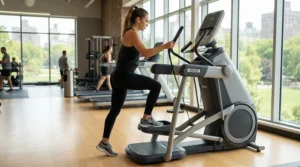
The appeal is simple. Ellipticals are low-impact, and that matters. Harvard Health Publishing’s overview of ellipticals notes that because your feet never leave the pedals, there is less stress on the knee, hip, and ankle joints than with running. The moving handlebars also put your arms, chest, shoulders, core, and back to work at the same time. That’s a lot of return for one footprint on your floor.
Not every machine delivers that promise equally, though. Seven real models are broken down below, from budget-friendly to premium. Every spec comes with what it means in practice, and every verdict rests on published specifications and aggregated editorial and buyer reviews. Nobody here is pretending to have logged months on each machine.
Three ideas run through the whole guide:
- Natural stride motion is the flat, walking-like path that makes a long session feel effortless.
- Stable platform design is the frame, base, and weight capacity that decide whether the machine wobbles or stays planted.
- Gym-quality home ellipticals is what you get when commercial-grade engineering is scaled down to fit a house.
Keep those three in mind and the spec sheets start making sense.
Quick Comparison: 7 Best Rear Drive Elliptical Machines at a Glance
| Model | Stride Length | Resistance | Price Range* | Best For |
|---|---|---|---|---|
| Life Fitness E5 | 18″–24″ adjustable | 20 levels | Premium (commonly above $2,000) | Tall users, gym-quality home ellipticals |
| NordicTrack SpaceSaver SE9i | 18″ auto-adjust | 24 digital levels | Upper tier | Incline lovers who need to fold |
| NordicTrack SpaceSaver SE7i | 18″ auto-adjust | 22 digital levels | Mid to upper-mid | Touchscreen training without incline |
| PooBoo Elliptical | 15.5″ | 16 levels | $550–$650 range | Heavier users on a budget |
| Niceday Elliptical | 15.5″ (verify variant) | 16 levels | $600–$800 range | Quiet apartments, no outlet |
| Sunny SF-E3912 | 15.5″ | 16 levels | $450–$600 range | No-frills reliability |
| YOUNGFIT Foldable | 15″ | 22 levels | $450–$550 range | Tiny spaces |
*Prices vary and change often. Check current price before buying.
Look at that table and a pattern jumps out. The two NordicTrack SpaceSaver models and the Life Fitness E5 all offer 18-inch-plus strides. That is the territory where taller walkers stop feeling cramped. Everything under about $650 sits at 15 to 15.5 inches, which suits shorter and average-height users well and can feel stepper-like for anyone over six feet. The PooBoo Elliptical and Niceday Elliptical stand out for value because both advertise a 400-pound capacity, well above the roughly 275-pound industry norm. If budget decides everything, the Sunny SF-E3912 and YOUNGFIT Foldable are the leanest paths in.
💬 Just one click — help others make better buying decisions too!😊
Top 7 Rear Drive Ellipticals: Expert Analysis
1. Life Fitness E5 — closest thing to a commercial floor at home
The standout here is a stride you can tune. The Life Fitness E5 offers an electronically adjustable 18 to 24 inches, which means a 5’3″ walker and a 6’4″ walker can both get a genuinely natural stride motion from one machine. It brings 20 resistance levels, a 400-pound capacity, and a footprint of roughly 84″ × 34″ × 66″. At about 251 pounds, it’s a stable platform design that stays put when you push hard. Console options include Go and Track Connect versions, and a wireless chest strap handles heart-rate tracking.
Based on the spec comparison, this is the purest expression of gym-quality home ellipticals here. It is built for shared households and long-term use. Editorial reviews highlight quiet, ergonomic operation and strong capacity. They also flag cost and size as the trade-offs, and the E5 has no interactive subscription training. Verified buyer reviews are thinner at this tier than on budget models, so weigh editorial sentiment accordingly.
Pros:
- ✅ Adjustable 18″–24″ stride suits nearly every height
- ✅ Quiet, smooth operation with a 400 lb capacity
- ✅ Multiple user profiles and heart-rate telemetry
Cons:
- ❌ Premium pricing and a large footprint
- ❌ No iFIT-style interactive programming
Price range: premium tier, commonly above $2,000 depending on console. Check current price and availability. Value verdict: worth it only if you’ll use it daily or share it.
2. NordicTrack SpaceSaver SE9i — rear drive with real incline
Incline is the standout. Rear drive machines often skip it, but the NordicTrack SpaceSaver SE9i offers a 0–10% incline range, 24 digital resistance levels, an 18-inch auto-adjusting stride, and an 18-pound flywheel. A 14-inch HD touchscreen plugs into iFIT, which includes a 30-day trial and then becomes a paid membership.
On paper, incline means you can shift effort toward glutes and hamstrings without changing speed. The 325-pound capacity and commercial-grade steel frame give it a planted feel for a folding machine, and it stores vertically. The catch is mass. At roughly 218 pounds, folding is easy but relocating it is not. The 18-inch stride is slightly shorter than some competitors because the folding mechanism limits length, so very tall users should look at the Life Fitness E5 instead.
Reviewers consistently praise stability, adjustable oversized pedals, and the touchscreen. They note cost and the subscription requirement as the downsides.
Pros:
- ✅ 0–10% incline rare among rear drive designs
- ✅ Stable, folding frame with adjustable pedals
- ✅ Large touchscreen with iFIT compatibility
Cons:
- ❌ Heavy and hard to relocate
- ❌ Paid membership needed after the trial
Price range: upper tier. Availability varies, so check current price. Value verdict: strong if incline and guided classes are your motivators.
3. NordicTrack SpaceSaver SE7i — touchscreen training without the premium jump
The standout is the entry point into this folding line. The NordicTrack SpaceSaver SE7i gives you a 10-inch HD touchscreen, 22 digital resistance levels, an 18-inch auto-adjusting stride, built-in speakers, and a workout fan. It has no incline, which is the clean dividing line between it and the SE9i.
Magnetic resistance keeps the ride quiet, so an apartment floor won’t complain. At around 215 pounds with a 325-pound capacity, the frame is a true stable platform design rather than a toy. Even folded, it remains about 80 inches long, so plan a dedicated space.
Editorial reviews single out smooth, quiet operation and sturdy construction. Some reviewers feel the 18-inch stride is modest, and the paid iFIT plan is the ongoing cost to factor in. If you’ll follow guided workouts, this is the gentler on-ramp to that ecosystem.
Pros:
- ✅ Smooth, quiet magnetic resistance
- ✅ Folding design with transport wheels
- ✅ 325 lb capacity on a steel frame
Cons:
- ❌ No incline adjustment
- ❌ Large footprint even when folded
Price range: mid to upper-mid; check current price. Value verdict: good for guided-workout fans who don’t need incline.
4. PooBoo Elliptical — 400-pound capacity at a mid-$500s price
The standout is capacity per dollar. The PooBoo Elliptical offers a 16-level magnetic resistance knob, a 15.5-inch stride, and a 400-pound rating on a thickened steel frame. It measures about 49″ × 30″ × 62″ and includes a rotatable tablet holder for devices up to roughly 11.8 inches. Three hand-grip positions let you vary how upper-body load is distributed.
A higher weight rating generally means less flex and wobble at everyday loads, which is a practical stability win. The short stride suits average and shorter users, and the flat path keeps natural stride motion intact for them. Buyers on Amazon frequently praise fast assembly, since it arrives largely pre-assembled. One reviewer flagged a discrepancy between posted and manual weight limits, so confirm the figure in your owner’s manual before relying on 400 pounds.
Pros:
- ✅ 400 lb capacity on a thick steel frame
- ✅ Mostly pre-assembled for quick setup
- ✅ Tablet holder with three grip positions
Cons:
- ❌ 15.5″ stride cramps taller users
- ❌ Weight-limit wording varies between sources
Price range: roughly $550–$650. Value verdict: a smart pick for heavier users on a budget.
5. Niceday Elliptical — whisper-quiet and no outlet required
The standout is silence plus portability. The Niceday Elliptical uses a 16-pound flywheel and 16 resistance levels, runs on batteries so it never needs an outlet, and measures about 48″ × 25″ × 62″. Weight capacity is listed at 400 pounds, and the machine weighs about 106 pounds.
The feature that matters most in daily life is no outlet. You can park it wherever the floor is flat, which is a real advantage in small apartments. Editorial testers report a near-noiseless ride and a sturdy steel base, with a little handlebar wobble. The standard model has a 15.5-inch stride, but some listings advertise a 20-inch variant with higher capacity, so confirm the exact model number before buying. The display is basic: time, calories, speed, distance, and pulse.
Pros:
- ✅ Nearly silent magnetic resistance
- ✅ Battery-powered, so no outlet needed
- ✅ Compact footprint with 400 lb capacity
Cons:
- ❌ Basic display with limited metrics
- ❌ Standard stride too short for tall users
Price range: roughly $600–$800, depending on variant and promotions. Value verdict: excellent for noise-sensitive homes.
6. Sunny SF-E3912 — no-frills durability for the budget-minded
The standout is simplicity that holds up. The Sunny SF-E3912 offers 16 magnetic resistance levels, 24 built-in programs, a 15.5-inch stride, and a 330-pound capacity in a 55″ × 23″ × 64.5″ frame that weighs about 105 pounds. Handlebars come in fixed and moving sets, and the fixed set carries pulse sensors.
One trained editor reported smooth motion forward and backward with no shaking, and rated durability highly. The pedals are firm plastic rather than cushioned, and the stride is short, so taller users should skip it. Programming is plentiful for the price, and the screen shows a useful set of metrics, including watts and RPM. Reviewers do mention occasional squeaks, monitor connectivity quirks, unclear assembly instructions that took about an hour and a half, and a warranty shorter than the industry norm.
Pros:
- ✅ Smooth, shake-free motion in both directions
- ✅ 24 programs and 16 resistance levels
- ✅ Compact and relatively light to move
Cons:
- ❌ Short stride and firm plastic pedals
- ❌ Warranty below industry standard
Price range: roughly $450–$600. Value verdict: the dependable baseline.
7. YOUNGFIT Foldable Elliptical — folds into a corner when the workout ends
The standout is how little space it claims. The YOUNGFIT Foldable Elliptical measures about 44″ × 20″ × 63″, offers 22 resistance levels, a 15-inch stride, and a 330-pound capacity. It arrives about 90% pre-assembled, and setup reportedly takes around half an hour. The footboards are cushioned and spacious, with a balance adjustment for uneven floors.
For apartment dwellers, that folding trick is the headline. Amazon reviewers cited by editorial coverage rate it highly and say they use it nightly. Complaints cluster around tension adjustment and heart-rate monitor malfunctions, so treat the pulse reading as approximate. The stride is the shortest here, so it suits shorter or lighter users.
Pros:
- ✅ Folds away for small-space living
- ✅ Cushioned, roomy footboards
- ✅ 22 resistance levels for the price
Cons:
- ❌ Tension changes frustrate some owners
- ❌ Heart-rate monitor may be unreliable
Price range: roughly $450–$550. Value verdict: ideal for tiny living spaces.
Side-by-Side Specs: What the Numbers Mean
| Model | Capacity | Footprint / Weight | Reviewer Takeaway | Best For |
|---|---|---|---|---|
| Life Fitness E5 | 400 lb | 84″×34″×66″ / ~251 lb | Quiet, ergonomic, expensive | Tall, shared households |
| NordicTrack SpaceSaver SE9i | 325 lb | ~80″×32″×67″ / ~218 lb | Stable, adjustable pedals | Incline and classes |
| NordicTrack SpaceSaver SE7i | 325 lb | ~80″×32″×67″ / ~215 lb | Smooth, quiet, sturdy | Guided workouts |
| PooBoo Elliptical | 400 lb | 49″×30″×62″ | Easy setup, weight-limit confusion | Heavier users |
| Niceday Elliptical | 400 lb | 48″×25″×62″ / ~106 lb | Near-silent, slight wobble | Apartments |
| Sunny SF-E3912 | 330 lb | 55″×23″×64.5″ / ~105 lb | Smooth, squeaks reported | Budget basics |
| YOUNGFIT Foldable | 330 lb | 44″×20″×63″ | Compact, HR sensor complaints | Small spaces |
The table says what the marketing doesn’t. Weight and capacity travel together: the heaviest machines are also the steadiest. The Life Fitness E5 and both NordicTrack SpaceSaver models trade portability for stability, while the Sunny SF-E3912 and Niceday Elliptical trade some planted feel for easy repositioning. Choose based on whether this machine moves or stays.
✨ Don’t Miss These Exclusive Deals!
🔍 Take your rear drive elliptical shopping to the next level with these carefully selected machines. Click on any highlighted product name to check current pricing and availability. These picks will help you build a home routine your joints will thank you for!
What Is a Rear Drive Elliptical?
A rear drive elliptical is a cross-trainer with its flywheel and resistance system mounted behind the user’s feet. That placement creates a flatter, longer, more upright stride path that resembles walking or running, usually with quiet magnetic resistance and a stable frame, in exchange for a longer footprint than most front drive models.
The design isn’t new. BarBend’s rear drive buying guide notes that Precor patented the rear drive layout in 1995, and it remains one of the oldest elliptical architectures still in production. With the flywheel behind you, the machine’s center of balance sits nearer the middle. That’s why a rear drive elliptical machine usually delivers a more level feel than a front drive model, which can have a slight built-in incline before you adjust anything.
Industry vocabulary can confuse shoppers, so here is the translation. Front drive models are sometimes called front-mech, rear drive models rear-mech, and center drive models mid-mech. Center drive machines blend the two but tend to cost considerably more. One honest caveat: some testers have observed that many higher-end manufacturers have stepped back from rear drive designs, which is why current availability should always be checked before you commit.

How to Choose a Rear Drive Elliptical
Follow these six steps in order, and the shortlist builds itself.
- Set your budget first. Prices span from well under $1,000 to over $2,000, and your ceiling narrows the field faster than any feature list.
- Measure your space. Rear drive layouts run longer, so measure the room, then add roughly 20 inches of clearance and check ceiling height with pedals at full travel.
- Match stride to height. Garage Gym Reviews advises that anyone six feet or taller look for at least 18 inches. Shorter users can be comfortable at 15 to 15.5 inches.
- Confirm weight capacity. The industry baseline is about 275 pounds. A higher rating generally means a steadier feel at everyday loads.
- Prefer magnetic resistance. It gives you repeatable control over intensity, and it keeps noise down.
- Check flywheel weight and warranty. A 16 to 20 pound flywheel is typical, and a longer warranty signals manufacturer confidence.
In short, this decision is about fit before features. A smooth rear drive elliptical you don’t fit on is just furniture.
Rear Drive Elliptical vs Front Drive Elliptical
Both designs deliver effective low-impact cardio, but they feel different and live differently in your home.
| Factor | Rear Drive | Front Drive | Best For |
|---|---|---|---|
| Stride feel | Flatter, walking-like | Slight built-in incline | Rear: walkers; Front: climbers |
| Footprint | Typically longer | Typically more compact | Front: tight rooms |
| Incline range | Often limited or none | Usually steeper | Front: glute work |
| Price | Often higher | Often lower | Front: tight budgets |
| Backward pedaling | Strong suit | Possible | Rear: reverse intervals |
Looking at the comparison, the choice hinges on how you move. If you want a level, upright, natural stride motion that mimics a brisk walk, rear drive is the clearer fit. If you want steep incline and a smaller floor footprint, front drive earns the nod. Notice, too, that the NordicTrack SpaceSaver SE9i blurs the line by offering a 0–10% incline within a rear drive layout, so the old rule of thumb has exceptions.
Natural Stride Motion: What a Rear Drive Elliptical Feels Like
Imagine walking on a very forgiving surface at a steady pace, then add handlebars that swing in sync. That is the character of natural stride motion on a well-built rear drive elliptical. The pedals travel a longer, flatter oval, and your body stays upright over your feet instead of leaning into a climb.
Why does that matter? Harvard Health’s guidance emphasizes upright posture and flat feet on the pedals to engage the core and protect the lower back. A flatter path helps you hold that form naturally. Reverse pedaling shifts the work toward the quadriceps and calves, while forward pedaling leans on hamstrings and glutes, so a machine that handles both directions smoothly gives you more training variety for free.
Stride length is where marketing and reality diverge. A 15.5-inch stride can feel natural for someone around 5’4″ and cramped for someone over six feet. Editorial testers have warned that taller users can feel like they’re on a stepper rather than a true elliptical. Machines with 18-inch-plus strides, such as the Life Fitness E5 and the NordicTrack SpaceSaver SE7i, keep the oval honest for longer legs. As a rule, match stride to leg length before chasing extra resistance levels.
Stable Platform Design: Why Frame Quality Beats Fancy Screens
A bright touchscreen won’t save a wobbly frame. A genuinely stable platform design starts with mass, base width, and floor contact. Heavier machines like the Life Fitness E5 (about 251 pounds) and the NordicTrack SpaceSaver SE9i (about 218 pounds) resist rocking, while lighter budget units depend on adjustable floor stabilizers and a sensible mat.
Weight capacity doubles as a stability hint. A machine rated for 400 pounds, like the PooBoo Elliptical or Niceday Elliptical, is engineered with more margin, which typically translates into less flex at normal loads. Reviews back up the nuance: a few testers report slight handlebar wobble on the Niceday Elliptical even though the base is sturdy, and some buyers say the Sunny SF-E3912 feels less steady under larger users.
Practical stability rules worth following:
- Place the machine on a flat surface and use a mat. A mat reduces noise, protects floors, and adds steadiness.
- Level the feet before every new workout area.
- Tighten bolts after the first week, since vibration loosens hardware.
Rear drive layouts also keep the flywheel behind you, which helps keep sweat away from internal parts. That’s one reason testers favor them for durability.
Gym-Quality Home Ellipticals: Features That Matter (And Those That Don’t)
“Gym-quality” is a phrase that gets stamped on everything, so it helps to know which features actually justify it.
What matters:
- Adjustable or long stride. The Life Fitness E5‘s 18″–24″ range is the clearest example of commercial thinking at home.
- Magnetic resistance with a meaningful flywheel. It means quiet, consistent intensity.
- Capacity and frame mass. These determine long-term steadiness.
- Pedal comfort. Cushioned, adjustable pedals, as on the NordicTrack SpaceSaver SE9i, reduce hot spots over long sessions.
What matters less than the marketing suggests:
- A giant screen if you never subscribe. Guided programming is useful, but iFIT-style plans cost extra after the trial.
- Dozens of preset programs. The Sunny SF-E3912 offers 24, but most people settle into three favorites.
- Heart-rate sensors on handles. Several budget machines show occasional accuracy complaints, so pair a chest strap for serious zone training.
Here’s the honest takeaway: if you want gym-quality home ellipticals, spend on stride, frame, and pedals first. Add tech later, because tech depreciates faster than steel.
Rear Drive Elliptical for Tall Users, Seniors, and Small Spaces
Tall users (6’0″ and up). Prioritize stride length. The Life Fitness E5 is the best fit on this list, and the NordicTrack SpaceSaver SE9i and SE7i are credible 18-inch options. The 15-inch class will feel short.
Seniors and joint-sensitive users. Harvard Health’s physical therapist source notes that ellipticals suit people with knee or hip osteoarthritis or those recovering from injury, but get approval from your doctor if you have mobility or balance concerns. Machines with a low step-up and a smooth rear drive elliptical glide, such as the NordicTrack SpaceSaver SE7i, fit this need well.
Small spaces. The YOUNGFIT Foldable Elliptical (about 44″ long) and the Niceday Elliptical (about 48″ long, battery-powered) are the clear choices. Rear drive models are often longer than front drive ones, so measure twice.
Heavier users. Capacity ratings matter most. The PooBoo Elliptical and Niceday Elliptical list 400 pounds, and the Life Fitness E5 does too. Check the owner’s manual to confirm the number for your exact model.
Long-Term Cost & Maintenance
Sticker price is only the first line of the ledger. Rear drive machines are often pricier upfront than front drive, but testers argue they can cost less to keep running. The flywheel sits behind the rider, so sweat is less likely to reach internal components. That said, Skelcore’s reliability guide cautions that rear drive designs commonly use longer rails and rollers that benefit from steady attention. Both views are fair, and your maintenance habits matter more than the layout.
| Tier | Example | Price Range* | Ongoing Costs | Best For |
|---|---|---|---|---|
| Budget | Sunny SF-E3912, YOUNGFIT Foldable | $450–$600 | Occasional lubrication | Casual use |
| Mid | PooBoo Elliptical, Niceday Elliptical | $550–$800 | Lubrication, bolt checks | Daily home use |
| Upper | NordicTrack SpaceSaver SE7i / SE9i | Upper tier | Possible iFIT membership | Guided training |
| Premium | Life Fitness E5 | Above $2,000 | Minimal, long warranty | Shared homes |
*Check current price.
Reading across the table, cost-per-use favors the mid tier for most households, while the premium tier wins on longevity if you’ll use it daily for years. Factor in subscription costs for the NordicTrack line, shorter warranties on the budget machines, and floor-mat and lubricant costs for all.
Setup and First-30-Days Guide
Assembly time varies widely: the YOUNGFIT Foldable Elliptical reportedly takes around 30 minutes, the Sunny SF-E3912 about an hour and a half, and the PooBoo Elliptical under an hour. Block out extra time if you’re building alone.
Week 1: Setup and calibration.
- Place the machine on a mat and level the feet.
- Re-tighten bolts after your first three sessions.
- Keep your feet flat, torso upright, and grip light, as Harvard Health recommends.
Weeks 2–3: Build the habit.
- Start with 15 to 20 minutes at low resistance and low incline.
- Add small, gradual resistance increases.
- Mix in forward and backward intervals, such as three minutes forward and two backward.
Week 4: Add structure.
- Try incline intervals if your model has incline, like the NordicTrack SpaceSaver SE9i: three minutes at 6–8%, two at zero, repeated three or four times.
- Add a 5-minute warm-up and a slower cool-down.
- Aim toward the HHS baseline of about 150 minutes of moderate aerobic activity weekly.
Common first-month mistakes:
- Gripping the handles too tightly, which strains shoulders and neck.
- Cranking resistance so high that your form collapses.
- Ignoring squeaks, which usually signal a loose bolt or dry roller.
Real-World Scenarios: Which Machine Fits Which Life
Scenario 1: The apartment dweller with thin floors. A one-bedroom, early-morning workouts, no spare outlet nearby. The battery-powered, near-silent Niceday Elliptical fits, and the YOUNGFIT Foldable Elliptical is the alternative if the machine needs to disappear after each session. Budget about $450–$800.
Scenario 2: The tall runner cross-training after knee soreness. A 6’3″ runner needs stride room. The Life Fitness E5‘s adjustable 18″–24″ stride is the match, with the NordicTrack SpaceSaver SE9i as a lower-cost route when incline and guided classes matter. Ask a clinician about returning to training.
Scenario 3: The household of three with mixed heights. One machine, many bodies, daily use. Capacity and adjustability dominate. The Life Fitness E5 offers multiple user profiles and the widest stride range, and the PooBoo Elliptical is the budget compromise with its 400-pound rating.
Scenario 4: The class-lover who wants guidance. Motivation comes from instructors. The NordicTrack SpaceSaver SE7i gives a touchscreen and folding frame at the lower end of that family, so confirm current pricing and subscription costs.
Each scenario shows the same rule at work. Start with the constraint that can’t change, whether that’s space, height, noise, or budget, then choose.
Frequently Asked Questions
❓ Is a rear drive elliptical good for beginners?
❓ Do rear drive ellipticals have incline?
❓ How much space does a rear drive elliptical machine need?
❓ Can a rear drive elliptical run without electricity?
❓ What stride length should I look for?
Conclusion: Choosing Your Rear Drive Elliptical
The best rear drive elliptical is the one that fits your body, your room, and your habits, and the research points to some clear answers. For tall users and shared households, the Life Fitness E5 brings the most complete gym-quality home ellipticals experience. For incline and guided training, the NordicTrack SpaceSaver SE9i is the standout, with the NordicTrack SpaceSaver SE7i as the touchscreen-without-incline alternative. For budget and capacity, the PooBoo Elliptical and Niceday Elliptical deliver 400-pound ratings at reasonable prices, while the Sunny SF-E3912 and YOUNGFIT Foldable Elliptical cover the lean, small-space end.
Remember the three principles from the start. Natural stride motion depends on stride length that matches your legs. A stable platform design depends on frame mass, capacity, and a level floor. Smooth, quiet operation depends on magnetic resistance and basic upkeep. Match those three to your situation and a smooth rear drive elliptical becomes less of a gamble and more of a daily habit you actually keep.
Prices and availability change, so always check current listings before you buy. Then pick a machine, set it on a mat, and give your joints a gentler way to get stronger.
✨ Ready to glide into a smoother routine?
🚴♂️ Click any highlighted product name above to check current pricing and availability, and start building the home workout your future self will thank you for!
Recommended for You
- Front Drive Elliptical Benefits: 7 Proven Picks For 2026
- Front Drive Vs Rear Drive Elliptical: 7 Best Picks
- Front Drive Elliptical: 7 Best Picks For 2026
Disclaimer: This article contains affiliate links. As an Amazon Associate, I earn from qualifying purchases. If you purchase products through these links, we may earn a small commission at no additional cost to you.
✨ Found this helpful? Share it with your friends! 💬🤗
