
In This Article
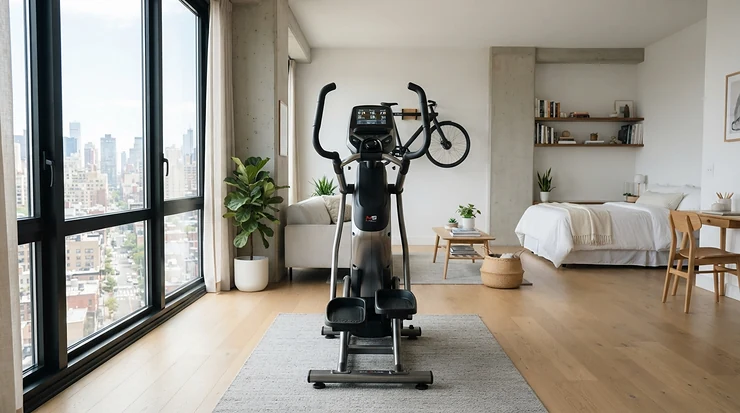
The best compact elliptical is a low-impact cardio machine that pairs a smooth gliding stride, adjustable resistance, and a stable frame with a footprint small enough for an apartment, bedroom corner, or home office, often under about 12 square feet. Its real job is simple: deliver a proper workout without swallowing your living room.
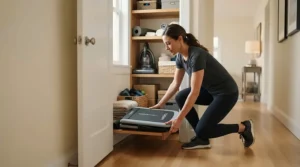
Here’s the problem. Most ellipticals were designed by people who’ve never had to walk around a couch. They arrive in a box the size of a small refrigerator, and then they sit in the middle of the room, silently judging you. A good compact model flips that script.
The upside is real. According to Harvard Health, ellipticals place less stress on the knee, hip, and ankle joints than running does, because your feet never leave the pedals. That makes them a smart fit for beginners, cross-trainers, and anyone nursing cranky joints. Reviewers also note that a 30-minute session can burn roughly 300-400 calories depending on body weight.
Size is only half the story, though. Stride length, noise, weight capacity, and how the machine moves in and out of its corner matter just as much. This guide ranks seven real machines, from a seated mini elliptical trainer to a premium touchscreen model. It also covers a compact elliptical for small spaces, a space saving elliptical for tight floor plans, and apartment cardio equipment that won’t annoy the neighbors. One honest note: this is research-based analysis of published specs and expert reviews, not hands-on testing.
Best Compact Elliptical Picks at a Glance
| Pick | Design | Key Spec | Price Range (Ballpark) | Best For |
|---|---|---|---|---|
| Bowflex Max Trainer M6 | Vertical, stair-style | 46″ L × 26″ W × 64.2″ H, 16 levels | $1,000–$2,000 | Tiny floor plans, short intervals |
| NordicTrack X16 | Upright, incline/decline | 26 levels, ±10% incline | Low $2,000s | Tech-loving, class-streaming buyers |
| Sole E25 | Front-drive, long stride | 20″ stride, 24″ wide, 350 lb capacity | $1,200–$1,300 | Taller users, narrow rooms |
| Schwinn 411 | Compact front-drive | 18″ stride | $700–$1,000 | Quiet, brand-trusting buyers |
| Niceday Elliptical | Magnetic home trainer | 16 levels, 400 lb capacity | $300–$500 | Value-minded households |
| YOSUDA Foldable Elliptical | Foldable | 16 levels, 400 lb capacity | $300–$500 | Storing it out of sight |
| Cubii JR1 | Seated mini | Under-desk pedaler | $200–$300 | Office and low-impact movement |
Prices are ballpark ranges at the time of research. Check current price before buying.
Looking at the table, the Sole E25 and Schwinn 411 offer the most “real elliptical” feel in a tight footprint. The Bowflex Max Trainer M6 trades stride length for a vertical design that fits almost anywhere. Budget buyers should notice that the Niceday Elliptical and YOSUDA Foldable Elliptical carry big weight capacities for the money, while the Cubii JR1 is a different category entirely: a movement tool, not a full workout.
💬 Just one click — help others make better buying decisions too!😊
Top 7 Best Compact Elliptical Machines: Expert Analysis
1. Bowflex Max Trainer M6 — vertical design for the tiniest floor plan
Instead of a long, flat glide, the Bowflex Max Trainer M6 stacks its motion upward. That’s how it fits into about 46 inches by 26 inches of floor, standing roughly 64 inches tall. Garage Gym Reviews notes it weighs less than the average elliptical, which matters when you’re sliding it around a studio.
The spec sheet lists 16 resistance levels and a backlit LCD display. In practice, the steeper, stair-like path loads your glutes and quads harder per minute. So it suits 15-20 minute interval sessions better than an hour of gentle gliding. It’s a space saving elliptical in spirit, though not a classic elliptical in motion.
Based on the spec comparison, it’s ideal for apartment dwellers who want short, sweaty workouts and don’t care about long-stride comfort. I couldn’t verify aggregated owner scores for this piece. Editorially, Garage Gym Reviews rated it 4.2 and scored it above average in nearly every category.
Pros:
- ✅ Very small floor footprint for the machine class
- ✅ Lighter than most traditional ellipticals
- ✅ Short, high-intensity sessions feel efficient
Cons:
- ❌ Stair-style motion, not a true elliptical glide
- ❌ No incline adjustment to vary the workout
Expect a four-figure price (about $1,000-$2,000; check current price). It’s good value if your floor plan is the priority.
2. NordicTrack X16 — most adjustable compact elliptical, with incline and decline
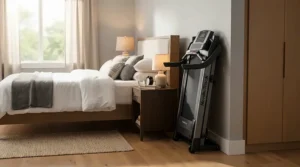
The NordicTrack X16 is the “compact” pick for buyers who refuse to give up features. Dimensions run about 58.5 inches long by 29.5 inches wide by 74 inches tall, so it’s tall rather than sprawling. That’s a different kind of space saving elliptical: small floor area, big vertical presence.
Its 26 resistance levels and ±10% incline and decline range are the headline. In plain English, you can reshape one machine into a flat-stride cruiser, a hill climb, or a glute-focused downhill session. The 16-inch tilting touchscreen supports streamed classes, though you’ll want to confirm current subscription terms. Garage Gym Reviews added it to its compact list in January 2026, citing its resistance range, ergonomics, and accommodating stride.
This one is for people who get bored easily. If variety keeps you consistent, the extra adjustability can justify the cost. If you just want to pedal while a show plays, you’ll pay for features you may never touch. Fortune’s testers named it their top compact pick, which signals strong editorial confidence rather than verified owner satisfaction.
Pros:
- ✅ Wide 26-level resistance range
- ✅ Incline and decline for workout variety
- ✅ Large touchscreen for streamed classes
Cons:
- ❌ 74-inch height can clash with low ceilings
- ❌ Priciest machine in this lineup
Expect the low $2,000s (confirm current price). It’s strong value for gadget lovers, and overkill for minimalists.
3. Sole E25 — longest stride in the narrowest frame
The Sole E25 is the answer to a classic apartment puzzle: how do you get a full 20-inch stride without a 36-inch-wide machine? Sole’s own materials say the E25 is just 24 inches wide, which is why it keeps surfacing in lists of the best compact elliptical for narrow rooms. Treat that as manufacturer data, but the stride figure matches what independent roundups report.
Stride length is the sleeper spec. A short stride feels like pedaling in a phone booth, while 20 inches lets taller users move naturally. Add the 350-pound weight capacity and quiet magnetic resistance, and you get a machine that feels closer to gym equipment than a toy.
On paper, this is the pick for users over about 5’10” who’ve been burned by cramped, choppy ellipticals. BarBend highlighted its high weight capacity, and NBC Select named its sibling the E35 best overall, which speaks to the brand’s reputation. Reviewers consistently describe the line as sturdy, though I couldn’t verify aggregated owner scores.
Pros:
- ✅ Full 20-inch stride in a narrow frame
- ✅ 350-pound weight capacity for stability
- ✅ Quiet magnetic resistance
Cons:
- ❌ Heavy and awkward to relocate solo
- ❌ Costs far more than budget options
Expect around $1,200-$1,300. That’s fair value if comfort and durability matter to you.
4. Schwinn 411 — quiet, premium feel without the premium footprint
The Schwinn 411 is the “grown-up” compact option. Sportsglory calls it a heavyweight premium machine that feels robust underfoot and runs almost silently. It offers an 18-inch stride that accommodates users up to roughly six feet tall, without demanding a full gym’s worth of space.
Why does silence matter? Because the best compact elliptical for a shared wall is the one your downstairs neighbor never hears. Magnetic resistance and a stable base mean fewer squeaks and less vibration. FitnessVolt names it the best premium compact pick, though it flags the higher price versus basic options.
My read of the spec comparison: it suits steady-state cardio fans who value smoothness over gadgets. If you want streaming classes or incline, look at the NordicTrack X16. If you want to pedal quietly through a podcast, this is a safer fit. Fortune also ranked it its best-value compact model, which tells you how the price-to-feel ratio lands.
Pros:
- ✅ Near-silent operation reported by reviewers
- ✅ 18-inch stride suits most body types
- ✅ Established brand with familiar console
Cons:
- ❌ Pricier than entry-level compact ellipticals
- ❌ Fewer smart features than touchscreen rivals
Expect roughly $700-$1,000 (a ballpark; check current price). Verdict: excellent value for quiet-seekers.
5. Niceday Elliptical — best value, with a big weight capacity
The Niceday Elliptical keeps appearing at the top of budget-friendly roundups, and the specs explain why. Listings cite 16 resistance levels, a 400-pound capacity, a 15.5-inch stride, and a commercial-grade steel build. Some variants advertise an 18-inch stride, so read the exact listing before you buy.
A 400-pound rating at this price is the quiet headline. Capacity ratings are a rough proxy for frame robustness, so heavier ratings usually mean fewer wobbles. Magnetic resistance keeps noise low, which matters for apartment cardio equipment.
This one fits first-time buyers who want a real machine without spending a premium-brand sum. It also fits larger or taller users who’ve been shut out of cheaper models. The tradeoff is a shorter stride than the Sole E25, which tall users may notice. Several publications, including a Six Storeys roundup, place it first overall for compact models, though I couldn’t verify aggregated owner ratings.
Pros:
- ✅ 400-pound capacity at a low price
- ✅ Sixteen resistance levels for progression
- ✅ Quiet magnetic drive suits shared walls
Cons:
- ❌ 15.5-inch stride can feel short to taller users
- ❌ Console and app features are basic
Expect roughly $300-$500 (ballpark; check current price). Verdict: the strongest value-per-dollar pick in this guide.
6. YOSUDA Foldable Elliptical — folds away when guests arrive
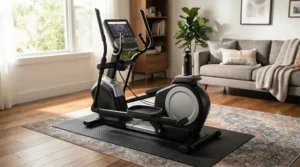
If a compact elliptical for small spaces still feels too permanent, the YOSUDA Foldable Elliptical is your escape hatch. Listings cite a 400-pound capacity, magnetic resistance with 16 levels, and a 15-inch stride. FitnessVolt names it the best foldable pick and notes the tradeoff: foldable frames can feel less planted than fixed ones.
Folding is the whole point. Among portable elliptical options, a machine you can tuck behind a door or under a bed solves the “I live in 500 square feet” problem more elegantly than any spec sheet. Garage Gym Reviews also praises the related YOSUDA EM1 for a footprint of about 8.6 square feet and sturdy build.
Based on the spec comparison, this suits renters who need floor space back every evening. The tradeoff is hinge wear over time and a slightly less rigid feel. Check that folding hardware inspects well when you assemble it.
Pros:
- ✅ Folds for closet or under-bed storage
- ✅ 400-pound capacity impressive for foldables
- ✅ Magnetic resistance keeps noise down
Cons:
- ❌ Less rigid than fixed-frame designs
- ❌ 15-inch stride is short for tall users
Expect roughly $300-$500 (ballpark; confirm current price). Verdict: top value for people who need the machine to disappear.
7. Cubii JR1 — the mini elliptical trainer for desks and couches
The Cubii JR1 isn’t an elliptical in the gym sense. It’s a seated pedal unit, which makes it the most honest mini elliptical trainer in this lineup. Active.com named it the best overall under-desk model, and FitnessVolt called it the best under-desk compact pick.
Here’s the reality check. Seated pedaling burns far fewer calories than standing elliptical work, so treat it as movement insurance rather than a cardio replacement. FitnessVolt says as much, noting it isn’t a full cardio substitute. For remote workers, older adults, or anyone whose day is mostly chairs, though, it can break up long sitting stretches with almost no noise.
Pair it with a standing machine like the Schwinn 411 or Niceday Elliptical, and you cover both daily movement and real workouts. Alone, it won’t replace either. Medical News Today notes that under-desk ellipticals may suit older adults who find exercise challenging.
Pros:
- ✅ Fits under most desks and tables
- ✅ Very quiet for calls and shared offices
- ✅ Easy entry point for low-intensity movement
Cons:
- ❌ Not a replacement for real cardio sessions
- ❌ Seated position limits calorie burn
Expect roughly $200-$300 (check current price). Verdict: great for office movement, poor if you want fitness gains.
Side-by-Side: Specs That Separate the Seven
| Product | Stride / Size | Resistance | Weight Capacity | Best For |
|---|---|---|---|---|
| Bowflex Max Trainer M6 | 46″ × 26″ × 64.2″ | 16 levels | Check listing | Interval training in tiny rooms |
| NordicTrack X16 | 58.5″ × 29.5″ × 74″ | 26 levels | Check listing | Variety seekers |
| Sole E25 | 20″ stride, 24″ wide | Magnetic | 350 lb | Tall users, narrow rooms |
| Schwinn 411 | 18″ stride | Magnetic | Check listing | Quiet, steady cardio |
| Niceday Elliptical | 15.5″ stride | 16 levels | 400 lb | Value-first buyers |
| YOSUDA Foldable Elliptical | 15″ stride, folds | 16 levels | 400 lb | Storage-limited renters |
| Cubii JR1 | Seated pedals | Adjustable | Check listing | Desk movement |
Notice how stride length and width pull in opposite directions. The Sole E25 is the rare machine that wins on both. Budget buyers lose stride length to the Niceday Elliptical and YOSUDA Foldable Elliptical, but gain capacity and price. The Cubii JR1 simply isn’t competing in this ring.
How to Choose the Best Compact Elliptical
Picking the best compact elliptical is mostly about matching a machine to your body and your floor. Garage Gym Reviews’ compact elliptical roundup is a useful benchmark for how experts weigh these factors. Work through this list in order.
- Measure your space first. Include the footprint plus clearance behind the pedals. A machine that “fits” on paper can still feel like a hallway obstacle course.
- Check ceiling height. Vertical designs like the NordicTrack X16 at 74 inches need headroom, especially if you stand on the pedals.
- Match stride to your height. Shorter strides (around 15 inches) suit shorter users. Taller users should aim for 18-20 inches, like the Schwinn 411 and Sole E25.
- Prioritize magnetic resistance. It’s typically quieter than friction systems, which matters in apartments.
- Verify weight capacity. Higher ratings, like 350-400 pounds, usually signal sturdier frames, even for lighter users.
- Decide on features honestly. Touchscreens and streaming are nice, but only if you’ll actually use them.
- Plan how it moves. Wheels, folding hinges, and weight affect whether you’ll actually put it away.
Follow these seven steps and the shortlist shrinks quickly. Most buyers land on a choice within the first three.
Compact Elliptical for Small Spaces: Measuring Before You Buy
A compact elliptical for small spaces lives or dies by one number: usable floor area. Not the box dimensions. Not the marketing photo. The actual rectangle you’ll stand in.
Start with the machine’s length and width, then add clearance. Pedal travel means your feet sweep a larger arc than the frame suggests. Leave breathing room behind and beside the unit, and don’t forget ceiling height if you’re taller than average.
Narrow models like the Sole E25, at 24 inches wide, help in hallways and bedroom corners. Short, vertical machines like the Bowflex Max Trainer M6 help in studios. Long, tall machines like the NordicTrack X16 may need an open wall.
A practical trick: tape the footprint on your floor with painter’s tape and live with it for a day. If you trip over the outline, a bigger machine won’t make you happier.
Don’t forget the route in. Doorways, stair turns, and elevators determine whether a heavy unit can even enter your apartment. A compact elliptical for small spaces that can’t reach the room is just an expensive shipping box.
Mini Elliptical Trainer: Where Under-Desk Models Fit
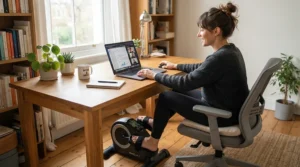
A mini elliptical trainer sits at the opposite end of the size spectrum from the NordicTrack X16. Think pedals, not strides. These are seated units that slide under a desk or sit in front of a couch.
Their strength is consistency. Pedaling quietly during emails or TV is easy to repeat daily, which beats the elaborate workout plan you abandon in week two. Consumer Reports splits under-desk models into manual and motorized types, noting manual units typically deliver the more challenging, calorie-focused workouts.
Stand-up mini options exist too. The JFIT Mini Elliptical is marketed as both under-desk and stand-up, and the Stamina InMotion line is a frequent budget recommendation. Standing versions burn more calories than seated ones, though balance and joint comfort vary by user.
The honest limitation: a mini elliptical trainer won’t replace a real cardio session. Treat it like a standing desk for your legs. Use the Cubii JR1 for daily movement, then add a full machine like the Niceday Elliptical for actual training days.
Space Saving Elliptical Designs Compared: Vertical, Folding, or Front-Drive?
Every space saving elliptical makes one of three tradeoffs, and knowing them saves you from buyer’s regret.
Vertical designs like the Bowflex Max Trainer M6 minimize floor area by growing upward. You get a tiny footprint, but a stair-like motion instead of a true glide.
Folding designs like the YOSUDA Foldable Elliptical reclaim floor space after workouts. The tradeoff is slightly less rigidity and shorter strides.
Compact front-drive designs like the Schwinn 411 and Sole E25 keep real elliptical motion in a smaller frame. They’re heavier, so they’re better parked than stored.
| Factor | Compact Elliptical | Treadmill | Stationary Bike | Under-Desk Pedaler |
|---|---|---|---|---|
| Joint impact | Low | Higher | Low | Very low |
| Floor space | Small to medium | Medium to large | Small | Minimal |
| Full-body engagement | Yes | Lower body mainly | Lower body | Lower body only |
| Best for | Home cardio | Running prep | Cycling fans | Desk movement |
The Mayo Clinic Care Network’s elliptical vs. treadmill guidance notes ellipticals are generally low-impact and can suit people with joint pain, while a treadmill is probably better preparation for road races. For general fitness in tight quarters, the compact elliptical wins on joint comfort and full-body engagement. Runners training for events should keep a treadmill in the mix. Desk workers get the most value from pairing a pedaler with a full machine.
Apartment Cardio Equipment: Noise, Floors, and Neighbors
Good apartment cardio equipment does three things: it fits, it’s quiet, and it doesn’t shake the building. Ellipticals tend to beat treadmills on all three. There’s no foot-pounding, no belt slap.
Noise comes mostly from resistance type and frame stability. Magnetic systems are the standard recommendation for quiet use, and reviews frequently flag the Schwinn 411 as near-silent. Adjustable floor stabilizers help too, since a wobbling frame amplifies vibration through the floor.
Problem → Solution:
- Problem: Downstairs neighbor complains about vibration. Solution: Place a dense rubber mat underneath and level the stabilizers.
- Problem: Squeaks after a few weeks. Solution: Re-tighten bolts and check pedal connections.
- Problem: Hardwood scratches. Solution: Use a thick mat sized beyond the machine’s footprint.
- Problem: Evening workouts feel risky. Solution: Choose magnetic models and keep sessions to reasonable hours.
The Niceday Elliptical and YOSUDA Foldable Elliptical also use magnetic drives, so budget buyers aren’t locked out of quiet operation. If a lease clause or thin floors worry you, prioritize quiet magnetic resistance over fancy consoles.
Small Footprint Machines: How to Read a Spec Sheet Honestly
Small footprint machines can mislead you. A listing might brag about a tiny base while ignoring pedal sweep, handlebar travel, or the fact that you need clearance to step on and off.
Look for three numbers together: length, width, and height. A machine can be narrow and tall, like the NordicTrack X16, or short and wide. Neither is wrong, but each suits a different room.
Then check the stride. A compact frame with a 14-inch stride might feel choppy for adults, which is why reviewers often flag stride length as the trade-off for ultra-small models. Other roundups list models like the CURSOR (14-inch stride) and Niceday 18-inch variants. Compare like with like.
Finally, check weight. Heavier machines are usually sturdier but harder to move. The Sole E25 rewards you with stability, while the YOSUDA Foldable Elliptical rewards you with portability.
What the spec sheet won’t tell you, but reviewers repeatedly note, is that real-world space needs usually run larger than the footprint suggests. Plan clearance, not just base dimensions. For small footprint machines, an extra foot of breathing room often decides whether you use the thing daily.
Portable Elliptical Options: Moving, Folding, and Storing
Among portable elliptical options, “portable” covers three different ideas. Know which one you need.
Wheeled machines roll from corner to corner. NBC Select noted the Sunny Health & Fitness SF-E905 as a compact budget model with transport wheels. Wheels help, but heavy frames still demand muscle.
Folding machines like the YOSUDA Foldable Elliptical shrink for storage. They’re the closest thing to genuinely portable elliptical options for full-size workouts.
Mini pedalers like the Cubii JR1 are portable the way a laptop is: you carry them, but you’re not doing a full workout.
Think about where it lives between sessions. A closet? Behind a couch? Under a bed? That answer matters more than any spec. Folding hinges also deserve a once-over: tighten bolts after the first few uses and check for play.
If you’re weighing portability against stability, compromise on mid-weight machines with wheels. If you truly need it out of sight daily, accept the slightly less rigid feel of a foldable design.
✨ Don’t Miss These Exclusive Deals!
🔍 Ready to turn a corner of your home into a cardio zone? Click on any highlighted product above to check current pricing and availability. These carefully selected machines will help you build a routine that actually fits your space! 🚴♂️
Features That Actually Matter (And Those That Don’t)
Marketing loves features. Your calves care about fundamentals.
What matters:
- Stride length. Short strides feel choppy. Aim for 18+ inches if you’re tall.
- Frame stability. Look for higher weight capacities and floor stabilizers.
- Quiet resistance. Magnetic systems are the apartment standard.
- Smooth transitions. Resistance changes shouldn’t jolt the pedals.
What often doesn’t:
- Giant touchscreens. Nice for classes, irrelevant if you’ll watch your own TV. The NordicTrack X16 justifies its screen for class lovers, but the Niceday Elliptical gets you moving for far less.
- Preset program counts. Twenty programs are rarely used. Most people settle into two or three.
- Bluetooth gimmicks. Useful if you track data, unnecessary otherwise.
Be wary of anything that adds cost without improving fit or feel. Incline and decline, as on the NordicTrack X16, are genuinely useful for variety, but only if you’ll change your workouts. Otherwise they’re an expensive hobby. A good rule: pay for stride, stability, and silence first. Pay for tech last.
Common Mistakes When Buying a Compact Elliptical
Most regrets follow the same five patterns.
Buying on footprint alone. A tiny base with a short stride gets annoying fast. Check both.
Ignoring ceiling height. The NordicTrack X16 stands about 74 inches tall, and pedals add height under your feet. Low ceilings can turn a great machine into a head-bump hazard.
Skipping weight capacity. It’s a stability signal, not just a limit. Even lighter users benefit from solid frames.
Overlooking assembly. Heavier machines like the Sole E25 take effort to build. Plan a helper.
Expecting under-desk pedalers to replace workouts. The Cubii JR1 is a movement tool, not a gym.
Another common trap: assuming “compact” means “light.” Many compact front-drive units are dense because stability costs mass. If you rent and might move, weigh the portability tradeoff before buying.
The cure is boring but effective: measure, read stride specs, and choose a machine for how you’ll actually use it, not how you imagine you might on January 1st.
Long-Term Cost & Maintenance
Sticker price is only the opening bid. Total cost of ownership includes subscriptions, mats, and occasional maintenance.
| Tier | Example | Ballpark Range | What You’re Paying For |
|---|---|---|---|
| Budget | Niceday Elliptical, YOSUDA Foldable Elliptical | $300–$500 | Basic frame, magnetic resistance |
| Mid-range | Schwinn 411 | $700–$1,000 | Quiet build, brand support |
| Upper-mid | Sole E25 | $1,200–$1,300 | Long stride, sturdy frame |
| Premium | NordicTrack X16 | Low $2,000s | Incline, touchscreen, class ecosystem |
Cost-per-use makes the math friendlier. A machine you use 150 times a year for three years costs far less per session than a gym membership you rarely visit, though results depend on consistency. The Niceday Elliptical amortizes quickly because it’s inexpensive. The NordicTrack X16 only pays off if you use its premium features.
Maintenance is light but real. Wipe down after use, check bolts monthly, and keep pedal areas clear of dust. Magnetic systems avoid friction-pad replacement, which lowers upkeep versus older designs. Also confirm warranty terms: Sole advertises a lifetime frame warranty on the E35, so verify what the E25 covers.
For most buyers, the best value sits between budget and premium. Pay for stride and stability, then stop.
Real-World Scenarios: Which Compact Elliptical Fits Which Life?
Scenario 1: The studio renter. You live in 450 square feet, share a wall, and work out three mornings a week. Priorities: quiet, small, easy to hide. The YOSUDA Foldable Elliptical folds away, while the Schwinn 411 offers quiet operation if you can keep it parked. Budget: $300-$1,000.
Scenario 2: The tall remote worker. You’re 6’2″, working from a spare room, and you’ve hated short-stride machines. The Sole E25 with its 20-inch stride is the logical match. Pair it with a Cubii JR1 for desk hours if budget allows.
Scenario 3: The interval-training fan. You like short, hard sessions and have almost no floor space. The Bowflex Max Trainer M6 matches that profile, trading glide for vertical intensity.
Scenario 4: The gadget lover. You want classes, incline, and variety. The NordicTrack X16 is built for you, but only buy it if screens motivate you.
Quick decision framework:
- If space is your biggest constraint → vertical or folding.
- If comfort matters most → longer stride, Sole E25 or Schwinn 411.
- If budget leads → Niceday Elliptical.
- If you mostly sit all day → add a Cubii JR1.
Your First 30 Days: Setup, Maintenance, and Mistakes to Avoid
The first month decides whether your machine becomes a habit or a clothes rack.
Setup. Assemble on a hard, level surface, then move it into position. Tighten every bolt twice, since vibration loosens fasteners. Place a mat underneath to protect floors and dampen sound.
Week 1: easy and steady. Harvard’s physical therapist advice is to start with a continuous steady tempo at zero or low incline, then increase resistance, speed, and incline gradually. Aim for short sessions you can repeat.
Weeks 2-3: build gradually. Add resistance in small steps, not jumps. If you own the NordicTrack X16, experiment with incline for variety. If you own the Niceday Elliptical, ramp resistance levels one at a time.
Week 4: add intervals. Alternate hard and easy minutes. Most people see better results from consistency than from heroic single workouts. For context, Livestrong cites HHS guidance of 150 minutes of moderate aerobic activity weekly as a baseline target.
Common first-month mistakes:
- Gripping the handles too hard. Let your legs do the work.
- Skipping warm-up and cool-down.
- Standing too far forward on the pedals.
- Ignoring loose bolts.
Maintenance schedule: wipe weekly, check bolts monthly, and re-level if the machine rocks. If something squeaks, address it early.
FAQ
❓ What is the best compact elliptical for a tall person?
❓ How much space does an under-desk mini elliptical trainer need?
❓ Are folding ellipticals as sturdy as fixed ones?
❓ Can I use a compact elliptical on an upper-floor apartment?
❓ Do I need a subscription to use a smart compact elliptical?
Conclusion
Finding the best compact elliptical comes down to one honest question: what are you willing to trade? Floor space, stride length, noise, features, and price all pull against each other, and no machine wins every category.
Here’s the short version. The Sole E25 is the pick for taller users and narrow rooms. The Schwinn 411 is the quiet, premium-feeling choice. The Niceday Elliptical wins on value, and the YOSUDA Foldable Elliptical wins on storage. The Bowflex Max Trainer M6 wins on tiny footprints, the NordicTrack X16 on variety and tech, and the Cubii JR1 on gentle daily movement.
Remember what the research actually says: a compact elliptical for small spaces can deliver low-impact, full-body cardio, but only if it fits your body and your routine. A space saving elliptical you use three times a week beats a premium machine gathering dust. Measure first, prioritize stride, stability, and quiet, then let features decide ties.
Your living room doesn’t need to become a gym. It just needs one smart machine.
✨ Ready to find your fit?
🔍 Click on any highlighted product above to check current pricing and availability, and start building a cardio routine that finally fits your space! 🚴♂️
Recommended for You
- Center Drive Elliptical Benefits: 7 Top Picks You Need In 2026
- Bowflex Max Trainer: 7 Best Picks Ranked & Compared (2026)
- Center Drive Vs Front Drive Elliptical: 7 Proven Picks 2026
Disclaimer: This article contains affiliate links. As an Amazon Associate, I earn from qualifying purchases. If you purchase products through these links, we may earn a small commission at no additional cost to you.
✨ Found this helpful? Share it with your friends! 💬🤗
