
In This Article
Most ellipticals are bullies. They muscle into a spare bedroom, claim a six-foot runway, and sit there like a parked sofa you never asked for. Anyone who has tried to squeeze one into a corner of a one-bedroom apartment knows the feeling.
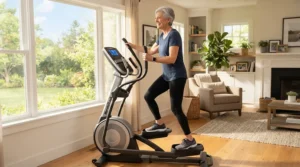
So what is the alternative? Center drive elliptical benefits are the practical advantages of an elliptical trainer whose flywheel sits directly beneath your feet, not out front or behind you. This layout shortens the machine, encourages a more upright posture, and gives you a stable, balanced stride that suits small rooms and joint-sensitive exercisers.
That is the short version. The longer one is more interesting, because the benefits come with trade-offs: price, weight, and a handful of design quirks you should know about before you buy.
An elliptical trainer is, at heart, a stationary machine that simulates walking, running, or stair climbing without pounding your joints. Where the flywheel lives changes almost everything about how that feels. Reviewers who compare the three layouts consistently describe center drive as a cross between front and rear drive. It has a gentle natural incline like the former and an upright stance like the latter.
This guide breaks down the real-world advantages center drive machines offer, the seven models worth your attention in 2026, and the honest downsides. Prices are given as ranges only, because they shift constantly. Check current pricing before you buy.
Quick Comparison Table: 7 Center Drive Ellipticals at a Glance
Here is the lineup before we dig in. Footprints are listed as length × width, with height where published.
| Model | Stride Length | Footprint | Best For |
|---|---|---|---|
| Best Fitness BFE2 | 21″ fixed | 48″ × 30″ × 66″ | Budget-minded buyers |
| NordicTrack FreeStride Trainer FS10i | Auto-adjusts up to 32″ | 58.5″ × 29.5″ × 74″ | Tech-curious value hunters |
| NordicTrack FreeStride Trainer FS14i | Auto-adjusts up to 32″ | 58.5″ × 29.5″ × 74″ | Guided-workout fans |
| TRUE M30 | 21″ fixed | 42″ × 30″ × 64″ | The tightest spaces |
| TRUE M50 | 21″ fixed | 42″ × 30″ | Small spaces plus better grips |
| TRUE Performance 300 | 21″ fixed | 49″ × 32.5″ (active length ~70″) | Stability and easy entry |
| Landice E7 | 21″ (some listings 17″–23″) | 35″ × 76″ operating | Heavier users, seniors needing rails |
Look at that stride column. Most front and rear drive machines in the home market sit between 18 and 20 inches, so a fixed 21 inches is already generous. The TRUE M30 and TRUE M50 pair that stride with the smallest footprints on the list. Meanwhile, both NordicTrack FreeStride models trade a little compactness for a stride length that can reach 32 inches.
Bear in mind that stride and footprint pull in opposite directions. The longer the stride, the more room you need around the machine while you move, so “compact” is a spectrum here, not a promise.
💬 Just one click — help others make better buying decisions too!😊
Top 7 Center Drive Ellipticals: Expert Analysis
Center drive is a smaller market than front or rear drive, and the pool of residential-friendly options is thin. These seven are real, currently documented machines from known brands, spanning budget to premium. The analysis below leans on published specs and reviewer consensus from sources such as the Garage Gym Reviews center drive roundup, not hands-on ownership.
1. Best Fitness BFE2 — the budget way into center drive
The BFE2 from Body-Solid’s Best Fitness line is about as close to a bargain as center drive gets. It still offers the patented center drive layout in a 48″ × 30″ × 66″ frame.
The stride is 21 inches, longer than the 18-to-20-inch norm, so taller users won’t feel cramped. The console is a 5-inch color display with 12 preset programs. On paper that means decent variety without any subscription strings.
Based on the spec sheet, this is a machine for the person who wants the center drive posture and small footprint without spending thousands. It is not for everyone, though. The 275-pound user capacity rules out heavier exercisers, and the console is basic compared with the touchscreens elsewhere on this list.
Reviewer coverage is thin: the retail listings we found carry few or no verified buyer ratings. Expert reviewers do repeatedly flag the weight limit and the lack of a touchscreen as the main compromises. That is a thin evidence base, so treat the BFE2 as promising rather than proven.
Pros:
- ✅ Longer-than-average 21-inch stride
- ✅ Frame covered by a 15-year warranty
- ✅ Lowest entry price among center drive picks
Cons:
- ❌ 275-pound user weight capacity
- ❌ No touchscreen console
Price range: roughly $1,300–$1,800 depending on promotions. For a first center drive, the value verdict is strong, provided your weight sits under the limit.
2. NordicTrack FreeStride Trainer FS10i — a three-in-one with a stride you can stretch
The FS10i does something unusual. Its pedals can glide like an elliptical, climb like a stepper, or stride like a treadmill, and the stride length is automatically adjustable up to about 32 inches.
The 20-pound flywheel sits under your body weight, which keeps your posture upright. A 10-inch touchscreen drives iFIT classes, and silent magnetic resistance keeps things quiet. The frame measures 58.5″ × 29.5″ × 74″, supports up to 375 pounds, and weighs roughly 284 pounds in the box.
What the spec sheet won’t tell you is that freedom of motion cuts both ways. Reviewers note the extra-long stride needs far more clear space than the footprint implies. They also report that switching stride patterns mid-workout takes practice, that the incline motor is on the noisy side, and that the absence of stationary handles makes stepping on slightly awkward. Garage Gym Reviews scores it around 4.2 out of 5.
For tall users the long stride is a genuine perk. For someone who wants a plain, quiet elliptical, it is possibly more machine than needed.
Pros:
- ✅ Auto-adjustable stride up to 32 inches
- ✅ Elliptical, stepper, and striding modes
- ✅ 375-pound user weight capacity
Cons:
- ❌ Lighter 20-pound flywheel for advanced users
- ❌ Stride adjustment feels fiddly mid-workout
Price range: about $1,900–$2,300. Good value if you will use the versatility.
3. NordicTrack FreeStride Trainer FS14i — the big-screen, full-feature flagship
Think of the FS14i as the FS10i with the volume turned up. It shares the 58.5″ × 29.5″ × 74″ footprint, the 20-pound flywheel, and the up-to-32-inch auto-adjustable stride. It adds a larger screen, 26 digital resistance levels, and a heavier build at about 287 pounds, again with a 375-pound capacity.
The flywheel is centered under your body weight, so you stand tall while resistance stays smooth. Garage Gym Reviews named it the best overall center drive elliptical, largely because of the all-in-one versatility and screen. Its numerical review score of 3.93 is more modest than the headline suggests, which hints at the compromises.
Here is the honest framing. This machine is really a subscription-driven experience. Reviewers consistently point out that you need an iFIT membership to unlock the guided workouts that justify the larger display. Without it, you are paying a premium for a very good hardware platform and a basic manual mode.
If trainer-led, auto-adjusting sessions are why you want an elliptical, the FS14i earns its price. If not, the cheaper FS10i covers most of the same ground.
Pros:
- ✅ Auto-adjustable stride up to 32 inches
- ✅ 26 digital resistance levels
- ✅ Large touchscreen for guided classes
Cons:
- ❌ Guided features need an iFIT subscription
- ❌ Heavy at roughly 287 pounds
Price range: mid-$2,000s at the time of research. Worth it only if you will actually use the classes.
4. TRUE M30 — one of the smallest footprints around
The M30 is TRUE’s entry-level residential center drive, and its headline is size. At roughly 42″ × 30″ × 64″, it is among the most compact full-stride ellipticals available.
The stride is a fixed 21 inches, the step-up height is about 9 inches, and the machine weighs around 275 pounds with a 300-pound user limit. TRUE’s Core Drive system is built for a stable, natural motion, and the console offers 12 programs plus heart rate control cruise features.
In practice, that combination means you get a commercial-feeling, near-silent ride that disappears into a corner when you are done. Reviewers describe the center drive as quiet, sturdy, and easy to live with, and they call it the best budget-friendly TRUE. The recurring complaint is the lack of a multi-grip handle, which limits upper-body variety.
Be realistic about price. It sits above the Best Fitness BFE2 and the FS10i, so you are paying for TRUE’s build quality and a small footprint.
Pros:
- ✅ Very compact 42″ × 30″ footprint
- ✅ Quiet, stable Core Drive system
- ✅ 21-inch stride in a small frame
Cons:
- ❌ No multi-grip handle option
- ❌ Expensive versus front drive models
Price range: around $3,000–$3,300. A premium for space efficiency, and a justified one for apartment dwellers.
5. TRUE M50 — same compact frame, friendlier grips
If the M30 is the lean version, the M50 is the same machine with better ergonomics. It keeps the compact footprint (about 42″ × 30″), the fixed 21-inch stride, and the Core Drive system. It adds ergonomic multi-grip handles.
That small change matters more than it sounds. The upper-body portion of an elliptical session is where grip variety pays off, because different hand positions shift the load between your back, shoulders, and arms. Multiple grips also make longer sessions more comfortable.
Based on the shared specs, the M50 is the better pick for anyone who plans to use the arms seriously or share the machine with different-sized users. Reviewers rank it as the option for people who want the M30‘s compact design with more ergonomic touches. The step-up height is the same 9 inches, so access is no easier.
The trade-off is the extra few hundred dollars, which is a fair ask for better grips but not a leap in performance.
Pros:
- ✅ Ergonomic multi-grip handles
- ✅ Same compact footprint as the M30
- ✅ Quiet, stable center drive feel
Cons:
- ❌ Costs more than the M30 for similar core hardware
- ❌ Still a 9-inch step-up
Price range: roughly $3,200–$3,700. Choose it over the M30 if grips matter to you.
6. TRUE Performance 300 — commercial toughness with stability aids
The Performance 300 is the machine you would find in a serious gym, scaled for the home. It uses Core Drive, a 21-inch stride, and a footprint of about 49″ × 32.5″, though the active footprint stretches to roughly 70 inches long once you are moving.
It adds side steps for getting on and off, plus side arms for stability, which is why reviewers often recommend it for people who want maximum confidence and accessibility. The unit weighs about 266 pounds and supports up to 350.
The honest takeaway: this is not a gadget machine. There is no flashy touchscreen, and one reviewer specifically wished for an upgraded screen option. What you buy is heavy-duty construction, a smooth stride, and the kind of stability that suits older exercisers or anyone nervous about balance.
It also costs more than anything else here except the Landice E7. Whether that premium is worth it depends on how much you value the commercial pedigree and the entry aids.
Pros:
- ✅ Side steps and side arms for stability
- ✅ 350-pound user weight capacity
- ✅ Commercial-grade build quality
Cons:
- ❌ Basic console compared with touchscreens
- ❌ Premium price point
Price range: about $4,100–$4,600. Best for stability-first buyers with the budget.
7. Landice E7 — the accessibility champion for heavier users
The E7 is built around one idea: let nearly anyone exercise safely. It supports up to 500 pounds, which is well above anything else on this list, and it includes medical-grade side rails for support.
Landice’s patented center drive delivers a natural stride, and most current listings give a 21-inch stride and 20 resistance levels. Some older retailer pages describe a 17-to-23-inch adjustable stride, so confirm the exact variant before ordering. The flywheel is 11 inches in diameter, pedal spacing is 2 inches, and the operating footprint is about 35″ × 76″.
That narrow width is the clever part. At 35 inches wide, the machine slots into tighter spaces than its length suggests, though it is heavy and demands a long, clear path. Reviewers call it the best pick for seniors or users needing extra support, while flagging the high price, the lack of a touchscreen, and the weight. Retail pages list lifetime parts coverage, but verify current warranty terms.
Pros:
- ✅ 500-pound user weight capacity
- ✅ Medical-grade side rails for support
- ✅ Lifetime parts coverage per retailer listings
Cons:
- ❌ Highest price on this list
- ❌ Heavy and lacks a touchscreen
Price range: roughly $4,300–$4,900. A specialist machine with real value for the right user.
Top 7 Specs Compared
| Model | User Capacity | Machine Weight | Price Range | Best For |
|---|---|---|---|---|
| Best Fitness BFE2 | 275 lb | ~180–215 lb (sources vary) | $1,300–$1,800 | Budget center drive |
| NordicTrack FS10i | 375 lb | ~284 lb | $1,900–$2,300 | Versatility on a budget |
| NordicTrack FS14i | 375 lb | ~287 lb | Mid-$2,000s | Guided training |
| TRUE M30 | 300 lb | ~275 lb | $3,000–$3,300 | Small spaces |
| TRUE M50 | 300 lb | ~275 lb | $3,200–$3,700 | Small spaces, better grips |
| TRUE Performance 300 | 350 lb | ~266 lb | $4,100–$4,600 | Stability and access |
| Landice E7 | 500 lb | Not confirmed | $4,300–$4,900 | Heavier users, rails |
The pricing ladder tells the story. The Best Fitness BFE2 and the two NordicTrack machines are the accessible tier, with the BFE2 the cheapest but most limited. The TRUE machines are the space-efficiency specialists. The Landice E7 is the outlier, priced for a use case, not a lifestyle. If your weight is near 300 pounds, the capacity column should shape your decision before anything else.
Advantages Center Drive Designs Offer Over Front and Rear Drive
Let’s be clear about what you actually gain. The advantages center drive layouts offer come down to four things: posture, footprint, balance, and quiet.
Posture. With the drive centered under you, you stand more upright. Front drive machines tend to pull you into a slight lean, and some users find that tiring over long sessions. Center drive reduces that tendency, which many exercisers find easier on the lower back.
Footprint. Without a long rear flywheel housing, the machine can be shorter. Some mainstream rear drive machines run 70 inches or more in length, while the TRUE M30 manages about 42.
Balance. The mass sits under your center of gravity, so the machine feels planted. The Best Fitness BFE2‘s makers specifically call out a low center of gravity that prevents rocking.
Smoothness. According to Consumer Reports’ buying guide, center drive paths tend to feel more rounded, with gentler transitions than front drive paths.
Here is how the three layouts stack up.
| Factor | Center Drive | Front Drive | Rear Drive |
|---|---|---|---|
| Floor space | Smallest | Compact | Largest |
| Posture | Upright | Slight forward lean | Upright |
| Typical price | Highest | Lowest | Middle |
| Stride feel | Rounded, stable | Bouncier | Smooth, walking-like |
| Best For | Small rooms, comfort | Tight budgets | Natural stride fans |
Looking at the table, center drive wins on space and posture but pays for it at the register. One source estimates center drive can cost roughly double a front drive model, and often 50 to 100 percent more than rear drive. If budget is your top priority, front drive remains the sensible choice. If you want the best blend of space and comfort, center drive justifies the premium.
✨ Don’t Miss These Exclusive Deals!
🔍 Take your home cardio to the next level with these carefully selected center drive picks. Click on any highlighted item to check current pricing and availability. These machines will help you build a joint-friendly routine your whole household can enjoy!
Centered Flywheel Design: Why Location Changes the Ride
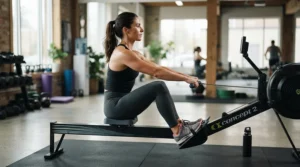
The centered flywheel design is the engine behind every benefit on this list, so it deserves a closer look.
On any elliptical, the flywheel stores momentum. A heavier, well-placed flywheel smooths out the stride so the pedals don’t feel jerky at the top and bottom of each rotation. Most guidance suggests a 16-to-20-pound flywheel for a smooth home machine.
Place that flywheel at the front and it creates a built-in slope. Place it at the rear and you get a longer frame to reach it. Place it in the center, directly beneath your pedals, and the mass sits where your weight already is.
That has two knock-on effects. First, the machine is shorter, because it does not need a long frame to reach a distant flywheel. Second, the load is better balanced, so the machine rocks less when you push through harder intervals.
The NordicTrack FS14i illustrates the point. Its reviewers describe a flywheel effectively weighing 20 pounds centered beneath you, with a flywheel under each pedal for a balanced feel. The Landice E7 uses an 11-inch-diameter flywheel in a generator-driven, self-powered system.
One caution: a centered flywheel is not automatically heavy. The 20-pound units on the NordicTrack machines are at the lighter end for advanced athletes, which is why reviewers say conditioned users might want more inertia. The design delivers balance, not guaranteed momentum.
Minimal Floor Space: What the Footprint Numbers Really Mean
The phrase minimal floor space sounds simple, but footprint listings can mislead if you read them carelessly.
There are two measurements that matter. The static footprint is the box the machine occupies when parked. The active footprint adds the room your feet and the moving pedals need during a workout. The TRUE Performance 300 is a perfect example: a 49-inch static length, but about 70 inches of active length.
So the right question is not “How big is it?” but “How much clear floor do I need while using it?” Measure that space, then add a few extra inches on each side and behind you for safety.
Height matters too. The NordicTrack FreeStride machines stand 74 inches tall, so check your ceiling, especially in a basement or attic room. The TRUE M30 is a more forgiving 64 inches.
Here is a quick comparison to keep in mind. The TRUE M30 and TRUE M50 are the most space-efficient on this list. The Landice E7 is narrow but long. The NordicTrack FS10i has a modest static footprint but needs extra clearance for its long stride.
Finally, think about weight. Machines in the 260-to-290-pound range are not going to move easily once placed. Choose the spot carefully, because you will probably leave it there.
Center Drive Features That Actually Matter (And Those That Don’t)
Marketing copy can bury the useful stuff. Here is how to sort signal from noise.
Features worth caring about:
- Stride length. A 21-inch stride suits most adults. Taller users should look hard at the NordicTrack machines or confirm the Landice E7 variant.
- Weight capacity. It varies wildly, from 275 pounds on the Best Fitness BFE2 to 500 on the Landice E7. Never ignore it.
- Step-up height. The TRUE M30 and TRUE M50 have a 9-inch step-up. Lower is easier on tired legs.
- Side rails or steps. They look humble, but they add real confidence for older exercisers.
- Warranty. Frame coverage of 10 to 15 years is typical in this segment, and parts warranties vary widely.
Features that matter less:
- Screen size. A giant touchscreen is lovely if you’ll use it, but it is not the same as a better machine.
- Preset program count. Twelve programs or thirty, most people use three.
- Bluetooth gimmicks. Handy for syncing, but rarely a deciding factor.
The honest summary is this: spend your budget on stride, stability, and access first. Treat screens and apps as pleasant extras. And remember that the FS14i in particular is a software-led product, so its value depends on whether you want a subscription.
Why Choose Center Drive? An Honest Buyer’s Case
So why choose center drive over cheaper alternatives? Because for the right buyer, the benefits compound.
You live small. If floor space is scarce, the savings of a center drive machine are not trivial. A TRUE M30 can fit where a rear drive machine simply won’t.
You value posture. Upright stance and balanced load can feel more natural, particularly across 30-minute sessions.
You want quiet. Reviewers consistently describe center drive systems, especially the TRUE Core Drive and the Best Fitness layout, as smooth and quiet. That matters in apartments and early mornings.
You need stability. The Landice E7 and TRUE Performance 300 are built for exercisers who prioritize security.
But let’s be fair about who should skip it. If you are on a tight budget, a front drive machine will likely cost far less. If you want the longest, most walking-like stride and have the space, rear drive may feel more natural. And if you are a very heavy user, make sure capacity limits line up, because most center drive machines top out between 275 and 375 pounds, with the Landice E7 as the exception.
Center drive is not the right answer for everyone. It is the right answer for people who treat space and comfort as the real price of a machine.
Compact Cardio Efficiency: Getting More From Less Room
Compact cardio efficiency is the idea that a smaller machine can deliver the same fitness return. Evidence supports the underlying exercise.
According to Harvard Health, ellipticals offer low-impact exercise that places less stress on the knee, hip, and ankle joints, and they work the upper and lower body together. That is exactly why center drive machines suit people who want effective workouts without joint punishment.
What about calories? A commonly cited Harvard Health estimate puts a 30-minute elliptical session at about 324 calories for a 150-pound person and around 378 for someone weighing 185 pounds. Treat these as ballpark figures, since intensity, resistance, and body weight all shift the result.
Efficiency also means time. Because a compact machine lives in your home, the friction to start a session drops. No commute, no waiting, no gym-bag logistics. A machine you actually use beats a bigger, better one gathering dust.
The point is simple: the compact layout doesn’t reduce your workout. It reduces the excuses.
How to Choose a Center Drive Elliptical
Here are seven steps, in order of importance.
- Measure your active space. Add the pedal travel and safety clearance to the listed footprint, and check ceiling height.
- Check weight capacity first. If you are above 275 pounds, the Best Fitness BFE2 is out, and the Landice E7 moves to the top.
- Match stride to your height. Most adults fit a 21-inch stride; taller exercisers should look at the NordicTrack adjustable strides.
- Decide on tech. Want guided classes? Choose a NordicTrack FreeStride model and budget for iFIT. Want simplicity? Choose a TRUE machine.
- Consider accessibility. Side rails, side steps, and low step-up matter more as you age.
- Compare warranties. Frame and parts coverage varies significantly, so read the fine print.
- Budget for the total cost. Include delivery, a floor mat, and any subscription.
Follow these in order and you will filter out most poor fits before comparing a single feature.
Common Mistakes When Buying a Center Drive Elliptical
Even careful shoppers stumble. These are the pitfalls that come up most.
Mistaking static footprint for usable footprint. The TRUE Performance 300 looks tiny on paper and needs about 70 inches in use.
Ignoring weight capacity. A beautiful machine you can’t safely use is an expensive ornament.
Overpaying for software. The FS14i is a great platform, but if you won’t take the classes, you are buying screen real estate.
Assuming center drive equals heavy flywheel. The mechanical layout and the inertia of the flywheel are two separate things.
Skipping the delivery plan. These machines are heavy. Check doorway widths and stair routes before the truck arrives.
Not confirming the exact variant. The Landice E7 has appeared with different stride specs and console options across retailers, so verify before you order.
Avoid these and you are ahead of most buyers.
Long-Term Cost & Maintenance
Price is only the entry fee. A smart buyer thinks in total cost of ownership.
Maintenance on magnetic-resistance machines is typically light: occasional cleaning, tightening of bolts, and a check on the pedals and rollers. Magnetic systems avoid friction pads that wear out, which helps long-term reliability.
Subscriptions are the hidden line item. The NordicTrack FreeStride machines unlock their guided workouts through iFIT, which is a recurring cost. Over several years, that adds up to a meaningful sum, so factor it in.
Warranty value matters too. Frame coverage of 10 to 15 years is typical in this segment, with parts and labor much shorter. A longer parts warranty, like the lifetime parts coverage listed for the Landice E7, reduces risk.
Here is a simple way to think about value:
| Tier | Models | Price Range | Best For |
|---|---|---|---|
| Entry | Best Fitness BFE2 | $1,300–$1,800 | First-time center drive buyers |
| Mid | NordicTrack FS10i, NordicTrack FS14i | $1,900–$2,500+ | Tech-led, versatile training |
| Upper-mid | TRUE M30, TRUE M50 | $3,000–$3,700 | Space-efficient daily use |
| Premium | TRUE Performance 300, Landice E7 | $4,100–$4,900 | Stability, accessibility, durability |
Notice how the tiers map to priorities, not just money. A cost-per-use view helps: a $3,000 machine used 250 times a year for five years works out to roughly $2.40 per session, before maintenance. That is a fair benchmark against a gym membership, but only if you actually use it.
Practical Usage Guide: Setting Up Your Center Drive Elliptical
A great machine still needs a good setup. Use this checklist for your first 30 days.
Placement. Put the machine on a flat, hard surface with a protective mat. Leave clearance behind and beside you. Check that the leveling feet are adjusted so the frame doesn’t rock.
First sessions. Start with 15 to 20 minutes at low resistance. Focus on keeping your chest tall and your hands relaxed. The goal is a smooth, upright stride.
Posture check. Don’t hang on the handles. Let your legs do the work, and use the arms to assist.
Progression. Add a few minutes each week. The federal Physical Activity Guidelines for Americans call for at least 150 minutes of moderate-intensity aerobic activity each week for substantial health benefits, and a center drive machine makes that target easier to reach in 30-minute chunks.
Maintenance schedule. Wipe down the machine after each session. Monthly, check bolts and pedals. Quarterly, inspect the power connection and console.
Common first-month mistakes. Setting resistance too high too soon, ignoring posture, and skipping warm-ups.
Real-World Scenarios: Which Center Drive Fits Which Life?
Three quick profiles show how the specs translate.
The studio apartment renter. She has 6 feet of free space, a tight budget, and neighbors below. The TRUE M30 is the strongest fit for its compact footprint and quiet drive, while the Best Fitness BFE2 is the budget alternative if her weight is under 275 pounds.
The tall, tech-loving home gym builder. He is 6’3″, loves guided classes, and has a spare room with a high ceiling. The NordicTrack FS14i suits him, with its long adjustable stride and large screen, provided he accepts the iFIT subscription.
The retiree prioritizing safety. He wants stability, easy entry, and a machine built to last. The Landice E7 or TRUE Performance 300 fits, with side rails and steps designed for confidence. If his weight is above 350 pounds, the Landice E7‘s 500-pound capacity decides it.
Each profile puts a different spec at the front of the line. Know yours first.
Problem → Solution Guide for New Owners
Problem: the machine rocks. Adjust the leveling feet and check the floor. A mat on uneven ground can make it worse.
Problem: a long stride feels awkward. On the NordicTrack FreeStride models, start with a shorter setting and lengthen gradually, since reviewers note the stride adjustment takes practice.
Problem: the screen is useless without a subscription. Run manual mode for basic workouts, or choose a TRUE machine with a simpler console.
Problem: you need more challenge. Raise resistance in small steps, use interval programs, and try reverse pedaling for variety.
Problem: knee discomfort. Check your posture, lower the resistance, and consult a healthcare professional if pain persists.
Frequently Asked Questions
❓ How much floor space does a center drive elliptical really need?
❓ Are center drive ellipticals worth the higher price?
❓ Which center drive elliptical suits heavier users?
❓ Is a center drive elliptical quiet enough for an apartment?
❓ Which center drive elliptical has the longest stride?
Conclusion
Center drive elliptical benefits come down to a simple trade: you spend more, and you get a smaller, steadier, more upright machine. The centered flywheel design puts mass where your weight already is, which supports balance and a rounded stride. The compact footprint makes the machine a better roommate. And the low-impact workout fits the guidance from sources such as Harvard Health on joint-friendly cardio.
The seven machines here cover a real spread. The Best Fitness BFE2 is the budget entry. The NordicTrack FS10i and FS14i reward tech-minded, tall, or variety-loving users. The TRUE M30 and TRUE M50 are space-saving specialists. The TRUE Performance 300 and Landice E7 are built for stability and accessibility.
Be honest with yourself about three things: your space, your weight, and your budget. Get those right and the rest is detail. Chasing the biggest screen or the longest feature list is the quickest way to overspend on a machine that doesn’t fit your life.
Choose the one that matches your priorities, then use it. Consistency is the real benefit, and a compact machine that stays in your routine will beat an impressive one that stays unused.
✨ Ready to find your fit?
Compare current prices on these center drive picks, pick the one that matches your space and goals, and start building a joint-friendly routine you will actually keep! 🚴♂️
Recommended for You
- Bowflex Max Trainer: 7 Best Picks Ranked & Compared (2026)
- Center Drive Vs Front Drive Elliptical: 7 Proven Picks 2026
- Center Drive Elliptical: 7 Ultimate Picks For 2026
Disclaimer: This article contains affiliate links. As an Amazon Associate, I earn from qualifying purchases. If you purchase products through these links, we may earn a small commission at no additional cost to you.
✨ Found this helpful? Share it with your friends! 💬🤗
