
In This Article
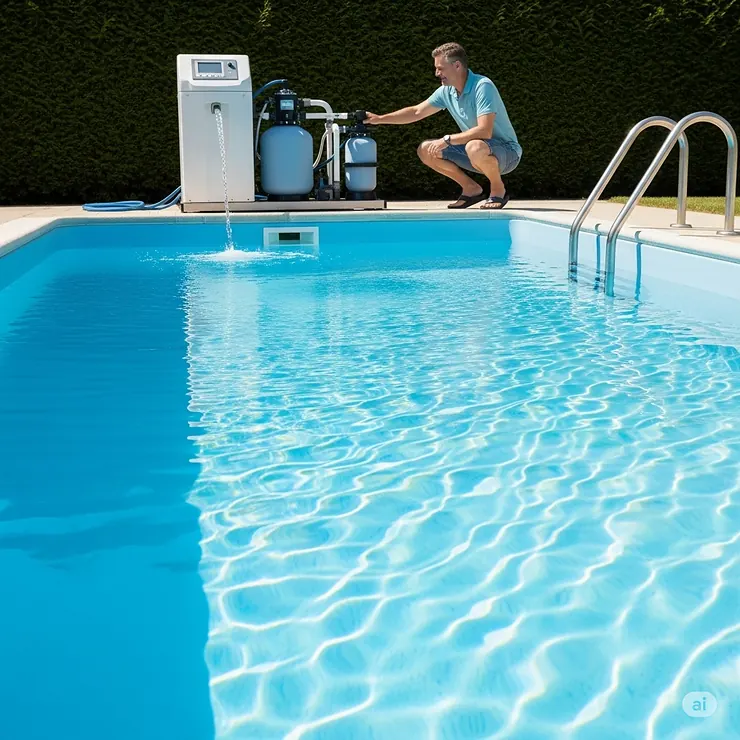
The best pool filters for inground pools are sand, cartridge, or diatomaceous earth (DE) units sized to your pump’s flow rate and your pool’s volume, so every gallon passes through at least once in 8 to 10 hours. A good one traps fine debris, helps your sanitizer work, and keeps weekly maintenance short.
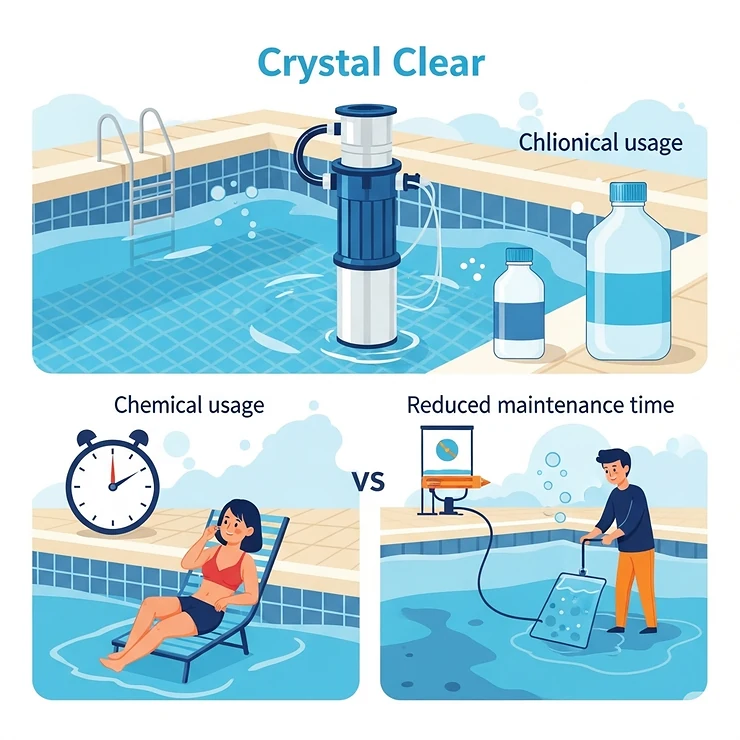
Here’s the part nobody mentions at the pool store. Chlorine kills germs, but it doesn’t remove the dead stuff. Pollen, sunscreen residue, dust and the occasional unlucky beetle all stay in the water until a filter physically catches them. That makes your filter the unsung hero of the equipment pad. Your pump gets the credit, the heater gets the bragging rights, and the filter does the quiet, thankless work.
Choosing wrong hurts in three ways. An undersized unit chokes your pump and leaves the water hazy. A fussy unit that doesn’t suit your habits ends up neglected. An overbuilt one means you paid for performance you’ll never use.
This guide compares seven real, widely sold models across all three technologies, from a classic sand filter to premium DE. It also covers the often-overlooked question of the best pool filter sand to put inside a sand tank. Everything below comes from published manufacturer specs and aggregated owner feedback, interpreted for real backyards. Prices appear as ranges only because they shift constantly, so check current pricing before you buy.
Quick Comparison: Best Pool Filters for Inground Pools at a Glance
| Model | Type | Filter Area / Capacity | Flow Rating | Price Range* | Best For |
|---|---|---|---|---|---|
| Hayward SwimClear C4030 | Cartridge | 425 sq ft | up to 150 GPM | $1,200–$1,700 | Low-effort upkeep on mid-to-large pools |
| Hayward ProSeries W3S244T | Sand | 3.14 sq ft, 300 lb sand | about 52 GPM (with 1 HP pump kit) | $700–$900 | Value-focused owners of average pools |
| Pentair Sand Dollar SD80 | Sand | 3.5 sq ft, 350 lb sand | 80 GPM | $750–$900 | Larger pools on a sand budget |
| Pentair Clean & Clear Plus CCP520 | Cartridge | 520 sq ft | up to 150 GPM | $1,200–$1,700 | Long cleaning intervals |
| Waterway ClearWater II FC1507 | Cartridge | 150 sq ft | up to 150 GPM (listed) | $400–$600 | Small inground pools, tight budgets |
| Pentair FNS Plus 60 | DE | 60 sq ft | up to 150 GPM max (120 GPM rated) | $1,300–$1,500 | Maximum clarity |
| Hayward Perflex W3EC75A | DE | 40 sq ft | about 100 GPM | $1,100–$1,400 | Clarity-focused mid-size pools |
*Ranges reflect general market pricing at the time of research and may vary. Check current price.
Read the table through the lens of maintenance, not just money. The two sand units, Hayward ProSeries W3S244T and Pentair Sand Dollar SD80, win on purchase price, but they use water every time you backwash. Hayward SwimClear C4030 and Pentair Clean & Clear Plus CCP520 cost more up front, yet you simply rinse the elements with a hose. Buyers who want the clearest possible water should look at the DE pair, accepting the extra routine that comes with them. Waterway ClearWater II FC1507 is the budget wildcard, best suited to smaller pools.
💬 Just one click — help others make better buying decisions too!😊
Top 7 Best Pool Filters for Inground Pools: Expert Analysis
1. Hayward SwimClear C4030 — big surface area, almost no babysitting
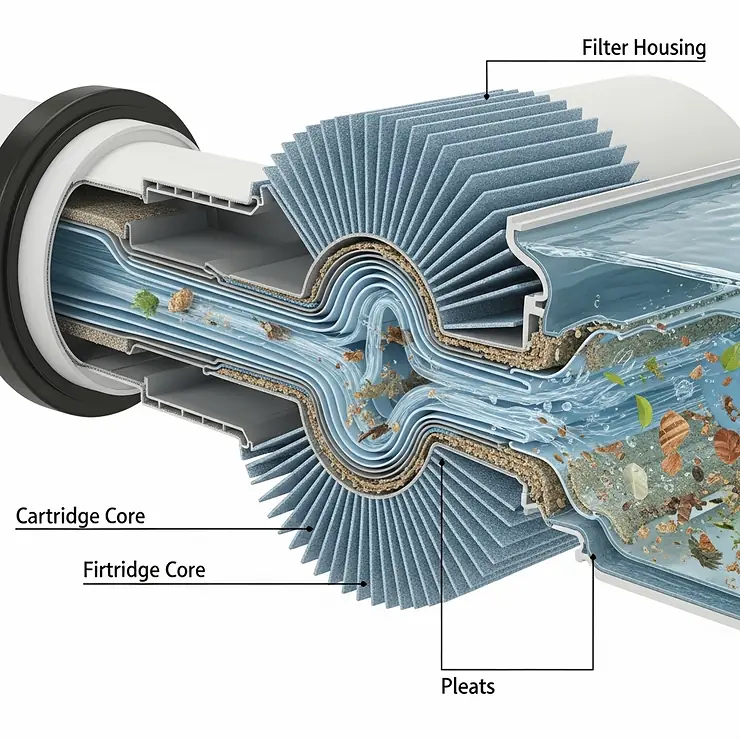
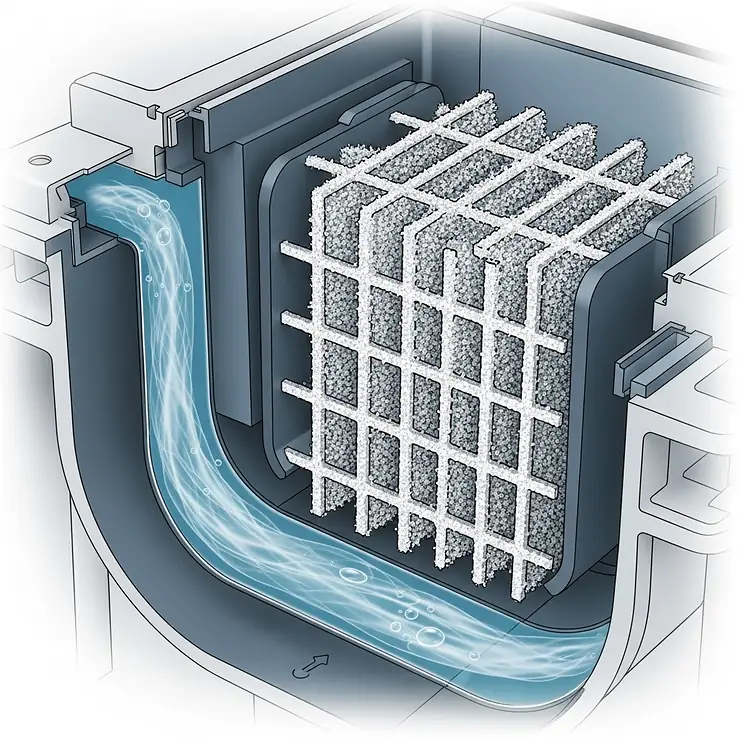
The standout trait is its four-element, 425-square-foot cluster. That much pleated polyester means a long time between cleanings, and Hayward’s published sell sheet lists the SwimClear family at 84 to 150 GPM.
The C4030 is rated to 50 PSI and a maximum of 150 GPM, with an eight-hour turnover figure around 72,000 gallons. In practice, that headroom means a normal pool won’t strain it, so pressure climbs slowly and the cleanings stay few.
Based on the spec comparison, this suits owners who dislike backwashing or live where it’s restricted. At around 80 pounds it’s heavy to lift, so plan placement carefully. Reviewer data is thin and uneven. One retailer page shows a 4.8-star average, but from only five reviews, so treat that as a sample, not a verdict.
Pros:
- ✅ Huge cleanable surface area for long cycles
- ✅ No backwashing, so no wasted pool water
- ✅ Handles up to 150 GPM flow
Cons:
- ❌ Heavy tank and elements to lift
- ❌ Replacement elements cost real money
Price range: roughly $1,200–$1,700. It’s good value if you’ll actually avoid backwashing for years.
2. Hayward ProSeries W3S244T — the dependable workhorse
Its calling card is longevity. Hayward’s own Q&A threads show owners replacing filters installed 15 or even 30-plus years ago, which tells you something about how the corrosion-proof tank holds up.
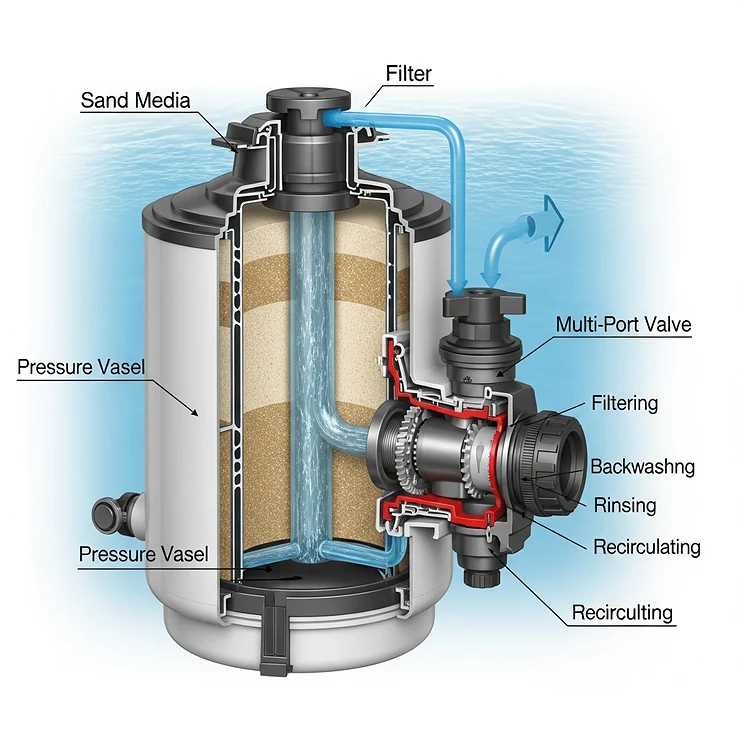
The 24-inch tank holds 300 pounds of #20 silica sand over 3.14 square feet of filter area. A top-mounted 7-position VariFlo valve covers filter, backwash, rinse, recirculate and winterize functions. With a 1 HP pump kit, Hayward cites roughly 52 GPM, or about 24,960 gallons in eight hours.
Do the math for your pool before buying. A 20,000-gallon pool needs about 42 GPM to turn over in eight hours, so this fits comfortably. On a 35,000-gallon pool it will feel stretched.
Owners’ support questions cluster around old stiff valve handles and sand escaping into the pool, which usually points to worn laterals rather than a design flaw. Real review volume isn’t verifiable here, so judge it by the track record above.
Pros:
- ✅ Rugged tank with decades-long track record
- ✅ Simple valve with large sand and water drain
- ✅ Affordable parts and sand
Cons:
- ❌ Backwashing uses pool water
- ❌ Coarser filtration than cartridge or DE
Price range: roughly $700–$900 for the tank and valve, with sand sold separately. It’s a safe value pick.
3. Pentair Sand Dollar SD80 — extra capacity without a cartridge price tag
Here the hook is its generous 26-inch tank, which takes 350 pounds of #20 silica sand over 3.5 square feet of filter area. Pentair rates the SD80 at 80 GPM, so it comfortably serves bigger pools than the 24-inch class.
The six-position clamp-style multiport valve and combination water-and-sand drain simplify winterizing and servicing. The extra sand depth is what matters in practice: more media means longer stretches between backwashes and a bit more forgiveness when debris loads spike.
The honest catch is size. Taller, wider tanks need more pad space, and you’ll haul one more 50-pound bag of sand. Public review samples are small and some were collected during a promotion, so they say little beyond general satisfaction. Pentair’s brand reputation does most of the talking.
Pros:
- ✅ Larger sand bed for bigger pools
- ✅ Combination water and sand drain
- ✅ Clean six-position valve operation
Cons:
- ❌ Needs more pad space and sand
- ❌ Still coarser than DE filtration
Price range: roughly $750–$900. Value is strong for pools in the 25,000-gallon neighborhood.
4. Pentair Clean & Clear Plus CCP520 — made for marathon cleaning intervals
Its headline feature is 520 square feet of nonwoven polyester across four cartridges. Pentair describes the Clean & Clear Plus line as filtering particles down to about 30 microns, comparable to sand, but with far more surface area.
Maximum flow is 150 GPM, with turnover figures around 72,000 gallons at eight hours. The tank is fiberglass-reinforced polypropylene with a 1.5-inch drain port, and the whole unit weighs roughly 83 pounds.
Watch the height. Spec sheets list a vertical clearance around 74 inches, which matters if your equipment sits under a deck or low roof. Cleaning involves opening the lid, pulling elements and spraying them down, which is the whole appeal.
Owner feedback I could verify is sparse, so don’t lean on star counts.
Pros:
- ✅ Very large filtration area
- ✅ Hose-rinse cleaning without backwashing
- ✅ Corrosion-resistant reinforced tank
Cons:
- ❌ Tall, needs lots of vertical clearance
- ❌ Elements wear out and need replacing
Price range: roughly $1,200–$1,700. It’s worth it if you value time over upfront savings.
5. Waterway ClearWater II FC1507 — the budget cartridge for smaller pools
Its edge is price. Waterway positions the ClearWater II line for above-ground and small inground pools, offering 75, 100, 150 or 200 square feet. The FC1507 is the 150-square-foot version, listed at 150 GPM.
The glass-filled polymer body and safety lock ring are sensible touches. As a rule, clean the cartridge once pressure climbs about 5 PSI above its clean starting reading, which is a handy, simple trigger.
Be realistic about where it fits. A 150-square-foot filter on a big, heavily used pool will need cleaning far more often than a 425- or 520-square-foot unit. For a modest backyard pool, though, it hits the sweet spot.
I couldn’t verify a meaningful pool of independent reviews for the exact FC1507, so evaluate it mainly on specs and Waterway’s reputation.
Pros:
- ✅ Lowest cost of the cartridge options
- ✅ Compact footprint on tight pads
- ✅ Sturdy lock-ring lid design
Cons:
- ❌ Smaller area means more frequent cleaning
- ❌ Not ideal for large or heavily used pools
Price range: roughly $400–$600 for the filter alone, with pump combos higher. It’s good value on small pools only.
6. Pentair FNS Plus 60 — the clarity champion
The star here is DE filtration, which sits at the finest end of the micron scale. Sources put DE at roughly 1 to 5 microns, finer than cartridge or sand.
The 60-square-foot unit uses curved vertical grids in a fiberglass-reinforced polypropylene tank, takes about 6 pounds of DE, and shows a 120 GPM rating (150 GPM maximum). Related FNS Plus models are listed as certified to NSF/ANSI Standard 50.
What the spec sheet won’t tell you: DE demands routine. You backwash, then recharge with fresh powder, and grids eventually need replacing. Use pool-grade DE only. Food-grade diatomaceous earth isn’t heat-treated the same way and won’t perform properly.
Review data for this exact model isn’t something I could verify, so lean on the specs.
Pros:
- ✅ Finest filtration of the three types
- ✅ Strong, corrosion-resistant tank
- ✅ Grid pack is easy to remove
Cons:
- ❌ Needs fresh DE after each backwash
- ❌ Grids need periodic replacement
Price range: roughly $1,300–$1,500. It’s worth the premium for clarity obsessives.
7. Hayward Perflex W3EC75A — extended-cycle DE for mid-size pools
Its trick is an extended-cycle design with 40 square feet of grid area and a roughly 100 GPM rating. That puts it in range for many mid-size inground pools, while keeping DE’s superior clarity.
Think of it as the “DE lite” option for people who want the clarity without a 60-square-foot tank’s footprint. You still handle DE powder, but the extended cycle aims to stretch intervals between backwashes.
Weigh your habits honestly. If you backwash faithfully and enjoy tinkering, this rewards you with crystal water. If you’d rather never touch your equipment, a cartridge system suits you better.
As with the other DE pick, I couldn’t verify independent review volume, so I’m leaning on published specs and the technology’s general reputation.
Pros:
- ✅ DE-level water clarity
- ✅ Extended-cycle design stretches intervals
- ✅ Suits mid-size pools well
Cons:
- ❌ Requires DE powder handling
- ❌ Less capacity than larger DE tanks
Price range: roughly $1,100–$1,400. Value is solid if clarity is your priority.
Setup, Startup and Maintenance: A Practical Guide
Listings rarely cover what happens after the box arrives, so here’s the playbook.
Before startup: Confirm your pipe size (1.5 or 2 inches) matches the valve. Fill sand tanks about halfway with water first, then pour sand slowly so the laterals aren’t cracked. Rinse new sand by backwashing for a couple of minutes before filtering.
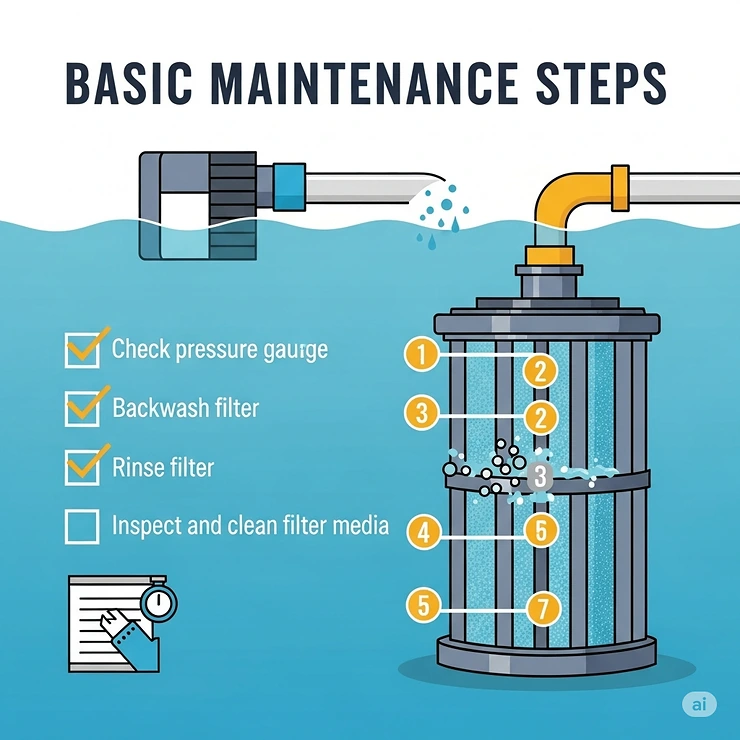
First week: Note your clean starting pressure on the gauge and write it on the tank with a marker. Every future decision hangs on that number. Sand units want backwashing when pressure rises roughly 8 to 10 PSI above baseline, while cartridge units want cleaning at about 5 PSI above baseline.
Monthly:
- Check the air relief valve and O-rings.
- Lubricate lid seals with a pool-safe lubricant.
- Inspect cartridges for flattened pleats.
Common first-30-day mistakes:
- Backwashing too often, which actually makes sand filter performance worse by removing the debris layer that helps catch fine particles.
- Forgetting to bleed air after opening a cartridge tank.
- Running a pump that outpaces the filter’s maximum GPM.
- Skipping the baseline pressure note.
Cartridge owners should keep a spare set of elements so cleaning day never means a dirty, cloudy pool. DE owners should keep a clearly labeled bucket of pool-grade DE near the pad.
Real-World Scenarios: Three Backyards, Three Filters
Specs mean little until you attach them to a life. Here are three realistic profiles.
The busy parents. A 16 x 32 pool, roughly 18,000 gallons, heavy kid traffic, and zero interest in equipment. The Hayward SwimClear C4030 fits: huge surface area, no backwashing, and a monthly hose-down. Budget is higher, but time saved is the real return.
The budget-conscious first-timers. A 14 x 28 pool, around 15,000 gallons, with a tight budget. The Hayward ProSeries W3S244T is the logical choice. The sand tank is cheap, rugged and easy to service, and a 1 HP pump delivers enough flow for the volume. Plan for backwashing and learn the valve early.
The clarity enthusiasts. A 20 x 40 pool near big trees, around 30,000 gallons, with owners who love tinkering. The Pentair FNS Plus 60 earns its place. Fine DE grids catch the pollen and silt that slip through sand, and the larger tank handles the volume.
Notice the pattern: no single “best” filter exists. Pool size, tree cover, bather load, and your tolerance for chores decide it. A 30,000-gallon pool with heavy tree cover will punish an undersized filter, while a small, shaded plunge pool will run happily on modest equipment.
Problem to Solution: Fixing the Most Common Filter Headaches
Problem 1: Cloudy water despite constant filtering. Check that the filter matches your pump flow. If a Hayward ProSeries W3S244T is feeding a pool far beyond its design, upgrading to a Pentair Sand Dollar SD80 or a cartridge unit usually helps.
Problem 2: Sand blowing back into the pool. This almost always signals a cracked lateral or a worn standpipe, not bad sand. Replacing laterals is cheaper than replacing the tank.
Problem 3: Pressure climbs quickly. On cartridge systems, that means dirty or collapsed pleats. On sand systems, it means channeling or exhausted media. Hayward’s guidance is to replace sand once backwashing no longer drops pressure or intervals shorten dramatically.
Problem 4: Water chemistry feels harder to manage. Poor filtration forces sanitizer to do extra work. The CDC’s pool guidance overview on sanitation and the general science summarized there reinforce that circulation and filtration support chemical balance, not replace it.
Problem 5: Constant leaks at the lid. Replace or relubricate the O-ring before you replace anything bigger. It’s a five-dollar fix that’s often misdiagnosed as a cracked tank.
How to Choose the Best Pool Filters for Inground Pools
- Calculate your required GPM. Divide pool volume by turnover hours, then by 60. A 24,000-gallon pool on an 8-hour cycle needs about 50 GPM. Pick a filter rated comfortably above that.
- Match the filter to your pump. A filter’s maximum flow should exceed your pump’s output at operating head, or you’ll choke the system.
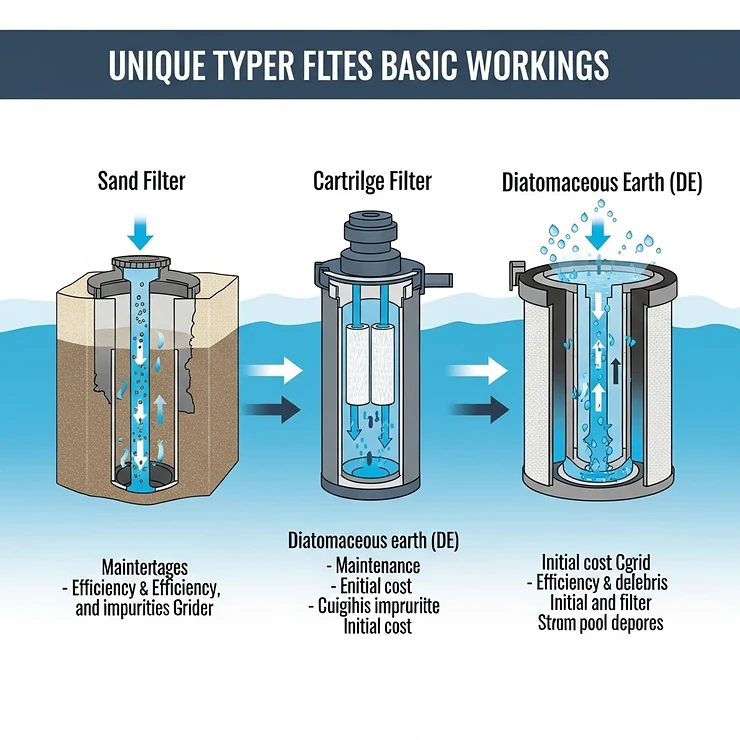
- Pick the filtration level you want. Sand is the coarsest, cartridge is mid-range, and DE is finest. More fineness usually means more routine.
- Be honest about maintenance. If you will genuinely backwash and recharge DE, great. If not, cartridge or sand protects you from yourself.
- Check your space. Measure vertical clearance and pad footprint, especially for tall cartridge units.
- Budget for the long run. Include sand, DE powder, replacement cartridges and the water lost to backwashing, not just the sticker price.
That sequence usually narrows seven options to two within minutes. The remaining decision comes down to routine versus budget.
Best Pool Filter Sand: What to Put Inside a Sand Tank
Choosing the best pool filter sand matters as much as the tank itself, yet it’s the part buyers skip.
The standard answer is #20 silica sand, a sharp, graded grain whose jagged edges trap debris. Hayward support specifically states it recommends only #20 silica in its sand filters. The company doesn’t recommend filter balls or other substitutes. Because media can affect warranty questions, it’s wise to check your manufacturer’s guidance first.
Quantity is simple. The Hayward ProSeries W3S244T takes 300 pounds, which is six 50-pound bags. The Pentair Sand Dollar SD80 takes 350 pounds, or seven bags. Bags commonly sell around $25 to $30 each, so a full fill generally lands in the $150–$210 range.
Alternatives exist. Glass media and zeolite are sold as upgrades claiming finer filtration and less backwashing, but they cost more, and results vary by product. Treat those claims cautiously and confirm compatibility with your tank.
When should sand be replaced? Don’t go by the calendar alone. Replace it when backwashing stops lowering pressure or intervals shrink noticeably. Many owners get several years out of a fill, depending on use and water chemistry.
Pro tip: buy fresh sand rather than leftover bags with unknown storage histories. The best pool filter sand is the cleanest, correctly graded sand you can find, poured slowly and rinsed well.
Sand vs. Cartridge vs. DE: A Written Comparison
| Factor | Sand | Cartridge | DE |
|---|---|---|---|
| Typical filtration | roughly 20–40 microns | roughly 10–15 microns | roughly 1–5 microns |
| Cleaning method | Backwash | Hose rinse | Backwash and recharge |
| Water used for cleaning | High | Minimal | High |
| Upfront cost | Lowest | Mid to high | Highest |
| Best For | Budget buyers | Low-effort owners | Clarity seekers |
Sources vary a bit on exact micron figures, so treat them as ranges, not guarantees. The ordering never changes, though: DE is finest, cartridge is middle, and sand is coarsest.
Looking at the comparison, cartridge units like the Hayward SwimClear C4030 hit the best balance for most families. They filter finer than sand and need no backwash. DE shines when the water’s appearance matters more than your free time. Sand remains the most forgiving, cheapest-to-run option, which is why a Hayward ProSeries W3S244T is still a perennial favorite.
Backwashing is the hidden variable. Each backwash sends gallons down the drain, and in some areas it’s restricted, so check local rules.
Common Mistakes When Buying Inground Pool Filters
Buying on price alone. A cheap tank that’s too small ends up costing more in chemicals, pump strain and frustration.
Ignoring pump compatibility. Pair a powerful pump with an undersized filter and you’ll push water through faster than the media can clean it.
Forgetting vertical clearance. The Pentair Clean & Clear Plus CCP520 can reach about 74 inches of needed headroom. Measure first.
Assuming DE is always better. It filters finest, but only if you maintain it. A neglected DE system often performs worse than a cared-for cartridge unit.
Skipping the hidden costs. Sand, DE powder, replacement elements and wasted water belong in your budget.
Buying the wrong sand. Beach, playground or “all-purpose” sand won’t work. Pool-grade #20 silica is the standard.
Overlooking local backwash rules. Some regions limit discharge, which tilts the decision toward cartridge.
Long-Term Cost and Maintenance
| Filter Type | Upfront Range | Ongoing Costs | Long-Term Value |
|---|---|---|---|
| Sand (Hayward ProSeries W3S244T, Pentair Sand Dollar SD80) | $700–$900 | Sand every several years, water for backwashing | Excellent for budget buyers |
| Cartridge (Hayward SwimClear C4030, Pentair Clean & Clear Plus CCP520, Waterway ClearWater II FC1507) | $400–$1,700 | Replacement elements, minimal water | Strong for low-effort owners |
| DE (Pentair FNS Plus 60, Hayward Perflex W3EC75A) | $1,100–$1,500 | DE powder, grid replacement, backwash water | Best clarity, highest routine |
Total cost of ownership shifts the picture. A sand tank is cheapest on day one, but the water and sand add up over a decade. Cartridge systems cost more initially, though they save water and labor, and replacement elements are a predictable expense. DE sits at the top on price and effort, which is worth it only if clarity is truly your goal.
For most owners, the gap between sand and cartridge closes after several seasons. If you plan to keep the pool for years, a cartridge system like the Hayward SwimClear C4030 can quietly win on lifetime value.
Features That Actually Matter (And Those That Don’t)
Features that matter:
- Filtration area or sand depth. More area means longer cycles.
- Flow rating. It must exceed your pump’s output.
- Valve quality. A smooth multiport valve saves headaches for years.
- Drain access. Large drains make winterizing painless, which the Pentair Sand Dollar SD80 does well.
- Pressure gauge and air relief. Cheap to include, vital for monitoring.
Features that don’t matter as much:
- Fancy colors. They’re cosmetic.
- Marketing buzzwords. “Revolutionary” and “ultra-premium” mean little without published specs.
- Tiny micron differences. Whether a cartridge filters at 10 or 15 microns rarely changes what you see.
The rule of thumb: pay for surface area, flow capacity and durability, and ignore the packaging.
Best Pool Filters for Inground Pools for Specific Audiences
Beginners. Start with a sand unit like the Hayward ProSeries W3S244T. It’s forgiving, inexpensive and easy to troubleshoot.
Busy households. Choose cartridge, such as the Hayward SwimClear C4030, so cleaning is a quick monthly rinse.
Small plunge pools. The Waterway ClearWater II FC1507 keeps costs low without overbuying capacity.
Large, tree-shaded pools. Consider the Pentair Sand Dollar SD80 for sand or the Pentair Clean & Clear Plus CCP520 for cartridge. Both offer capacity to handle heavy debris.
Water-clarity perfectionists. The Pentair FNS Plus 60 or Hayward Perflex W3EC75A deliver the finest filtration, provided you keep up with the DE routine.
Water-restricted regions. Cartridge is the safest bet because it avoids backwash discharge.
Match the filter to the household, not the other way around.
FAQ
❓ How long should I run my inground pool filter each day?
❓ Can I upgrade from sand to cartridge on the same plumbing?
❓ Why does my filter pressure spike right after cleaning?
❓ Is a bigger filter always better for my pool?
❓ Should I drain the filter tank for winter?
Conclusion: Pick the Routine You’ll Actually Keep
There’s no magic filter, only a match between your pool, your pump, your budget and your patience. The best pool filters for inground pools in this guide span three technologies for a reason.
If you want low drama and reliable value, the Hayward ProSeries W3S244T and Pentair Sand Dollar SD80 deliver proven sand filtration, and choosing the best pool filter sand keeps them performing. If hose-and-go maintenance appeals, the Hayward SwimClear C4030 and Pentair Clean & Clear Plus CCP520 offer large cartridge capacity. Smaller pools can lean on the Waterway ClearWater II FC1507, while clarity lovers have the Pentair FNS Plus 60 and Hayward Perflex W3EC75A.
Start with your GPM math, confirm vertical clearance, be honest about maintenance, and budget for sand, DE or cartridge replacements. Do that, and your filter will quietly earn its keep for years.
✨ Don’t Miss These Exclusive Deals!
🔍 Take your pool care to the next level with these carefully selected filters. Click on any highlighted product to check current pricing and availability. These picks will help you create the sparkling, swim-ready water your family will love! 🏊♂️💧
Recommended for You
- Best Pool Pump: 7 Proven Picks to Slash Energy Bills in 2026
- Above Ground Swimming Pool Lighting: 7 Brilliant Picks for 2026
- Pool Sand Filters for Above Ground Pools: 7 Smart Picks (2026)
Disclaimer: This article contains affiliate links. As an Amazon Associate, I earn from qualifying purchases. If you purchase products through these links, we may earn a small commission at no additional cost to you.
✨ Found this helpful? Share it with your friends! 💬🤗
