
In This Article
The Peloton Tread starts at around $2,700, but here’s what the marketing brochure won’t tell you: that’s just the entry fee. Add in the mandatory $44/month All-Access membership, and you’re looking at an additional $1,584 over three years. That’s $4,284 total before you’ve logged your first mile.
What most buyers overlook is this: the treadmill you bought won’t work without paying monthly rent on features that should be yours from day one. No subscription? Your $2,700 machine becomes a glorified clothes rack with a locked touchscreen.
The good news? Connected fitness has evolved beyond Peloton’s walled garden. In 2026, you can get comparable streaming platforms, automatic incline control, immersive workout content, and robust build quality without signing away your paycheck every month. The treadmills we’re covering today range from around $500 to $2,300, and several require zero monthly fees to access their full feature sets.
According to the CDC’s Physical Activity Guidelines, adults need at least 150 minutes of moderate-intensity aerobic activity per week. A quality home treadmill makes hitting that target achievable regardless of weather, schedule, or gym access—but only if the economics actually work for your household long-term.
Let’s break down seven peloton tread alternatives that deliver where it counts: motor power, running surface, subscription flexibility, and total cost of ownership.
Quick Comparison: Top Peloton Tread Alternatives at a Glance
| Model | Motor Power | Running Surface | Incline/Decline | Screen Size | Subscription Required? | Price Range | Best For |
|---|---|---|---|---|---|---|---|
| NordicTrack Commercial 1750 | 3.8 CHP | 22″ x 60″ | 12% / -3% | 16″ touchscreen | Optional (iFIT) | $1,800-$2,000 | Serious runners wanting global routes |
| SOLE F85 | 4.0 CHP | 22″ x 60″ | 15% / -6% | 15.6″ touchscreen | No | $2,200-$2,400 | Marathon trainers needing durability |
| SOLE F80 | 3.5 CHP | 22″ x 60″ | 15% / 0% | 10.1″ touchscreen | No | $1,700-$1,900 | Budget-conscious serious runners |
| ProForm Pro 2000 | 3.5 CHP | 22″ x 60″ | 15% / -3% | 10″ touchscreen | Optional (iFIT) | $1,100-$1,400 | Value seekers with iFIT interest |
| Horizon Fitness 7.4 AT | 3.5 CHP | 22″ x 60″ | 15% / 0% | Device holder (no screen) | No | $900-$1,100 | App-agnostic fitness enthusiasts |
| Bowflex Treadmill 10 | ~4.0 HP (est.) | 22″ x 60″ | 15% / -5% | 10″ touchscreen | Optional (JRNY) | $1,900-$2,100 | Streaming entertainment fans |
| Sunny Health SF-T7705 | 2.5 HP | 49″ x 15.5″ | 15% / 0% | LCD monitor | Optional (SunnyFit) | $500-$700 | Beginners or space-limited users |
Looking at the comparison above, the SOLE F85 and SOLE F80 deliver exceptional value for runners who want gym-quality performance without recurring fees. The 15.6-inch touchscreen on the F85 comes preloaded with Netflix, YouTube, and Disney+ at no subscription cost—something Peloton won’t give you even after paying $44/month. If hill training is your priority, both SOLE models offer steeper inclines than Peloton’s 12.5% maximum, and the F85’s -6% decline capability trains eccentric muscle strength that Peloton’s flat-bottom range can’t touch. Budget-conscious buyers should note that the Horizon 7.4 AT and Sunny Health SF-T7705 sacrifice touchscreen size and streaming apps for aggressive price points, but they deliver solid mechanical performance where it counts.
💬 Just one click — help others make better buying decisions too!😊
Top 7 Peloton Tread Alternatives: Expert Analysis
1. NordicTrack Commercial 1750 — The iFIT Integration Champion
The NordicTrack Commercial 1750 bridges the gap between Peloton’s immersive content experience and the subscription flexibility most buyers actually want. This machine sits in the $1,800-$2,000 range depending on sales, positioning it around $700 below Peloton’s base model while offering comparable smart features.
Motor & Performance: The 3.8 CHP motor handles sustained speeds up to 12 MPH without the whine or vibration you’ll find in underpowered alternatives. What matters more than the spec sheet number is how it performs during interval work—the Commercial 1750 transitions from recovery pace to sprint intervals without the lag that breaks your flow. Peloton’s motor hits similar numbers, but you’re not paying Peloton’s brand premium here.
Expert Take: This treadmill is best for runners who want iFIT’s automatic hardware control (the treadmill adjusts incline and speed based on instructor cues) but don’t want to commit to monthly payments forever. Here’s the key distinction most reviewers miss: iFIT is optional. You can use this treadmill in manual mode without paying a dime, then subscribe for a month when you want structured training blocks, then cancel. Peloton doesn’t let you do that—their subscription is functionally mandatory.
Customer Feedback: Users consistently praise the 16-inch pivoting touchscreen and the RunFlex cushioning system, which reduces joint impact compared to running on asphalt. Complaints center on assembly complexity (expect 2-3 hours) and iFIT’s occasional connectivity hiccups.
Pros:
✅ 12% incline to -3% decline (more range than Peloton’s 12.5% max incline)
✅ Massive 16″ touchscreen with pivot capability for floor workouts
✅ iFIT subscription is optional, not mandatory
Cons:
❌ Requires iFIT subscription ($39/month) to access automatic adjustments
❌ Assembly is time-intensive
Price & Value Verdict: In the $1,800-$2,000 range, you’re getting Peloton-caliber hardware with subscription flexibility. Over three years, you’ll save around $1,500 compared to Peloton even if you keep iFIT the whole time.
2. SOLE F85 — The Subscription-Free Powerhouse
The SOLE F85 is what happens when a treadmill manufacturer decides to compete on substance rather than hype. This machine has been SOLE’s flagship folding treadmill for years, and the 2026 model proves why it keeps winning comparisons.
Motor & Deck: The 4.0 CHP commercial motor is the highest horsepower in SOLE’s lineup, and you can feel it. This isn’t just marketing—the motor stays whisper-quiet even at 12 MPH with a 200-pound runner pounding away. The 22″ x 60″ deck matches Peloton’s dimensions, but the Cushion Flex Whisper Deck reduces joint impact by up to 40% compared to outdoor running—a feature Peloton’s standard belt can’t match.
Expert Take: The F85 is built for marathon trainers and heavy users who need commercial-grade durability without commercial-grade pricing. The 15% incline and -6% decline capabilities outclass Peloton’s range, enabling proper hill training and downhill eccentric work that builds quad strength and prepares your body for race-day terrain. What most buyers miss is the Z-shaped frame design—those aren’t just aesthetic. The geometry extends motor life and reduces maintenance needs compared to traditional H-frames.
The Subscription Edge: Here’s where SOLE fundamentally differs from Peloton: the 15.6″ touchscreen comes preloaded with Netflix, YouTube, Disney+, Hulu, Amazon Prime, and Spotify—all accessible via WiFi without any subscription. Screen mirroring lets you cast the Peloton App, Zwift, Apple Fitness+, or any other platform directly to the display. You get Peloton’s content when you want it, on your terms, without Peloton’s monthly fee. The free SOLE+ App provides hundreds of additional classes if you want structured programming.
Customer Feedback: Buyers love the “built like a tank” solidity—this 300+ pound machine doesn’t wobble during sprints. The most common praise? “I should have bought this years ago instead of throwing money at a gym membership I never used.” Criticisms are minor: the screen isn’t as crisp as Peloton’s for streaming apps, and the 82.5″ length when unfolded means it won’t fit in tight spaces.
Pros:
✅ 4.0 HP motor—gym-quality power
✅ 15% incline / -6% decline (Peloton stops at 12.5% incline with no decline)
✅ 375 lb capacity (75 lbs more than Peloton)
✅ Zero subscription required for full functionality
✅ Lifetime frame and motor warranty
Cons:
❌ Large footprint (82.5″ length)
❌ Short handrails for stability
Price & Value Verdict: Around $2,200-$2,400, the F85 costs less than Peloton’s base price and saves you $1,584 over three years in subscription fees. You’re looking at $3,500+ in total savings over the Peloton Tread while getting superior incline/decline range and higher weight capacity.
3. SOLE F80 — The Smart Budget Pick
The SOLE F80 is essentially the F85’s younger sibling with a slightly smaller motor and screen. In the $1,700-$1,900 range, this treadmill delivers about 90% of the F85’s performance at 75% of the price.
Motor & Build: The 3.5 CHP motor handles speeds up to 12 MPH and supports a 350 lb weight capacity—still 50 lbs higher than Peloton’s 300 lb limit. What you’re giving up compared to the F85 is the decline capability (F80 has incline only, no decline) and motor headroom for very heavy users or ultra-intense training.
Expert Take: This is the treadmill for serious runners who train 4-5 days a week but don’t need commercial-gym specs. The 10.1″ touchscreen (down from the F85’s 15.6″) still provides access to Netflix, YouTube, and all the streaming apps, plus screen mirroring for your preferred training platform. The sweet spot buyer here is someone who wants the no-subscription freedom and solid build quality but can save $500 by accepting a slightly smaller screen and no decline function.
Customer Feedback: Reviewers consistently rate the F80 as one of the best treadmills under $2,000, citing the whisper-quiet motor and the Easy Assist folding system that makes storage painless. One verified buyer noted: “I’m 6’4″, 300 lbs, and this treadmill handles me without any wobble at walking or running pace.”
Pros:
✅ 3.5 HP motor—plenty of power for most runners
✅ 15% incline capability
✅ No subscription required
✅ Lifetime frame and motor warranty
Cons:
❌ No decline capability (unlike the F85)
❌ Smaller screen (10.1″ vs F85’s 15.6″)
Price & Value Verdict: At $1,700-$1,900, you’re saving $800-$1,000 compared to Peloton’s base price, plus the $1,584 in subscription fees over three years. Total savings: $2,400-$2,600. For most home runners, this is the rational choice.
4. ProForm Pro 2000 — The iFIT Value Entry
The ProForm Pro 2000 competes directly with NordicTrack (both brands are owned by the same parent company) but targets budget-conscious buyers who still want smart features. In the $1,100-$1,400 range, this is one of the most affordable ways to access iFIT’s trainer-led content and automatic hardware adjustments.
Motor & Specs: The 3.5 CHP motor delivers smooth performance up to 12 MPH, with a 22″ x 60″ running surface that accommodates tall runners. The 15% incline and -3% decline range enables terrain simulation, though it falls short of the SOLE F85’s -6% decline. The 10″ HD touchscreen provides access to iFIT’s library of global workouts where trainers control your speed and incline automatically.
Expert Take: This treadmill makes sense for two buyer profiles: (1) beginners who want iFIT’s hand-holding and motivation but aren’t ready to invest $2,000+, and (2) experienced runners who plan to use iFIT seasonally (subscribe for winter training blocks, cancel in summer when they’re running outdoors). What the spec sheet won’t tell you: ProForm’s build quality is a step down from NordicTrack and SOLE. The frame feels lighter, and long-term durability reports show more service issues after 3-4 years of heavy use. But at this price point, that’s the trade-off.
Customer Feedback: Users appreciate the value proposition—getting automatic incline/decline control and a 10-year frame warranty for around $1,200. Complaints focus on the iFIT requirement (many buyers don’t realize the treadmill’s smart features are locked behind the subscription) and assembly frustrations.
Pros:
✅ Most affordable way to access iFIT’s automatic controls
✅ 15% incline / -3% decline
✅ 10-year frame warranty
Cons:
❌ Requires iFIT subscription to unlock smart features
❌ Build quality is lighter than SOLE or NordicTrack Commercial series
Price & Value Verdict: Around $1,100-$1,400 makes this the budget champion for iFIT enthusiasts, saving you $1,300+ versus Peloton before accounting for subscription costs.
5. Horizon Fitness 7.4 AT — The App-Agnostic Athlete’s Choice
The Horizon Fitness 7.4 AT takes a different approach than every other treadmill on this list: it doesn’t try to lock you into any ecosystem. No proprietary screen, no subscription push, just a rock-solid machine designed to work with whatever app you prefer.
Motor & Performance: The 3.5 CHP motor and 500 lb thrust incline motor create what Horizon calls “the most responsive drive system available.” The 22″ x 60″ deck features 3-Zone Variable Response Cushioning that adjusts flex and support through different phases of your stride. Top speed hits 12 MPH with 15% incline capability.
Expert Take: This is the treadmill for runners who already have a training app they love (Zwift, Peloton app, Apple Fitness+, Runkeeper, etc.) and just want a stable platform that gets out of the way. The built-in device holder securely holds your tablet or phone, and advanced Bluetooth connectivity syncs with your device for crisp stereo sound through integrated speakers. The Sprint 8 HIIT program is built-in and proven to burn up to 27% body fat in eight weeks—a rare feature at this price point. What you won’t find: a flashy touchscreen or streaming apps. Horizon assumes you’ll bring your own device, which lets them engineer a more durable machine at a lower price.
Customer Feedback: Reviewers praise the stability and quiet operation. One marathon trainer noted: “This treadmill doesn’t shake at all during hard interval work, which is more than I can say for the Peloton at my gym.” Criticisms center on the lack of a built-in screen—buyers who want an all-in-one solution will be disappointed.
Pros:
✅ Works with any app (Peloton, Zwift, Apple Fitness+, etc.)
✅ No subscription fees
✅ Advanced Bluetooth connectivity
✅ Sprint 8 HIIT program built-in
Cons:
❌ No built-in touchscreen
❌ Requires you to bring your own device
Price & Value Verdict: In the $900-$1,100 range, you’re saving around $1,600 versus Peloton’s base price, plus all future subscription costs. If you already have a tablet and a preferred training app, this is pure value.
6. Bowflex Treadmill 10 — The Entertainment Streaming Specialist
The Bowflex Treadmill 10 is Bowflex’s answer to Peloton’s content-first approach, but with one key differentiator: you can stream Netflix, Hulu, Disney+, HBO Max, and Amazon Prime Video directly on the treadmill’s 10″ touchscreen while following JRNY workouts. Peloton doesn’t let you do this—their screen only shows Peloton content unless you use a separate device.
Motor & Deck: Bowflex doesn’t disclose the motor horsepower (rumored to be around 4.0 HP), but user reports confirm it handles heavy runners and high speeds without strain. The 22″ x 60″ ComfortTech deck cushioning absorbs shock effectively, and the 15% incline / -5% decline range supports serious hill training. The 400 lb weight capacity is among the highest in this price class.
Expert Take: This treadmill is built for people who want entertainment and fitness to coexist on one screen. JRNY’s adaptive workouts ($11.99/month or $99/year) adjust based on your performance, but here’s what matters: you can stream Netflix while your workout metrics run in a sidebar, or pause your workout to finish an episode. That’s impossible on Peloton. The Treadmill 10 also integrates seamlessly with Zwift and other apps via Bluetooth, giving you subscription flexibility. Bowflex’s refusal to disclose motor specs is frustrating, but real-world performance reviews confirm it’s powerful enough for serious training.
Customer Feedback: Users love the dual-screen functionality and the SoftDrop folding system that makes storage easy. The most common praise: “I can finally watch my shows while working out without needing a separate tablet.” Complaints include the 336 lb weight (this is a beast to move) and the lack of motor specification transparency.
Pros:
✅ Stream Netflix, Hulu, Disney+ directly on treadmill screen while working out
✅ 15% incline / -5% decline
✅ 400 lb weight capacity
✅ JRNY is optional, not mandatory
Cons:
❌ Heavy (336 lbs)
❌ Motor specs not disclosed
Price & Value Verdict: Around $1,900-$2,100 puts this close to Peloton’s base price, but you’re getting entertainment streaming that Peloton won’t provide, plus a higher weight capacity. JRNY’s $11.99/month is significantly cheaper than Peloton’s $44/month if you choose to subscribe.
7. Sunny Health & Fitness SF-T7705 SMART — The Budget-Friendly Entry Point
The Sunny Health & Fitness SF-T7705 SMART is proof that connected fitness doesn’t require a four-figure investment. In the $500-$700 range, this treadmill delivers automatic incline, Bluetooth app connectivity, and enough performance for beginners and walkers.
Motor & Build: The 2.5 HP motor tops out at 9 MPH—fine for brisk walking and light jogging but underpowered for serious runners. The 49″ x 15.5″ running surface is noticeably smaller than the 60″ decks on premium models, which may feel cramped for tall users or those with long strides. The 15 automatic incline levels provide variety, and the 220 lb weight capacity handles most users (though it’s 80-180 lbs lower than the premium options).
Expert Take: This is a first treadmill or a supplement to outdoor running for people with tight budgets or limited space. The SunnyFit app provides access to 1,000+ workout videos and real-time metrics via Bluetooth, but don’t expect the polished experience of iFIT or JRNY. The soft-drop folding system and built-in transportation wheels make storage painless, which is critical for apartment dwellers. What you’re sacrificing for the price: build quality, motor power, and running surface size. This won’t replace a gym membership for marathon trainers, but it will get casual exercisers off the couch.
Customer Feedback: Buyers appreciate the quiet operation and ease of assembly. Criticisms focus on the small running deck and the 220 lb weight limit—heavier users report the machine feels unstable.
Pros:
✅ Extremely affordable ($500-$700)
✅ 15 automatic incline levels
✅ SunnyFit app connectivity (optional)
✅ Quiet operation
✅ Easy storage with soft-drop folding
Cons:
❌ Small running surface (49″ x 15.5″)
❌ 220 lb weight capacity
❌ 9 MPH max speed (too slow for serious runners)
Price & Value Verdict: At $500-$700, you’re saving $2,000+ versus Peloton. This is a budget-friendly entry into home fitness, not a Peloton replacement for serious athletes.
How to Choose Your Peloton Tread Alternative: A Decision Framework
Buying a treadmill isn’t about finding the “best” model—it’s about matching your actual needs to the right machine. Here’s how to approach the decision without getting lost in marketing hype.
Step 1: Define Your Training Intensity
Casual walkers and beginner joggers (2-3 days/week, under 5 miles/week): Motors in the 2.5-3.0 HP range are sufficient. The Sunny Health SF-T7705 handles this profile well. You don’t need a 4.0 HP commercial motor if you’re walking at 3 MPH for 30 minutes.
Regular runners (3-5 days/week, 10-20 miles/week): Look for 3.5+ CHP motors and 22″ x 60″ running surfaces. The SOLE F80, ProForm Pro 2000, and Horizon 7.4 AT sit in this sweet spot. These machines can handle sustained moderate-intensity work without overheating or excessive wear.
Serious athletes and marathon trainers (5+ days/week, 25+ miles/week): You need 4.0 HP motors, commercial-grade frames, and high weight capacities. The SOLE F85 and potentially the Bowflex Treadmill 10 are your targets. Don’t compromise here—underpowered machines will fail under consistent heavy use.
Step 2: Determine Your Subscription Tolerance
Subscription-free preference: SOLE F80, SOLE F85, and Horizon 7.4 AT require zero monthly fees to access full functionality. You own the machine outright with no ongoing costs.
Flexible subscription interest: NordicTrack Commercial 1750, ProForm Pro 2000, and Bowflex Treadmill 10 work in manual mode without subscriptions but unlock additional features with optional memberships. You can subscribe during training blocks and cancel off-season.
Content-dependent training: If you absolutely need instructor-led classes with automatic hardware adjustments, iFIT-compatible machines (NordicTrack, ProForm) or JRNY (Bowflex) make sense. Just calculate the three-year total cost before buying.
Step 3: Assess Your Space and Portability Needs
Space-constrained: All models except the Sunny Health SF-T7705 require similar floor space when in use (roughly 80″ x 35″). The critical difference is weight. Models under 250 lbs (Sunny Health, ProForm Pro 2000) are easier to relocate. Models over 300 lbs (SOLE F85, Bowflex Treadmill 10) need a permanent home.
Folding requirement: Every model on this list folds except the Bowflex Treadmill 22 (not covered here). Check the folded dimensions—some “folding” treadmills still stand 70″+ tall when upright.
Step 4: Match Screen Size to Your Usage
No screen needed: If you’ll stream workouts from your phone or tablet anyway, the Horizon 7.4 AT saves you money by skipping the built-in display.
10″ is enough: For most users, a 10″ touchscreen (SOLE F80, ProForm Pro 2000, Bowflex Treadmill 10) provides adequate visibility for metrics and casual streaming.
Go big for immersion: The NordicTrack Commercial 1750 (16″) and SOLE F85 (15.6″) deliver larger screens that make content easier to follow without squinting.
Step 5: Calculate True Total Cost of Ownership
Don’t just compare sticker prices. Factor in:
- Subscription costs over 3 years: Peloton = $1,584. iFIT = $1,404 (at $39/month). JRNY = $431 (at $11.99/month). SOLE/Horizon = $0.
- Delivery and assembly: Some brands charge $200-$300 for white-glove delivery. DIY assembly takes 2-4 hours on average.
- Warranty coverage: Lifetime frame/motor warranties (SOLE) vs 10-year frames (NordicTrack, ProForm) vs 15-year frames (Bowflex). Parts and labor coverage varies significantly.
Real-World Usage Scenarios: Which Treadmill for Which Runner?
Scenario A: The Postpartum Runner Rebuilding Mileage
Profile: 32-year-old mom, former half-marathoner, currently walking 2-3 miles daily with gradual return to running. Budget: $1,500-$2,000. Needs: Joint-friendly cushioning, flexible training options, ability to stream shows during long walks.
Best Match: SOLE F80 The Cushion Flex Whisper Deck reduces impact by 40% versus outdoor surfaces—critical for postpartum recovery. The 10.1″ touchscreen streams Netflix and other apps without subscription fees, and the 350 lb weight capacity provides stability. As mileage increases, the 15% incline supports hill training without leaving home. The $1,700-$1,900 price point fits budget while leaving room for a jogging stroller if needed.
Scenario B: The Corporate Remote Worker Combating Sitting Disease
Profile: 45-year-old software engineer working from home, needs to break up 8-hour desk sessions, not training for races but wants consistent movement. Budget: $800-$1,200. Needs: Quiet operation for Zoom calls, ease of use, low commitment.
Best Match: Horizon Fitness 7.4 AT The whisper-quiet motor won’t interrupt meetings, and the Bluetooth connectivity lets them stream podcasts or take walking meetings. The no-subscription model means they can hop on whenever without feeling pressure to “get their money’s worth.” The Sprint 8 HIIT program provides structure for days when they want intensity. At $900-$1,100, it’s a rational investment for health without overthinking.
Scenario C: The Competitive Age-Group Triathlete
Profile: 38-year-old triathlete training year-round, needs interval workouts with precise incline/decline control, runs 30-40 miles weekly in training season. Budget: $2,000-$2,500. Needs: Commercial-grade durability, advanced terrain simulation, integration with Zwift and TrainingPeaks.
Best Match: SOLE F85 The 4.0 HP motor handles sustained high-intensity intervals without overheating. The -6% decline capability builds eccentric quad strength for race-day downhills—something most home treadmills can’t provide. Screen mirroring supports Zwift connectivity for virtual race training, and the 375 lb weight capacity ensures zero wobble during sprint efforts. The lifetime motor warranty matters when you’re logging 1,500+ miles annually. At $2,200-$2,400, the F85 delivers commercial gym specs without commercial gym prices.
Common Mistakes When Buying Peloton Tread Alternatives
Mistake #1: Prioritizing Screen Size Over Motor Power A 22″ touchscreen means nothing if the motor can’t sustain your training intensity. Motor power determines longevity and performance, especially for heavier users and high-mileage runners. Don’t let flashy screens distract you from what actually matters under the hood.
Mistake #2: Ignoring Weight Capacity Weight capacity isn’t just about whether the machine can hold you—it’s about frame stability and durability. A treadmill rated for 300 lbs will feel shakier for a 250 lb user than a machine rated for 400 lbs at the same weight. Buy 50-100 lbs above your actual weight for better stability.
Mistake #3: Underestimating Subscription Costs Always calculate the three-year total cost, not just the upfront price. A $1,200 treadmill with a mandatory $39/month subscription costs $2,604 over three years. A $2,000 treadmill with no subscription costs $2,000. The “cheaper” option just cost you $604 more.
Mistake #4: Assuming “Folding” Means Compact Most folding treadmills stand 60-80 inches tall when folded and weigh 250-350 lbs. That’s not “compact”—it’s vertical storage. Measure your space before buying and account for the footprint in both positions.
Mistake #5: Buying Based on Brand Hype Instead of Specs Peloton’s brand is powerful, but you’re paying a premium for marketing and ecosystem lock-in. Compare actual motor power, running surface dimensions, incline/decline range, and warranty terms. Often, the less-hyped brands deliver better specs at lower prices.
What to Expect: Real-World Performance Insights
Motor Noise Levels
Commercial-grade motors (3.5+ CHP) should be whisper-quiet at walking pace and no louder than normal conversation at running speeds. If your treadmill sounds like a lawn mower, something’s wrong. The SOLE F80/F85 and NordicTrack Commercial 1750 consistently receive praise for quiet operation. The Sunny Health SF-T7705 is surprisingly quiet given its price point.
Cushioning Reality Check
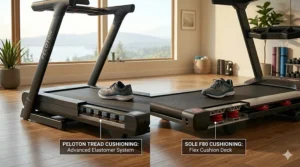
All manufacturers claim “cushioning systems” that reduce joint impact. What matters is the cushioning type and deck construction. SOLE’s Cushion Flex Whisper Deck, NordicTrack’s RunFlex, and Bowflex’s ComfortTech use multi-zone cushioning that firms up at toe-off (for energy return) and softens at heel strike (for impact reduction). Cheap treadmills use uniform padding that feels “mushy” and slows you down.
Screen Quality for Streaming
If you’re planning to stream Netflix or YouTube while running, know that not all touchscreens are created equal. The SOLE F85’s 15.6″ display and NordicTrack’s 16″ screen offer decent streaming quality, but they’re not iPad-level clarity. If pristine video quality matters, you might prefer the Horizon 7.4 AT approach: use your own tablet with its superior screen.
Assembly Time
Budget 2-4 hours for DIY assembly on any treadmill over $1,000. Some brands (NordicTrack, Bowflex) offer white-glove delivery and assembly for an extra fee ($200-$300). If you’re not mechanically inclined, that fee is worth every penny—treadmill assembly involves heavy components and precise alignment.
Long-Term Cost & Maintenance Analysis
Total Cost of Ownership: 5-Year Comparison
Peloton Tread:
- Base price: $2,695
- Subscription (60 months @ $44/month): $2,640
- 5-year total: $5,335
SOLE F85 (No Subscription):
- Base price: $2,300
- Subscription: $0
- Belt lubrication kit ($30/year × 5): $150
- 5-year total: $2,450
- Savings vs Peloton: $2,885
NordicTrack Commercial 1750 (With Optional iFIT):
- Base price: $1,900
- iFIT subscription if used full-time (60 months @ $39/month): $2,340
- 5-year total with iFIT: $4,240
- 5-year total without iFIT: $1,900
- Savings vs Peloton (with iFIT): $1,095
- Savings vs Peloton (without iFIT): $3,435
Bowflex Treadmill 10 (With Optional JRNY):
- Base price: $2,000
- JRNY subscription if used full-time (60 months @ $11.99/month): $719
- 5-year total with JRNY: $2,719
- 5-year total without JRNY: $2,000
- Savings vs Peloton (with JRNY): $2,616
- Savings vs Peloton (without JRNY): $3,335
Maintenance Requirements
Annual maintenance for all treadmills:
- Belt lubrication: Every 3 months or 40 hours of use. Cost: $8-$10 per application.
- Belt alignment check: Monthly visual inspection, adjustment as needed (DIY, no cost).
- Deck cleaning: Wipe down after each use to prevent dust buildup. Cost: $0.
- Bolt tightening: Every 6 months. Cost: $0 (requires allen wrench set).
Parts replacement over 5 years (estimates):
- Running belt: $150-$300 (typically needed after 3,000-5,000 miles)
- Motor brushes: $50-$100 (if motor uses brushes; many modern motors are brushless)
Warranty coverage matters here. SOLE’s lifetime motor warranty means you won’t pay for motor failures. NordicTrack and ProForm’s 10-year frame warranties are solid. Bowflex’s 15-year frame warranty is excellent. Sunny Health’s 3-year frame warranty is the shortest and reflects its budget positioning.
Features That Actually Matter (And Those That Don’t)
Critical Features:
✅ Motor Power (3.5+ CHP for runners): Determines longevity and performance
✅ Running Surface (22″ × 60″ minimum for runners): Prevents feeling cramped
✅ Incline Range (12%+ minimum): Necessary for hill training
✅ Weight Capacity (50-100 lbs above your weight): Ensures stability
✅ Warranty (Lifetime motor, 10+ year frame): Protects your investment
Nice-to-Have Features:
🔹 Decline Capability: Great for serious runners; not critical for casual users
🔹 Touchscreen Size: Bigger is better, but 10″ is adequate
🔹 Built-in Speakers: Convenient, but most people use headphones
🔹 Heart Rate Monitoring: Useful if you train by HR zones
🔹 Folding Design: Space-saver, but adds weight and complexity
Marketing Fluff (Ignore These):
❌ “HD Touchscreen”: Meaningless without specifying resolution
❌ “Commercial-Grade” (without specs): Pure marketing unless backed by actual motor/frame specs
❌ “Whisper-Quiet”: All decent motors are quiet; this isn’t a differentiator
❌ “Cushioned Deck”: Every treadmill has some cushioning; ask about the system specifics
❌ “Bluetooth Enabled”: Bluetooth is standard in 2026; not a feature, just baseline expectation
Peloton Tread vs Budget-Friendly Smart Treadmills: The Honest Comparison
| Feature | Peloton Tread | SOLE F85 | NordicTrack Commercial 1750 |
|---|---|---|---|
| Base Price | ~$2,695 | $2,200-$2,400 | $1,800-$2,000 |
| Required Subscription | $44/month | None | None (iFIT optional at $39/month) |
| 3-Year Total Cost | $4,279 | $2,300 | $1,900-$3,304 (depending on iFIT) |
| Motor Power | 3.0 HP | 4.0 CHP | 3.8 CHP |
| Running Surface | 20″ × 59″ | 22″ × 60″ | 22″ × 60″ |
| Incline Range | 0-12.5% | 0-15% | 0-12% |
| Decline Range | None | -6% | -3% |
| Screen Size | 24″ | 15.6″ | 16″ |
| Weight Capacity | 300 lbs | 375 lbs | 300 lbs |
| Warranty (Motor) | 12 months | Lifetime | Lifetime |
| Stream Netflix/Apps | No (Peloton content only) | Yes (no subscription) | Via iFIT subscription |
The numbers tell a clear story: Peloton charges a premium for brand recognition and content ecosystem lock-in, but you’re getting less motor power, smaller running surface, no decline capability, and lower weight capacity compared to alternatives that cost $500-$900 less upfront and eliminate subscription fees entirely.
Peloton’s strength is the curated community experience and live classes. If that social motivation is worth $1,584-$2,640 in subscription fees over 3-5 years to you, buy the Peloton. If you want the hardware without the monthly bill, the SOLE F85 or NordicTrack Commercial 1750 deliver comparable or superior specs at lower total cost.
Safety & Regulatory Compliance: What You Need to Know
When shopping for peloton tread alternatives, safety features and industry compliance aren’t optional—they’re essential, especially after Peloton’s high-profile safety recalls in recent years.
Critical Safety Features:
- Emergency Stop Mechanism: All quality treadmills include a safety clip that attaches to your clothing and immediately stops the belt if you fall or step off. This isn’t negotiable—never use a treadmill without attaching the clip.
- Side Rails: Stable handrails on both sides provide support during speed/incline transitions. The rails should extend at least 2/3 the length of the running deck.
- Auto-Stop Technology: Higher-end models (like the Sunny Health SF-T7705 and Bowflex Treadmill 10) include sensors that detect inactivity and automatically pause the belt after 5-10 seconds. This prevents runaway treadmill incidents.
- Belt Speed Limits: Most consumer treadmills cap out at 12 MPH (5-minute mile pace). This protects users from accidentally setting dangerous speeds.
According to the Consumer Product Safety Commission, treadmill injuries send approximately 22,500 people to emergency rooms annually. The most common causes are: loss of balance during speed changes, failure to use the safety clip, children accessing running machines, and placing treadmills too close to walls (resulting in pinch points).
Space Clearance Requirements:
- 3 feet of clearance behind the treadmill (exit space)
- 2 feet on each side (fall zone)
- Minimum ceiling height of 7 feet for average-height users
Child Safety: Never allow children under 12 to operate a treadmill unsupervised. Many newer models (Bowflex Treadmill 10, NordicTrack Commercial 1750) include passcode locks that prevent unauthorized use.
❓ Frequently Asked Questions
❓ Can I use the Peloton app on these cheaper than Peloton treadmill alternatives?
❓ What's the difference between similar to Peloton tread machines and actual commercial treadmills?
❓ Do these budget-friendly smart treadmills require professional assembly?
❓ How long do these alternative streaming platforms last compared to Peloton?
❓ Can I finance these comparable connected fitness treadmills like Peloton offers?
Conclusion: The Smarter Path to Connected Home Fitness
The Peloton Tread revolutionized home fitness by proving people will pay premium prices for immersive content and community. But in 2026, that innovation has been democratized. You no longer need to choose between connected features and financial sanity.
The seven treadmills we’ve analyzed—ranging from $500 to $2,400—deliver motor power, running surface dimensions, incline/decline capabilities, and smart features that match or exceed Peloton’s specs. More importantly, five of them require zero monthly subscription fees, giving you true ownership of the machine you buy.
For most runners, the sweet spot sits at the SOLE F80 ($1,700-$1,900) or SOLE F85 ($2,200-$2,400). Both machines deliver 4.0 CHP motors, commercial-grade construction, lifetime warranties, and built-in streaming apps with no subscriptions. You’re saving $1,000-$1,500 upfront and $1,584 in subscription fees over three years compared to Peloton—a total savings of $2,600-$3,100.
If you want iFIT’s automatic hardware control and global workouts, the NordicTrack Commercial 1750 ($1,800-$2,000) provides that experience with subscription flexibility—use it when you want it, cancel when you don’t. Budget-conscious buyers will find exceptional value in the ProForm Pro 2000 ($1,100-$1,400) or Horizon Fitness 7.4 AT ($900-$1,100), both of which deliver solid performance without subscription lock-in.
The question isn’t whether these alternatives can replace Peloton. They already have for thousands of runners who did the math and realized they were paying for branding, not performance. The question is: are you ready to stop renting features you should own outright?
The CDC recommends 150 minutes of moderate-intensity aerobic activity per week for adult health. A quality treadmill makes hitting that target achievable year-round, but only if the economics make sense for your household long-term. Choose the machine that fits your training needs and budget, not the one with the best marketing department.
Recommended for You
- Peloton Tread vs Tread Plus 2026: 7 Best Alternatives Worth Every Dollar
- 7 Best Peloton Tread Review 2026: Is Premium Worth It?
- 7 Best Compact Treadmill with Incline for Small Spaces 2026
Disclaimer: This article contains affiliate links. As an Amazon Associate, I earn from qualifying purchases. If you purchase products through these links, we may earn a small commission at no additional cost to you.
✨ Found this helpful? Share it with your friends! 💬🤗
