
In This Article
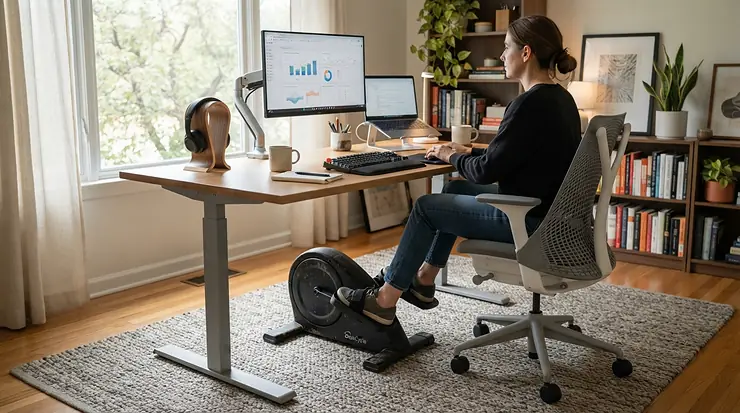
Here’s a confession most desk workers won’t say out loud: by 2 p.m., your legs have basically filed for early retirement. You’ve been upright in spirit, but horizontal in practice, for six straight hours. A seated desk bike is a compact pedal machine — usually magnetic or mechanical resistance, sometimes elliptical-style — that sits under a desk or replaces your office chair so you can pedal while you type, email, or sit through yet another meeting that could’ve been an email. It’s not a substitute for a real workout. It’s something better suited to the actual shape of your day: constant, low-grade movement instead of one heroic hour at the gym followed by nine hours of sitting like a houseplant.
That distinction matters more than marketing copy usually admits. Researchers who study what’s called non-exercise activity thermogenesis — basically, all the energy you burn that isn’t formal exercise — have found it accounts for a surprisingly large chunk of daily calorie burn in people who move often throughout the day, and a shrinking share in people who don’t. A seated desk bike is, in effect, a machine built to manufacture more of that quiet, unglamorous movement, one pedal stroke at a time.
This guide walks through seven real, currently sold models spanning roughly $35 to $400, explains what actually differs between “8 resistance levels” on a cheap unit versus a premium one, and gives you a framework for picking the right seated desk bike for your specific desk, chair, and tolerance for gadgetry. No invented reviews, no fabricated star ratings — just spec comparisons, honestly framed aggregated review sentiment, and straightforward reasoning about who each product actually fits.
Quick Comparison Table: Seated Desk Bikes at a Glance
| Seated Desk Bike | Resistance Type | Best For | Price Range |
|---|---|---|---|
| FlexiSpot Sit2Go FC211 | Mechanical dial | Replacing your office chair entirely | $250–$400 |
| DeskCycle 2 | Magnetic, 8 levels | Very low desks, tight knee clearance | $200–$230 |
| Cubii JR2 | Magnetic, 8 levels | Smooth, elliptical-style motion | $270–$300 |
| YOSUDA Under Desk Bike | Magnetic, multi-level | First-time buyers on a budget | $100–$150 |
| Vaunn Medical Pedal Exerciser | Manual tension knob | Rehab, seniors, absolute simplicity | $35–$95 |
Looking at this snapshot, the split is really about how much machine you want between your foot and the floor. The FlexiSpot Sit2Go FC211 replaces a chair entirely, which is a bigger commitment than the pedal-only options, while the Vaunn Medical Pedal Exerciser asks almost nothing of you — financially or spatially — in exchange for a much simpler workout. If your main obstacle is desk height, the DeskCycle 2‘s low pedal profile solves a problem the others don’t even attempt to fix.
Just one click — help others make better buying decisions too!😊
Top 7 Seated Desk Bikes: Expert Analysis
Picking a winner here depends entirely on what “winner” means to you: quietest, cheapest, smoothest, or most likely to double as an actual office chair. Below, all seven get the same honest treatment — real specs, what those specs mean day to day, and where the aggregated review sentiment lands.
1. FlexiSpot Sit2Go FC211 — office chair and bike in one
The standout here isn’t the pedals, it’s the fact that this thing is a chair first and a bike second, which changes the entire calculation. Instead of parking a separate unit under your existing desk setup, the FlexiSpot Sit2Go FC211 replaces your chair outright, with a breathable mesh backrest and a firm seat cushion sitting atop the pedal mechanism. Its 8 mechanical resistance levels are adjusted via a dial rather than magnets, which tightens cogs and springs to simulate anything from a flat road to a mild uphill grind. The seat height range runs 22.4 to 31.5 inches, and it supports users up to 220 pounds — solid for most home offices, though it’s worth double-checking against your own weight before buying.
Based on the spec comparison with pedal-only competitors, this is the pick for someone who wants zero extra footprint: no bike parked under the desk, no chair-plus-pedaler combo cluttering the floor. Reviewers consistently note that the pedal motion stays quiet even at higher resistance settings, and several call out the seat as genuinely comfortable for a full workday, not just a quick pedal session. A recurring complaint in aggregated feedback is that the LCD calorie tracker has no backlight, making it hard to read under a desk, and a few reviewers mention the seat can feel slightly wobbly at the toughest resistance settings.
Pros:
- ✅ Doubles as a full office chair, no separate footprint
- ✅ Whisper-quiet mechanical resistance even at high tension
- ✅ Breathable mesh backrest holds up through full workdays
Cons:
- ❌ LCD screen has no backlight, hard to read
- ❌ Seat can wobble slightly at maximum resistance
In the $250–$400 range depending on retailer and color, the FlexiSpot Sit2Go FC211 is a genuinely different value proposition than a pedal-only unit — you’re buying a chair replacement, not an accessory, and the price reflects that.
2. DeskCycle 2 — lowest pedal height for tight desks
If your desk sits uncomfortably low, or your knees have ever clipped the underside of a drawer mid-pedal, the DeskCycle 2 solves a problem most competitors ignore. Its adjustable legs bring pedal height down to as little as 9 inches off the ground, and the whole unit fits under desks as low as 25 to 27 inches — a meaningfully lower threshold than most rivals in this list. The 8-level magnetic resistance system, driven by a roughly 29-pound flywheel, produces a smooth, consistent stroke whether you’re barely turning the pedals or leaning into a harder setting.
What most buyers overlook about magnetic resistance versus the mechanical dial on the FlexiSpot chair is that magnetic units tend to feel more linear — level 4 feels like exactly double level 2, rather than a fuzzier mechanical ramp. The detachable 5-function LCD tracks time, distance, calories, and cadence, and syncs with Fitbit and Apple Watch, a small but genuinely useful touch for anyone already tracking daily activity. Reviewers frequently mention that the pedal stroke stays smooth in both directions, though a subset with larger feet report the pedals themselves run a little small, and the unit sits at the pricier end for a pedal-only machine.
Pros:
- ✅ Lowest pedal clearance of any model on this list
- ✅ Smooth, linear magnetic resistance across all 8 levels
- ✅ Syncs with Fitbit and Apple Watch for tracking
Cons:
- ❌ Pedals run small for larger shoe sizes
- ❌ Pricier than most pedal-only competitors
At around $200–$230, the DeskCycle 2 costs more than most pedal exercisers, but for anyone whose real obstacle is desk clearance rather than budget, that premium buys a fit nothing else on this list matches.
3. Cubii JR2 — smoothest elliptical-style stride
Rather than a straight up-and-down pedal stroke, the Cubii JR2 moves your legs in an elliptical arc, which is gentler on the knees for anyone managing joint sensitivity or recovering from a lower-body injury. Its ZeroGravitii flywheel is the headline upgrade over the older JR1 model — 25% lighter and about 10% more compact, while still delivering 8 resistance levels through a manual control knob. The included LCD monitor tracks strides, calories, distance, time, and RPM, and adjustable foot straps (a JR2-exclusive feature in the lineup) keep your feet properly anchored through the stride, something loose pedals on cheaper machines can’t replicate.
Here’s what the spec sheet won’t tell you outright: the elliptical motion means less strain on the front of the knee compared to a straight pedal stroke, which is exactly why physical therapists and rehab patients gravitate toward this style. Cubii’s own product literature cites a clinical study showing a roughly 84.5% increase in seated energy expenditure over 20 minutes of use compared to sitting still — a manufacturer-sourced figure worth treating as directional rather than gospel, but consistent with the general logic of continuous light movement. Reviewers consistently praise how quiet and stable the unit feels, especially compared to earlier Cubii models, though a common complaint is the lack of Bluetooth connectivity on the JR2 specifically (that’s reserved for the pricier JR2+), and the resistance ceiling tops out lower than a true gym elliptical.
Pros:
- ✅ Elliptical arc is gentler on knees than straight pedaling
- ✅ Adjustable foot straps keep stride properly anchored
- ✅ Notably quieter and more stable than the older JR1
Cons:
- ❌ No Bluetooth connectivity (reserved for JR2+ model)
- ❌ Resistance ceiling is modest next to full ellipticals
Priced around $270–$300, the Cubii JR2 sits at the premium end of pedal-only devices, justified mainly by the smoother stride mechanics and foot-strap security most competitors skip.
4. FitDesk FD3030 — hands-free foot-shifter resistance
Most seated desk bikes make you bend down and fiddle with a knob mid-workday, which is exactly the kind of small friction that kills a habit. The FitDesk FD3030 answers that with a foot-shifter, letting you bump resistance up or down without ever reaching under the desk or breaking your typing rhythm. It runs on 8-position magnetic resistance driven by a balanced flywheel and twin belt drive, with a pedal rotation height of about 9.5 to 9.75 inches — low enough to clear desks down to roughly 25 to 26 inches.
Based on the spec comparison with the DeskCycle 2’s similarly low profile, the real differentiator here is that foot-shifter: it’s a small mechanical detail, but it directly targets the single biggest reason people stop using a desk pedaler, which is the mid-task interruption of adjusting settings. The onboard meter reports speed, distance, calories, and a basic scan mode cycling through all three. Reviewers frequently cite the twin belt drive as noticeably smoother and quieter than single-belt competitors at this price point, while a recurring gripe is that the meter’s small screen can be tricky to read at a glance, and the one-year warranty runs shorter than some premium competitors offer.
Pros:
- ✅ Foot-shifter changes resistance without reaching down
- ✅ Twin belt drive delivers a notably smooth stroke
- ✅ Low 9.5-inch pedal height fits most desks
Cons:
- ❌ Small meter screen is hard to read quickly
- ❌ One-year warranty is shorter than some rivals
Typically priced in the $180–$220 range, the FitDesk FD3030 lands as a genuinely mid-tier pick — not the cheapest, not the fanciest, but arguably the most thoughtfully engineered for actual daily use without interrupting your workflow.
5. YOSUDA Under Desk Bike — best simple value pick
Sometimes the honest answer to “which desk bike should I buy” is the one that does the job without asking you to think about it much, and that’s where the YOSUDA Under Desk Bike earns its spot. It runs on adjustable magnetic resistance, and while exact level counts vary slightly between current listings, most current units on the market offer a comparable multi-level range to the 8-step systems used across this list. The frame is built for smooth, low-impact pedaling whether you’re rehabbing an injury or just trying to add movement to an otherwise sedentary job.
What most buyers overlook about entry-level magnetic bikes like this one is that the resistance quality — not the number of levels — is what actually determines whether pedaling feels smooth or jerky, and aggregated reviewer sentiment on this model leans strongly toward “smoother than expected for the price.” It’s compact enough to store in a closet when not in use and light enough that repositioning it between rooms isn’t a project. Reviewers commonly describe it as sturdy and quiet for extended use, with a smaller cluster of complaints centered on the LCD display’s basic feature set and occasional squeaking after several months of heavy use — a maintenance issue addressed later in this guide.
Pros:
- ✅ Smooth resistance quality well above its price point
- ✅ Compact and light enough to move or store easily
- ✅ Consistently described as quiet in aggregated reviews
Cons:
- ❌ Basic LCD lacks advanced tracking features
- ❌ Some units develop squeaking after months of heavy use
At roughly $100–$150, the YOSUDA Under Desk Bike occupies exactly the spot most first-time buyers are looking for: proven enough to trust, cheap enough that trying it isn’t a real financial risk.
6. MERACH Under Desk Elliptical — quietest auto-pedal option
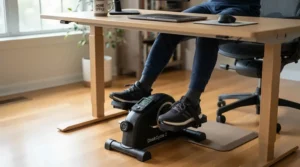
Open-plan offices and thin apartment walls both have the same enemy: a squeaky, clunky exercise machine. The MERACH Under Desk Elliptical is built specifically around that problem, running at under 15 decibels — genuinely close to silent — while offering both 12 manual speed settings and 12 automated modes, plus forward-and-reverse motion for more balanced muscle engagement across a session. A small onboard motor drives the auto modes, meaning you can let it pedal your legs for you during a call where even light manual effort would be distracting.
Here’s what the spec sheet won’t tell you outright: an auto-mode desk elliptical is really solving a different problem than a purely manual pedal bike. It’s less about building cardio fitness and more about passive circulation support — useful for long-haul flights’ worth of sitting, post-surgery recovery, or simply keeping blood moving during back-to-back video calls where manual pedaling would be visibly distracting. The LED touchscreen and included remote display time, distance, speed, pedal count, and calories in real time, and it works equally well set on the floor for legs or on a tabletop for arm exercises. Reviewers frequently praise the quiet operation as genuinely best-in-class for the category, though the motorized components mean there’s more that could eventually need servicing compared to a fully mechanical unit, and the auto modes are gentler than a hard manual workout.
Pros:
- ✅ Under-15dB operation, quietest option on this list
- ✅ Auto-pedal mode works hands-free during calls
- ✅ Dual floor-or-tabletop use for legs or arms
Cons:
- ❌ Motorized parts add more that could need repair
- ❌ Auto mode is gentler than true manual effort
Priced around $100–$160, the MERACH Under Desk Elliptical is the clear pick for anyone whose top priority is not being heard, seen, or noticed while quietly staying active.
7. Vaunn Medical Pedal Exerciser — most affordable entry point
Let’s be honest about what this one is: closer to a classic folding pedal exerciser than a full-featured seated desk bike, and that honesty is exactly why it belongs on this list. The Vaunn Medical Pedal Exerciser uses a simple adjustable tension knob rather than stepped resistance levels, non-skid rubber feet for stability on various floor types, and a folding frame that collapses flat for storage in seconds. It’s built for exactly one job: light, low-impact leg and arm movement for people who don’t need — or want — a feature-rich machine.
Based on the spec comparison with every other product here, this is the floor of the category, and that’s a legitimate use case rather than a compromise. Physical therapy patients, seniors managing balance concerns, and post-surgery recovery cases are the audiences this model was actually designed around, not office workers chasing a serious calorie burn. Aggregated reviewer sentiment skews heavily toward praise for ease of setup and gentle, controllable resistance, with occasional complaints about missing hardware in a small share of units and a general acknowledgment that this isn’t built for intense workouts.
Pros:
- ✅ Lowest price point of any product on this list
- ✅ Folds flat in seconds for easy storage
- ✅ Gentle, controllable resistance ideal for rehab use
Cons:
- ❌ No stepped resistance levels, just a tension knob
- ❌ Not designed for higher-intensity cardio goals
At roughly $35–$95 depending on whether you choose the basic or electronic-display version, the Vaunn Medical Pedal Exerciser is the safest low-risk entry point into the category — and, aggregated reviews suggest, a genuinely solid one for its intended rehab-and-seniors use case.
Practical Usage Guide: Setting Up Your Seated Desk Bike for Ergonomic Workspace Fitness
Buying the right seated desk bike is maybe 40% of the outcome; the other 60% comes down to whether your setup actually supports ergonomic workspace fitness rather than fighting against it. Start with chair and desk height together, not separately — pedal height only matters relative to where your hips and knees sit, so measure your seated knee height first, then check it against the specific unit’s pedal clearance rather than trusting a generic “fits most desks” claim.
Give yourself a real 30-day break-in period rather than expecting all-day comfort on day one. Most first-time users start at the lowest resistance level for the first week, gradually working upward as ankle and hip mobility adjust to the new, repetitive motion — jumping straight to a high resistance setting is the single most common reason people quit within the first ten days. A stabilizing mat or chair anchor, included with several models on this list, prevents your office chair from slowly rolling away mid-session, which otherwise turns a good habit into a minor daily annoyance.
For genuine ergonomic workspace fitness, keep your monitor and keyboard exactly where they’d sit in a normal seated posture — resist the temptation to lean forward while pedaling, since that undermines the neutral spine position your setup should already support. The Occupational Safety and Health Administration’s computer workstation guidance offers a useful baseline checklist for monitor height, elbow angle, and lower-back support that applies just as much to a desk-bike setup as to a standard chair. Wipe down pedals and check for squeaking every few weeks; a dry flywheel bearing is the most common maintenance issue reported across nearly every model in this category, and a drop of the manufacturer-recommended lubricant usually resolves it in under five minutes.

Real-World Scenarios: Who Actually Uses a Desk Bike for Work From Home
Picture three different people, because “who should buy this” genuinely depends on which one you are. First, the remote software developer, mid-30s, six-plus hours of daily screen time, moderate budget, home office with a standard 29-inch desk — for this profile, a desk bike for work from home like the DeskCycle 2 or FitDesk FD3030 makes sense precisely because low pedal clearance and quiet magnetic resistance matter more than premium tracking features nobody has time to check mid-sprint.
Second, the customer support rep working from a shared apartment, budget-constrained, worried about noise disturbing a partner on their own calls in the next room — here, the MERACH Under Desk Elliptical‘s sub-15dB operation solves the actual constraint, not the theoretical one. Third, the retiree managing early-stage arthritis, prioritizing gentle joint movement over calorie burn, working occasionally from a home desk but mostly just wanting daily circulation support — the Vaunn Medical Pedal Exerciser or Cubii JR2‘s elliptical motion both fit that use case far better than a high-resistance magnetic unit built for serious cardio.
The common thread across every profile considering a desk bike for work from home isn’t the specific model — it’s matching the constraint that actually governs your day (space, noise, joints, budget) rather than defaulting to whichever product has the flashiest marketing copy.
Seated Active Working: A Buyer’s Decision Framework
If you’re still torn between models, run through this simple framework rather than agonizing over spec sheets line by line. If your desk sits lower than 27 inches, prioritize the DeskCycle 2 or FitDesk FD3030, because pedal clearance eliminates several otherwise-solid options outright. If shared walls or open-plan noise is your real constraint, choose the MERACH Under Desk Elliptical first, since decibel level matters more here than resistance range.
If you’re managing joint pain, recovering from surgery, or supporting a senior family member’s seated active working goals, the elliptical motion of the Cubii JR2 or the gentle tension knob on the Vaunn Medical Pedal Exerciser will serve you better than a stiff magnetic system built for cardio intensity. If budget is the dominant factor and you just want to try the category before committing further, start with the YOSUDA Under Desk Bike or the Vaunn Medical Pedal Exerciser — both keep the financial downside of “this isn’t for me” close to negligible. And if you want a genuinely permanent seated active working setup that replaces your chair rather than adding to your floor space, the FlexiSpot Sit2Go FC211 is the only product on this list actually built for that job.
How to Choose a Seated Desk Bike
Choosing well comes down to seven concrete checks, in roughly this order of importance:
- Measure your desk clearance first. Sit at your desk normally, measure from floor to the underside of your desk, and subtract at least two inches for knee movement — this single number eliminates several options before you even look at price.
- Decide between magnetic, mechanical, and pedal-versus-elliptical motion. Magnetic resistance tends to feel more linear and quiet; mechanical dials are simpler but slightly less consistent; elliptical motion is gentler on knees than straight pedaling.
- Check the weight capacity against your own weight, with margin. Manufacturer figures vary noticeably by listing and retailer, so treat any single number as a starting point rather than a guarantee, and lean toward a unit rated comfortably above your weight.
- Weigh noise level against your workspace. A shared office or thin apartment walls make decibel rating a bigger factor than most buyers initially assume.
- Consider whether you actually want tracking features. LCD calorie counters and app connectivity add real value for some users and become ignored clutter for others — be honest about which camp you’re in before paying extra for them.
- Factor in your body’s actual needs, not aspirational ones. Rehab, seniors, and joint-sensitive users generally do better with elliptical or gentle tension-knob resistance than high-range magnetic systems.
- Set a realistic price ceiling based on how permanent this purchase feels. A $40 pedal exerciser is a low-stakes experiment; a $300 unit is a commitment, and both are legitimate depending on your confidence level.
According to the CDC’s physical activity guidelines for adults, the recommendation is 150 minutes of moderate aerobic activity weekly alongside two days of muscle-strengthening work — a seated desk bike won’t replace that target on its own, but it’s a legitimate way to chip away at the “move more, sit less” half of the guidance during hours you’d otherwise spend entirely still.
Common Mistakes When Buying a Seated Desk Bike
The most common mistake, by a wide margin, is buying based on resistance-level count alone. An 8-level magnetic system and an 8-level mechanical dial can feel completely different in practice — the number on the box tells you almost nothing about smoothness, which is why aggregated review sentiment matters more than spec-sheet bragging rights.
A close second is ignoring pedal height relative to your specific desk. Buyers frequently assume “under desk bike” means universal fit, then discover their knees clip the drawer the moment they sit down — this is an entirely avoidable problem solved by a single tape-measure check before ordering. Third, people underestimate noise tolerance in shared spaces, assuming “quiet” marketing language is interchangeable across brands when decibel ratings can vary meaningfully between models that use near-identical language to describe themselves.
Fourth, and this one’s subtle: buyers assume more expensive automatically means more effective for their specific goal. The FlexiSpot Sit2Go FC211 is genuinely worth its premium price if you need a chair replacement, but it’s a poor value if all you wanted was a pedal exerciser to tuck under an existing chair. Fifth, skipping the 30-day adjustment period and starting at maximum resistance is a near-guaranteed way to quit within two weeks — ease in the way you would with any new physical habit.
Seated Desk Bike vs Standing Desk vs Treadmill Desk: Active Sitting Solutions Compared
Active sitting solutions aren’t a single category — a seated desk bike, a standing desk, and a treadmill desk all attack the same core problem (too much stillness) from genuinely different angles, and comparing them side by side clarifies which one actually fits your work style.
| Feature | Seated Desk Bike | Standing Desk | Treadmill Desk |
|---|---|---|---|
| Typing/mousing stability | High | Medium | Low |
| Typical noise level | Low | None | Moderate to high |
| Space required | Small | Medium | Large |
| Rough calorie burn (light use, per hour) | 100–150 | Minimal | 150–200 |
| Typical upfront cost | $35–$400 | $150–$600 | $400–$1,500 |
Looking at this comparison, the seated desk bike wins decisively on typing stability, which matters enormously if your job involves precise mouse work, coding, or detailed writing — a treadmill desk’s constant micro-movement genuinely degrades fine motor accuracy in a way pedaling from a stationary seat doesn’t. A standing desk, meanwhile, solves posture variety better than either alternative but does almost nothing for active calorie burn on its own. The Mayo Clinic’s analysis of prolonged sitting risks notes that even 60 to 75 minutes of moderate daily activity can meaningfully offset the health risks tied to extended sitting — which is exactly the gap a seated desk bike is built to help close during hours a standing desk alone can’t touch.

What to Expect: Real-World Performance
Specs on a box translate into everyday experience in ways that are worth setting expectations around before you buy. A seated desk bike is not going to leave you breathless — that’s by design, not a shortcoming, since the whole point is sustaining light movement through hours you’d otherwise spend entirely still, not simulating an interval workout while you draft emails.
Expect an adjustment period of one to two weeks before pedaling feels genuinely unconscious rather than something you’re actively managing alongside your actual work. Expect noise levels to matter more than they seem to on a spec sheet — a unit rated “quiet” in isolated testing can still feel noticeably present in a silent home office during a video call. Expect calorie burn in the range of 100 to 150 calories per hour at light-to-moderate resistance for most users, meaningfully less than a dedicated workout but meaningfully more than sitting motionless. And expect that the biggest performance variable isn’t the machine at all — it’s whether you actually use it consistently, which is why fit (desk height, noise tolerance, resistance style) matters more long-term than any single spec number.
Seated Desk Bikes as Office Fitness Equipment for Teams
When a company starts stocking office fitness equipment for a hybrid or in-office workforce, seated desk bikes occupy an interesting middle ground between “wellness perk nobody uses” and “genuinely adopted habit.” Unlike a shared gym or a standing-desk mandate, a desk bike is personal, quiet, and doesn’t require anyone to change out of work clothes or leave their desk — three factors that meaningfully raise actual usage rates over time compared to bulkier office fitness equipment options.
For a shared or rotating-desk office environment, budget-friendly, easy-to-clean units like the YOSUDA Under Desk Bike or Vaunn Medical Pedal Exerciser tend to work better than premium chair-replacement systems like the FlexiSpot Sit2Go FC211, since multiple people using one unit favors simplicity and low cost over personalization. For a fully remote team where the company reimburses individual purchases, letting employees choose based on their own desk height and noise constraints — rather than standardizing on one model — respects the genuinely different real-world scenarios covered earlier in this guide. Either way, framing a seated desk bike as one piece of a broader office fitness equipment strategy, alongside things like standing desk options and walking-meeting norms, tends to produce more consistent long-term use than treating it as a stand-alone solution to sedentary work.
Desk-Based Cardio: Long-Term Cost, Calories & Maintenance
Desk-based cardio’s real value shows up over months and years, not in a single session, so it’s worth running the numbers the way you would for any recurring habit. At the budget end, the Vaunn Medical Pedal Exerciser costs so little upfront that even light, occasional use makes it worthwhile — using it three times a week for two years works out to well under twenty cents per session. Mid-range units like the YOSUDA Under Desk Bike or DeskCycle 2 land around 30 to 75 cents per session under the same usage assumptions, while premium options like the FlexiSpot Sit2Go FC211 or Cubii JR2 run closer to 80 cents to $1.30 per session — still a fraction of a single gym class, assuming you actually use it that consistently.
| Price Tier | Example Product | Approx. Cost per Session (3x/week, 2 years) |
|---|---|---|
| Budget ($35–$95) | Vaunn Medical Pedal Exerciser | Under $0.20 |
| Mid-range ($100–$230) | YOSUDA Under Desk Bike / DeskCycle 2 | $0.30–$0.75 |
| Premium ($250–$400) | FlexiSpot Sit2Go FC211 / Cubii JR2 | $0.80–$1.30 |
Looking at the table, the real ROI variable isn’t price at all — it’s consistency of use, since even the priciest unit becomes an excellent value if you use it daily, and even the cheapest becomes a waste of money gathering dust in a closet. Maintenance costs stay low across the entire category: expect to occasionally replace AA or AAA batteries in LCD displays, apply a drop of lubricant to a squeaky flywheel bearing every few months, and check strap or pedal wear roughly once a year. None of the seven products here carry ongoing subscription costs beyond optional premium app tiers, which several buyers report skipping entirely without losing core functionality.
Features That Actually Matter (And Those That Don’t)
Marketing copy loves to list features, but not all of them affect your actual daily experience. Resistance smoothness matters enormously — a unit that feels linear and predictable across its range will get used far more consistently than one with a jerky, inconsistent stroke, regardless of how many resistance “levels” it claims. Pedal height and desk clearance matter just as much, since a bike that physically doesn’t fit your setup is worthless no matter how well-reviewed it is elsewhere. Noise level genuinely matters for shared or open-plan spaces, and foot strap or pedal security matters for anyone planning longer daily sessions rather than occasional light use.
On the other side of the ledger, Bluetooth connectivity and app integration matter far less than marketing suggests for most casual users — genuinely useful if you’re already deep into fitness tracking, and largely ignored clutter if you’re not. Exact resistance-level counts beyond a basic range (6 versus 8 versus 12) matter less than resistance quality, echoing the common-mistakes point above. And branded “clinical study” calorie-burn figures, while not meaningless, should be read as directional marketing claims rather than personalized guarantees — your own results depend heavily on your weight, pedaling cadence, and how consistently you actually use the machine, not just which model you bought.
FAQ
❓ Does a seated desk bike actually help you lose weight?
❓ How loud is a seated desk bike during video calls?
❓ Can a seated desk bike fit under any desk?
❓ Is a seated desk bike good for bad knees?
❓ How often should you use a seated desk bike for real benefits?
Conclusion
There isn’t a single “best” seated desk bike, and honestly, anyone who tells you otherwise is skipping the part where your desk height, noise tolerance, joint health, and budget all pull in different directions. What the seven models above share is that they’re real products with verifiable specs, not marketing fiction — from the chair-replacing FlexiSpot Sit2Go FC211 at the premium end down to the no-frills Vaunn Medical Pedal Exerciser for anyone just testing the waters.
If you take one thing from this guide, let it be the measuring-tape step: knowing your actual desk clearance before you shop eliminates more bad purchases than any spec comparison ever will. From there, match the model to your real constraint — noise, joints, budget, or full chair replacement — rather than chasing whichever unit has the most resistance levels listed on the box. Small, consistent movement, sustained across months rather than one ambitious week, is where the actual benefit of a seated desk bike lives.
Recommended for You
- Desk Bike With Resistance: 7 Powerful Picks To Crush Sitting In 2026
- 7 Best Quiet Desk Bikes For 2026: Silent Picks Compared
- Portable Desk Bike 2026: 7 Picks That Actually Work At A Desk
Disclaimer: This article contains affiliate links. As an Amazon Associate, I earn from qualifying purchases. If you purchase products through these links, we may earn a small commission at no additional cost to you.
✨ Found this helpful? Share it with your friends! 💬🤗
