
In This Article
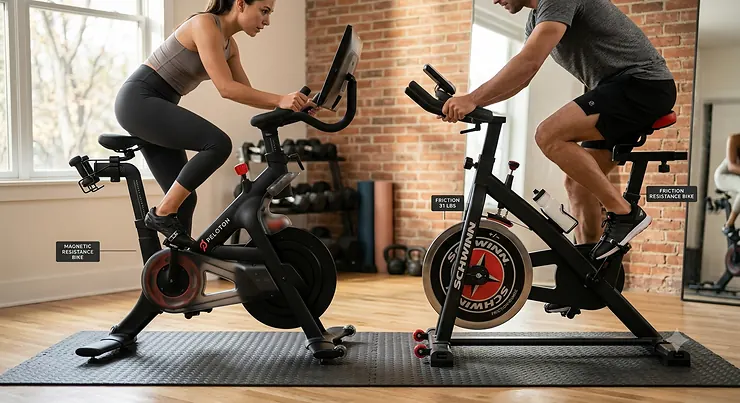
Somewhere in your living room right now, there’s a ghost bike — the one you almost bought, the one still open in eleven browser tabs. And the fork in the road stopping you? Almost always, it’s resistance type. A magnetic vs friction resistance bike decision sounds like a spec-sheet footnote, but it quietly decides how quiet your mornings are, how often you’ll tinker with a wrench, and how much cash leaves your wallet over the next five years. Here’s the 50-word version: magnetic resistance uses magnets hovering near a spinning flywheel to create drag without any contact, while friction resistance presses a physical pad against the flywheel — the same principle as a bicycle brake — to slow it down. One is silent and low-maintenance; the other is cheap and blunt-force reliable.
Neither option is objectively “wrong.” A college kid in a paper-thin apartment has different priorities than a former competitive cyclist who wants to feel actual pedal strain climb by climb. This guide walks through both systems honestly, then puts seven real 2026 models — three friction, four magnetic — through a side-by-side breakdown so you’re not guessing at 11 p.m. with a credit card in hand.
Quick Comparison Table
| Bike | Resistance Type | Flywheel Weight | Price Range | Best For |
|---|---|---|---|---|
| Yosuda YB001R | Magnetic | 35 lb | $230–$300 | Quiet budget upgrade |
| Yosuda Indoor Cycling Bike | Friction | 35 lb | $170–$220 | Rock-bottom budget |
| Sunny Health & Fitness SF-B1002 | Friction | 49 lb | $400–$450 | Heavier riders, momentum feel |
| Bowflex C6 | Friction | 40 lb | $900–$1,000 | App-based training without magnets |
| Schwinn IC4 | Magnetic | 40 lb | $700–$900 | Studio-quality all-rounder |
| Echelon Connect EX-15 | Magnetic | 30 lb | $500–$650 | Compact apartments, streaming classes |
| NordicTrack S22i | Magnetic | 30 lb | $1,700–$2,000 | Auto-adjusting incline, immersive training |
Looking at this lineup, there’s a clean pattern: friction bikes cluster at the extremes — dirt cheap or app-connected mid-range — while magnetic models dominate once you cross the $500 mark. That’s not an accident; magnets and the electronics that control them cost more to manufacture, so brands typically reserve magnetic resistance for models where they can also justify a bigger price tag with a screen, an app, or a heavier frame. Notice too that flywheel weight doesn’t track cleanly with price — the budget Yosuda YB001R actually out-weighs the far pricier Echelon Connect EX-15 and NordicTrack S22i, which lean on smart resistance electronics rather than brute mass for their smooth feel.
💬 Already leaning toward one system? Jump to the product that matches your budget below.
Just one click — help others make better buying decisions too!😊
Top 7 Magnetic and Friction Resistance Bikes: Expert Analysis
1. Yosuda YB001R Magnetic Indoor Cycling Bike — quietest ride under $300
The YB001R is proof that “budget” and “silent” aren’t mutually exclusive anymore. Its 35-pound flywheel is genuinely heavy for the price bracket, and because it relies on magnets instead of felt pads, there’s no audible contact noise even when you crank the resistance knob toward its upper end. The steel frame and dual transport wheels keep total weight around 68 pounds, so it’s easy for one person to shuffle it into a closet after a workout, and the compact footprint suits apartments where every square foot of floor is contested territory.
Based on the spec comparison, the biggest trade-off here is feedback: the resistance knob isn’t numbered, so you’re adjusting by feel rather than dialing in a repeatable “level 6” workout. Reviewers consistently note that the ride feels smoother and quieter than the brand’s own friction sibling, though a few mention the seat padding is thin enough that a gel cover becomes a near-mandatory add-on within the first month.
Pros:
- ✅ Near-silent magnetic resistance for shared walls
- ✅ 35-lb flywheel feels stable at higher cadences
- ✅ Lightweight frame is easy to relocate solo
Cons:
- ❌ Unlabeled resistance knob limits workout tracking
- ❌ Stock seat padding is thin for long rides
At around $230–$300, this is one of the few genuinely magnetic options priced like a friction bike — a strong value pick if quiet operation matters more than a numbered display.

2. Yosuda Indoor Cycling Bike (Friction) — most-reviewed budget pick
This is the bike that launched a thousand “does a $200 spin bike actually work?” questions, and the honest answer is: mostly, yes. It shares the same 35-pound belt-driven flywheel as its magnetic sibling, but resistance comes from a felt pad pressed directly against the wheel, tightened or loosened with a simple turn knob. What most buyers overlook about this model is that the friction contact actually gives a more road-like resistance curve — pedaling harder produces an immediate, tactile increase in drag, rather than the slightly smoother taper you get with magnets.
Aggregated customer feedback across major retail platforms consistently praises the sturdy frame and easy assembly, while a recurring complaint centers on toe-cage pedal clasps loosening over extended use. The console is basic — speed, distance, calories, time — with no app connectivity, which keeps the price low but means serious data-trackers will need a separate sensor.
Pros:
- ✅ Lowest price of entry into serious indoor cycling
- ✅ Direct, road-like feel from felt-pad resistance
- ✅ Simple mechanism is easy to self-repair
Cons:
- ❌ Felt pad wears and needs periodic replacement
- ❌ No app or Bluetooth connectivity included
Priced under $220, this remains the default answer for “cheapest bike that won’t fall apart in a month,” provided you’re comfortable with occasional pad maintenance.
3. Sunny Health & Fitness SF-B1002 Belt Drive Indoor Cycling Trainer — heaviest flywheel under $450
If the two Yosuda models are entry-level, the SF-B1002 is the “I actually want this to feel substantial” upgrade. Its 49-pound flywheel is noticeably heavier than most bikes in this price tier, which translates into smoother momentum through pedal strokes — less of that jerky stop-start feeling beginners associate with cheap spin bikes. The belt-drive system paired with that mass produces a ride that leans closer to a boutique studio bike than its price tag suggests.
Here’s what the spec sheet won’t tell you, but reviewers note: that extra flywheel weight means the bike itself is heavier and harder to reposition, so this is more of a “pick a spot and leave it” purchase than a fold-and-stash option. Friction resistance means eventual pad wear, but the trade-off is a max resistance ceiling that satisfies stronger riders who find lighter flywheels feel “mushy” at high effort.
Pros:
- ✅ 49-lb flywheel delivers standout momentum and stability
- ✅ Belt drive keeps operation notably quieter than chain models
- ✅ Sturdy frame suits taller and heavier riders
Cons:
- ❌ Substantial weight makes relocation a two-person job
- ❌ Friction pad will need eventual replacement
In the $400–$450 range, this is the strongest friction pick for anyone who wants gym-caliber momentum without paying magnetic-tier prices.
4. Bowflex C6 — app-connected training without the magnetic price tag
The Bowflex C6 occupies an interesting middle ground: it uses a friction-based resistance system, but wraps it in Bluetooth connectivity that syncs cadence and resistance data to popular training apps. That means you get real-time metrics and structured workouts — features usually reserved for magnetic, subscription-tier bikes — while keeping mechanical simplicity underneath.
Based on the spec comparison, the C6’s dual-link pedals (compatible with both standard cycling shoes and toe cages) and micro-adjustable seat/handlebar geometry make it a strong fit for households with multiple riders of different heights. What most buyers overlook is that because resistance is still friction-based, the pad will wear over years of heavy use — but Bowflex’s parent company sells replacement kits, keeping repair costs modest relative to a full magnetic resistance module replacement.
Pros:
- ✅ Bluetooth syncs resistance and cadence to training apps
- ✅ Dual-link pedals fit multiple shoe types
- ✅ Highly adjustable geometry suits multi-rider households
Cons:
- ❌ Friction pad still wears faster than magnetic systems
- ❌ No built-in screen; requires your own tablet
At roughly $900–$1,000, the C6 makes sense for buyers who want app-based structure but aren’t sold on paying a magnetic-resistance premium.
5. Schwinn IC4 — 100-level magnetic resistance, studio-quality build
The Schwinn IC4 has quietly become the default recommendation across nearly every independent bike review roundup, and the reasoning holds up under scrutiny. Its magnetic system offers 100 micro-adjustable resistance levels, controlled by a simple lever, giving genuinely fine-grained control that felt-pad bikes can’t replicate — you can nudge intensity up by a hair rather than jumping in coarse increments. The 40-pound flywheel and belt drive combine for a smooth, low-vibration ride, and dual-sided pedals (SPD clip-in on one side, cage on the other) mean you’re not locked into cycling shoes.
What most buyers overlook about the IC4 is that it works with free apps like Zwift or the Peloton app without a mandatory subscription — a meaningful cost difference over a few years compared to bikes that lock core features behind a paywall. Reviewers who’ve used it for years consistently point to its durability as a standout; the magnetic system shows minimal performance drift even after heavy, sustained use.
Pros:
- ✅ 100 magnetic resistance levels for precise control
- ✅ Dual-sided pedals fit clip-in or cage shoes
- ✅ No mandatory subscription for app compatibility
Cons:
- ❌ No built-in display; needs a phone or tablet mount
- ❌ Costs meaningfully more than budget friction models
In the $700–$900 range, the IC4 is the clearest “buy once, stop shopping” pick for anyone serious about a long-term home cycling habit.
6. Echelon Connect EX-15 Smart Connect — compact magnetic bike for streaming classes
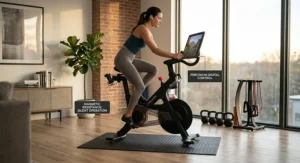
The Echelon Connect EX-15 targets a specific buyer: someone who wants a smart, class-streaming experience but doesn’t have room — literally or financially — for a full NordicTrack-style setup. Its belt-driven magnetic system offers 32 resistance levels, fewer than the IC4’s 100 but still enough granularity for structured interval work, and the frame’s smaller footprint makes it a realistic fit for a bedroom corner or shared living room.
Here’s what to weigh: the flywheel is lighter than most bikes on this list, which trims momentum feel slightly on standing sprints, but the trade-off is a noticeably smaller physical presence and easier home integration. Aggregated review sentiment frequently highlights the phone/tablet mounting and streaming compatibility as the standout feature, while a common complaint involves the optional class subscription cost stacking up if you use the bike daily.
Pros:
- ✅ Compact frame suits small apartments and shared rooms
- ✅ Belt-driven magnetic resistance stays notably quiet
- ✅ Streaming class compatibility across phone and tablet
Cons:
- ❌ Lighter 30-lb flywheel reduces momentum on sprints
- ❌ Full class library requires an ongoing subscription
Priced around $500–$650, this is the pragmatic pick for space-constrained buyers who still want a connected, magnetic-resistance experience.
7. NordicTrack S22i — premium magnetic bike with auto-adjusting incline
At the top of this lineup sits the NordicTrack S22i, a bike that stops pretending resistance type is the only variable that matters. Its magnetic “SilentMag” system pairs with iFit-powered automatic incline and decline adjustment — the bike physically tilts up to 20% and down to -10% to mimic real terrain during guided rides, something no friction or basic magnetic bike on this list attempts. A 22-inch rotating HD touchscreen anchors the experience, and the resistance itself auto-adjusts in sync with instructor-led workouts if you don’t want to touch a dial at all.
On paper, this means you’re paying for the total training environment, not just the flywheel. Reviewers consistently note the incline feature as the differentiator that makes hill-focused training feel genuinely different from flat-road pedaling on cheaper bikes — but the trade-off is a running iFit subscription cost and a footprint that demands real dedicated space, not a fold-away corner.
Pros:
- ✅ Automatic incline/decline mimics real outdoor terrain
- ✅ 22-inch touchscreen with guided instructor-led training
- ✅ Magnetic resistance stays smooth even during interval spikes
Cons:
- ❌ Requires an ongoing iFit subscription for full features
- ❌ Large footprint needs dedicated floor space
In the $1,700–$2,000 range, the S22i is squarely for buyers who see this as a long-term studio replacement rather than a basic cardio machine.
Practical Usage Guide: Your First 30 Days
Getting a new resistance bike home is the easy part; keeping it running smoothly is where most people wing it and quietly regret it. Start with assembly: torque every bolt to spec rather than “finger tight,” since a wobbling frame gets misdiagnosed as a bad flywheel more often than you’d expect. For friction bikes specifically, apply a small amount of the manufacturer-recommended lubricant to the flywheel-pad contact point after the first 20–30 rides — this single step is the most commonly skipped maintenance task, and skipping it is exactly why some friction bikes get louder within weeks instead of months.
For magnetic bikes, the equivalent early habit is checking magnet-to-flywheel spacing if you notice inconsistent resistance at the same knob setting — a rare but real issue when bikes ship after rough transit. In week one, resist the urge to max out resistance for “real training” — dial it to roughly 60% of max and build tolerance over two weeks, which protects both your joints and your pedal-strap hardware from early wear. A common first-month mistake on any resistance bike, magnetic or friction, is skipping seat-height calibration; a knee that shouldn’t fully extend at the bottom of the stroke is one of the fastest routes to nagging pain.
Real-World Scenarios: Which Rider Are You?
Picture three people shopping for the exact same keyword phrase, and you’ll see why “which resistance is better” doesn’t have one universal answer. First, there’s the studio apartment renter — thin walls, downstairs neighbor, 6 a.m. rides before work. For them, a magnetic bike like the Yosuda YB001R or Echelon Connect EX-15 is close to non-negotiable; friction noise carries through shared walls in a way that turns a quick cardio session into a diplomatic incident.
Second, picture a former competitive road cyclist who wants pedal resistance that mimics a genuine hill climb rather than a smooth digital curve. That rider often prefers the tactile bite of friction resistance on something like the Sunny Health & Fitness SF-B1002, where pushing harder produces an immediate, almost mechanical increase in drag. Third, there’s the family household with three different riders and wildly different fitness levels sharing one bike — here, the Schwinn IC4‘s 100-level magnetic system and dual-sided pedals earn their higher price tag by adapting cleanly to a teenager’s easy recovery ride and a parent’s max-effort interval session on the same machine, same afternoon.
Buyer’s Decision Framework
If quiet operation and shared walls are your top concern, choose a magnetic bike, because the complete absence of contact noise solves that problem outright rather than merely reducing it. If your budget caps out under $250 and long-term maintenance doesn’t intimidate you, choose a friction bike, because the mechanical simplicity keeps repair costs and complexity low even years down the line. If you’re chasing structured, app-guided training with real metrics, prioritize Bluetooth or Wi-Fi connectivity over resistance type itself — both the friction-based Bowflex C6 and magnetic Echelon Connect EX-15 deliver that, just through different underlying mechanisms.
If multiple household members with different strength levels will share the bike, lean magnetic with a high resistance-level count, since fine-grained adjustment matters more when the same machine serves a beginner and an advanced rider. And if you want the bike to double as an immersive, terrain-simulating training tool rather than a plain cardio box, only a premium magnetic model with auto-incline, like the NordicTrack S22i, actually delivers that — no friction bike on the market currently replicates automatic incline shifting.
Magnetic vs Brake Pad Bike: What’s Actually Different
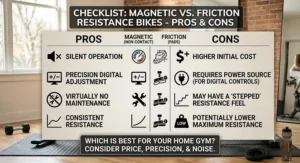
“Magnetic vs brake pad bike” is really asking the same underlying question in more mechanical language, and it deserves a straight answer: a brake-pad (friction) system works almost identically to the disc brake on an actual bicycle. A pad — usually felt or a composite material — presses directly against a spinning flywheel, and tightening a knob increases contact pressure, which increases drag. It’s the same physics your car uses to slow down, just scaled to a stationary wheel. This contact is exactly why friction bikes eventually need pad replacement and why they produce that familiar swooshing sound as resistance climbs.
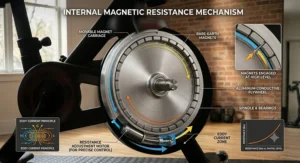
A magnetic system skips physical contact entirely. Two magnets sit on either side of the flywheel, and moving them closer creates a stronger opposing magnetic field — technically called an eddy current — that slows the spinning metal disc without anything ever touching it. You can read more about the underlying physics in this explanation of eddy current braking, which covers the same principle used in train and roller-coaster braking systems. The practical upshot for your living room: no contact means no wear-and-tear friction surface, which is the single biggest durability advantage magnetic systems hold over brake-pad designs.
So, Which Resistance Is Better for You?
There’s no universal winner here — “better” depends entirely on what you’re optimizing for — but a structured decision process gets you to the right answer fast:
- Define your noise tolerance first. If anyone sleeps, works, or takes calls near your workout space, weight magnetic resistance heavily; it’s the only system that’s genuinely silent under load.
- Set a real budget ceiling, not an aspirational one. Friction bikes routinely undercut magnetic equivalents by $150–$300 at similar build quality, so know your number before you fall for a feature list.
- Consider your maintenance appetite honestly. If replacing a felt pad every year sounds like a hassle rather than a five-minute chore, magnetic’s low-maintenance profile is worth the premium.
- Match resistance granularity to your training style. Interval athletes benefit from magnetic systems with 32–100 numbered levels; casual riders often don’t notice the difference.
- Factor in who else will use it. Shared households benefit from magnetic bikes’ repeatable, labeled resistance settings more than solo riders do.
- Decide if you want app connectivity baked in. Both systems now offer it, so don’t assume you need magnetic resistance just to get Bluetooth metrics.
- Weigh long-term cost of ownership, not just the sticker price. A cheaper friction bike with $20–$30 annual pad replacements can still cost less over five years than a magnetic bike’s higher upfront price — do the simple math for your situation.
Common Mistakes When Buying a Magnetic vs Friction Resistance Bike
The single most common mistake is assuming louder automatically means “cheaper” and quieter automatically means “better” — plenty of budget magnetic bikes exist, and plenty of friction bikes have gotten meaningfully quieter in recent years through improved pad materials. A second frequent misstep is ignoring flywheel weight entirely and fixating only on resistance type; a heavy-flywheel friction bike like the Sunny Health & Fitness SF-B1002 can feel smoother in practice than a light-flywheel magnetic bike, because momentum and resistance type are two separate variables doing two separate jobs.
Buyers also routinely skip checking weight capacity against their actual body weight plus gear, which matters more for frame longevity than most spec sheets suggest. Another overlooked detail: assuming a smart display or app compatibility requires magnetic resistance — the Bowflex C6 proves that’s false. Finally, people frequently underestimate ongoing costs, focusing only on the purchase price while ignoring app subscriptions, replacement pads, or shipping costs on heavy premium bikes if something needs warranty service.
What to Expect: Real-World Performance
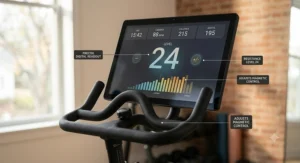
Specs on a page and specs under your legs are two different experiences, so here’s the translation. A 100-level magnetic system like the Schwinn IC4‘s doesn’t mean you’ll ever consciously use all 100 levels — in practice, most riders settle into a working range of maybe 20–30 levels and nudge within that band. What the fine granularity actually buys you is smoothness: transitioning from level 40 to 41 feels like a whisper of extra effort rather than a jump, which matters most during structured interval workouts where precise, repeatable intensity is the entire point.
Friction resistance, by contrast, tends to feel more binary in daily use — turning the knob a quarter turn can shift perceived effort noticeably more than the equivalent magnetic adjustment, which some riders genuinely prefer because it mimics the abrupt feel of hitting a real hill. Flywheel weight changes the character of every pedal stroke regardless of resistance type: heavier flywheels like the Sunny Health & Fitness SF-B1002‘s 49 pounds carry momentum through the bottom of the pedal stroke, smoothing out the “dead spot” that lighter flywheels can produce, especially noticeable during standing climbs.
Durability Comparison: Long-Term Wear and Tear
Durability is where the magnetic vs friction resistance bike debate gets its clearest, least-debatable answer. Because magnetic systems never physically contact the flywheel, there’s no pad to wear down and, critically, nothing generating friction-based heat or dust inside the resistance mechanism — the entire system’s failure points shrink to electronics and the magnet-adjustment motor or cable, both of which tend to be simpler, lower-wear components. Friction bikes, by design, wear a consumable part every single ride; felt or composite pads gradually thin, and once they do, resistance becomes inconsistent even at the same knob setting, which is your signal it’s time for a swap.
That said, “more durable” doesn’t mean “bulletproof” — magnetic systems can develop their own long-term issues, particularly around the mechanism that physically moves magnets closer to or farther from the flywheel, since that’s still a mechanical linkage even if the resistance itself is contactless. Reviewers who’ve logged years on bikes like the Schwinn IC4 note it holds its performance remarkably well over extended heavy use, while friction bikes such as the standard Yosuda Indoor Cycling Bike remain perfectly serviceable for years provided you replace the felt pad on a reasonable schedule rather than riding it down to bare metal contact.
Long-Term Cost, Maintenance & Safety Certifications
Sticker price is only chapter one of the cost story. Friction bikes typically need a felt or composite pad replacement every 6–12 months of regular use, running roughly $15–$30 per set — a modest, predictable expense. Magnetic bikes largely skip that recurring cost, but many mid-to-premium models bundle in app subscriptions ($10–$40 monthly) that, over a few years, can quietly exceed the friction bike’s cheaper upfront price plus pad replacements combined. Run the actual five-year math for your specific bike before assuming “more expensive upfront” automatically means “more expensive overall” — it often doesn’t.
On the safety and compliance side, check listed weight capacity against your own weight plus any additional gear, and confirm the frame carries a recognized testing standard where the manufacturer publishes one; reputable fitness equipment brands typically reference independent structural testing in their product documentation. General exercise safety still applies regardless of resistance type — the CDC’s physical activity guidelines for adults recommend building toward at least 150 minutes of moderate-intensity aerobic activity weekly, and a stationary bike, magnetic or friction, is a legitimate way to hit that target without joint-pounding impact.
Features That Actually Matter (And Those That Don’t)
Flywheel weight, resistance granularity, and pedal type consistently matter — they directly shape how a bike feels under real effort, day after day. A number-labeled resistance system matters more than marketing copy suggests too, since “resistance level 12” being repeatable across sessions is what lets you actually track progress instead of guessing. Weight capacity and frame material matter for anyone above an average build, full stop — don’t gloss over this line item.
What matters far less than the spec sheet implies: raw top resistance level count beyond what you’ll realistically use, since most riders never approach a magnetic bike’s ceiling anyway. Built-in touchscreens are genuinely nice but replaceable by a $20 tablet mount and your own device for most casual users, and “compatible with 50+ apps” marketing claims matter less than confirming the two or three apps you’ll actually open are supported. For a broader independent perspective on which features held up under real testing across a dozen bikes, this exercise bike testing roundup is worth a look before you finalize a shortlist.
Frequently Asked Questions
❓ Is magnetic resistance better than friction for weight loss?
❓ Do friction resistance bikes get louder over time?
❓ Can I upgrade a friction bike to magnetic resistance?
❓ Which resistance type is quieter for apartment living?
❓ Do magnetic bikes really need less maintenance long-term?
Conclusion
Strip away the marketing gloss and the magnetic vs friction resistance bike question comes down to a handful of honest trade-offs: quiet versus cheap, low-maintenance versus simple-to-repair, smooth digital feel versus tactile mechanical bite. None of the seven bikes above are wrong choices — they’re just built for different lives. The Yosuda YB001R and Echelon Connect EX-15 solve for apartment quiet on different budgets, the Yosuda Indoor Cycling Bike and Sunny Health & Fitness SF-B1002 solve for value and momentum, the Bowflex C6 and Schwinn IC4 split the difference between app-connected training and long-term durability, and the NordicTrack S22i solves for buyers who want a full studio replacement in their spare room.
Before you check out, revisit your own noise tolerance, your realistic maintenance appetite, and who else in your household will actually use the bike — those three questions matter more than any single spec on this page. Whichever resistance system you land on, the best bike is still the one that gets ridden consistently, not the one with the most impressive number printed on the box.
✨ Don’t Miss These Exclusive Deals!
🔍 Take your home cardio setup to the next level with these carefully selected picks. Click on any highlighted model to check current pricing and availability. These bikes will help you build a consistent, comfortable home workout routine your whole household can share!
Recommended for You
- Magnetic Exercise Bike 2026: 7 Quietest Picks Ranked
- Treadmill Dust Cover: 7 Best Picks to Stop Dust Damage in 2026
- How To Lubricate Treadmill Belt: 7 Best Silicone Lubricants (2026)
Disclaimer: This article contains affiliate links. As an Amazon Associate, I earn from qualifying purchases. If you purchase products through these links, we may earn a small commission at no additional cost to you.
✨ Found this helpful? Share it with your friends! 💬🤗
