

In This Article
Rear drive elliptical benefits are the practical advantages of placing the flywheel and drive system behind the user: a flatter, more walk-like foot path, an upright posture, a simpler mechanical layout, and, on many home models, a smaller footprint and a lower entry price. Here’s what that means in practice.
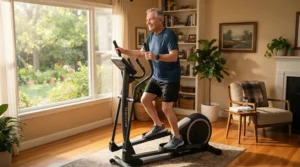
Picture two machines side by side. One has its flywheel hogging the front, so the pedals tilt up in a stair-climbing wedge. The other tucks everything behind you, and your feet sweep out a long, level glide. That second machine is the rear drive, and it’s the oldest design in the category. According to Wikipedia’s overview of the elliptical trainer, rear drive came first, front drive second, and center drive last. Commercial gym staples like Life Fitness and Precor have long leaned on the rear drive layout, which is why so many people associate it with that “real gym” feel.
So why should you care in 2026? Because the market has quietly shifted. Garage Gym Reviews notes that many higher-end brands have stopped making rear drive models, leaving the affordable and mid-priced end of the market to carry the format. That makes picking well more important, not less.
I should be upfront about method. This guide is built on spec sheets, published reviewer findings, and biomechanics research. I haven’t tested these machines, so I’ll say “reviewers report” when I mean it. Where sources disagree, I’ll say that too, because a buying guide that hides the messy bits isn’t doing its job.
Quick Comparison Table: 7 Rear Drive Ellipticals at a Glance
| Product | Stride | Resistance | Max User Weight | Price Range | Best For |
|---|---|---|---|---|---|
| Sunny Health & Fitness SF-E3912 | 15.5 in | 16 magnetic levels | 330 lb | Under $600 | Beginners on a budget |
| Exerpeutic Heavy Duty Magnetic Elliptical | About 13 in | 8 magnetic levels | 300 lb | Just over $300 | Tight spaces, tiny budgets |
| pooboo E399 | 15.5-17 in | 16 magnetic levels | 350 lb (listings vary) | Around $300-$350 | Quiet apartment cardio |
| YOUNGFIT Foldable Elliptical | 14.5 in | 22 levels | Check listing | Budget tier | Storage-first buyers |
| Niceday CT11S-18 | 18 in | 16 magnetic levels | 400 lb | Around $500-$700 | Mid-range stability |
| Niceday CT11PRO-20 | 20 in | 16 magnetic levels | 500 lb | Around $600-$900 | Tall or heavier users |
| ProForm Hybrid Trainer XT | 15 in | 16 digital levels | 250-350 lb (sources conflict) | Around $600-$900 | Elliptical plus recumbent bike |
Prices are approximate ranges from the time of research and change often, so check current prices before you buy. I’ve left out star ratings on purpose. They shift weekly, and quoting a number that’s stale by Friday helps nobody.
Look at the stride column and one pattern jumps out: only the Niceday CT11PRO-20 and Niceday CT11S-18 reach the 18 to 20 inch range that Garage Gym Reviews calls the industry standard. Everything else is shorter, which is fine if you’re under six feet and a problem if you’re not. Capacity tells a different story. The Niceday CT11PRO-20 leads on paper, while the ProForm Hybrid Trainer XT has conflicting figures across sources. If weight rating matters to you, verify it on the exact listing.
💬 Just one click — help others make better buying decisions too!😊
Top 7 Rear Drive Ellipticals: Expert Analysis
Seven real machines follow, spanning budget to upper mid-range. A caution first: retailers and reviewers don’t always label drive type consistently. Where a model’s classification is disputed, I say so.
1. Sunny Health & Fitness SF-E3912 — best entry ticket for beginners
This one’s appeal is plainness: it asks for little and gives you a working, steady cardio machine. The headline specs are a 15.5-inch stride, a 13-pound flywheel, 16 magnetic resistance levels, 24 built-in workouts, and a 330-pound user rating, all in a machine that weighs about 105 pounds.
In practice, 105 pounds means one person can tilt and roll it into a corner. The 15.5-inch stride sits under the 18-to-20-inch norm Garage Gym Reviews cites, so it suits walking-style workouts and users under about six feet. Based on the spec comparison, the 13-pound flywheel is on the light side, so expect less momentum than the heavier machines further down this list.
Reviewers consistently describe the ride as smooth and stable. Common complaints are the short stride, assembly instructions that aren’t clear, and a warranty (three years on the frame, 180 days on parts) that falls short of the industry standard.
Pros:
- ✅ Smooth, stable ride at a low price
- ✅ 24 built-in workouts for guided sessions
- ✅ Light enough to move solo
Cons:
- ❌ 15.5-inch stride cramps taller users
- ❌ Warranty is shorter than most competitors
Price range: under $600, and often cheaper. For a first machine, that’s a fair-value verdict if you’re under six feet.
2. Exerpeutic Heavy Duty Magnetic Elliptical — smallest footprint on the list
The standout is how little floor it demands: about 54 inches long, 23 wide, and 63 high, at 74.5 pounds. That makes it the machine for people who measure rooms in dinner-plate increments.
It offers eight magnetic resistance levels, a 3.4-inch LCD, a tablet holder, and Bluetooth via the MyCloudFitness app. Stride is listed around 13 inches in some reviews, and the weight limit is 300 pounds. The 13-inch stride is the shortest here, so it favors compact bodies and gentle sessions. Eight resistance levels sounds stingy, but in this price tier it’s more of a simplicity trade-off than a flaw. One practical tip from Garage Gym Reviews: add 21 inches to the tallest user’s height to check ceiling clearance.
Reviewers describe it as sturdy, with a smooth glide and surprisingly challenging tension for the money. Gripes center on time-consuming assembly, occasional squeaking that lubrication reportedly fixes, and a short warranty.
Pros:
- ✅ Compact footprint suits small rooms
- ✅ Challenging tension for a budget machine
- ✅ Bluetooth app tracking included
Cons:
- ❌ Short stride limits taller users
- ❌ Assembly is reportedly slow
Price range: just over $300. It’s strong value for small spaces, though not for long legs.
3. pooboo E399 — quietest budget pick for apartments
Quiet is the hook. The listing advertises a magnetic rear drive system, and retail roundups mention noise around 20 decibels.
Stride is listed at roughly 15.5 to 17 inches, with 16 resistance levels and a 350-pound rating that some listings push to 400. That stride range works for users between about 5’4″ and 6’0″, according to roundups. The “up to 6’5″” claim in some listings looks optimistic to me, given that reviewers say people over 6’2″ find it cramped.
Reviewers highlight the near-silent operation, quick setup (the machine arrives about 80 percent pre-assembled), and a sturdy feel at capacity. The common complaints involve stride length for taller users and some variability between listings, so confirm the exact model and capacity before ordering.
Pros:
- ✅ Very quiet for apartment living
- ✅ Mostly pre-assembled, quick setup
- ✅ Sturdy at its rated capacity
Cons:
- ❌ Stride feels short above 6’2″
- ❌ Listing specs vary between sellers
Price range: around $300 to $350. That’s good value for a quiet, compact rear drive.
4. YOUNGFIT Foldable Elliptical — best fold-away convenience
Where the others sit permanently, this one folds, and that’s the point. Its stride is listed at 14.5 inches, with up to 22 resistance levels and a lightweight frame that moves easily.
The folding design is the real story. Space-poor buyers often abandon fitness machines because they dominate a room, and a foldable removes that excuse. The trade-off is stride length: 14.5 inches is on the short side, and Your Workout Book flags it as less suited to taller users. The same reviewer calls its performance surprisingly robust despite being basic.
Reviewers describe it as lightweight, easy to assemble, and dependable at beginner intensity. The complaints echo the stride issue, and some shoppers want a heavier, more planted feel than a foldable can provide. BarBend’s roundup lists it as its pick for the best foldable rear drive elliptical.
Pros:
- ✅ Folds away for easy storage
- ✅ Wide 22-level resistance range
- ✅ Light enough to reposition
Cons:
- ❌ 14.5-inch stride cramps tall users
- ❌ Less planted than fixed-frame rivals
Price range: budget tier, so check current price. It’s worth it if storage is your main obstacle.
5. Niceday CT11S-18 — quiet, stable mid-range workhorse
Its stand-out is the 18-inch stride paired with a 400-pound rating, a combination that’s uncommon at this price. Reviewers describe operation below 20 decibels, thanks to silent rollers and a magnetic system.
An 18-inch stride sits at the low end of the industry norm, but it’s a big step up from the 13-to-15.5-inch machines above. Roundups say it suits users up to roughly six feet two. One source labels it a rear drive upright, while another lists a sibling model as front drive, so confirm the classification on the listing. The lack of incline adjustment is a limitation if you want varied muscle emphasis.
Reviewers consistently praise the quiet operation, sturdy 400-pound frame, and compact size. Complaints include no incline and a basic console.
Pros:
- ✅ 18-inch stride fits most adults
- ✅ Whisper-quiet magnetic operation
- ✅ 400-pound capacity inspires confidence
Cons:
- ❌ No incline adjustment
- ❌ Basic console and features
Price range: around $500 to $700. It’s strong value for a stable mid-range rear drive.
6. Niceday CT11PRO-20 — longest stride and highest capacity
The 20-inch stride and 500-pound rating make this the tall-and-heavy-user pick. Roundups credit a 2-inch thickened H-shaped steel tube frame, 16 resistance levels, and a flywheel listed around 18 pounds.
A 20-inch stride is the top of the 18-to-20-inch standard, and reviewers say it fits users up to about 6’5″. That’s the biggest practical edge on this list. Based on the spec comparison, the capacity gives headroom for heavy users or anyone who wants a machine that won’t flex under sprint intervals. One source cautions the flywheel cover is plastic, and another notes the console is basic.
Reviewers report minor console accuracy quirks and a lower review count than rivals, which means less crowd-sourced durability data. Drive-type labels are also inconsistent across retailers, so verify the exact version.
Pros:
- ✅ 20-inch stride suits tall users
- ✅ 500-pound capacity, highest here
- ✅ Quiet magnetic drive
Cons:
- ❌ Basic console, minor accuracy quirks
- ❌ Smaller review pool than competitors
Price range: around $600 to $900, depending on seller. It’s the best value here for taller or heavier users.
7. ProForm Hybrid Trainer XT — elliptical and recumbent bike in one
Two machines in one frame is the story. Flip the pedals and it converts from an elliptical to a recumbent bike in a couple of steps. It lists a rear flywheel, 16 resistance levels, a 15-inch stride, and iFIT compatibility.
The hybrid design is clever, but it comes with compromises. Garage Gym Reviews calls the 13-pound flywheel light, the stride short for taller people, and the console basic. Weight capacity figures conflict across sources (250 to 350 pounds), so check the exact listing. Assembly is reportedly straightforward, helped by a detailed manual.
Reviewers like the versatility and ease of assembly. The consistent criticism is stride length for taller users and the modest flywheel.
Pros:
- ✅ Converts between elliptical and recumbent bike
- ✅ iFIT compatible, with 16 resistance levels
- ✅ Straightforward assembly
Cons:
- ❌ 15-inch stride is short for tall users
- ❌ Lighter flywheel than dedicated ellipticals
Price range: around $600 to $900. It’s a sound buy if you want both workouts and have little room.
Your First 30 Days: Setup, Maintenance Schedule and Optimization Tricks
Spec sheets stop at the box. Here’s what they don’t tell you about getting the most out of a rear drive machine.
Setup. Put it on a flat, hard surface and level the stabilizers before you tighten anything. A wobble on day one becomes a squeak by week three. Check ceiling clearance: Garage Gym Reviews suggests adding 21 inches to the tallest user’s height, and the ceiling is where many buyers get surprised.
Week one. Start with 15 to 20 minutes at low resistance. A rear drive’s upright posture and flat foot path feel natural, but your hips and core still need an adjustment period. The CDC recommends at least 150 minutes of moderate-intensity activity per week, and that’s a destination, not a day-one demand. Five 30-minute sessions get you there.
Weeks two to four. Add resistance before speed. Magnetic resistance rewards steady cadence, and cranking speed on a lighter flywheel can make the motion feel choppy. Try reverse pedaling for a few minutes at the end of sessions to change which leg muscles do the work.
Maintenance schedule. Wipe sweat off rails and handles after each session. Check bolts monthly, since vibration loosens them. Inspect rollers and rails every few months, because rear drives typically use longer rails with rollers that travel along them, and that’s where wear shows first.
Common first-month mistakes: skipping the stabilizers, gripping the handles too tightly, and starting at a resistance level that makes you stand up straight and fight the motion. Relax your grip and let your legs lead.
Real-World Scenarios: Matching Rear Drive Elliptical Benefits to Your Life
Specs mean little until you put a person in front of them. Here are three profiles and the machines that fit.
Scenario 1: The apartment renter, 5’6″, $350 budget. She wants quiet mornings and a machine that won’t annoy the downstairs neighbor. The pooboo E399 or the Exerpeutic Heavy Duty Magnetic Elliptical fit best. The pooboo’s reported low noise and mostly pre-assembled setup suit an apartment, and the 15.5-to-17-inch stride suits her height. If floor space is the tightest constraint, the Exerpeutic Heavy Duty Magnetic Elliptical‘s 54-by-23-inch footprint wins.
Scenario 2: The tall, heavier-set user, 6’3″, daily sessions. Short strides are his enemy, and so is a flimsy frame. The Niceday CT11PRO-20 is the logical match: a 20-inch stride, 500-pound rating, and a thick steel frame. If budget is tighter, the Niceday CT11S-18 is the fallback, though an 18-inch stride may feel short at his height.
Scenario 3: The return-from-injury user, mixed cardio goals. He wants low-impact cardio plus an occasional seated session when his knee complains. The ProForm Hybrid Trainer XT suits him: it converts to a recumbent bike, and Mayo Clinic notes that elliptical machines offer a low-impact workout. Check with a clinician before choosing, because individual joint issues vary.
The thread running through all three: the right machine depends on height, noise tolerance, and space, not on which brand sounds loudest.
Problem → Solution Guide: Fixing Common Rear Drive Gripes
Problem 1: “My stride feels cramped.” Solution: stride length is mostly fixed, so this one is a buying decision, not a settings fix. Users above roughly six feet should target 18 inches or more, which in this lineup means the Niceday CT11S-18 or Niceday CT11PRO-20.
Problem 2: “It squeaks.” Solution: reviewers of the Exerpeutic Heavy Duty Magnetic Elliptical report squeaking that proper assembly and lubrication resolved. Check that every bolt is tight before you reach for lubricant.
Problem 3: “It wobbles at higher resistance.” Solution: re-level the stabilizers on a flat surface. If the wobble persists, the frame class may be the issue, and heavier-framed models like the Niceday CT11PRO-20 are built for that.
Problem 4: “The console feels basic.” Solution: use a tablet holder and a free tracking app. The ProForm Hybrid Trainer XT works with iFIT, while the Exerpeutic Heavy Duty Magnetic Elliptical pairs with MyCloudFitness.
Problem 5: “It’s too big for my space.” Solution: consider a foldable like the YOUNGFIT Foldable Elliptical, or measure twice. Footprint numbers don’t include the room you need for arms and pedals in motion.
Why Rear Drive Elliptical Better? The Core Rear Drive Advantages
The honest answer to “why rear drive elliptical better” is: better for whom? Here are the rear drive advantages that hold up across sources.
A flatter, more walk-like foot path. NordicTrack’s buying guide says stepping on a rear drive feels more level and upright than the natural incline of a front drive. If walking or jogging is your reference point, that matters.
An upright posture. The flywheel sits behind you, so there’s no front housing pushing the pedals into a climb. You stand tall, which many users find more comfortable for long sessions and for conversation or TV.
Mechanical simplicity. Retailer guides like Lifespan Fitness argue that rear drive machines are simpler in design, which can mean easier maintenance. That’s a plausible claim, though Skelcore cautions that rails and rollers still need regular attention.
Backward pedaling. Your Workout Book recommends rear drive machines for people who like to pedal in reverse.
Home-gym accessibility. Many of the machines in this guide cost far less than commercial rear drives, which is why rear drive advantages show up so clearly at the entry level.
Why rear drive elliptical better still depends on your goals. If you want steep incline climbs, front drive wins. The sections below weigh both sides.
Rear Drive vs Front Drive: A Written Comparison
Rear drive vs front drive is the core design debate, and it’s more nuanced than the marketing suggests.
| Factor | Rear Drive | Front Drive | Best For |
|---|---|---|---|
| Foot path | Flatter, walk-like | Slight incline, stair-like | Rear drive for walkers |
| Posture | More upright | Leans forward slightly | Rear drive for comfort |
| Incline range | Usually modest | Often steeper | Front drive for climbers |
| Stride length | Varies; sources disagree | Often up to ~48-51 cm | Front drive for tall users |
| Footprint | Often compact (home models) | Often more compact in length per some sources | Depends on model |
| Price | Many budget options | Often lower per some sources | Check current prices |
Sources split on several rows, and I’d rather show that than pick a side. True Fitness says front drives are typically more compact, while FitWinkel and others say rear drives are. NordicTrack says rear drives may cost a bit more, while Garage Gym Reviews says they’re often more affordable. My reading: at the home level, budget rear drives dominate under $1,000, while premium front and center drives dominate above it.
The practical takeaway on rear drive vs front drive: if you want a walk-like glide and an upright stance, rear drive is a strong fit. If you want steep incline work or a longer stride for a tall frame, front drive deserves a look. Neither is universally better.
Biomechanical Efficiency: What the Research Actually Supports
Biomechanical efficiency is a phrase that gets thrown around freely, so let me be careful with it. I found no head-to-head study comparing rear drive and front drive machines on joint loading. Anyone claiming rear drive is proven more efficient is going beyond the evidence.
What research does show is more general. A National Taiwan University team studying step length during elliptical exercise notes that because the feet are constrained to an elliptical path, there’s potential for disadvantageous joint loads, and that choosing step length carefully may help reduce them. That’s a useful reason to care about stride length, which is exactly what separates a cramped 13-inch machine from a 20-inch one.
Other findings add nuance. A Western Washington University researcher’s force-plate work, reported by The Globe and Mail, found that even at a fast stride the forces on the lower legs were comparable to walking and two to three times lower than running. A Clinical Biomechanics study from 2012 found lumbar flexion and rotation were generally greater on the elliptical than in walking, so the machine isn’t automatically kind to every back. And a pedal-slope thesis from National Taiwan University found that inward pedal angle didn’t make the motion more walking-like.
So what can a rear drive claim? Its flatter path and upright stance are plausible reasons it feels natural, but that’s an ergonomic argument, not a proven biomechanical efficiency advantage. Match stride to your leg length and pay attention to how your back feels.
Smooth Elliptical Path and Professional-Grade Motion: What to Expect
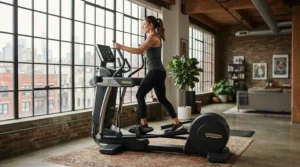
The words “smooth elliptical path” appear in nearly every product listing, so let’s translate them. Smoothness comes from three things: flywheel mass, bearing and roller quality, and how well stride length fits your body. Rear drive geometry contributes by keeping the path flat, but it doesn’t guarantee smoothness on its own.
Professional-grade motion is a similar story. Commercial gyms lean on rear drive designs from brands like Life Fitness and Precor, which is where the association comes from. But the machines in this guide borrow the layout, not the commercial build. Their flywheels are lighter, their frames are lighter, and their warranties are shorter. Expect a pleasant glide at home, not a rebuilt gym unit.
On the Sunny Health & Fitness SF-E3912, a 13-pound flywheel means a smooth but not heavy feel. On the Niceday CT11PRO-20, a longer stride and heavier frame promise a more planted ride. Neither is a commercial machine, and I’d be wary of any listing that implies otherwise.
For a reality check on low-impact claims, Mayo Clinic notes that elliptical machines offer an effective low-impact workout, and some include handles so you can exercise arms and legs at once. That’s the realistic upside: joint-friendly cardio with an upper-body option. Anything past that is marketing flourish.
✨ Ready to Find Your Glide?
🔍 Take your rear drive elliptical search to the next level with these carefully selected products. Click on any highlighted item to check current pricing and availability. These machines will help you build a cardio habit your joints will thank you for!
How to Choose a Rear Drive Elliptical
- Match stride to height. Under six feet, 15 to 18 inches can work. Above that, aim for 18 to 20 inches, because a short stride forces an unnatural gait.
- Check weight capacity with a margin. Look for a rating well above your body weight. Heavier ratings usually mean thicker frames.
- Weigh the flywheel. Heavier flywheels generally smooth out the dead spots at the top and bottom of the stroke. The 13-pound units are lighter than the 18-pound-plus ones.
- Measure your space, including ceiling height. Add 21 inches to the tallest user’s height, and leave room for arm and pedal travel.
- Decide how much noise you can tolerate. Magnetic systems are quiet, and apartment dwellers should favor models advertising low decibel levels.
- Verify drive type and specs on the exact listing. Retailers sometimes mislabel, and capacity figures vary between sellers.
- Check the warranty. Short parts warranties are common at this price, so read the terms.
Common Mistakes When Buying a Rear Drive Elliptical
Buying on price alone. A $300 machine is a fine starter, but a short stride can make taller users quit within weeks.
Trusting “up to 6’5″” claims. Listings are optimistic. Reviewers say people over 6’2″ find some 15.5-inch machines cramped.
Ignoring labeling disputes. Drive type is inconsistently labeled across retailers, so confirm it before you click buy.
Forgetting assembly time. Several budget models have reportedly time-consuming assembly. Some retailers offer paid assembly, which can be worth it.
Assuming incline is included. Many rear drive home models offer little or no incline, so check the spec sheet if you want it.
Skipping the return policy. Sunny Health & Fitness offers a 30-day return window, and similar windows exist elsewhere. Know the terms before you open the box.
Long-Term Cost & Maintenance
| Cost Factor | Budget Tier (Under $400) | Mid-Range ($500-$900) |
|---|---|---|
| Upfront price | Low | Moderate |
| Typical warranty | Short (about 1 year or less on parts) | Varies; read the terms |
| Maintenance | Lubrication, bolt checks | Lubrication, bolt checks, roller inspection |
| App or subscription cost | Often free apps | iFIT-style subscriptions are extra |
| Likely upgrade need | Higher (stride, flywheel) | Lower |
Cost-per-use is where mid-range machines earn their keep. If a $350 machine gets abandoned in four months because the stride is wrong, it cost more per workout than a $700 machine used daily for years. Based on the spec comparison, the Niceday CT11S-18 and Niceday CT11PRO-20 offer the best long-term value for taller users, while the pooboo E399 is the smartest starter pick for shorter users.
Don’t forget subscriptions. The ProForm Hybrid Trainer XT works with iFIT, which is a paid service beyond any trial period. Budget for that if you want guided classes.
FAQ
❓ Are rear drive ellipticals good for small apartments?
❓ How much should I spend on a rear drive elliptical?
❓ Is a rear drive elliptical better for tall users?
❓ Do rear drive ellipticals need more maintenance than front drive models?
❓ Can I pedal backward on a rear drive elliptical?
Conclusion
Here’s the short version of rear drive elliptical benefits: a flatter, walk-like foot path, an upright stance, a mechanically simple layout, and a market full of affordable home options. Those are real, source-backed advantages, but they’re not magic. Stride length, frame strength, and fit matter as much as where the flywheel lives, and the research I found doesn’t prove rear drive is more biomechanically efficient than front drive.
If you’re under six feet and on a budget, the pooboo E399 or Sunny Health & Fitness SF-E3912 are sensible starting points. If you’re short on space, the Exerpeutic Heavy Duty Magnetic Elliptical and YOUNGFIT Foldable Elliptical earn their spot. For tall or heavier users, the Niceday CT11PRO-20 and Niceday CT11S-18 offer the stride and capacity the others lack, and the ProForm Hybrid Trainer XT makes sense if you want a bike and an elliptical in one frame.
Take one action today: measure your height, your floor space, and your ceiling, then match them to the stride and footprint columns in the table above.
✨ Your Glide Awaits!
🔍 Ready to feel the difference? Click any highlighted product above to check current pricing and availability, and start building a low-impact cardio habit that fits your home and your body!
Recommended for You
- Rear Drive Elliptical: 7 Best Picks For Smooth Home Workouts 2026
- Front Drive Elliptical Benefits: 7 Proven Picks For 2026
- Front Drive Vs Rear Drive Elliptical: 7 Best Picks
Disclaimer: This article contains affiliate links. As an Amazon Associate, I earn from qualifying purchases. If you purchase products through these links, we may earn a small commission at no additional cost to you.
✨ Found this helpful? Share it with your friends! 💬🤗
