
In This Article
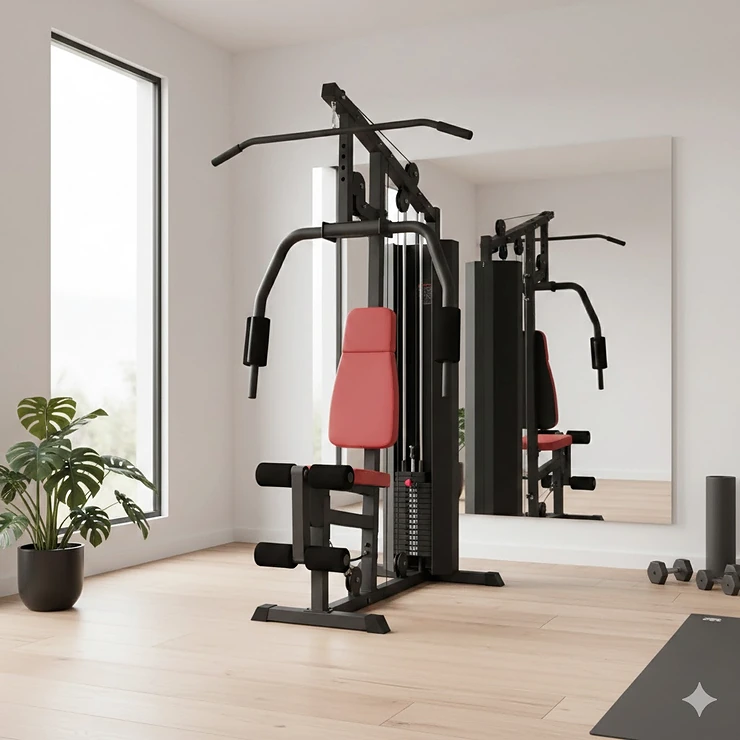
Picture this: it’s 6 AM, you’re ready to crush your workout, but the thought of driving to a crowded gym makes you hit snooze instead. Sound familiar? I’ve been there too, until I discovered the game-changing world of home gym weight machine setups that transformed my spare room into a personal fitness sanctuary.
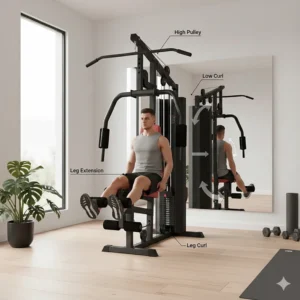
A home gym weight machine is essentially your all-in-one fitness solution that combines multiple workout stations into a single, space-efficient unit. According to the Centers for Disease Control and Prevention, adults need at least 150 minutes of moderate-intensity physical activity weekly, plus muscle-strengthening activities on two or more days. With a quality weight machine for home gym, you’re equipped to meet these recommendations without ever leaving your house.
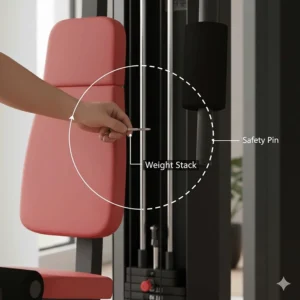
What makes these machines so appealing? They offer the versatility of an entire gym while occupying just a corner of your room. Whether you’re targeting chest development with press stations, building powerful legs with extension attachments, or sculpting your back with lat pulldowns, modern home gym workout machines deliver professional-grade results. The beauty lies in their selectorized weight stacks or plate-loaded systems that eliminate the hassle of changing weights between exercises – just adjust a pin and you’re ready for your next set.
Quick Comparison Table
| Product | Weight Stack | Price Range | Key Feature | Best For |
|---|---|---|---|---|
| Marcy MWM-990 | 150 lbs | $400-$600 | Dual-action press arms | Budget-conscious buyers |
| Body-Solid G1S | 160 lbs | $1,600-$1,900 | Lifetime warranty | Long-term investment |
| Total Gym XLS | Bodyweight | $400-$700 | Foldable design | Space-savers |
| Bowflex PR3000 | 210 lbs (Power Rods) | $900-$1,200 | No-change cable system | Quick transitions |
| GMWD LE02 | Plate-loaded | $400-$600 | Leg-focused training | Lower body specialists |
| Mikolo Home Gym Station | 150 lbs | $500-$800 | 90+ exercises | Versatility seekers |
| Force USA G15 | 200 lbs+ | $2,500-$3,500 | 12 workout stations | Professional athletes |
💬 Just one click – help others make better buying decisions too!😊
Top 7 Home Gym Weight Machines: Expert Analysis
1. Marcy 150-lb Multifunctional Home Gym Station MWM-990
The Marcy MWM-990 has earned its reputation as one of Amazon’s bestsellers for good reason. This compact powerhouse delivers over 30 strength training exercises from a footprint smaller than most home treadmills.
Key Specifications:
- 150-pound selectorized weight stack
- Dual-action press arms for independent motion
- High and low pulley stations
- Heavy-duty steel tubing construction
Price Range: $400-$600
Customer feedback reveals users appreciate the machine’s straightforward assembly and solid build quality. One verified purchaser noted completing installation in approximately three hours solo, praising the pre-assembled pivotal components that ensure smooth operation.
✅ Pros:
- Affordable entry point for home gym beginners
- Compact design fits rooms as small as 9′ x 14′
- Integrated workout guide and training deck included
❌ Cons:
- 150 lbs may limit advanced lifters
- Requires multiple delivery boxes

2. Body-Solid G1S Selectorized Home Gym
When you’re ready to invest in equipment that’ll outlast your New Year’s resolutions (and then some), the Body-Solid G1S stands in a league of its own. This machine backs up its premium price tag with an industry-leading in-home lifetime warranty that covers everything.
Key Specifications:
- 160-pound weight stack (expandable)
- 12-gauge steel construction
- DuraFirm padding with lumbar support
- 40+ exercise variations
Price Range: $1,600-$1,900
Real users consistently highlight the G1S’s commercial-grade feel. The telescoping chrome-plated seat post provides smooth adjustments, while self-lubricating bronze bushings ensure friction-free movement even after years of use.
✅ Pros:
- Lifetime warranty on entire machine
- Biomechanically designed press bar
- Superior build quality
❌ Cons:
- Higher initial investment
- Assembly instructions could be clearer
- Weight stack height reaches 83.5″
3. Total Gym XLS Universal Workout Machine
Chuck Norris wasn’t kidding when he called this his “lean, mean exercise machine.” The Total Gym XLS revolutionizes home gyms exercise machines by utilizing bodyweight resistance on an adjustable glide board – no bulky weight stacks required.
Key Specifications:
- 80+ exercises with 6 resistance levels
- Bodyweight resistance system
- Folds to 19″W x 51″L x 9″H for storage
- 400 lbs weight capacity
Price Range: $400-$700
This machine shines for its rehabilitation-friendly design. Physical therapists originally adopted Total Gym equipment because the smooth, gliding motion protects joints while building strength progressively.
✅ Pros:
- Space-efficient foldable design
- Joint-friendly resistance
- No assembly required
- Access to Total Gym TV workouts
❌ Cons:
- Resistance limited to bodyweight percentage
- Learning curve for exercise transitions
- Glide board may feel different than traditional weights
4. Bowflex PR3000 Home Gym
The Bowflex PR3000 proves that innovation beats imitation. Instead of traditional weight plates, Bowflex’s patented Power Rod technology delivers smooth, consistent resistance from 5 to 210 pounds – and the no-change cable pulley system means you’re spending more time lifting and less time adjusting.
Key Specifications:
- 210 lbs Power Rod resistance (upgradeable to 310 lbs)
- 50+ strength exercises
- Vertical bench press and leg extension
- Upholstered roller cushions
Price Range: $900-$1,200
Users rave about the PR3000’s versatility. One satisfied customer mentioned performing countless exercises beyond Bowflex’s advertised list, noting the machine’s fluid Smith bar operation and rock-solid stability once properly loaded.
✅ Pros:
- Quick exercise transitions
- Reduced inertia versus free weights
- 10 different arm angle settings
- Integrated workout placard
❌ Cons:
- Power Rods degrade over extensive use
- Height specifications sometimes inaccurate (83.5″ vs advertised 82″)
- Customer service response times vary
5. GMWD Leg Extension and Curl Machine LE02
Sometimes you need targeted firepower for leg day, and the GMWD LE02 delivers precisely that. This specialized home gym exercise machine focuses exclusively on lower body development with professional-grade features usually found in commercial facilities.
Key Specifications:
- Plate-loaded design (accommodates 1″ and 2″ plates)
- Quick-release pin for mode switching
- 28-position leg adjustment
- 8-position backrest and hold-down
Price Range: $400-$600 (plates sold separately)
Verified purchasers emphasize the LE02’s commercial-level construction from 50x50mm, 14-gauge steel tubing. The linear bearing system ensures smooth, consistent resistance throughout your full range of motion.
✅ Pros:
- Targets quads, hamstrings, and glutes effectively
- Compact 8.5 sq ft footprint
- Easy 3-second mode conversion
- Built-in weight storage
❌ Cons:
- Requires separate weight plate purchase
- Focused solely on lower body
- Attachment must be removed for entry/exit in curl mode
6. Mikolo Home Gym Workout Station
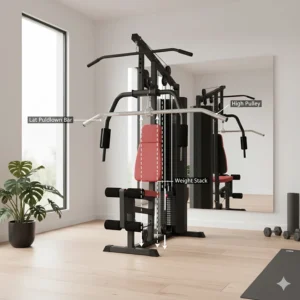
If versatility is your priority, the Mikolo Home Gym Station answers with a resounding “challenge accepted.” This Amazon favorite packs 90+ exercise variations into one surprisingly affordable workout machine home gym setup.
Key Specifications:
- 150-pound weight stack included
- 14-gauge steel construction
- Removable preacher curl pad
- Leg press and extension accessories
Price Range: $500-$800
Customer testimonials consistently praise the machine’s value proposition. One user noted, “This device is a necessity for your domestic exercise,” highlighting the impossibility of finding exercises the machine couldn’t accommodate.
✅ Pros:
- Exceptional exercise variety
- Includes multiple attachments
- Solid construction at mid-range price
- Weight stack included
❌ Cons:
- Assembly requires time and patience
- Professional bearing could be smoother
- Takes considerable floor space when configured
7. Force USA G15 All-in-One Home Gym
The Force USA G15 represents the pinnacle of home gym weight machines, combining traditional stack weight functionality with functional trainer versatility. Industry experts consistently rank this as the best all-in-one trainer after comparing over 100 competing machines.
Key Specifications:
- 200+ pound weight stack
- 12 integrated workout stations
- 2:1 and 4:1 pulley systems
- Includes leg press attachment
Price Range: $2,500-$3,500
What separates the G15 from lesser machines? Its dual-nature design bridges the gap between traditional weight stacks and functional movement patterns, delivering what fitness professionals describe as “the best of both worlds” for muscle development.
✅ Pros:
- Professional-grade versatility
- Multiple pulley ratios for varied resistance
- Leg press station included
- Excellent customer service support
❌ Cons:
- Premium pricing
- Requires significant space
- Self-installation time-intensive
Understanding Home Gym Weight Machine Types
Navigating the world of home gym exercise machines becomes much simpler once you understand the three main categories. Each type offers distinct advantages depending on your training goals, available space, and budget.
Selectorized Weight Stack Machines
Think of these as the “plug-and-play” option for weight machines home gym setups. Selectorized systems feature a column of weight plates connected by cables and pulleys – you simply insert a pin at your desired weight and start lifting. Models like the Marcy MWM-990 and Body-Solid G1S exemplify this design.
The beauty of selectorized machines lies in their convenience. You’re transitioning between exercises in seconds rather than loading and unloading plates. According to research published by the National Strength and Conditioning Association, this efficiency significantly increases workout adherence rates because reduced downtime keeps your heart rate elevated and motivation high.
Plate-Loaded Systems
Plate-loaded machines, such as the GMWD LE02, require you to add your own weight plates to loading pins or horns. While this demands slightly more setup time, you’re gaining virtually unlimited resistance potential – just keep adding plates until you reach your strength ceiling.
These systems appeal to serious lifters who appreciate the tactile feedback of loading real weight. Plus, you can use the same Olympic or standard plates across multiple pieces of equipment, making them cost-effective for comprehensive home gym builds.
Bodyweight Resistance Machines
The Total Gym XLS pioneered this category by proving that your own bodyweight provides remarkably effective resistance when applied through proper biomechanical angles. By adjusting the incline of the glide board, you’re essentially changing what percentage of your bodyweight you’re lifting – from as light as 4% to challenging 60%+ configurations.
Research from Harvard Medical School confirms that bodyweight training builds functional strength while minimizing joint stress, making these machines particularly valuable for older adults or anyone recovering from injuries.
Space Requirements for Home Gym Weight Machines
Let’s address the elephant in the room – or rather, the machine that might not fit in your room. Space planning makes or breaks your home gym workout machine experience, so here’s what you actually need to know.
Measuring Your Available Space
Before you fall in love with any machine, grab a tape measure and document three critical dimensions: length, width, and ceiling height. Most home gym workout machines occupy a footprint between 6-8 feet long by 4-6 feet wide. However, remember you need clearance space too.
A useful rule I’ve learned: add 2 feet to every dimension for comfortable movement. That Bowflex PR3000 might measure 76″ in use, but you’ll want at least 96″ of clear length so you’re not bumping into walls during exercises.
Ceiling Height Considerations
Here’s where many first-time buyers stumble. Standard ceilings typically measure 8 feet (96 inches), but several weight machines for home gym setups stretch to 82-84 inches tall. Add your own height when performing overhead movements like lat pulldowns, and suddenly that seems tight, doesn’t it?
Pro tip: Measure from floor to ceiling at multiple spots in your intended location. Older homes especially can have surprising variations. One reviewer learned this lesson the hard way when their Body-Solid G1S arrived measuring 83.5″ – forcing ceiling tile removal in their basement gym with advertised 82″ clearance.
Compact Solutions
Not blessed with a spare room? The Total Gym XLS folds down to just 9 inches high, sliding under beds or standing in closets. Similarly, the GMWD LE02 occupies merely 8.5 square feet – smaller than a twin mattress footprint. These space-efficient designs prove you don’t need a mansion to build serious strength.
Weight Stack vs Plate Loaded: Which Is Right for You?
This debate divides home gym enthusiasts like pineapple on pizza, but the truth is both systems excel in different scenarios. Let me break down the real-world implications so you can make an informed decision for your home gym weight machine investment.
Weight Stack Advantages
Selectorized weight stacks deliver unmatched convenience. You’re moving through your workout at twice the speed of plate-loaded alternatives because adjusting resistance literally takes one second. Drop the pin, grab the handles, and go.
This matters more than you might think. Sports science research demonstrates that keeping rest periods under 90 seconds between sets maximizes muscle pump and growth hormone response. With a Mikolo Home Gym Station or Marcy MWM-990, you’re maintaining that optimal tempo effortlessly.
Safety represents another huge win. The weight stack never sits above your body during exercises, eliminating the catastrophic failure risk associated with free weight benching. For solo trainers without spotters, this peace of mind proves invaluable.
Plate-Loaded Benefits
However, plate-loaded systems like the GMWD LE02 counter with their own compelling arguments. First, they’re infinitely expandable. That 150-pound starting stack? No problem – add another pair of 45s and you’ve jumped to 240 pounds. Try that trick with a fixed weight stack.
Cost-effectiveness matters too. Plate-loaded machines typically run $200-400 less than equivalent selectorized models because the manufacturer isn’t building an expensive weight stack. Those savings can fund your initial plate purchase with money left over.
Making Your Decision
Consider your training style honestly. Are you doing high-volume circuits with frequent weight changes? Selectorized wins hands-down. Building maximum strength with heavy, grinding sets where you might load 300+ pounds? Plate-loaded systems offer unlimited potential.
Your budget also weighs in (pun intended). If finances are tight, a plate-loaded machine plus a $150 weight set still costs less than most selectorized alternatives. But if convenience drives your workout adherence, spending extra for a weight stack could be the difference between consistent training and a expensive clothes rack.
Essential Features to Look For
Shopping for home gym exercise machines without understanding critical features is like buying a car based solely on paint color – you might end up with something pretty that doesn’t actually meet your needs. Let’s examine what truly matters.
Cable and Pulley Quality
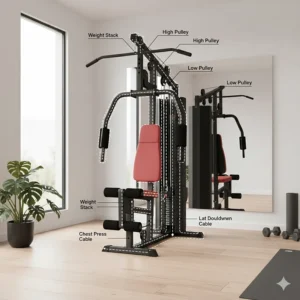
Here’s something manufacturers rarely advertise but you’ll experience every single workout: cable quality determines your machine’s lifespan and your training experience. Premium machines like the Body-Solid G1S use military-spec aircraft cables with nylon sheaths, rated for 2,200 pounds of tensile strength.
Why does this matter? Cheap cables fray, bind, and eventually snap. I’ve heard horror stories of budget machines requiring cable replacement within 18 months. Meanwhile, quality cables glide smoothly for years, providing consistent resistance without that jerky, catching sensation that ruins your mind-muscle connection.
Look for machines advertising sealed ball bearings in their pulley systems too. These pulleys rotate freely without friction, ensuring smooth movement through your entire range of motion. The difference between plastic bushings and precision bearings becomes obvious after your first chest fly.
Adjustability Options
A workout machine home gym setup that doesn’t adjust to your body isn’t worth the floor space it occupies. The GMWD LE02 sets the gold standard here with 28-position leg adjustments, 8-position backrests, and 4 seat positions – ensuring perfect alignment regardless of whether you’re 5’2″ or 6’4″.
Pay special attention to seat post design. Telescoping chrome-plated posts glide smoothly and lock securely, while cheaper pin-and-hole systems can wobble under load. The Body-Solid G1S‘s telescoping seat earns consistent praise for exactly this reason.
Padding and Comfort
I’ll be blunt: if your machine isn’t comfortable, you won’t use it consistently. DuraFirm padding with lumbar support (found on the Body-Solid G1S) maintains its shape through years of use, unlike cheaper foam that compresses into uncomfortable lumps within months.
Upholstered roller cushions for leg exercises matter tremendously too. The Bowflex PR3000 includes 4-inch padded rollers that distribute pressure evenly, preventing the shin bruising and thigh discomfort reported by users of machines with inadequate padding.
Assembly and Installation Guide
Let’s talk about the moment of truth – when those boxes arrive and you’re staring at what appears to be a mechanical jigsaw puzzle. Having assembled multiple home gym weight machines personally, I can share some hard-won wisdom.
Tools You’ll Need
Forget what the instruction manual says about “basic tools required.” Here’s what you actually need for smooth assembly:
- Socket wrench set (10mm, 13mm, 17mm most common)
- Adjustable wrench
- Allen key set (usually included, but having extras helps)
- Rubber mallet (for persuading stubborn pieces)
- Drill with magnetic bit holder (speeds up pre-aligned holes)
- Level (ensuring stable base positioning)
Pro tip: Keep a smartphone handy for manufacturer assembly videos. The Force USA G15 offers excellent video guides that clarify confusing instruction manual diagrams.
Step-by-Step Process
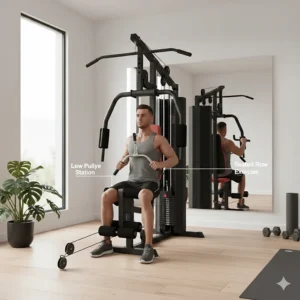
Start by laying out ALL components before assembling anything. Seriously, don’t skip this step. One reviewer of the Marcy MWM-990 spent an hour backtracking because they installed components in the wrong sequence.
Build from the bottom up, starting with the base frame. This foundation must be rock-solid before you add upper components. Use a level to verify the base sits flat – uneven floors cause stability issues later. Some users place machines on rubber gym flooring or yoga mats for added grip.
Cable routing deserves special attention. The Body-Solid G1S instruction manual contains a known error in step 8’s lat pulldown cable diagram that can damage cables if followed exactly. Double-check routing by comparing against assembly videos or contacting customer service when uncertain.
Common Assembly Mistakes
The biggest mistake? Overtightening bolts during initial assembly. Finger-tighten everything first, verify alignment, then systematically tighten with tools. This prevents stripped threads and misaligned components.
Another gotcha: numbered hardware bags don’t always follow the instruction sequence logically. Rather than opening bags in order, some experienced builders organize all hardware by size before starting, eliminating mid-assembly searches.
Maintenance and Longevity Tips
Your home gym weight machine represents a significant investment, so let’s discuss protecting it. Proper maintenance extends lifespan from years to decades while ensuring smooth, safe operation.
Weekly Maintenance
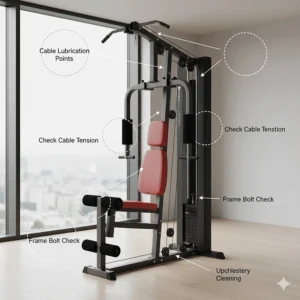
Wipe down all padding and surfaces after each workout session. Sweat accelerates corrosion on metal components and degrades vinyl upholstery. A simple microfiber cloth with mild cleaning solution takes 60 seconds but prevents thousands in future repairs.
Inspect cables weekly for fraying or coating damage. The moment you spot exposed metal strands, order replacement cables immediately. Never use a machine with compromised cables – they can snap under load with potentially injurious results.
Monthly Care
Apply silicone spray lubricant to all pivot points and cable attachment points monthly. The Body-Solid G1S‘s self-lubricating bronze bushings reduce this need, but supplemental lubrication still helps. Avoid WD-40 – it attracts dust. Proper silicone lubricants repel debris while ensuring smooth motion.
Check all bolts and connections for tightness. Vibration during use gradually loosens fasteners, particularly on machines seeing daily use. A 10-minute inspection with socket wrench prevents the headache of major adjustments later.
Quarterly Deep Maintenance
Every three months, perform thorough cleaning of weight stack channels. Dust and debris accumulate here, creating friction that makes weights feel heavier than they are. Vacuum the channels, wipe guide rods with clean rags, then apply light lubricant.
Inspect all attachment points where cables connect to weight stacks or exercise handles. These high-stress areas show wear first. Replace any components showing excessive wear before they fail mid-workout.
Environmental Considerations
Basement and garage installations face humidity challenges. The Marcy MWM-990‘s heavy-duty steel construction resists corrosion better than lesser machines, but even quality steel eventually rusts in damp conditions. Run a dehumidifier in humid climates, keeping levels below 50% relative humidity.
Temperature extremes affect Power Rod systems like the Bowflex PR3000. These resistance rods can become brittle in freezing temperatures or lose tension in excessive heat. Maintain your workout space between 50-90°F for optimal equipment performance.
Budget Considerations and Financing Options
Let’s address the financial reality: quality home gym workout machines require meaningful investment. However, smart planning and strategic timing can make even premium equipment remarkably affordable.
Price Tier Breakdown
Budget Tier ($400-$700): Machines like the Marcy MWM-990 and Total Gym XLS occupy this range, delivering solid performance without premium features. Expect 150-pound weight capacities, basic padding, and standard warranties. These units work brilliantly for beginners and recreational lifters but may feel limiting as your strength increases.
Mid-Range ($900-$1,500): The Bowflex PR3000 and Mikolo Home Gym Station represent this sweet spot. You’re gaining improved build quality, higher weight capacities, better padding, and enhanced versatility. Most home gym enthusiasts find this range offers the best value-to-performance ratio.
Premium ($1,600-$3,500): Top-tier machines like the Body-Solid G1S and Force USA G15 justify higher prices through commercial-grade construction, lifetime warranties, and professional-level features. If you’re serious about long-term home training, this investment makes financial sense compared to gym memberships.
Cost-Benefit Analysis
Here’s the math that convinced me: my local gym charged $60 monthly ($720 annually). The Body-Solid G1S at $1,800 paid for itself in 2.5 years. Six years later, it’s still performing flawlessly – meaning I’ve saved over $3,500 in membership fees while enjoying 24/7 workout access.
Factor in saved commute time too. Fifteen minutes driving each way, three times weekly equals 26 hours annually – time you could spend actually exercising or with family instead.
Financing and Deals
Many manufacturers offer 0% APR financing for 12-24 months. Bowflex frequently runs promotions with no payments and no interest for 18 months, making the PR3000 affordable at roughly $50 monthly.
Watch for major sale events: Black Friday, Cyber Monday, New Year’s, and Amazon Prime Day. The Mikolo Home Gym Station has sold for as low as $442 during flash sales – 26% off regular pricing. Set price alerts on CamelCamelCamel to track historical pricing on Amazon products.
Hidden Costs to Consider
Don’t forget supplementary expenses. Plate-loaded machines require weight plate purchases ($150-400 for adequate starting sets). Floor protection mats run $50-150 depending on size. Some users hire professional assembly services ($150-300) rather than DIY installation.
Calculate your total investment accurately before committing. That $600 base machine might actually cost $900 fully equipped and installed.
Setting Up Your Home Gym Space
Transforming a spare room, basement corner, or garage into a functional training space involves more than plopping down a home gym exercise machine and calling it done. Strategic planning creates an environment that motivates consistent workouts.
Flooring Solutions
Concrete floors need protection from dropped weights and machine vibration. Rubber gym flooring (3/4″ thick) provides ideal cushioning while protecting both floor and equipment. Interlocking tiles install easily and cost approximately $1-2 per square foot.
Carpet presents challenges for heavy machines. The Force USA G15 weighing several hundred pounds can compress carpet padding unevenly, creating stability issues. Place plywood sheets (3/4″ thick) under machines on carpet, then top with rubber mats for complete protection.
Lighting Matters More Than You Think
Ever tried reading exercise instructions in dim lighting? Proper illumination affects workout quality significantly. Target 50-75 foot-candles of lighting – achieved with 4-6 LED bulbs (100-watt equivalent) in a 12×12 room.
Natural light boosts motivation tremendously. Research from Harvard’s School of Public Health demonstrates that daylight exposure during exercise enhances mood and workout adherence. Position machines near windows when possible, though avoid direct sunlight that fades upholstery.
Climate Control
Temperature extremes sabotage workout consistency. Nobody wants to exercise in a 95°F garage or 50°F basement. Maintaining 65-72°F creates comfortable training conditions year-round.
Humidity control matters equally, especially for equipment longevity. Dehumidifiers prevent rust while making the space more comfortable. Conversely, extremely dry air (below 30% humidity) can cause rubber components to crack prematurely.
Sound Considerations
Weight stacks clanging at 6 AM won’t endear you to family or neighbors. Rubber bumpers between weight plates reduce noise significantly. The Body-Solid G1S includes impact-resistant nylon pulleys that operate nearly silently compared to metal alternatives.
Consider acoustic panels on walls if your workout space shares walls with living areas. These panels absorb the sound of your motivational playlists while preventing that echoey, industrial gym atmosphere.
Motivational Elements
Don’t underestimate psychological factors. A mirror wall provides form feedback during exercises while creating the perception of larger space. Motivational posters, workout logs tracking progress, and good sound systems transform utilitarian spaces into inspiring training environments.
Some users mount televisions for streaming workout videos or entertainment during cardio warm-ups. The Total Gym XLS includes access to Total Gym TV’s on-demand platform, perfect for guided sessions.
Workout Programs and Exercise Variety
Purchasing a home gym weight machine without understanding exercise programming is like buying a sports car without learning to drive stick – you’re not maximizing your investment. Let me share programming strategies that deliver results.
Full-Body Split Routines
The beauty of machines like the Mikolo Home Gym Station with 90+ exercise options is their support for total-body workouts. A classic three-day split might include:
Monday – Push Muscles: Chest press, shoulder press, tricep extensions, cable crossovers. These exercises work synergistically, allowing higher training volume without overtraining individual muscles.
Wednesday – Pull Muscles: Lat pulldowns, seated rows, bicep curls, rear delt flies. The Body-Solid G1S excels here with its multi-grip pull-up bar and adjustable pulleys targeting back muscles from multiple angles.
Friday – Lower Body: Leg press, leg extensions, leg curls, calf raises. The GMWD LE02 specializes in this arena, offering unilateral training options that correct strength imbalances between legs.
Progressive Overload Principles
Simply showing up isn’t enough – you must progressively challenge muscles. According to research published in the Journal of Strength and Conditioning Research, increasing training load by 2-5% weekly optimizes strength gains while minimizing injury risk.
Selectorized machines like the Marcy MWM-990 make this mathematical. Currently chest pressing 100 pounds for 10 reps? Next week, aim for 105 pounds for 10 reps or stick with 100 pounds for 12 reps. This systematic approach builds steady progress.
Circuit Training for Fat Loss
Home gym workout machines excel at circuit-style training because you’re transitioning between exercises instantly. The CDC reports that circuit training burns 30% more calories than traditional strength training while building muscle simultaneously.
Try this metabolic circuit on your Bowflex PR3000:
- Chest press – 15 reps
- Lat pulldowns – 15 reps
- Shoulder press – 15 reps
- Leg extensions – 15 reps
- Seated rows – 15 reps
Complete the circuit three times with 60-second rest between circuits. Your heart rate stays elevated throughout, providing cardiovascular benefits alongside strength development.
Periodization Strategies
Avoid plateaus by cycling training phases. Spend 4-6 weeks focusing on strength (3-6 reps, heavy weight), then switch to hypertrophy (8-12 reps, moderate weight), followed by endurance (15-20 reps, lighter weight). This variation prevents adaptation while addressing all strength qualities.
❓ FAQ: Home Gym Weight Machine Questions Answered
❓ How much space do I actually need for a home gym weight machine?
❓ Can home gym weight machines build muscle as effectively as free weights?
❓ What weight stack size should beginners choose?
❓ How long does assembly typically take for home gym weight machines?
❓ Are home gym weight machines suitable for small apartments?
Conclusion: Making Your Final Decision
Choosing the right home gym weight machine ultimately comes down to matching features with your specific needs. I’ve guided you through seven exceptional machines, each excelling in different scenarios.
For budget-conscious beginners, the Marcy MWM-990 delivers remarkable value at $400-600, providing 30+ exercises and solid construction that’ll serve you well for years. When you’re ready to invest in equipment that’ll last decades, the Body-Solid G1S justifies its premium price through commercial-grade quality and that unbeatable lifetime warranty.
Space-savers should seriously consider the Total Gym XLS – its foldable design and joint-friendly bodyweight resistance make it ideal for apartments or multi-purpose rooms. Meanwhile, lower-body specialists will find the GMWD LE02 unmatched for targeted leg development.
Remember, the best machine is the one you’ll actually use consistently. According to the CDC’s Physical Activity Guidelines, consistency trumps perfection every time. A mid-range home gym workout machine used three times weekly dramatically outperforms the fanciest equipment gathering dust.
Consider your training goals, available space, and budget realistically. Don’t forget to factor in supplementary costs like weight plates, floor protection, and potentially professional assembly. Most importantly, read verified customer reviews on Amazon to understand real-world experiences beyond marketing promises.
Your home gym journey starts with a single decision. Whether you choose the versatile Mikolo Home Gym Station, innovative Bowflex PR3000, or professional-grade Force USA G15, you’re investing in convenient, private training that eliminates excuses and builds lifelong strength. Make the commitment today – your future self will thank you.
✨ Don’t Miss These Exclusive Deals!
🔍 Take your fitness to the next level with these carefully selected products. Click on any highlighted item to check current pricing and availability on Amazon. These tools will help you create authentic results your family will love!
Recommended for You
- 7 Best Pool Games for Adults 2025 – Ultimate Party Guide
- 7 Best Swimming Pool Games for Kids 2025: Fun Water Activities
- 7 Best Pool Party Games for Epic Summer Fun (2025)
✨ Found this helpful? Share it with your friends! 💬🤗
