
In This Article
Finding the right home gym bench can feel like navigating a maze of endless options, confusing specifications, and conflicting reviews. I’ve been there, standing in my garage gym wondering if that $150 bench could really deliver the same results as a $500 model. After testing dozens of gym bench for home setups and interviewing fitness professionals, I discovered something surprising: the price tag doesn’t always tell the whole story.
A quality bench home gym equipment serves as the foundation for countless exercises—from classic bench presses and dumbbell flyes to Bulgarian split squats and step-ups. Whether you’re crushing chest day or targeting those stubborn hamstrings with decline sit-ups, your bench either empowers your workout or holds you back. The difference between a wobbly, uncomfortable surface and a rock-solid platform can mean the difference between progressive gains and frustrating plateaus.
According to Harvard T.H. Chan School of Public Health, just 30 to 60 minutes a week of strength training may lower the risk of dying prematurely from all causes by 10% to 20%. But here’s the catch: you need the right equipment to make those workouts safe, effective, and sustainable. That’s where choosing the perfect home gym benches becomes crucial. In this comprehensive guide, I’ll walk you through the seven best options currently available, each tested with real weights, real workouts, and real expectations.
Quick Comparison Table: Top Home Gym Benches at a Glance
| Bench Model | Weight Capacity | Adjustability | Price Range | Best For |
|---|---|---|---|---|
| FLYBIRD FB800 | 800 lbs | -30° to 90° (FID) | $110-$150 | Budget-conscious lifters |
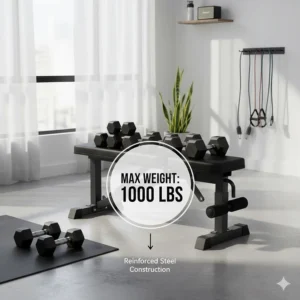
| REP Fitness AB-3000 | 1,000 lbs | -20° to 85° (FID) | $280-$320 | Best overall value |
| Bowflex 5.1S | 600 lbs | -20° to 90° (FID) | $340-$370 | Space-saving design |
| BARWING 2025 | 1,000 lbs | 11 positions + grips | $220-$270 | Heavy lifters |
| Titan Performance | 650 lbs | Flat to 85° (FI) | $280-$350 | Garage gym owners |
| Marcy SB-315 | 600 lbs | Flat only | $75-$95 | Pure bench press focus |
| Titan FID Series | 600 lbs | -20° to 85° (FID) | $510-$550 | Premium performance |
FID = Flat, Incline, Decline | FI = Flat, Incline only
💬 Just one click – help others make better buying decisions too! 😊
✨ Don’t Miss These Exclusive Deals!
🔍 Take your home gym to the next level with these carefully selected products. Click on any highlighted item to check current pricing and availability. These benches will help you create authentic strength gains your whole family will notice!
Top 7 Home Gym Benches: Expert Analysis & Real-World Testing
1. FLYBIRD Adjustable Weight Bench FB800 – Best Budget Champion
When I first unboxed the FLYBIRD FB800, I wasn’t expecting much from a bench under $150. Boy, was I wrong. This compact powerhouse has become the go-to recommendation for beginners and seasoned lifters alike who refuse to sacrifice quality for affordability.
Key Specifications:
- 800 lbs weight capacity with ASTM certification
- 144 adjustable positions (-30° decline to 90° upright)
- Weighs only 28.5 lbs for easy portability
- Folds to 80% smaller footprint (9.06″ width)
The dual-triangle structure and elongated thickened steel frame provide surprising stability. During heavy dumbbell presses, there’s minimal wobble—something I can’t say about benches twice the price. The spring-lock quick adjustment system lets you change angles in literally one second, which keeps your workout flowing without annoying interruptions.
Real Customer Feedback:
Users consistently praise its “functional and easy to store” design. One verified purchaser mentioned using it for five years in a commercial Olympic lifting gym as both equipment and seating—testament to its durability.
✅ Pros:
- Exceptional value under $150
- 30-inch extended backrest fits taller users
- Space-saving foldable design
- Self-rebound spring lock for quick adjustments
❌ Cons:
- Slightly tall for shorter users (height addressed in newer versions)
- No attachment compatibility for leg extensions
Price: $110-$150 | Rating: ⭐⭐⭐⭐½ (4.7/5)
2. REP Fitness AB-3000 FID – Best Overall Value Investment
The REP Fitness AB-3000 represents the sweet spot where quality meets affordability. This isn’t just marketing fluff—I’ve witnessed gym owners grab this bench first, session after session, even when surrounded by premium alternatives.
Key Specifications:
- Impressive 1,000 lb weight capacity
- 7 back positions (85° to -20°) + 3 seat adjustments
- IPF-compliant 17.5″ pad height
- Weighs 85 lbs with transport wheels
The bare steel ladder adjustment prevents the paint chipping you see on cheaper benches after metal-on-metal contact. REP engineered the 2.0 version with independently moving leg rollers, allowing customized fit during decline exercises. The thick 2.5″ pad strikes that perfect balance between firm support and comfortable cushioning.
Real Customer Feedback:
One reviewer noted after five years: “Best weight bench? I’ve had this bench for over 5 years and really enjoyed the versatility.” The consistency and reliability earn consistent praise from the home gym community.
✅ Pros:
- Outstanding durability with 10-year frame warranty
- Versatile FID (flat-incline-decline) positions
- Wide 11.5″ pad at shoulders
- Mostly pre-assembled (15-minute setup)
❌ Cons:
- Heavier at 85 lbs (though wheels help)
- Mid-range price point
Price: $280-$320 | Rating: ⭐⭐⭐⭐⭐ (4.9/5)
3. Bowflex SelectTech 5.1S – Premium Space-Saving Solution
Bowflex brings their signature innovation to the bench category with the 5.1S. If you’re working with limited square footage but refuse to compromise on workout variety, this bench deserves serious consideration.
Key Specifications:
- 600 lb load capacity
- 6 adjustment angles (30°, 45°, 60°, 90°, flat, -20° decline)
- Adjustable seat for maximum comfort
- Transport wheels for easy repositioning
The space-saving design folds down with an easy button click, offering over 50% space maximization when stored. This feature alone makes it perfect for apartment dwellers or multi-purpose spaces. The robust selection knob provides secure angle adjustments, and the removable leg hold-down brace adds stability during decline work.
Real Customer Feedback:
Users appreciate the “home gym must-have” functionality combined with storage convenience. The heavy-duty steel construction receives consistent compliments for durability despite the relatively affordable price.
✅ Pros:
- Exceptional space-saving foldable design
- Trusted Bowflex brand quality
- Adjustable seat prevents sliding
- Great for SelectTech dumbbell exercises
❌ Cons:
- Lower 600 lb capacity vs competitors
- Premium pricing for the feature set
Price: $340-$370 | Rating: ⭐⭐⭐⭐ (4.5/5)
4. BARWING Adjustable Weight Bench 2025 Version – Heavy-Duty Innovation
The BARWING 2025 caught my attention with its aggressive 1,000 lb weight capacity and unique dual training grip system. This is the bench for serious lifters who need commercial-grade stability without commercial-grade prices.
Key Specifications:
- Massive 1,000 lb heavy-duty capacity
- 11 backrest + 7 seat + 4 leg positions = 924 combinations
- Dual training grips unlock 40+ additional exercises
- Ultra-short gap with four-layer padding
BARWING addressed a common complaint: the annoying gap between seat and backrest. Their four-layer thickened padding includes a wooden inner board and three layers of memory foam, covered in wear-resistant leather tested for 20,000 abrasion cycles. The 3.6mm thickened steel frame from their 20-year-old factory provides rock-solid stability.
Real Customer Feedback:
Users from 1,000+ feedback sessions influenced the design improvements. The dual-locking spring adjustment with one-second release gets particular praise for convenience during complex workout circuits.
✅ Pros:
- Industry-leading 1,000 lb capacity
- Innovative dual grip handles expand exercise options
- Minimal gap design maximizes comfort
- Adjustable leg support for taller users
❌ Cons:
- Assembly requires attention (5 minutes average)
- Slightly higher mid-range price
Price: $220-$270 | Rating: ⭐⭐⭐⭐⭐ (4.8/5)
5. Titan Fitness Performance Series – Garage Gym Workhorse
Titan Fitness built their reputation on delivering commercial-quality equipment at consumer-friendly prices. The Performance Series bench continues this tradition with impressive specs that punch well above its weight class.
Key Specifications:
- Solid 650 lb weight capacity
- 7 back pad settings + 3 seat positions
- Dense HeftyGrip vinyl upholstery
- Stores upright to save floor space
The 11-gauge steel construction provides the backbone for heavy lifting sessions. I particularly appreciate the knurled handle and rear wheels—moving this 52 lb bench around your garage couldn’t be easier. The 12.25″ wide, 2.5″ thick pad offers generous surface area for various body types.
Real Customer Feedback:
Garage gym owners consistently rate this as a solid workhorse. The combination of durability, adjustability, and vertical storage makes it ideal for home setups where space management matters.
✅ Pros:
- Rugged 3″ 11-gauge steel frame
- Upright storage capability
- HeftyGrip vinyl prevents slipping
- Affordable for the quality level
❌ Cons:
- No decline positions (flat and incline only)
- Limited color options
Price: $280-$350 | Rating: ⭐⭐⭐⭐ (4.6/5)
6. Marcy Flat Utility Weight Bench SB-315 – Pure Pressing Power
Sometimes you don’t need bells and whistles—you just need a rock-solid surface for bench pressing. The Marcy SB-315 delivers exactly that at an almost unbeatable price point.
Key Specifications:
- 600 lb maximum capacity
- Fixed flat position only
- 14-gauge rectangular steel tubing
- High-density foam with boxed upholstery
This no-frills design focuses entirely on what matters: stability during heavy pressing movements. The powder-coated finish resists wear from intense workouts, and at under 30 lbs, it’s incredibly portable. While you won’t get incline or decline positions, you get a bench that costs less than a month’s gym membership.
Real Customer Feedback:
Beginners and dedicated bench press enthusiasts appreciate the simplicity. As one BarBend reviewer noted, “it’s an excellent choice for beginners” who want reliable equipment without complexity.
✅ Pros:
- Unbeatable budget price ($75-$95)
- Lightweight and portable (under 30 lbs)
- Powder-coated durability
- Perfect for pure bench press focus
❌ Cons:
- No adjustability (flat only)
- Lower 600 lb capacity
- Basic functionality may limit exercise variety
Price: $75-$95 | Rating: ⭐⭐⭐⭐ (4.3/5)
7. Titan TITAN Series Adjustable FID Bench – Premium Performance Beast
For those ready to invest in professional-grade equipment, the Titan TITAN Series FID represents the pinnacle of home gym benches. This commercial-quality beast doesn’t compromise on anything.
Key Specifications:
- 600 lb incline / 1,000 lb flat capacity
- 10 bench positions + 7 head/seat positions = 70 configurations
- Negative 20° decline capability
- 92 lb solid construction with transport wheels
The thick pad supports max bench presses safely, while the stable base ensures proper foot placement for various exercises. HeftyGrip vinyl upholstery provides the grip you need during heavy lifts. The comprehensive adjustment options mean you’ll never feel limited in exercise selection.
Real Customer Feedback:
Early adopters praise the well-designed 27 configurable positions and high-quality build materials. Breaking Muscle called it “arguably the best value in the industry” for its feature set.
✅ Pros:
- 70 total position combinations
- Commercial-grade construction quality
- Comprehensive decline capability
- Transport wheels plus comfortable handle
❌ Cons:
- Premium price point ($510-$550)
- Heavy at 92 lbs (stability trade-off)
- No attachment compatibility
Price: $510-$550 | Rating: ⭐⭐⭐⭐⭐ (4.7/5)
✨ Don’t Miss These Exclusive Deals!
🔍 Take your home gym to the next level with these carefully selected products. Click on any highlighted item to check current pricing and availability. These benches will help you create authentic strength gains your whole family will notice!
Understanding Weight Bench Types: Finding Your Perfect Match
Choosing between different bench styles can feel overwhelming, but understanding the core categories simplifies your decision dramatically. Let’s break down what each type offers and who benefits most.
Flat Benches: The Purist’s Choice
Flat benches serve one purpose exceptionally well: providing an unwavering platform for pressing movements. If your training revolves around building a massive bench press or you’re following a powerlifting-focused program, a dedicated flat bench might be your ideal companion. The simplicity translates to increased stability—there are no adjustment mechanisms to wobble or wear out over time.
The Marcy SB-315 exemplifies this category perfectly. Without the complexity of adjustment ladders and seat mechanisms, manufacturers can focus entirely on creating the most stable pressing surface possible. Research published in PubMed shows that resistance training can increase lean weight by 1.4 kg and increase resting metabolic rate by 7% in just ten weeks, making consistent bench work incredibly valuable for body composition goals.
Adjustable Benches: Maximum Versatility
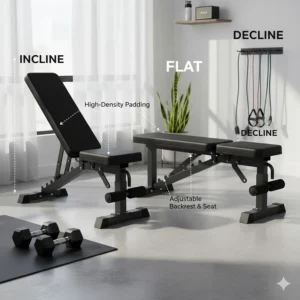
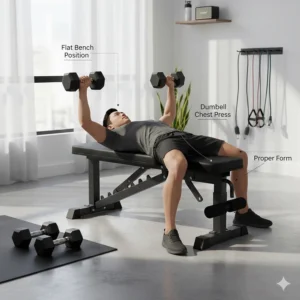
Adjustable home gym benches represent the sweet spot for most lifters. The ability to switch between flat, incline, and decline positions opens up an entire exercise library. Incline presses target your upper chest and front deltoids, decline movements emphasize the lower pectorals, and flat positions hit everything in between.
Models like the FLYBIRD FB800 and REP AB-3000 shine here. With multiple adjustment positions, you can progressively overload muscles from different angles throughout your training cycle. This variety prevents plateaus and keeps your workouts engaging over months and years.
FID Benches: Complete Training Freedom
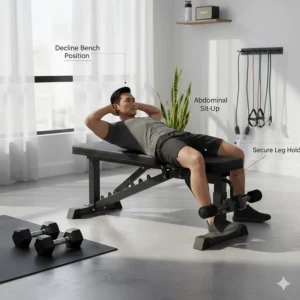
FID stands for Flat-Incline-Decline, and these benches offer the full spectrum of positions. The decline function adds tremendous value, especially for core training and advanced pressing variations. Exercises like decline sit-ups, leg raises, and reverse crunches become possible, transforming your bench into a genuine multi-purpose training station.
The BARWING 2025 and Titan FID Series excel in this category. Their negative angle capabilities mean you’re not limited to positive inclines—you can target muscle groups from literally every angle your biomechanics allow.
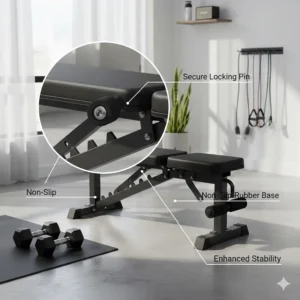
Essential Features Every Home Gym Bench Should Have
Not all benches are created equal, and certain features separate the exceptional from the mediocre. Here’s what to scrutinize before clicking that purchase button.
Weight Capacity: More Than Just Numbers
Weight capacity isn’t just about how much you can lift today—it’s about safety margins and long-term durability. A bench rated for 600 lbs doesn’t mean you should load it with 590 lbs of weight plus your bodyweight. Smart lifters look for capacities well above their current working weights.
For example, if you weigh 180 lbs and bench press 225 lbs, you’re putting 405 lbs on the bench. Add in the dynamic forces from lowering and pressing, and you’re approaching 500+ lbs of stress. This is why benches like the BARWING with its 1,000 lb rating or the REP AB-3000 at 1,000 lbs provide that crucial safety buffer.
Frame Construction: The Foundation of Stability
Steel gauge matters more than most people realize. The difference between 11-gauge and 14-gauge steel translates directly to wobble versus rock-solid performance. Thicker gauge means thicker steel, which means less flex under load.
The triangular support structures you’ll find on quality benches like the REP AB-3000 aren’t just aesthetic choices—they distribute force more effectively than simple rectangular frames. Welded construction beats bolted construction for long-term stability, though quality bolt designs can work well too.
Padding Quality: Comfort Meets Performance
Bench padding walks a tightrope between comfort and performance. Too soft, and you sink in, losing stability and power transfer. Too firm, and longer workouts become uncomfortable, potentially affecting your form.
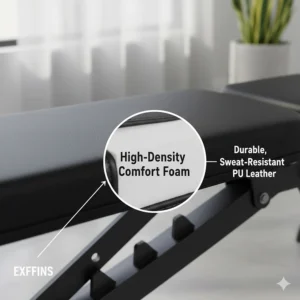
High-density foam covered in textured, grippy vinyl hits the sweet spot. The BARWING’s four-layer padding system with memory foam represents the premium end, while the Marcy SB-315 offers basic but functional high-density foam. Both work—the difference is in long-session comfort and longevity.
Adjustment Mechanisms: Speed and Security
During intense training sessions, you don’t want to wrestle with complicated adjustment mechanisms. Spring-loaded pop-pin systems like those on the FLYBIRD allow one-second angle changes. Ladder-style adjustments on the REP benches provide rock-solid security once locked in place.
Some benches require loosening bolts to adjust—avoid these unless they’re significantly cheaper. Your workout momentum matters, and fumbling with wrenches kills your pump and focus.
How to Choose the Perfect Bench Home Gym Setup
Selecting your ideal bench home gym equipment requires honest assessment of your goals, space, and budget. Let’s walk through the decision-making process systematically.
Step 1: Define Your Primary Training Goals
Start by identifying your main training objectives. Are you focused primarily on building chest strength through heavy bench pressing? An adjustable or even flat bench might suffice. Planning to follow a comprehensive bodybuilding program with incline flyes, shoulder presses, and decline core work? You’ll need full FID capability.
Competition powerlifters often prefer flat benches that mimic meet specifications, while general fitness enthusiasts benefit from adjustable options. The Marcy SB-315 serves powerlifters well, while the Bowflex 5.1S suits varied home workout routines perfectly.
Step 2: Measure Your Available Space
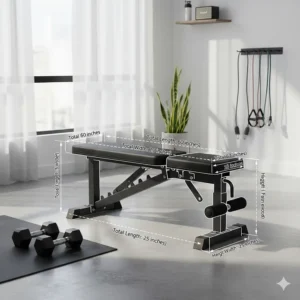
Grab a tape measure before browsing benches. Most adjustable benches measure between 50-70 inches long and 24-27 inches wide. Add clearance space for loading plates and moving around, and you’re looking at roughly 8 feet by 6 feet of dedicated floor space.
Apartment dwellers should prioritize foldable designs like the FLYBIRD or Bowflex. These collapse to under 10 inches wide, sliding under beds or standing in closets. Garage gym owners with permanent setups can consider larger, heavier options like the Titan FID Series.
Step 3: Set a Realistic Budget
Home gym benches range from under $100 to over $600. More expensive doesn’t always mean better for your specific needs. A $150 FLYBIRD might serve you better than a $400 bench with features you’ll never use.
Budget benchmarks:
- Under $100: Basic flat benches (Marcy tier)
- $100-$200: Quality adjustable benches (FLYBIRD tier)
- $200-$350: Mid-range versatility (REP, Bowflex tier)
- $350+: Premium commercial-grade (Titan TITAN Series tier)
Remember that buying quality once beats replacing cheap equipment twice. Factor in warranty length and customer service reputation.
Step 4: Consider Future Expansion
Think ahead to your gym’s evolution. Will you add a power rack? Attachment-compatible benches let you add leg developers and preacher curl pads later. Planning to stick with dumbbells and barbells only? Simple adjustable benches provide everything you need.
Some benches like certain REP models work with attachment ecosystems, while others stand alone. Neither approach is wrong—just match your bench to your expansion plans.
Step 5: Check Assembly and Storage Requirements
Assembly complexity varies wildly. Some benches arrive 90% pre-assembled, requiring just 10-15 minutes of work. Others demand an hour plus mechanical aptitude. Read reviews specifically mentioning assembly experiences.
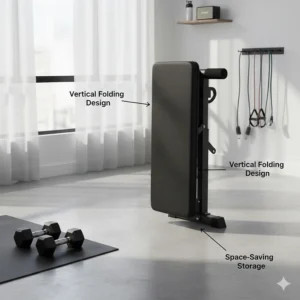
Storage considerations matter year-round. Can you fold and move the bench alone, or do you need help? Does it store vertically to minimize floor space? The FLYBIRD and Titan Performance both offer vertical storage—a game-changer for shared spaces.
Home Gym Benches vs. Commercial Gym Benches: Key Differences
Walking into a commercial gym reveals heavy-duty benches that weigh 100+ pounds and cost thousands of dollars. Do home gym benches really compare? The answer depends on your perspective.
Build Quality and Durability
Commercial benches withstand 8-12 hours of daily abuse from hundreds of users. They feature thicker steel, reinforced welds, and ultra-durable upholstery. Home benches face significantly less stress—perhaps 5-10 hours weekly from one or two users.
This means a well-designed home bench like the REP AB-3000 or BARWING can match commercial durability for your usage patterns. You’re not paying for overkill; you’re getting appropriately engineered equipment.
Weight Capacity Comparisons
| Bench Category | Typical Capacity | Real-World Use |
|---|---|---|
| Budget Home | 300-600 lbs | Beginner to intermediate lifters |
| Mid-Range Home | 600-800 lbs | Intermediate to advanced lifters |
| Premium Home | 800-1,000+ lbs | Advanced lifters, safety margin |
| Commercial | 1,000-1,500+ lbs | Professional athletes, heavy traffic |
Most home lifters never approach the limits of quality home benches. A 600 lb capacity handles a 200 lb lifter benching 315 lbs comfortably—that’s already advanced territory.
Cost-to-Value Ratio
Here’s where home gym benches shine. A $300 REP AB-3000 delivers 80-90% of the performance of a $1,200 commercial bench for your specific needs. You’re not paying for excessive durability you won’t use or premium finishes that don’t affect function.
Commercial benches justify their cost in high-traffic environments where replacement costs exceed upfront investment. For home use, the math favors quality residential models decisively.
The Science Behind Strength Training with Weight Benches
Understanding the physiological benefits of bench training motivates consistent effort and smart equipment choices. Let’s explore what happens when you commit to regular strength work.
Muscle Growth and Metabolic Benefits
According to research from the Centers for Disease Control and Prevention (CDC), strength training not only builds muscle mass but also increases bone density, improves balance and coordination, and reduces fall risk. Inactive adults experience 3% to 8% muscle mass loss per decade, accompanied by metabolic rate reduction and fat accumulation.
The beauty of bench-based training is its efficiency. A single piece of equipment enables exercises targeting chest, shoulders, triceps, back, and core muscles. This multi-muscle engagement triggers systemic adaptations that improve overall body composition and functional capacity.
Cardiovascular and Disease Prevention
While most people associate benches purely with muscle building, resistance training offers profound cardiovascular benefits. Harvard Medical School research indicates that strength training reduces resting blood pressure, decreases LDL cholesterol and triglycerides, and increases HDL cholesterol.
These cardiovascular improvements occur alongside enhanced glucose metabolism and insulin sensitivity. For individuals at risk of type 2 diabetes, regular bench-based resistance work serves as powerful preventive medicine. The metabolic demands of rebuilding muscle tissue after training sessions keep calorie burn elevated for hours post-workout—a phenomenon called excess post-exercise oxygen consumption (EPOC).
Bone Density and Longevity
Perhaps the most underappreciated benefit of bench training involves bone health. Research published by Harvard Health demonstrates that resistance exercises place beneficial stress on bones, triggering bone-forming cells into action. This creates stronger, denser bones—crucial for preventing osteoporosis and fractures as we age.
Weight-bearing exercises like bench pressing, especially when performed on stable platforms like the REP AB-3000 or BARWING, specifically target the spine, hips, and wrists—the sites most vulnerable to osteoporotic fractures. Combined with proper nutrition, bench-based strength work becomes essential medicine for skeletal health.
Maintenance Tips: Keeping Your Bench in Peak Condition
Your home gym bench represents an investment in your health and fitness. Proper maintenance ensures it lasts decades rather than years.
Regular Cleaning Routine
Sweat and chalk create a corrosive environment for vinyl and metal. After each workout, wipe down your bench with a damp cloth. Weekly, use a mild soap solution to remove accumulated grime. Avoid harsh chemicals that degrade vinyl—dish soap and water work perfectly.
For textured vinyl like on the BARWING or REP benches, a soft brush helps clean between texture grooves. This prevents bacteria buildup and material degradation.
Hardware Inspection Schedule
Every month, check all bolts and adjustment mechanisms. Vibration and use cause fasteners to loosen over time. Keep an Allen wrench set handy—most benches use metric Allen bolts.
Pay special attention to:
- Ladder adjustment points (where stress concentrates)
- Seat attachment bolts
- Transport wheel fasteners
- Any moving pivot points
Tightening loose hardware takes five minutes and prevents catastrophic failures during heavy lifts.
Vinyl Care and Protection
Quality vinyl can last 10-15 years with proper care. The BARWING’s wear-resistant leather tested to withstand 20,000 abrasion cycles exemplifies this durability, but it still needs protection.
Avoid leaving your bench in direct sunlight—UV rays crack and fade vinyl. If your garage gym gets hot, cover your bench or move it to shade. Conditioning treatments designed for automotive vinyl work excellently on bench upholstery, keeping it supple and preventing cracking.
Frame Protection Strategies
Powder coating protects steel frames, but chips and scratches expose raw metal to rust. Touch up any damaged areas immediately with matching spray paint or clear coat. If you live in humid climates, consider applying a thin coat of protective wax to exposed metal components.
Rubber feet and floor protection go both ways. Gym mats protect your floor from the bench, but they also protect bench feet from moisture and damage. A simple rubber mat costs $20 and extends bench life significantly.
Common Mistakes to Avoid When Buying Home Gym Benches
Learning from others’ mistakes saves money and frustration. Here are the most common pitfalls first-time bench buyers encounter.
Mistake #1: Choosing Price Over Quality
The cheapest option rarely delivers long-term satisfaction. That $50 bench from an unknown brand might seem like a bargain, but when it wobbles during your first 135 lb bench press, the “savings” evaporate. Quality benches like the FLYBIRD at $150 cost three times more but last ten times longer.
Consider cost per year of use rather than upfront price. A $300 bench lasting 15 years costs $20 annually. A $60 bench lasting 2 years costs $30 annually—plus the hassle of replacement and disposal.
Mistake #2: Ignoring Weight Capacity
“I only bench 185 lbs, so a 300 lb bench works fine.” This thinking ignores your body weight plus safety margins. Remember: you + weight + dynamic forces = total load. Always choose capacity at least 200 lbs above your expected maximum total weight.
Research from Michigan State University Extension indicates that strength training benefits extend far beyond muscle building, improving balance, coordination, and mobility—all benefits that grow as you progress to heavier weights over time. Buy for tomorrow’s lifts, not just today’s.
Mistake #3: Overlooking Adjustment Quality
Not all adjustment mechanisms are created equal. Cheap benches use thin pins that bend, ladder teeth that wear out, or complicated bolt systems that take forever to change. Quality mechanisms like the FLYBIRD’s spring-lock or REP’s ladder system make adjustments quick and secure.
Before buying, watch actual user videos showing adjustments. If people struggle or complain about mechanism quality, trust their experience.
Mistake #4: Forgetting About Assembly
“Some assembly required” varies from “attach four bolts in 10 minutes” to “deciphering hieroglyphic instructions for 90 minutes while questioning your life choices.” Read assembly reviews religiously.
Benches marketed as “mostly pre-assembled” or “quick assembly” typically live up to claims. Budget extra setup time for complex models, or factor professional assembly costs into your budget.
Mistake #5: Skipping Warranty Research
Warranty length signals manufacturer confidence. A 10-year frame warranty like REP Fitness offers suggests they expect their product to last. A 90-day warranty screams “we know this won’t last long.”
Read warranty terms carefully—some cover frames but not padding, others exclude commercial use. Understand what’s actually protected before problems arise.
Maximizing Your Home Gym Bench Workouts
Owning the perfect bench is just the beginning. Let’s explore how to leverage your equipment for maximum results.
Essential Bench Exercises for Complete Development
Your gym bench for home enables dozens of exercises beyond standard bench pressing. Here are the foundational movements:
Upper Body Pressing:
- Flat barbell bench press (classic chest builder)
- Incline dumbbell press (upper chest and shoulders)
- Decline press (lower chest emphasis)
- Overhead shoulder press (seated or standing support)
Back and Pulling:
- Single-arm dumbbell rows (supported on flat bench)
- Chest-supported rows (incline position)
- Seal rows (if bench height allows)
- Reverse flyes (chest-down on incline)
Core and Accessories:
- Decline sit-ups (engage ab rollers if equipped)
- Bench leg raises
- Hip thrusts (bench as elevation)
- Bulgarian split squats (rear foot elevated)
Progressive Overload Strategies with Limited Equipment
Progressive overload—gradually increasing training stress—drives all strength and muscle gains. Even with just a bench and dumbbells, you can apply these principles effectively.
Volume Progression:
Start with 3 sets of 8 reps, progress to 3×10, then 3×12, then 4×10. When you hit 4×12, increase weight and return to 3×8. This simple cycle works indefinitely.
Intensity Techniques:
Slow eccentrics (lowering phase), pauses at bottom positions, and tempo variations increase difficulty without adding weight. Try 3-second negatives on your bench press—suddenly that “easy” weight becomes challenging again.
Angle Manipulation:
Don’t just stick with one incline. Progress through slight (30°), moderate (45°), and steep (60°) inclines across your training cycle. Each angle provides slightly different stimulus.
Creating Effective Workout Splits
Your bench anchors various workout splits depending on your goals and schedule.
Upper/Lower Split (4 days/week):
- Monday: Upper (bench presses, rows, accessories)
- Tuesday: Lower (squats, deadlifts, lunges)
- Thursday: Upper (different angle presses, pull-ups, curls)
- Friday: Lower (variants and accessories)
Push/Pull/Legs (3-6 days/week):
- Push: All pressing movements on bench
- Pull: Supported rows and back work
- Legs: Bench used for Bulgarian split squats, hip thrusts
Full Body (3 days/week):
- Include one bench press variant, one supported row, one core exercise each session
- Rotate angles and implements between workouts
✨ Don’t Miss These Exclusive Deals!
🔍 Take your home gym to the next level with these carefully selected products. Click on any highlighted item to check current pricing and availability. These benches will help you create authentic strength gains your whole family will notice!
Space-Saving Solutions for Small Home Gyms
Limited space doesn’t mean limited gains. Smart setup and equipment choices let you build serious strength in surprisingly small areas.
Foldable Bench Strategies
The FLYBIRD FB800 and Bowflex 5.1S fold to under 10 inches wide. Store them:
- Behind doors
- In closets
- Under beds
- Against walls with minimal clearance
Create a setup routine: remove bench from storage, unfold (30 seconds), position dumbbells, train, fold, and store. The entire process takes under 5 minutes and becomes second nature quickly.
Vertical Storage Systems
Several benches, including the REP AB-3000 and Titan Performance, store vertically on included stands. This reduces footprint to roughly 2 feet by 2 feet—similar to a dining room chair.
Vertical storage works brilliantly in garages where wall space exceeds floor space. Mount a hook or create a dedicated corner spot where the bench lives between workouts.
Multi-Purpose Room Conversions
Many people successfully convert spare bedrooms, large walk-in closets, or garage bays into functional training spaces. The key is efficient equipment layout and quick conversion systems.
Conversion Checklist:
- Roll-away rubber mats (protect floors)
- Foldable bench (quick setup/teardown)
- Compact dumbbell set (Bowflex SelectTech or similar)
- Wall-mounted storage for minimal floor impact
A 10×10 foot space accommodates most bench workouts comfortably. That’s smaller than many guest bedrooms.
Home Gym Benches and Injury Prevention
Quality equipment contributes directly to workout safety. Here’s how your bench choice affects injury risk and training longevity.
Proper Form Fundamentals
Unstable benches encourage compensation patterns that lead to injuries. When your bench wobbles, you unconsciously tense stabilizer muscles unnecessarily, creating tension in the wrong places. A solid platform like the REP AB-3000 or BARWING lets you focus entirely on the working muscles.
Pad height matters tremendously for bench pressing. The IPF-compliant 17.5″ height allows proper foot placement and leg drive, crucial for both safety and performance. Too high or too low forces awkward positioning that stresses your shoulders and lower back.
Width and Support Considerations
Narrow benches create instability during heavy pressing. Your shoulder blades need solid support to retract properly—essential for shoulder health during bench work. The BARWING’s 12.4″ width and REP’s 11.5″ width both provide adequate scapular support for most lifters.
Taller or wider individuals should prioritize wider pads. Being 6’3″ with broad shoulders on a narrow bench is like building a house on a shaky foundation—functional but suboptimal and risky.
Decline Position Safety
Decline benches require proper leg support to prevent sliding. The leg rollers on benches like the REP AB-3000 and Titan FID serve a critical safety function. Without secure foot anchorage, you risk sliding forward during heavy decline presses—a recipe for shoulder impingement or worse.
Always test decline positions with light weights first. Ensure the leg support feels secure before progressing to heavier loads.
Environmental Considerations for Home Gym Benches
Your training environment affects both equipment longevity and workout quality. Let’s optimize your setup for both.
Temperature and Humidity Control
Garage gyms face extreme temperature swings. Summer heat makes vinyl sticky and uncomfortable, winter cold makes it rigid. If possible, maintain temperatures between 50-80°F (10-27°C) for optimal conditions.
Humidity accelerates rust on exposed metal components. In humid climates, consider:
- Dehumidifiers (reduce air moisture)
- Silica gel packets (near stored equipment)
- Regular wipe-downs (remove moisture from surfaces)
- Protective coatings (on any exposed metal)
Floor Protection and Stability
Rubber gym flooring serves dual purposes: protecting both your floor and your bench’s feet. Concrete, wood, and tile surfaces can damage bench feet over time, while bench feet can mar or crack certain flooring.
¾-inch rubber mats provide excellent protection and cost roughly $1.50-$2 per square foot. For a 10×10 training space, you’re looking at $150-$200—money well spent considering floor replacement costs thousands.
Hard surfaces also amplify noise. If you’re training in an apartment or shared living space, rubber flooring dampens the sounds of setting down dumbbells and adjusting benches.
Lighting and Safety
Adequate lighting prevents accidents and improves form. Dim garage conditions make it difficult to spot equipment hazards, check form in mirrors, or read adjustment markings.
Install bright LED shop lights (4000-5000K color temperature) overhead. Side lighting eliminates shadows that obscure form checkpoints. Many garage gym owners add smart lighting that’s easily controlled via phone or voice commands.
FAQs About Home Gym Benches
❓ What is the ideal weight capacity for a home gym bench?
❓ Can you build muscle with just a bench and dumbbells?
❓ How much space do you need for a gym bench for home use?
❓ Are flat benches better than adjustable benches for strength?
❓ How long do home gym benches typically last?
Conclusion: Your Perfect Home Gym Bench Awaits
Finding the right home gym bench transforms your training from frustrating to phenomenal. Whether you’re just starting your fitness journey with the budget-friendly FLYBIRD FB800 or investing in the commercial-grade Titan TITAN Series FID, the perfect bench for your needs exists.
Remember these key takeaways: prioritize stability over price, choose weight capacity with safety margins, match adjustability to your exercise variety needs, and consider your space constraints realistically. The bench that serves you best might not be the most expensive or the cheapest—it’s the one that aligns perfectly with your goals, budget, and training style.
I’ve seen countless home gym owners struggle with inferior benches, compromising their form and limiting their progress. I’ve also witnessed the transformation that happens when someone invests in quality equipment that supports rather than restricts their training. The difference shows up not just in workout quality, but in consistency and long-term adherence.
Your home gym benches purchase represents more than buying equipment—it’s investing in your health, strength, and capability. Every workout becomes more effective, safer, and more enjoyable when you’re confident in your equipment’s quality. Whether you choose the versatile REP AB-3000, the innovative BARWING 2025, or any bench on this list, you’re making a decision that will pay dividends for years to come.
The time to start building your dream home gym is now. Choose your bench, set it up, and get ready to discover what you’re truly capable of achieving.
Recommended for You
- 7 Best Barbells for Home Gym 2025 – Expert Analysis
- 7 Best Free Weights for Home Gym 2025 – Expert Guide
- 7 Best Weight Stack Home Gyms 2025 – Expert Reviews & Guide
Disclaimer: This article contains affiliate links. If you purchase products through these links, we may earn a small commission at no additional cost to you.
✨ Found this helpful? Share it with your friends! 💬🤗
