
In This Article
Standing in your garage gym or spare bedroom, staring at that empty space where a bench should be, you’ve probably asked yourself the million-dollar question: flat bench vs adjustable bench—which one actually deserves my hard-earned money?
I’ve been there. Six years ago, I bought the cheapest flat bench I could find on Amazon, thinking “a bench is just a bench, right?” Wrong. Two months later, I was shopping again because I couldn’t do incline presses, and my shoulder development had completely stalled. That $60 mistake taught me an expensive lesson about the difference between these two bench styles.
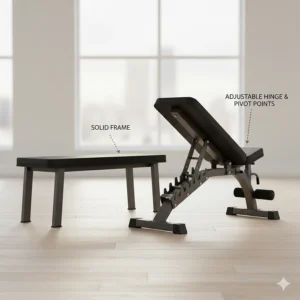
The truth is, the flat bench vs adjustable bench debate isn’t about which one is “better”—it’s about which one fits your training goals, space constraints, and budget. A powerlifter training for competition needs something entirely different than someone doing dumbbell workouts in their apartment.
Both flat and adjustable benches have carved out their place in serious home gyms, but they serve distinctly different purposes. Strength training can help build and maintain muscle mass and strength, and strong muscles lead to strong bones, which can minimize the risk of fracture due to osteoporosis. Whether you’re pressing barbells or performing isolation exercises, having the right bench makes all the difference in achieving these benefits safely and effectively.
In this comprehensive guide, I’ll break down everything you need to know about the flat bench vs adjustable bench comparison, analyze seven real products currently available on Amazon, and help you make the smartest investment for your training needs. Let’s dive into which bench will actually help you build the physique you’re chasing.
Quick Comparison Table: Flat Bench vs Adjustable Bench
| Feature | Flat Bench | Adjustable Bench |
|---|---|---|
| Price Range | $100-$300 | $80-$500+ |
| Weight Capacity | 600-1,000+ lbs | 480-990 lbs |
| Space Required | Minimal (48-52 inches) | Moderate (54-60 inches) |
| Exercise Variety | Limited to flat movements | Incline, decline, flat, upright |
| Stability | Excellent | Good to very good |
| Best For | Powerlifting, barbell work, serious lifters | Dumbbell training, variety, home gyms |
| Portability | Easy to move | Many fold for storage |
| Durability | Highly durable | Varies by model |
💬 Just one click – help others make better buying decisions too!😊
Top 7 Weight Benches for Home Gym: Expert Analysis
1. FLYBIRD Adjustable Weight Bench
The FLYBIRD Adjustable Weight Bench has become one of the most popular choices for home gym enthusiasts, and for good reason. With an 800-pound weight capacity and ASTM certification, this foldable bench offers serious stability without breaking the bank.
Key Specifications:
- Weight capacity: 800 lbs
- Adjustable positions: 7 back positions, 3 seat positions
- Dimensions when folded: Highly compact for storage
- Price range: $120-$160
What sets the FLYBIRD apart is its extended 30-inch backrest, which accommodates taller users—something many budget benches completely ignore. The bench adjusts from 90° upright to -30° decline, giving you genuine versatility for incline decline bench exercises without compromise.
Customer feedback consistently praises its sturdy construction and quick-fold mechanism. One verified buyer mentioned: “Feels solid even with heavier weights, and the adjustment mechanism is smooth and secure.” The triangular frame design enhances stability, preventing the wobbling issues that plague cheaper alternatives.
✅ Pros:
- Excellent weight capacity for the price
- Extended backrest for taller users
- Quick-fold design saves space
❌ Cons:
- Pad could be thicker for extended sessions
- Assembly required (15-20 minutes)
Best for: Intermediate lifters wanting adjustable weight bench benefits without premium pricing.
2. YOLEO Adjustable Weight Bench
If you’ve been watching Amazon’s bestseller list, you’ve seen the YOLEO Adjustable Weight Bench dominating the charts—with over 20,000 units sold in a single month. At just $80 during sales, it’s the best budget adjustable bench for beginners.
Key Specifications:
- Weight capacity: 660 lbs
- Adjustable positions: 8 backrest positions
- Weight: 23 pounds
- Price range: $80-$130
The Yoleo bench rests on a tough steel alloy frame with rubberized feet to keep it firmly planted on the floor while exercising. The bench folds in half with a built-in carrying strap, making it incredibly portable—perfect for apartment dwellers or those with limited space.
Reviewers consistently highlight three selling points: rock-solid stability, versatility for various exercises, and space-saving design. “Takes up barely any space when stored,” one buyer noted, while another emphasized it “feels sturdy and doesn’t shake during heavy sets.”
✅ Pros:
- Unbeatable price-to-value ratio
- Ultra-lightweight and portable
- Easy storage with folding design
❌ Cons:
- Lower weight capacity than premium options
- Padding thinner than higher-end benches
Best for: Beginners starting their home gym journey or anyone on a tight budget who still wants adjustability.
3. Bowflex 5.1S Stowable Bench
The Bowflex 5.1S Stowable Bench represents the premium end of adjustable benches, and if you’re serious about your training, the $349 price tag delivers impressive returns. This bench features a space-saving design with 6 different adjustment angles including 30°, 45°, 60°, 90°, flat, and decline (-20°), along with seat adjustment for maximum exercise options and comfort.
Key Specifications:
- Weight capacity: 600 lbs
- Adjustable positions: 6 angles plus decline
- Space-saving: Folds to save 50% floor space
- Price range: $349-$399
What justifies the premium? Build quality. The heavy-duty steel construction feels commercial-grade, and the robust selection knob makes adjustments effortless mid-workout. Transport wheels let you easily reposition the 85-pound bench without calling for backup.
Fitness professionals consistently recommend this bench for its durability and thoughtful design. “Perfect for home gyms with limited space,” one trainer noted, praising the stowable feature that doesn’t compromise on stability.
✅ Pros:
- Commercial-grade construction
- Excellent adjustment mechanism
- Space-efficient stowing system
❌ Cons:
- Higher price point
- Heavier than budget options
Best for: Serious lifters who want premium quality and have a moderate budget for long-term investment.
4. REP Fitness AB-4100 Adjustable Weight Bench
When gym equipment reviewers consistently name something “Best Overall,” you pay attention. The REP Fitness AB-4100 Adjustable Weight Bench earned that title through meticulous engineering and attention to detail.
Key Specifications:
- Weight capacity: 1,000 lbs
- Adjustable positions: 7 backrest positions, 3 seat positions
- Frame: 14-gauge steel construction
- Price range: $299-$349
The AB-4100 addresses every common complaint about adjustable benches. The gap between seat and back pad? Minimal. The adjustment mechanism? Butter-smooth. The padding? Grippy vinyl that prevents sliding, with high-density foam that stays firm under heavy loads.
This bench is relatively lightweight, fully adjustable, and is made with highly durable 14-gauge steel. Built-in wheels and a handle make repositioning effortless, while the three-post design anchors it solidly during pressing movements.
Customer reviews rave about comfort: “The backrest feels way more cushioned than other benches in its class, yet still manages to deliver rigidity when I drive my shoulder blades down for bench presses.”
✅ Pros:
- Exceptional 1,000 lb capacity
- Superior padding and comfort
- Minimal gap design
❌ Cons:
- Mid-to-high price range
- Not foldable for storage
Best for: Dedicated lifters prioritizing comfort and durability over portability.
5. REP Fitness FB-3000 Flat Bench
For those firmly in the flat bench camp, the REP Fitness FB-3000 Flat Bench represents the gold standard for flat bench for home gym setups. This no-nonsense bench focuses on doing one thing exceptionally well.
Key Specifications:
- Weight capacity: 1,000 lbs
- Dimensions: Competition-standard sizing
- Pad height: 17 inches from floor
- Price range: $179-$199
What makes this flat bench special? The grippy vinyl upholstery prevents slippage during heavy pressing, while firm, high-density foam cushioning provides stability without sacrificing comfort. For less than $200, there isn’t a better flat bench on the market.
The three-post design includes wheels and a handle for easy movement, and dimensions match those used in powerlifting competitions. If you’re training for meets or just want that authentic competition feel, this bench delivers.
One powerlifter noted: “Built like a tank. I’ve had cheaper benches that started wobbling after a year. This thing doesn’t budge, even with 300+ pounds.”
✅ Pros:
- Unmatched stability for the price
- Competition-standard dimensions
- Simple, durable design
❌ Cons:
- No adjustability whatsoever
- Limited exercise variety
Best for: Powerlifters, serious bench pressers, and anyone prioritizing stability over versatility.
6. Ironmaster Super Bench Pro V2
The Ironmaster Super Bench Pro V2 isn’t just a bench—it’s a modular home gym foundation. At $499, it’s expensive, but the extensive attachment ecosystem transforms it into a complete training station.
Key Specifications:
- Weight capacity: 1,000 lbs flat, 600 lbs incline
- Adjustable positions: 11 lockout angles (0-85 degrees)
- Frame: 11 and 12-gauge steel
- Weight: 69 pounds
- Price range: $499-$549
This versatile bench is compatible with Ironmaster PRO attachments that can help you add sit-ups, dips, pull-ups, preacher curls, and more to your workout. The unique telescoping spine design provides rock-solid adjustment, and the included incline seat pad ensures comfort at every angle.
What customers love: “Got it with the dip bar, sit-up, preacher curl, leg attachment, and wheel kit. It’s super solid and what little assembly there was, was a breeze. I can easily move it out of the corner and adjust it for all my exercises.”
The Pro V2 updates include an integrated handle for transport, numbered angle markers, and improved hybrid padding. If space is tight but you want maximum versatility, this bench system makes sense.
✅ Pros:
- Extensive attachment options
- Compact footprint for capabilities
- Excellent build quality
❌ Cons:
- Higher initial investment
- Attachments sold separately
Best for: Space-conscious lifters wanting a complete gym in minimal square footage.
7. MERACH Foldable Adjustable Weight Bench
The MERACH Foldable Adjustable Weight Bench has recently exploded in popularity, offering an impressive 990-pound capacity at an entry-level price point of $59.99 (with promo code).
Key Specifications:
- Weight capacity: 990 lbs
- Adjustable positions: 72 training angles (6 back, 4 seat, 3 footrest)
- Folded dimensions: 7.8 x 28.3 x 11.8 inches
- Price range: $59.99-$109 (varies with promotions)
This bench offers 6 backrest positions, 4 seat adjustments, and 3 footrest configurations for 72 unique angles, suiting various exercises from bench press to isolation movements for all fitness levels. The heavy-duty steel construction supports serious weight, and the quick-fold design saves up to 80% of floor space.
However, buyer feedback suggests this ultra-budget option works best for lighter dumbbell work. “Don’t do it unless the total weight being benched including your weight is under 250 lbs,” one experienced lifter cautioned. The bench sits lower than standard (12 inches from ground), which some users found awkward for proper foot placement.
✅ Pros:
- Incredible price point
- Massive weight capacity claim
- Extremely compact when folded
❌ Cons:
- Lower height may not suit taller users
- Quality concerns for heavy lifting
Best for: Budget-conscious beginners doing light to moderate dumbbell exercises.
Understanding Flat Benches: Pros and Cons
What Makes a Flat Bench Special?
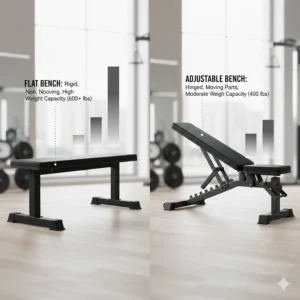
A flat bench does exactly what its name suggests—it stays flat. No adjustments, no moving parts, just a solid, stable platform for pressing exercises. Think of it as the cast iron skillet of weight training equipment: simple, reliable, and nearly indestructible.
The beauty of a flat bench lies in its simplicity. Research from Harvard T.H. Chan School of Public Health shows that people who do muscle-strengthening workouts are less likely to die prematurely than those who don’t, with just 30 to 60 minutes a week of strength training potentially being enough. Flat benches make this strength training straightforward and accessible.
Advantages of Flat Benches
Superior Stability for Heavy Loads
When you’re pushing serious weight, you need a platform that won’t budge. Flat benches typically support 600 to 1,000+ pounds precisely because they lack moving parts. That 3-inch by 3-inch steel frame doesn’t compromise with adjustment mechanisms—it’s all structural integrity.
Competition-Standard Training
Powerlifters training for meets need to practice on competition-standard equipment. Most flat benches match IPF specifications: 17-inch pad height, specific width dimensions, and the exact feel you’ll experience on meet day. You can’t replicate this with an adjustable bench.
Lower Maintenance and Longevity
No adjustment pins to wear out. No hinges to lubricate. No moving parts to fail. A quality flat bench will outlive most adjustable benches simply because there’s less to break. Many lifters pass these down to the next generation.
Better Price-to-Quality Ratio
Dollar for dollar, flat benches offer superior construction quality. That $200 you’d spend on a basic adjustable bench could buy a bomb-proof flat bench with commercial-grade padding and a lifetime warranty. Penn Medicine research confirms that strength training offers increased strength, combats muscle loss, and provides health benefits that cardio alone cannot provide, including improved bone density and joint flexibility.
Disadvantages of Flat Benches
Limited Exercise Variety
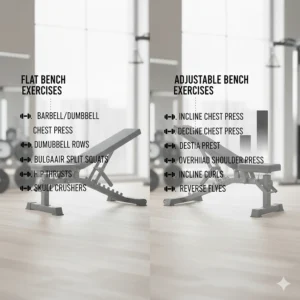
Here’s where flat benches show their weakness. Want to do incline presses for upper chest development? You’ll need dumbbells and creative positioning. Need decline work for lower chest? Time to improvise or buy additional equipment.
Incomplete Muscle Development
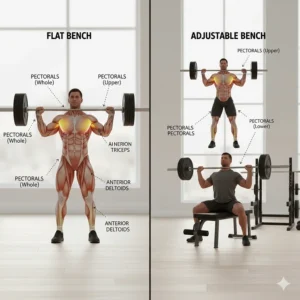
Your chest has three regions: upper, middle, and lower. Weight training exercises like bench pressing primarily target specific muscle groups depending on the angle used. Flat pressing primarily targets the middle chest. Without incline angles, your upper chest development will lag behind, creating an unbalanced physique over time.
Less Versatile for Dumbbell Training
Dumbbell workouts thrive on angle variation. Shoulder presses, incline flies, Bulgarian split squats—all these exercises work better with an adjustable surface. A flat bench limits your dumbbell training creativity.
Understanding Adjustable Benches: Pros and Cons
What Defines an Adjustable Bench?
An adjustable bench transforms your training potential through multiple angle settings. Most quality benches adjust from flat (0°) through various inclines up to 90° upright, with many also offering decline positions (-10° to -30°).
Advantages of Adjustable Benches
Complete Exercise Library
One bench, dozens of exercises. Benefits of resistance training include improved physical performance, movement control, walking speed, functional independence, cognitive abilities, and self-esteem. Adjustable benches unlock all these benefits by enabling proper form across multiple movement patterns.
Incline presses target upper chest. Military presses build shoulders. Decline work hits lower chest. Bulgarian split squats torch legs. All from one piece of equipment. For home gym owners with limited space, this versatility is invaluable.
Better Dumbbell Training Platform
Dumbbells and adjustable benches are natural partners. The angle variations let you target muscles from every direction, ensuring balanced development. Your shoulder program alone can include military presses, incline presses, lateral raises from a seat position, and rear delt work—all requiring different angles.
Space Efficiency
Many modern adjustable benches fold for storage. The FLYBIRD collapses to a fraction of its working size. The Bowflex 5.1S stows vertically. For apartment dwellers or crowded garages, this space-saving feature can be a dealbreaker.
Injury Prevention and Recovery
Flat pressing can aggravate shoulder issues. Incline angles often feel more natural and reduce strain on the rotator cuff. If you’re recovering from an injury or dealing with chronic shoulder problems, adjustable angles provide safer training alternatives.
Disadvantages of Adjustable Benches
Reduced Stability Under Heavy Loads
Those adjustment mechanisms? They’re potential weak points. While quality benches like the REP AB-4100 minimize this issue, most adjustable benches can’t match the absolute rock-solid feel of a dedicated flat bench when you’re pressing your max weight.
Higher Initial Investment
Quality adjustable benches start around $150 and climb to $500+. Budget options exist, but they often sacrifice durability or comfort. The added complexity of adjustment mechanisms increases manufacturing costs.
More Maintenance Required
Adjustment pins wear. Hinges need periodic lubrication. Moving parts eventually develop play or stick. While not demanding intensive maintenance, adjustable benches require more attention than their flat counterparts.
Gap Between Seat and Back
Many adjustable benches have a gap where the seat and backrest meet. This gap can create discomfort or instability in certain exercises. The best benches minimize this issue, but it’s something cheaper models struggle with.
Fixed Bench vs Adjustable Bench Price: What’s the Difference?
Budget Tier ($80-$150)
In this price range, fixed bench vs adjustable bench price comparison favors flat benches significantly. You can find solid flat benches with 600+ pound capacities, while adjustable benches at this price often sacrifice stability or durability.
Flat Bench Options: Basic but reliable construction, adequate padding, decent weight capacity.
Adjustable Bench Options: Entry-level models like YOLEO or MERACH offer decent functionality but may compromise on pad quality or frame thickness.
Smart Shopping Tip: If your budget is tight, consider whether you truly need adjustability. A quality flat bench beats a questionable adjustable bench every time.
Mid-Range Tier ($150-$300)
This sweet spot offers the best value in the fixed bench vs adjustable bench price debate. Quality improves dramatically, and you start seeing features that separate good benches from great ones.
Flat Bench Options: Competition-grade construction, superior padding, weight capacities of 1,000+ pounds (like the REP FB-3000).
Adjustable Bench Options: Solid construction, smooth adjustment mechanisms, decent padding, and adequate stability (FLYBIRD Adjustable, for example).
Value Assessment: This tier represents the minimum investment for equipment that will last 10+ years with proper care. Spending less often means replacing sooner.
Premium Tier ($300-$500+)
At this level, the fixed bench vs adjustable bench price distinction matters less than intended use. Both options deliver exceptional quality, but serve different training philosophies.
Flat Bench Options: Commercial-grade construction that will outlive you. Think Rogue Monster Utility Bench or equivalent.
Adjustable Bench Options: REP Blackwing, Bowflex 5.1S, Ironmaster Super Bench Pro V2—these benches combine stability, comfort, and versatility without compromise.
Investment Perspective: Premium benches hold resale value. If you later upgrade or change training styles, you can recoup 60-70% of your investment selling quality equipment.
Incline Decline Bench Exercises: Maximizing Your Training
Upper Chest Development with Incline Work
Your upper chest (clavicular head of the pectoralis major) responds best to pressing movements at 30-45° angles. Flat pressing alone can’t fully develop this area, creating that “bottom-heavy” chest look that screams incomplete training.
Essential Incline Exercises:
Incline Dumbbell Press (30-45° angle) The king of upper chest exercises. The angle shifts emphasis from mid-chest to upper chest, while dumbbells allow greater range of motion than barbells. Start lighter than your flat pressing weight—the angle makes these substantially harder.
Incline Dumbbell Flyes Isolation work that stretches and contracts the upper chest through a full range of motion. Keep a slight bend in your elbows and control the eccentric (lowering) phase.
Incline Cable Flyes If you have cable access, these maintain constant tension throughout the movement. The adjustable bench lets you dial in the perfect angle for maximum muscle engagement.
Lower Chest Training with Decline Positions
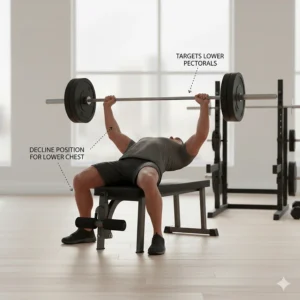
Decline work targets the lower (sternal) head of your chest. While often neglected, this area adds fullness to your overall chest development and creates that defined lower chest line.
Key Decline Exercises:
Decline Dumbbell Press Similar setup to flat pressing, but the decline angle shifts emphasis downward. Use caution with heavy weights—have a spotter if possible.
Decline Push-Ups No equipment needed. Elevate your feet on the bench and perform push-ups. The angle naturally targets lower chest while providing a different stimulus than traditional push-ups.
Decline Sit-Ups Wait, we’re talking about chest training, right? Actually, decline sit-ups are one of the most underrated core exercises you can do. The adjustable bench becomes a complete training tool.
Shoulder Training Applications
Adjustable benches unlock comprehensive shoulder development. According to research published in PubMed, benefits of resistance training include improved physical performance, movement control, walking speed, functional independence, cognitive abilities, and self-esteem. Resistance training may also help prevent and manage type 2 diabetes by decreasing visceral fat and improving insulin sensitivity.
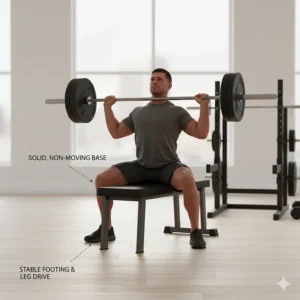
Seated Shoulder Press (80-90° angle) Set the bench nearly upright. This supported position lets you focus on pressing strength without worrying about stabilizing your torso. Go heavier than you could with standing military presses.
Incline Lateral Raises Set the bench to 45° and lie chest-down. Perform lateral raises from this position—the angle prevents momentum and forces strict form, maximizing medial deltoid engagement.
Which Weight Bench Should I Buy: Decision Framework
Assess Your Primary Training Style
Your dominant training method should drive this decision more than any other factor.
Choose a Flat Bench If:
- You primarily barbell press
- You’re training for powerlifting competitions
- You value absolute stability over versatility
- Your program focuses on compound movements
- You have room for multiple pieces of equipment
Choose an Adjustable Bench If:
- Dumbbells are your primary tools
- You train at home with limited space
- You want complete upper body development
- You’re recovering from injuries requiring angle variation
- This will be your only bench
Space Considerations
Measure your training area before buying. I learned this lesson the hard way when my first bench barely fit through the basement door.
Small Space Solutions (Under 100 sq ft): Prioritize foldable adjustable benches like the FLYBIRD or Bowflex 5.1S. When not in use, these practically disappear. The space savings justify any slight stability trade-off.
Medium Space (100-200 sq ft): You have options. Could accommodate a quality flat bench plus a separate incline setup, or invest in a premium non-folding adjustable bench for the best of both worlds.
Large Space (200+ sq ft): Consider owning both. A competition flat bench for serious pressing plus an adjustable bench for accessory work gives you ultimate flexibility.
Budget Allocation Strategy
Smart home gym builders allocate funds based on long-term value, not initial cost savings.
Under $150 Budget: Buy the YOLEO or MERACH adjustable bench. Yes, it’s entry-level, but adjustability beats a mediocre flat bench at this price point. Plan to upgrade within 2-3 years as your training advances.
$150-$300 Budget: This is decision time. Go flat for maximum quality (REP FB-3000) or adjustable for versatility (FLYBIRD Adjustable). Consider which you’ll regret NOT having more.
$300-$500 Budget: Buy the best adjustable bench you can afford. The REP AB-4100 or Bowflex 5.1S delivers near-lifetime durability. Cheap out elsewhere if needed, but get your bench right.
$500+ Budget: Buy both. Get a premium flat bench for main pressing work (REP FB-5000) and a quality adjustable bench for accessory movements (REP AB-4100). Your training will thank you.
Training Goals Alignment
Your specific fitness objectives should heavily influence which weight bench you should buy.
Muscle Building Goals: Adjustable bench wins. Muscle growth requires progressive overload across multiple angles. You need incline work for upper chest, decline for lower chest, and various angles for shoulders and back.
Strength Development: Flat bench probably wins. Maximal strength development happens through heavy compound movements, and flat benches provide the most stable platform for this work.
General Fitness: Adjustable bench wins. You want exercise variety to stay engaged, and adjustable weight bench benefits include preventing boredom through exercise diversity.
Flat Bench for Home Gym: Setup and Best Practices
Optimal Positioning and Space Requirements
A flat bench needs roughly 6 feet of length and 3 feet of width for safe operation. Add clearance for loading plates if you’re doing barbell work—another 2 feet on each side of the bar.
Safety Zone Creation: Mark out your lifting area with tape or mats. This prevents accidentally backing into equipment or walls mid-set. Your spotter (if you have one) needs room to move around the bench.
Flooring Protection: Even “light” weights add up. A fully loaded barbell weighs 300+ pounds. Rubber flooring protects your foundation and reduces noise. Interlocking rubber mats (3/4 inch thick) work perfectly and cost under $100 for adequate coverage.
Maintaining Your Flat Bench
Flat benches require minimal maintenance, but these simple steps extend their life indefinitely:
Weekly Tasks:
- Wipe down padding with antibacterial cleaner after each use
- Check all bolts and connections for tightness
- Inspect frame for any stress cracks or damage
Monthly Tasks:
- Deep clean vinyl with appropriate cleaner
- Tighten all hardware with appropriate tools
- Check feet or wheels for wear
Annual Tasks:
- Inspect welding points for cracks
- Consider vinyl protectant application
- Evaluate whether padding needs replacement
Best Budget Adjustable Bench: Value Analysis
What “Budget” Really Means
In the fitness equipment world, “budget” spans a wide range. Some people consider $100 budget, others think $300 is reasonable. For this analysis, we’re defining the best budget adjustable bench as anything under $200 that delivers legitimate value.
YOLEO: The Value Champion
At $80-$130 depending on sales, the YOLEO Adjustable Weight Bench dominates the budget category. It’s not perfect—the padding could be thicker, and serious powerlifters will outgrow it quickly—but for beginners and intermediate lifters doing dumbbell work, it’s nearly unbeatable.
What makes it the best budget adjustable bench?
- Legitimate 660 lb capacity
- 8 adjustment positions
- Folds for storage
- Consistently positive customer feedback
Reality Check: If you’re pressing 300+ pounds combined with body weight, skip this bench. But for dumbbell training up to 60-70 pound dumbbells? It’s more than adequate.
FLYBIRD: The “Slightly More” Sweet Spot
Spend $40-$60 more and the FLYBIRD Adjustable Weight Bench delivers noticeably better quality. The frame feels more substantial, the padding is thicker, and the 800 lb capacity provides genuine headroom for progression.
This represents the minimum investment I’d recommend for someone serious about long-term training. Yes, it costs more than the YOLEO, but it’s also the bench you won’t need to replace in two years.
Smart Shopping Strategies
Timing Matters: Fitness equipment sees major discounts around New Year’s (when everyone has fitness goals) and in late spring (when manufacturers clear inventory). Set price alerts on Amazon for your target benches.
Consider Warehouse Deals: Amazon Warehouse often has “like new” or “used – acceptable” benches at 30-40% off. Small cosmetic damage doesn’t affect function. I’ve bought three pieces of equipment this way—zero regrets.
Factor in Total Cost: That $80 bench looks tempting until you add assembly tools, protective flooring, and storage solutions. Budget for the complete setup, not just the bench price.
Making Your Final Decision: Action Steps
Step 1: Define Your Non-Negotiables
Write down your absolute requirements. Not wants—requirements. Mine were:
- Holds 300+ pounds safely
- Fits through basement door
- Adjusts to at least 45° incline
- Under $250
Your list will differ. That’s fine. But knowing your non-negotiables prevents impulse purchases you’ll regret.
Step 2: Test If Possible
Local sporting goods stores often have benches on display. Lie down on them. Adjust the mechanisms. Feel the padding. Photos don’t capture how stable (or unstable) a bench feels under you.
Can’t test in person? Read detailed reviews focusing on your specific concerns. Ignore generic “great bench!” reviews. Look for specifics: “The adjustment pin stuck after six months” or “Holds 315 without wobble.”
Step 3: Calculate Long-Term Value
That $80 bench seems like a steal until you factor in replacement costs. A review of studies found that strength training is linked to lower risk for developing cardiovascular disease, diabetes, and cancer, and a 10% to 17% lower overall risk of early death.
Investing in proper equipment means you’ll actually use it, reaping these health benefits for years. Break down cost per year:
- $80 bench lasting 2 years: $40/year
- $300 bench lasting 10+ years: $30/year
The expensive bench costs less long-term while delivering better performance throughout.
Comparison Table: Top 7 Benches Specifications
| Model | Type | Weight Capacity | Price Range | Best For |
|---|---|---|---|---|
| REP FB-3000 | Flat | 1,000 lbs | $179-$199 | Powerlifting, max stability |
| FLYBIRD Adjustable | Adjustable | 800 lbs | $120-$160 | Best overall value |
| YOLEO Adjustable | Adjustable | 660 lbs | $80-$130 | Budget beginners |
| Bowflex 5.1S | Adjustable | 600 lbs | $349-$399 | Premium quality, space-saving |
| REP AB-4100 | Adjustable | 1,000 lbs | $299-$349 | Serious home gym |
| Ironmaster Pro V2 | Adjustable | 1,000 lbs (flat) | $499-$549 | Modular gym system |
| MERACH Foldable | Adjustable | 990 lbs | $59.99-$109 | Ultra-budget option |
✨ Don’t Miss These Exclusive Deals!
🔍 Take your home gym to the next level with these carefully selected benches. Click on any highlighted item to check current pricing and availability. These tools will help you build the strength and physique you’ve been chasing!
Benefits Comparison: Flat vs Adjustable Benches
| Benefit | Flat Bench | Adjustable Bench |
|---|---|---|
| Muscle Development | ⭐⭐⭐ | ⭐⭐⭐⭐⭐ |
| Strength Gains | ⭐⭐⭐⭐⭐ | ⭐⭐⭐⭐ |
| Exercise Variety | ⭐⭐ | ⭐⭐⭐⭐⭐ |
| Stability | ⭐⭐⭐⭐⭐ | ⭐⭐⭐⭐ |
| Space Efficiency | ⭐⭐⭐ | ⭐⭐⭐⭐ (with folding models) |
| Durability | ⭐⭐⭐⭐⭐ | ⭐⭐⭐⭐ |
| Value for Money | ⭐⭐⭐⭐ | ⭐⭐⭐⭐⭐ |
| Beginner Friendly | ⭐⭐⭐ | ⭐⭐⭐⭐⭐ |
Frequently Asked Questions
❓ Can I bench press heavy weights safely on an adjustable bench?
❓ What's the optimal height for a weight bench for proper form?
❓ How much should I spend on a quality home gym bench?
❓ Do I need a spotter for bench pressing at home?
❓ What's the difference between Olympic benches and standard benches?
Conclusion: Your Path to the Perfect Bench
After analyzing seven real-world products and dissecting the flat bench vs adjustable bench debate from every angle, here’s the truth: there’s no universally “best” option—only the best option for you.
If you’re a powerlifter training for competition or someone who primarily does heavy barbell pressing, a dedicated flat bench for home gym use makes perfect sense. The REP FB-3000 at $179 delivers competition-grade stability that will serve you for decades.
But for most home gym owners—especially those with space constraints or those primarily training with dumbbells—an adjustable bench offers superior value. The versatility justifies the slightly reduced stability, and modern designs like the REP AB-4100 minimize that stability gap considerably.
Research shows that just 30 to 60 minutes a week of strength training may be enough for significant health benefits, with those who worked out for this duration having a 10% to 20% lower risk of dying during the study period from all causes. Whether you choose flat or adjustable, the key is actually using your bench consistently.
My personal recommendation? If you can only afford one piece of equipment and you’re building a home gym from scratch, invest in a quality adjustable bench like the FLYBIRD Adjustable ($120-$160) or stretch for the REP AB-4100 ($299-$349) if budget allows. These benches unlock nearly every upper body exercise while taking up minimal space.
Still can’t decide? Remember this: the best bench is the one you’ll actually use. Pick the option that removes barriers to your training, fits your space, and aligns with your primary training style. Then get under that bar (or dumbbells) and start building.
Your future stronger self will thank you for making this decision today rather than continuing to analyze paralysis your way through another month of no progress.
Recommended for You
- 7 Best Weight Benches for Home Gym: Expert Rankings 2026
- 7 Best Wall Mounted Home Gyms 2026 – Save 70% Space Fast
- 7 Best Half Rack for Home Gym (2026) – Space-Saving Power Racks
Disclaimer: This article contains affiliate links. If you purchase products through these links, we may earn a small commission at no additional cost to you.
✨ Found this helpful? Share it with your friends! 💬🤗
