
In This Article
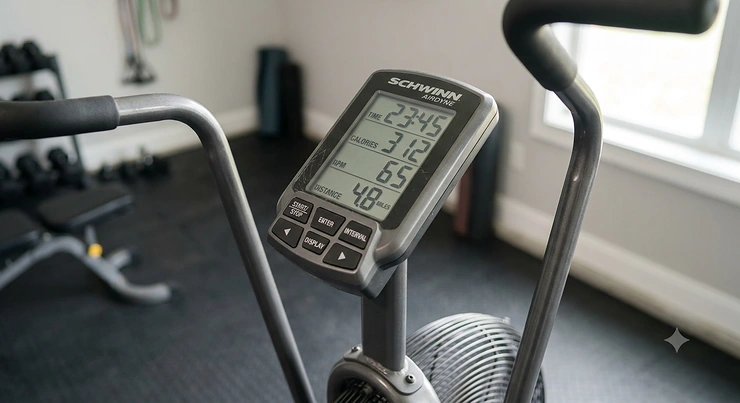
A schwinn airdyne bike is a dual-action stationary bike that uses a spinning fan blade, instead of a magnet or a flywheel, to create resistance — the harder you push the pedals and pull the moving handlebars, the more air the fan displaces, and the harder it pushes back. That’s the whole trick, and it’s a genuinely clever one: no motor, no calibration drift, no “levels” to fuss with. Just physics doing the heavy lifting while you do the actual heavy lifting.
If you’ve spent any time lurking in home gym forums, you already know the Airdyne name carries weight. It’s been the quiet workhorse of CrossFit boxes, physical therapy clinics, and garages since long before “fan bike” became a category unto itself. But Schwinn currently sells more than one version, and the lineup has quietly split into a budget model, two mid-tier options, and a commercial-grade sibling that’s practically a cult favorite among serious lifters — which means picking the right one isn’t quite as simple as walking into a store and grabbing whatever’s on the shelf.
This guide breaks down seven real machines — four from Schwinn’s own Airdyne family and three from the competitors people cross-shop most often — with honest, spec-backed analysis instead of marketing fluff. According to the CDC’s physical activity guidelines for adults, adults need at least 150 minutes of moderate-intensity activity a week, and an air bike happens to be one of the most time-efficient ways to rack up those minutes without leaving your garage. Let’s get into it.
Quick Comparison Table
Before you dive into the full breakdown, here’s the 30,000-foot view. This table exists so you can scan it, form an opinion in ten seconds, and then go read the section that actually matters to you.
| Model | Drive Type | Weight Capacity | Price Range | Best For |
|---|---|---|---|---|
| Schwinn Airdyne AD2 | Belt | 250 lb | $350-$400 range | Tight budgets, casual home use |
| Schwinn Airdyne AD6 | Belt | 300 lb | $650-$750 range | Everyday mid-range home cardio |
| Schwinn Airdyne AD7 | Belt | 350 lb | $850-$950 range | Feature-hungry home users |
| Schwinn Airdyne Pro | Belt | 350 lb | $900-$1,100 range | Commercial gyms, serious training |
| Rogue Echo Bike | Belt | 330-350 lb | $795-$895 range | CrossFit-style home gyms |
| Assault AirBike Classic | Chain | 300 lb | $650-$700 range | Budget-conscious box owners |
| Titan Fitness Fan Bike | Chain | 330 lb | $600-$700 range | Value shoppers who want extras included |
Look at that spread for a second. Notice how the price climbs almost in lockstep with weight capacity and console features, but not always — the Titan Fitness Fan Bike undercuts the Assault AirBike Classic on price while beating it on weight capacity, mostly because Titan bundles in accessories (turf tires, a wind guard, a bottle holder) that other brands sell as add-ons. Meanwhile, the jump from Schwinn Airdyne AD6 to Schwinn Airdyne AD7 buys you built-in workout programs and a higher weight limit, not necessarily a better core workout — the fan resistance mechanism itself barely changes.
💬 Already narrowing it down? Compare specs side-by-side before you commit — your future self will thank you.
Top 7 Schwinn Airdyne & Air Bike Models: Expert Analysis
Here’s the deep dive. Every model below gets the same honest treatment: real specs, what they mean in the real world, who should actually buy it, and what actual owners tend to say once the “new equipment” glow wears off.
1. Schwinn Airdyne AD2 — most affordable true Airdyne
The Schwinn Airdyne AD2 is Schwinn’s entry point into the Airdyne family, and it wears that “no-frills” label proudly rather than apologetically.
Under the hood, it’s a belt-driven fan bike with a 250 lb weight capacity and a basic LCD console that cycles through speed, RPM, distance, time, and calories one field at a time. That single-field display sounds limiting on paper, but in practice it just means you’re not distracted by a dashboard full of numbers you don’t need mid-interval. The seat only adjusts vertically, not fore-and-aft, which matters if you’re outside the average height range — something taller or shorter riders should weigh before buying. Compared with other exercise bikes under $500, the AD2’s main advantage is versatile, unlimited resistance and moving handlebars for a total-body workout.
Here’s the honest read: this bike is for someone who wants the Airdyne motion — that smooth, synchronized arm-and-leg pump — without paying for a screen full of programs they’ll ignore after week three. It’s not for anyone chasing max weight capacity or built-in workouts.
Reviewers consistently note the seat comfort as the weak point, and a few mention a bushing or belt-tension bearing developing a click after moderate use — not catastrophic, but worth knowing going in.
Pros:
- ✅ Lowest price of any true Schwinn Airdyne model
- ✅ Full-body motion via synchronized moving handlebars
- ✅ Lightweight frame with transport wheels for easy storage
Cons:
- ❌ Seat only adjusts up-down, not forward-back
- ❌ Lower 250 lb weight capacity than every other model here
At around $350-$400, the Schwinn Airdyne AD2 is the cheapest legitimate way into the Airdyne ecosystem, and for light-to-moderate home use, it earns its keep.
2. Schwinn Airdyne AD6 — best mid-range everyday workhorse
Step up to the Schwinn Airdyne AD6 and the picture changes fast: a proper upright console with a reading rack, wireless heart rate compatibility, an integrated water bottle holder, and a 300 lb weight capacity that opens the bike up to a much wider range of users.
The console upgrade isn’t cosmetic. The AD6 adds wireless heart rate monitoring, a larger RevMeter display, a water bottle holder, and a heavier 300 lb max user weight on top of everything the base AD2 offers. In practice, that heart rate compatibility means you can actually train in zones instead of guessing off perceived effort — a meaningful upgrade if you’re doing structured interval work rather than just pedaling until you’re tired.
Based on the spec comparison across the Schwinn line, the AD6 sits in a genuine sweet spot: enough durability and features for daily use, without paying Airdyne Pro money for a home gym that sees moderate traffic. Reviewers report the drive system — a dual-belt setup rather than the AD2’s single belt — runs quieter and smoother over time, though the fan blade design across all Schwinn models stays fundamentally the same.
Pros:
- ✅ Wireless heart rate monitor compatibility for zone training
- ✅ 300 lb weight capacity fits most home gym users
- ✅ Larger RevMeter display readable mid-interval
Cons:
- ❌ No built-in workout programs (that’s AD7/Pro territory)
- ❌ Seat still lacks fore-aft adjustment like the AD7
Priced in the $650-$750 range, the Schwinn Airdyne AD6 is the one most households actually need — the AD7’s extra features matter more to specific use cases than to daily cardio.
3. Schwinn Airdyne AD7 — most feature-rich Schwinn model
The Schwinn Airdyne AD7 is Schwinn’s flagship for home use, and it’s the only model in the family that ships with actual structured programming built in.
Specifically, the AD7 includes 9 different workout programs covering intervals, heart rate–based training, and goal-driven options like calories, time, or distance — and yes, it’s telemetry heart rate monitor compatible, which is how the heart rate workouts actually function. On top of that, the seat gains full fore-and-aft adjustability, and weight capacity climbs to 350 lb, making it noticeably friendlier for taller riders and larger frames.
What most buyers overlook about the AD7 is that the resistance itself isn’t computer-controlled — the console guides your workout, but you’re still the one generating every bit of resistance through the fan. That’s actually the point: it keeps the machine mechanically simple (nothing to short out) while giving structure to people who’d otherwise just free-ride without a plan. It’s also one of the quieter air bikes on the market, and its belt-drive system requires less maintenance than chain-drive competitors.
Pros:
- ✅ 9 built-in workout programs unique to this Schwinn model
- ✅ Fully adjustable seat and highest Schwinn weight capacity
- ✅ Quiet belt drive with low ongoing maintenance
Cons:
- ❌ Noticeably pricier than the AD6 for the same core fan resistance
- ❌ Programs guide pacing but don’t add resistance automatically
Expect to pay in the $850-$950 range for the Schwinn Airdyne AD7 — worth it if guided workouts and a bigger weight capacity genuinely matter to you, skippable if you just want steady cardio.
4. Schwinn Airdyne Pro — best for commercial and serious home gym use
Here’s where things get interesting for anyone specifically hunting a schwinn airdyne pro: the Airdyne Pro and the AD7 are, spec for spec, the same bike — same warranty, same weight capacity, same console, same workout programs. The difference is purely in positioning and distribution.
Schwinn sells the AD7 and AD6 directly on its own site, with the AD2 possibly discontinued, while the Pro is marketed toward commercial gyms and found primarily through third-party retailers rather than Schwinn’s own storefront. That distinction matters practically: if you see “Airdyne Pro” listed somewhere at a markup over the AD7’s going rate, you’re not paying for better hardware — you’re paying for commercial-channel pricing and, often, a heavier-duty retail warranty structure aimed at gyms with dozens of daily users.
Here’s what the spec sheet won’t tell you outright: because the Pro name gets attached to commercial fleets, used units show up on the secondhand market with real mileage on them, and those can be a genuinely smart buy if you’re comfortable inspecting a belt and bearings before purchase. For someone building a garage gym meant to survive years of hard, frequent use — not just occasional cardio — the Pro’s commercial-grade reputation and identical internals to the AD7 make it a reasonable target, provided you’re not overpaying simply for the name.
Pros:
- ✅ Identical hardware and programs to the Schwinn Airdyne AD7
- ✅ Reputation for surviving high-frequency commercial gym use
- ✅ Same 350 lb weight capacity and full seat adjustability
Cons:
- ❌ Often priced higher than an equivalent AD7 for the same specs
- ❌ Harder to find at MSRP outside third-party commercial channels
At roughly $900-$1,100 depending on retailer, the Schwinn Airdyne Pro only makes sense once you’ve confirmed you’re not simply paying a premium for a badge on the same AD7 platform.
5. Rogue Echo Bike — best belt-drive competitor
Stepping outside the Schwinn family, the Rogue Echo Bike is the machine most often cross-shopped against Airdyne models by CrossFit-adjacent buyers, and for good reason.
The Echo Bike combines features of both the Schwinn Airdyne Pro and the Assault AirBike to create what many reviewers consider the best value air bike on the market — and its belt-drive system means, like the higher-end Schwinn models, it skips the maintenance headaches of a chain. The current V3.0 version added Garmin ANT+ watch connectivity via a January 2026 firmware update, letting athletes sync workout data straight to a Garmin device without a phone as a middleman — a small but genuinely useful upgrade for anyone already tracking training load elsewhere.
Based on the comparative data, bigger fan blades on the Echo mean it can generate noticeably more resistance at high effort than lighter competitors, which is exactly why it shows up so often in competition programming. One tradeoff worth flagging honestly: the Echo Bike is only sold directly through Rogue Fitness, ships from Ohio, and typically takes one to two weeks to arrive with no Prime shipping option.
Pros:
- ✅ Belt drive eliminates chain maintenance entirely
- ✅ Bluetooth and Garmin ANT+ connectivity built into the console
- ✅ Higher resistance ceiling for serious, high-output training
Cons:
- ❌ Not sold on Amazon — direct-only with slower shipping
- ❌ Larger footprint than most chain-driven competitors
Sitting in the $795-$895 range, the Rogue Echo Bike earns its reputation as the closest thing to an Airdyne Pro alternative for buyers who want CrossFit pedigree.
6. Assault AirBike Classic — best budget CrossFit-style pick
The Assault AirBike Classic was, for years, the default fan bike in CrossFit boxes before the Echo Bike arrived, and it remains a little more affordable and requires a little less floor space than its Rogue rival.
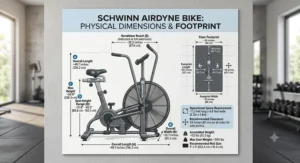
Its defining trait is the chain drive rather than a belt — a distinction that matters because belt drives require less maintenance and run quieter, while the Assault’s chain needs periodic lubrication. What that means day to day: budget an occasional five minutes with a bike-chain lubricant, and don’t expect library-quiet operation during hard intervals. In exchange, the Assault’s smaller 51-by-23-inch footprint fits tight training spaces much better than the Echo’s 59-by-30-inch frame.
Reviewers frame it as a proven, no-surprises workhorse rather than an innovator — it hasn’t changed dramatically in years, and that stability is part of its appeal for buyers who just want a known quantity.
Pros:
- ✅ Compact footprint fits small home gyms comfortably
- ✅ Proven CrossFit-standard reputation with a long track record
- ✅ Lower price than most belt-drive competitors
Cons:
- ❌ Chain drive needs periodic lubrication and is louder
- ❌ 300 lb weight capacity trails the Echo Bike’s 330-350 lb
Priced around $650-$700, the Assault AirBike Classic remains the value benchmark chain-drive buyers measure everything else against.
7. Titan Fitness Fan Bike — best budget pick with extras included
Rounding out the list, the Titan Fitness Fan Bike has built a reputation as the fan bike equivalent of a well-optioned trim package — you get accessories standard that competitors charge extra for.
Unlike most air bikes, including the Rogue Echo Bike, the Schwinn Airdyne, and the AssaultBike, the Titan bike includes a pair of all-terrain front tires, plus a wind guard, bottle holder, and phone mount as standard equipment. It carries a 330 lb weight capacity, higher than both the AD6’s and Assault Classic’s 300 lb limit, though it still trails the Echo Bike’s top-end capacity.
Here’s the honest tradeoff: it’s chain-driven, so it inherits the same maintenance quirks as the Assault Classic, and a small number of reviewers report a clanking noise inside the fan enclosure or a misaligned RPM sensor — not universal complaints, but a pattern worth knowing about. One tester rated it especially high on value, describing it as combining the best of the Echo and Assault bikes at a lower price point.
Pros:
- ✅ Standard accessories that competitors sell as add-ons
- ✅ Highest weight capacity among the sub-$700 options here
- ✅ Frequently discounted below its already competitive list price
Cons:
- ❌ Chain drive requires the same upkeep as the Assault Classic
- ❌ Occasional reports of console sensor or fan-enclosure noise
At $600-$700, with sales occasionally dipping lower, the Titan Fitness Fan Bike is the pick for buyers who want the most included hardware per dollar.
✨ Ready to compare real-time pricing? Check current availability before these models sell through — stock on the popular tiers moves fast.
Practical Usage Guide: Setup, First 30 Days, and Maintenance
Getting a fan bike out of the box is the easy part — getting the most out of it long-term takes a little know-how that no product listing bothers to mention.
On setup day, resist the urge to skip the leveling step. Air bikes generate real lateral force through the moving handlebars, and a wobbly base amplifies that motion into an annoying rock with every stroke. Most models, including every Schwinn Airdyne variant, ship with adjustable feet specifically for this. Tighten every bolt to spec before your first ride, then re-check them again after roughly ten sessions — vibration loosens hardware faster than people expect, especially on chain-driven models like the Assault AirBike Classic and Titan Fitness Fan Bike.
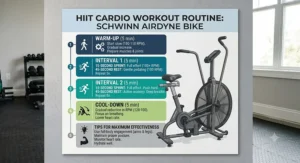
The most common first-30-days mistake is treating the fan bike like a steady-state cardio machine and nothing else. Because resistance scales directly with your effort, short, hard intervals reveal what the bike can actually do far better than a slow, even pedal. Try 20 seconds all-out, 40 seconds easy, repeated eight times, and you’ll understand the appeal fast.
For maintenance, belt-driven models (AD6, AD7, Airdyne Pro, Rogue Echo Bike) need very little — an occasional wipe-down and a visual check of belt tension every few months. Chain-driven models need actual chain lubricant every 20-30 hours of use; skip this and you’ll hear about it in the form of squeaking and, eventually, premature wear. Either way, per the history of the stationary bicycle as exercise equipment, these machines were designed from the start to survive heavy repeated use with minimal upkeep — a low-maintenance ceiling you should expect to actually hit if you follow the basics.
Real-World Scenarios: Who Should Buy Which Model
Specs are one thing; matching a bike to an actual life is another. Here are three profiles that map cleanly onto the lineup above.
The apartment-dwelling beginner. Limited space, limited budget, three sessions a week. The Schwinn Airdyne AD2 or Titan Fitness Fan Bike both fit here, but the AD2’s lighter frame and transport wheels make it easier to tuck away between workouts, while the Titan wins if floor space isn’t tight and you want the included accessories.
The structured home-gym athlete. Someone training five-plus days a week, following programmed intervals, and wanting data to track progress. The Schwinn Airdyne AD7 and Rogue Echo Bike both serve this profile well — the AD7 for built-in guided programs, the Echo Bike for its Garmin connectivity and higher resistance ceiling.
The small commercial gym owner. Multiple daily users, budget still matters, but downtime for repairs is expensive. The Schwinn Airdyne Pro and Assault AirBike Classic both fit — the Pro if you want Schwinn’s commercial-channel warranty and belt-drive reliability, the Assault Classic if floor space is at a premium and a modest chain maintenance routine is acceptable.
Buyer’s Decision Framework
If you’re still torn, run through this simple priority checklist in order:
- If budget is your hard constraint, choose the Schwinn Airdyne AD2 or Titan Fitness Fan Bike — both undercut $700 while covering the fundamentals.
- If weight capacity above 330 lb matters, choose the Schwinn Airdyne AD7, Schwinn Airdyne Pro, or Rogue Echo Bike — all clear 330-350 lb.
- If you want zero drivetrain maintenance, choose any belt-driven model — that rules out the Assault AirBike Classic and Titan Fitness Fan Bike.
- If built-in guided workouts matter, choose the Schwinn Airdyne AD7 or Schwinn Airdyne Pro — the only two with preset programs.
- If floor space is genuinely tight, choose the Assault AirBike Classic — its footprint beats every belt-driven competitor here.
How to Choose a Schwinn Airdyne Bike
Cutting through the marketing, here’s the actual decision process, step by step.
- Start with your weight capacity, not the price tag. A bike rated 50 lb below your body weight will wear out faster and feel less stable at high effort, regardless of brand.
- Decide whether guided programs matter to you. If you already know how to structure intervals, you’re paying extra for a feature you won’t use — skip straight to the AD6 or AD2 tier.
- Weigh belt drive against chain drive honestly. Belt drives cost more upfront but essentially eliminate a recurring maintenance task; chain drives cost less but ask a little upkeep from you.
- Measure your actual floor space. The difference between a 51-inch and a 59-inch footprint sounds trivial until you’re maneuvering around it daily.
- Check for heart rate compatibility if you train by zones. Only the AD6 and above support this across the Schwinn lineup.
- Factor in noise tolerance. Apartment dwellers and shared spaces should lean belt-driven; standalone garages have more flexibility.
- Decide new versus commercial-channel used. A well-inspected used Schwinn Airdyne Pro can undercut a new AD7 while delivering identical hardware.
Schwinn Airdyne vs Chain-Drive Air Bikes: What Actually Differs
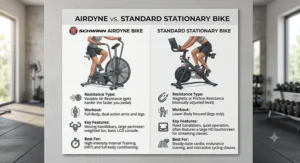
The Schwinn Airdyne line and chain-driven competitors like the Assault AirBike Classic and Titan Fitness Fan Bike solve the same basic problem — fan-generated resistance — through meaningfully different drivetrains, and the difference shows up in daily use, not just spec sheets.
Belt drives, used across every current Schwinn Airdyne model plus the Rogue Echo Bike, transfer pedaling force with less mechanical loss and noticeably less noise. There’s also functionally no scheduled maintenance beyond an occasional visual check. Chain drives, by contrast, deliver a slightly more direct, immediate feel under hard acceleration — some experienced riders genuinely prefer that sensation — but they demand periodic lubrication and will eventually stretch and need replacement.
What most buyers overlook is that this isn’t a durability contest so much as a maintenance-versus-feel tradeoff. A well-maintained chain-drive bike will last just as long as a belt-drive one; the question is whether you’ll actually do the maintenance. If you already know you’re the type to skip a chore, the belt-driven Airdyne models remove that risk entirely.
Common Mistakes When Buying an Air Bike
Even smart shoppers trip on a few predictable pitfalls here.
Buying on price alone. The cheapest option on paper often has the lowest weight capacity and thinnest console — fine for light use, frustrating if your training grows more serious.
Ignoring footprint. A bike that looks compact in a product photo can eat more floor space than an entire squat rack once the moving handlebars are factored in.
Assuming “Pro” always means better hardware. As covered above, the Schwinn Airdyne Pro and AD7 share identical internals — paying a Pro premium only makes sense at the right price.
Skipping the weight capacity math. A 300 lb-rated bike used by a 280 lb rider will show wear far sooner than the same bike used by a 180 lb rider — capacity ratings aren’t just about safety, they’re about longevity.
Underestimating noise in shared living spaces. Chain-driven models are audibly louder under hard effort — a real consideration for apartments or shared walls.
What to Expect: Real-World Performance
Specs only tell half the story — here’s what actually happens once you’re pedaling.
The first thing most new owners notice is how quickly resistance scales with effort: a light spin feels almost effortless, while an all-out sprint feels like pushing through wet cement within seconds. That’s the fan doing exactly what it’s designed to do, and it’s also why research on low-volume, high-intensity interval training has shown cardiometabolic improvements comparable to, or better than, traditional endurance training that requires far more time — a genuinely useful data point if your excuse for skipping cardio has always been time.
Noise varies more than people expect between models — belt-driven Schwinn models and the Echo Bike run at a low, steady whoosh, while chain-driven bikes add an audible chain hum under load. Comfort-wise, the seat is the most commonly cited weak point across nearly every model in this price category, Schwinn included; budgeting for an aftermarket gel seat cover is a common, inexpensive upgrade actual owners make within the first month.
Long-Term Cost & Maintenance
Sticker price is only part of the total cost of ownership here, and it’s worth running the numbers honestly before you buy.
Belt-driven models like the Schwinn Airdyne AD7 and Rogue Echo Bike carry a higher upfront price but close to zero recurring maintenance cost — no chain lubricant, no adjustment kits, no replacement links down the line. Chain-driven models like the Assault AirBike Classic and Titan Fitness Fan Bike cost less to buy but ask for periodic lubricant purchases and, eventually, a chain replacement every few years of heavy use — a cost that’s modest per instance but adds up over a machine’s working life.
Warranty terms matter here too, and they’re not uniform. Schwinn’s frame warranty across the Airdyne line has shrunk from 30 years to 10 in recent years, while the Assault Air Bike offers only 5 years on its frame — a detail worth checking against current listings, since warranty policy shifts more often than build quality does. Per the American College of Sports Medicine’s guidance on physical activity, consistent training over years — not any single machine feature — is what actually drives long-term health outcomes, which is a good reminder that the “cheapest to maintain” bike is often the one you’ll actually keep using.
Schwinn Airdyne Pro for Serious Home Gym Athletes
For anyone training five or six days a week, chasing structured intervals, or simply putting more hours on a bike than the average household ever will, the schwinn airdyne pro deserves a closer look specifically.
Because it shares every internal component with the AD7 — same belt drive, same 350 lb capacity, same nine programs — the real question isn’t performance, it’s channel and price. Serious athletes buying secondhand from commercial gym liquidations can often land a well-maintained Pro unit below new AD7 pricing, provided they inspect belt tension and console function before purchase. For anyone building a garage gym meant to outlast a few years of daily five-a.m. sessions, that combination of commercial-grade reputation and Schwinn’s mainstream parts availability is hard to beat.
Features That Actually Matter (And Those That Don’t)
Marketing copy loves to bury the useful details under a pile of buzzwords — here’s an honest filter.
Actually matters: weight capacity relative to your body weight, drive type (belt vs. chain), seat adjustability if you’re outside average height, and heart rate compatibility if you train by zones.
Doesn’t matter much: the exact number of built-in workout programs (most riders default to two or three favorites anyway), cosmetic console redesigns between model years, and marginal fan-blade material differences that reviewers can rarely distinguish blind.
Genuinely surprising: transport wheels, which sound like an afterthought but make the difference between a bike you actually move to vacuum under and one that becomes a permanent dust magnet in the corner.
Frequently Asked Questions
❓ Is a Schwinn Airdyne bike good for beginners?
❓ What is the difference between the Schwinn Airdyne AD6 and AD7?
❓ Is the Schwinn Airdyne Pro the same as the AD7?
❓ How much does a Schwinn Airdyne bike cost?
❓ Are air bikes better than treadmills for weight loss?
Conclusion
Picking the right schwinn airdyne bike really comes down to three honest questions: how much weight capacity do you actually need, do you want to handle occasional chain maintenance or pay upfront to avoid it, and how much are guided workout programs worth to you personally. The Schwinn Airdyne AD2 covers the basics affordably, the AD6 hits the sweet spot for most households, and the AD7 or Airdyne Pro make sense once you want built-in programming and a higher weight ceiling. Outside the Schwinn family, the Rogue Echo Bike, Assault AirBike Classic, and Titan Fitness Fan Bike all deserve a look depending on budget and floor space.
Whichever model you land on, the underlying formula hasn’t changed in decades: push harder, get more resistance, in a machine that’s mechanically simple enough to outlast almost anything else in your gym.
Recommended for You
- Rogue Echo Bike Review 2026: 7 Best Air Bikes Compared
- Assault Air Bike Guide 2026: 7 Picks Worth the Sweat
- Best Air Bike 2026: 7 Picks Worth Your Sweat (And Cash)
Disclaimer: This article contains affiliate links. As an Amazon Associate, I earn from qualifying purchases. If you purchase products through these links, we may earn a small commission at no additional cost to you.
✨ Found this helpful? Share it with your friends! 💬🤗
