
In This Article
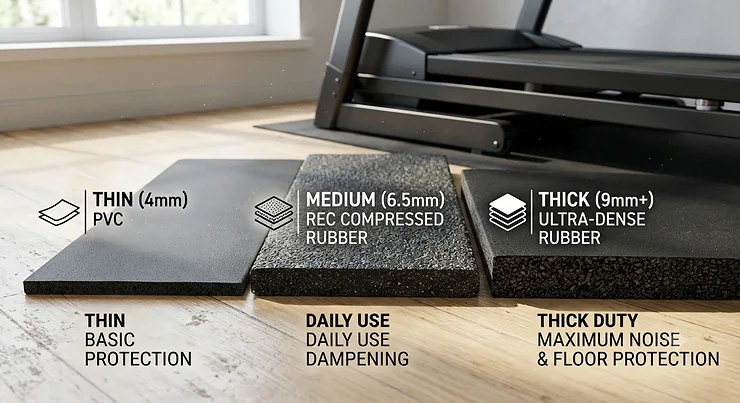
If you’ve ever Googled “treadmill mat thickness” at 11 p.m. while your treadmill hums away on bare hardwood, you already know the panic. Treadmill mat thickness is simply how many millimeters (or fractions of an inch) of material sit between your machine and your floor — and it’s the single biggest factor in how much noise, vibration, and wear your home gym produces.
Here’s the short version: most home treadmill mats run anywhere from 3mm (about 1/8 inch) up to 13mm (1/2 inch), and the “right” thickness depends less on marketing copy and more on your flooring type, your treadmill’s weight, and whether your downstairs neighbor has filed a noise complaint yet. 😅
I’ve spent years around home gym setups — moving treadmills, patching dented hardwood, and listening to way too many “is this mat actually 1 inch thick?” complaints — and the honest answer is that thicker isn’t automatically better. A 4mm high-density PVC mat can outperform a 10mm foam one if the density is right. That’s the nuance most buying guides skip, and it’s exactly what we’re unpacking below, alongside seven real mats currently sold on Amazon that span every budget and use case.
Quick Comparison Table
| Mat | Thickness | Material | Price Range | Best For |
|---|---|---|---|---|
| Amazon Basics Treadmill Mat | 0.3 in (~8mm) | High-density PVC | Under $30 | Apartment budgets |
| ProsourceFit Puzzle Mat | 0.5 in (13mm) | Interlocking EVA foam | $25–$35 | Odd-shaped spaces |
| BalanceFrom GoFit Mat | 1/4 in (~6mm) | High-density PVC | $35–$45 | Carpet & hard floors |
| ProForm Large Equipment Mat | 4mm (~0.16 in) | Vinyl/foam composite | $35–$45 | Light to mid-size treadmills |
| SuperMats Solid PVC Mat | ~1/8–1/4 in (despite “1-inch” label) | Solid vinyl | $60–$140 | Long-deck commercial treadmills |
| Rubber-Cal Treadmill Mat | 3/16 in (~4.8mm) | Recycled solid rubber | $50–$90 | Heavy machines, garages |
| Gorilla Mats Premium Mat | 8mm | Heavy-duty rubber | $80–$130 | Multi-purpose home gyms |
Looking at this lineup, you’ll notice thickness alone doesn’t predict price — the SuperMats option costs more than the thicker Gorilla Mats option, largely because of its size and vinyl construction rather than raw thickness. If noise reduction is your top priority, lean toward the denser rubber options (Rubber-Cal, Gorilla Mats) rather than the thinnest PVC sheets, even though those PVC sheets win on portability and price.
💬 Just one click — help others make better buying decisions too!😊
Top 7 Treadmill Mats by Thickness: Expert Analysis
| Mat | Thickness | Dimensions | Price Range | Best For |
|---|---|---|---|---|
| Amazon Basics Treadmill Mat | 0.3 in | 72″ x 30″ | Under $30 | Budget apartment use |
| ProsourceFit Puzzle Mat | 0.5 in | Modular, fits any footprint | $25–$35 | Custom-shaped rooms |
| BalanceFrom GoFit Mat | 1/4 in | 7′ x 5′ | $35–$45 | Carpeted home gyms |
| ProForm Large Equipment Mat | 4mm | 40″ x 80″ or 36″ x 72″ | $35–$45 | Compact-to-mid treadmills |
| SuperMats Solid PVC Mat | ~1/8–1/4 in | 90″ x 36″ | $60–$140 | Extra-long treadmill decks |
| Rubber-Cal Treadmill Mat | 3/16 in | 4′ x 6.5′ or 4′ x 7.5′ | $50–$90 | Heavy-duty, daily use |
| Gorilla Mats Premium Mat | 8mm | 7′ x 4′ | $80–$130 | Multi-equipment home gyms |
The pattern that jumps out here: every mat under 1/4 inch is built for portability and price, not for serious vibration control — so if you’re running a 250-lb commercial treadmill daily, the Rubber-Cal and Gorilla Mats options are doing real structural work that the thinner PVC sheets simply can’t match. On the flip side, paying premium prices for a thick mat under a lightweight folding treadmill is overkill — you’re solving a noise problem you don’t have yet.
1. Amazon Basics High-Density Exercise Equipment & Treadmill Mat
The Amazon Basics Treadmill Mat stands out for doing the basics shockingly well — it’s the rare house-brand product that doesn’t feel like a downgrade. At 0.3 inches thick with a high-density PVC core, it’s thin enough to slide under doors but dense enough to genuinely dampen vibration on hardwood and tile; in practice, that means your treadmill stops creeping forward an inch per session.
What most buyers overlook is that this mat lays flat almost immediately — no three days of standing on the corners to flatten curled edges, which is a real problem with cheaper imports. Owners frequently note it handles spilled water and sweat without staining or warping, and the 72″ x 30″ footprint comfortably covers most folding and compact treadmills, though larger commercial decks will overhang slightly.
✅ Pros: Lies flat fast, wipes clean easily, budget-friendly
❌ Cons: Smooth underside can shift on polished floors, footprint too small for long-deck treadmills
At under $30, this is the mat I’d recommend to anyone testing the waters with their first home treadmill before investing in something heavier-duty.
2. ProsourceFit Puzzle Exercise Mat
The ProsourceFit Puzzle Exercise Mat solves a problem the other six mats on this list can’t: irregular spaces. Sold as six interlocking EVA foam tiles, it’s built for garages with support poles, corners, or treadmills wedged next to storage shelves.
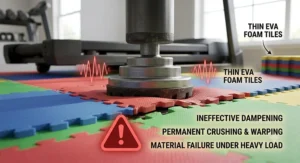
At 0.5 inches thick, it’s actually thicker than several “premium” mats here, and that extra foam cushioning noticeably softens footfall noise on concrete basements. The tradeoff — and it’s worth knowing before you buy — is that EVA foam compresses under sustained heavy weight faster than rubber or PVC, so a 300-lb commercial treadmill will eventually leave permanent indentations.
Customer feedback consistently praises the lifetime warranty and the ability to remove and reuse the border edging if you expand your setup later.
✅ Pros: Modular for odd spaces, thick cushioning, lifetime warranty
❌ Cons: Compresses under heavy machines, foam isn’t as water-resistant as vinyl
In the $25–$35 range, it’s the smart pick for anyone who needs flexible coverage rather than one rigid rectangle.
3. BalanceFrom GoFit High-Density Gym Equipment Floor Mat
The BalanceFrom GoFit Mat is the generalist of this list — a 7′ x 5′ high-density PVC sheet at roughly 1/4 inch thick that’s equally happy under a treadmill, a stationary bike, or a weight bench. That versatility matters if your “treadmill mat” doubles as your entire home gym floor.
In practice, the 1/4-inch thickness sits in a sweet spot: thick enough to flatten low-pile carpet dents and dull vibration noise, but not so thick that the treadmill rocks or feels unstable mid-run. What most reviews don’t mention is that the larger surface area also catches sweat and dust from adjacent equipment, which extends the life of your actual flooring underneath, not just the spot directly under the treadmill.
✅ Pros: Large multi-equipment coverage, stable under load, easy to clean
❌ Cons: Heavier and bulkier to move once unrolled, basic black aesthetic only
Priced around $35–$45, this is the mat for someone outfitting an entire corner of a room, not just one machine.
4. ProForm Large Equipment Mat
The ProForm Large Equipment Mat leans into a different strength: brand familiarity from a company that also builds treadmills, so the fit and finish feel purpose-made rather than generic. At 4mm thick — one of the thinner options here — it’s a clear signal that this mat is designed for noise dampening and floor protection, not joint cushioning.
In real-world terms, 4mm of dense vinyl-foam composite is enough to stop scuff marks and muffle the rhythmic thud of a walking pace, but if you’re a runner who hits the deck hard, you’ll feel more of that impact through the floor than with a thicker rubber option. Available in two sizes (40″ x 80″ or 36″ x 72″), it scales reasonably well to different treadmill footprints.
✅ Pros: Trusted fitness brand, two size options, waterproof vinyl surface
❌ Cons: Thinner profile offers less impact cushioning, less effective on uneven subfloors
At $35–$45, it’s a solid mid-tier choice if floor protection — not noise elimination — is your main goal.
5. SuperMats Solid PVC Mat for Treadmills
The SuperMats Solid P.V.C. Mat earns its spot here mainly on sheer size: at 90″ x 36″, it’s built for long-deck treadmills that smaller mats simply can’t cover edge to edge. Here’s the catch buyers should know upfront — despite some listings advertising it as “1-inch thick,” independent testing from outlets like BarBend and widespread owner feedback put the actual thickness closer to 1/8 to 1/4 inch, so don’t buy this one expecting a cushioned, foam-like feel.
What it does deliver is durability. The solid vinyl construction resists denting from heavy treadmill feet and stays flat without the curling issues that plague cheaper PVC rolls. Some owners do mention a powdery black residue on first unboxing, which wipes away with a damp cloth and doesn’t return.
✅ Pros: Excellent coverage for large machines, durable vinyl, lies flat out of the box
❌ Cons: Marketed thickness is misleading, no real cushioning benefit despite the size
In the $60–$140 range depending on length, this is a fit-first purchase — measure your treadmill before buying, not the other way around.
6. Rubber-Cal Treadmill Mat
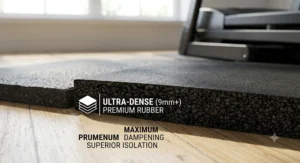
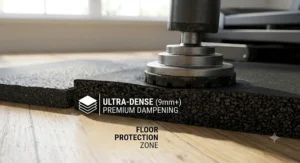
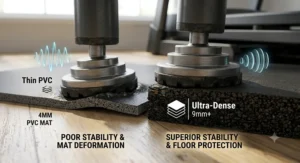
The Rubber-Cal Treadmill Mat is where this list shifts from “floor protector” to genuine vibration-control equipment. Made from recycled tire rubber at 3/16 inch thick, it’s built with the kind of mass and density that lighter PVC and foam mats simply can’t replicate.
In practice, that density translates to real reductions in low-frequency rumble — the kind that travels through floor joists into the room below, which matters enormously if you’re on a second floor or sharing walls with neighbors. The 35-lb weight per roll means it stays put under its own mass once the treadmill is set on top, no adhesive required. The tradeoff is a noticeable rubber odor for the first few days, which is standard for recycled-rubber products and fades with ventilation.
✅ Pros: Genuinely effective noise/vibration dampening, heavy enough to stay in place, eco-friendly recycled material
❌ Cons: Initial rubber smell, heavier and harder to roll/store than vinyl
At $50–$90, this is the pick for apartment dwellers and anyone running a heavier treadmill daily who’s serious about not bothering the people below them.
7. Gorilla Mats Premium Extra Thick Exercise Mat
The Gorilla Mats Premium Exercise Mat rounds out this list as the multi-purpose heavyweight. At 7′ x 4′ and 8mm thick, it’s sized more like a full home-gym floor than a single-machine mat, which makes sense if your treadmill shares space with dumbbells, a yoga routine, or bodyweight training.
The extra surface area and thickness genuinely help with joint comfort during floor work — something none of the thinner PVC mats on this list can offer — while still providing solid vibration control under the treadmill itself. The dual-sided grip texture keeps it anchored during high-movement workouts like jump training, not just static treadmill use.
✅ Pros: Doubles as a full workout mat, strong grip, large coverage area
❌ Cons: Requires hand-washing rather than machine cleaning, premium price for the size
At $80–$130, it’s the best value if your treadmill lives in a multi-purpose workout room rather than a dedicated machine corner.
Practical Usage Guide: Getting the Most From Your Mat
A new mat almost always arrives rolled tightly, and unrolling it in a warm room speeds up flattening — cold garages can take days longer. Before placing your treadmill, vacuum the floor underneath; trapped grit under a mat acts like sandpaper over time and quietly scratches hardwood or vinyl plank flooring.
For the first 30 days, recheck that your treadmill hasn’t “walked” off the mat — even dense rubber mats can shift slightly during heavy use until the weight settles. If you’re using a PVC or vinyl mat, wipe it down weekly with a mild cleaner rather than harsh solvents, which can dry out and crack the surface over months of sweat exposure. Rotating the mat 180° every few months also evens out compression wear directly under the treadmill’s feet.
Real-World Scenario: Matching Mats to How You Actually Use Your Treadmill
Picture three different households. A college student in a third-floor walk-up running a compact folding treadmill needs noise control above almost anything else — the Rubber-Cal Treadmill Mat or Gorilla Mats Premium Mat earns its higher price tag here by actually protecting neighbor relationships.
A family with a long-deck commercial treadmill in a finished basement cares more about coverage and durability than noise — concrete already absorbs most vibration — so the SuperMats Solid PVC Mat‘s extra length matters more than its thin profile.
A renter testing out a first treadmill on a tight budget, meanwhile, is better served by the Amazon Basics or ProsourceFit options — enough protection and dampening to be useful, without overcommitting financially to a machine they might return in a month.
Problem → Solution: Fixing the Most Common Treadmill Mat Complaints
Problem: My mat won’t lie flat. Solution: warm the room, then weight the corners with books for 24–48 hours; PVC options like the Amazon Basics and BalanceFrom mats typically flatten faster than rolled rubber.
Problem: My treadmill still shakes the floor. Solution: thickness alone won’t fix this — switch to a denser material like the Rubber-Cal or Gorilla Mats rubber options rather than a thicker foam mat, which can actually amplify wobble on hard floors.
Problem: The mat smells. Solution: this is common with recycled rubber (Rubber-Cal); ventilate the room for 3–5 days before first use, and the odor fades on its own.
Problem: My mat is too small for my treadmill. Solution: measure your treadmill’s full footprint plus 6 inches of clearance on all sides before buying — the SuperMats option exists specifically for oversized decks.
✨ Don’t Miss These Exclusive Deals!
🔍 Take your home gym to the next level with these carefully selected mats. Click on any highlighted item to check current pricing and availability. These mats will help you protect your floors and create a quieter, more comfortable workout space your family will love!
How to Choose the Right Treadmill Mat Thickness
What is treadmill mat thickness, and why does it matter? It’s the measured depth of material between your treadmill and the floor, typically ranging from 3mm to 13mm in home-use mats, and it directly affects noise reduction, vibration control, and how much floor protection you actually get.
- Measure your treadmill’s full footprint — add 6 inches of clearance on every side before picking a mat size.
- Identify your flooring type — hardwood and tile need denser mats for vibration control; carpet often just needs a flat, stable barrier.
- Weigh your treadmill — heavier commercial decks (200+ lbs) benefit from rubber options like Rubber-Cal or Gorilla Mats rather than thin PVC.
- Consider your neighbors — apartment or multi-story living pushes the decision toward denser rubber over foam or thin vinyl.
- Decide between protection vs. portability — thicker rubber mats protect better but are heavier to move; thin PVC sheets roll up easily for storage.
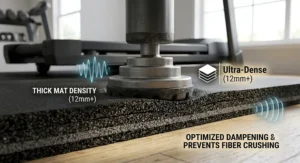
- Check material, not just thickness — a 4mm high-density mat can outperform a 10mm low-density foam mat, so don’t shop by number alone.
- Budget realistically — expect $25–$45 for basic protection and $50–$130 for genuine noise/vibration control.
Common Mistakes When Buying a Treadmill Mat
The single biggest mistake is shopping by thickness number alone instead of mat density ratings — a thick, airy foam mat will compress and underperform a thinner, denser rubber or PVC mat within months. Buyers also frequently skip measuring their treadmill’s actual footprint, ending up with mats that overhang awkwardly or leave the rear rollers exposed.
Another overlooked issue: assuming all mats are interchangeable across flooring types. A mat that performs beautifully on concrete may feel unstable and “squishy” on top of plush carpet, since the carpet itself is already absorbing the load unevenly. Finally, many buyers ignore odor and off-gassing timelines — recycled rubber mats like Rubber-Cal need a few days to air out, and judging the product on day one unfairly skews expectations.
Thick vs. Thin Treadmill Mat: Which Actually Wins?
This is the rubber mat thickness comparison question everyone eventually asks, and the honest answer is “it depends on density, not just depth.” A thin, high-density mat like the ProForm Large Equipment Mat at 4mm can outperform a thicker, lower-density foam tile for noise control, because dense materials absorb vibration energy rather than just cushioning impact.
That said, thicker mats generally win on joint comfort and floor-leveling over uneven or slightly worn subfloors — the extra material fills small gaps a thin sheet can’t bridge. The practical takeaway: choose thin and dense (Rubber-Cal, ProForm) for hard, level floors and noise control; choose thicker and more cushioned (Gorilla Mats, ProsourceFit) for comfort, multi-purpose use, or slightly uneven flooring.
What to Expect: Real-World Performance
On paper, the difference between a 4mm and an 8mm mat looks dramatic. In daily use, it’s subtler. You’ll notice the difference most clearly in two moments: when the treadmill kicks on (thicker, denser mats noticeably soften that initial motor hum) and when you’re running rather than walking (impact noise drops more with density than with raw thickness).
What you generally won’t notice — despite what marketing suggests — is a meaningful difference in how “bouncy” or comfortable the treadmill belt itself feels. That’s determined by the treadmill’s own deck cushioning, not the mat underneath it. Mats manage floor-level noise and vibration; they don’t change your running experience on the belt.
Features That Actually Matter (And Those That Don’t)
Matters: material density, non-slip underside texture, and size relative to your equipment’s actual footprint. These three factors determine 90% of how well a mat performs day to day.
Doesn’t matter as much: exact thickness in millimeters when compared across different materials, fancy surface patterns or colors, and “1-inch thick” marketing claims that, as the SuperMats example shows, don’t always hold up to a tape measure. Cushioning levels matter most for floor exercises done on the same mat — for pure treadmill use, vibration dampening and floor protection are the metrics worth your attention.
Long-Term Cost & Maintenance
A $25 PVC mat that needs replacing every 18 months due to cracking technically costs more over five years than a $90 rubber mat that lasts a decade — run the math before assuming “budget” automatically means “cheaper long-term.” Rubber options like Rubber-Cal and Gorilla Mats typically outlast PVC and foam by several years under daily use, a durability gap independent testers at Garage Gym Reviews have also flagged when comparing mat lifespans side by side.
Maintenance costs stay low across the board: a damp cloth and mild cleaner handle weekly upkeep for vinyl and rubber, while EVA foam tiles (ProsourceFit) need slightly gentler cleaning to avoid surface pitting over time.
Benefits vs. Going Without a Mat
| Factor | With a Quality Mat | No Mat / DIY Cardboard or Towel |
|---|---|---|
| Floor protection | High — prevents dents and scratches | Minimal to none |
| Noise reduction | Moderate to high (material-dependent) | None |
| Equipment stability | Improved, reduces “walking” | Often worse, increases slipping |
| Upfront cost | $25–$130 | $0–$10 |
The table makes the tradeoff obvious: a few dollars in upfront mat cost consistently prevents floor damage that costs far more to repair, especially on hardwood or vinyl plank. DIY solutions like cardboard or old towels offer essentially no vibration control and tend to slip or bunch up under a moving treadmill belt, creating a safety hazard rather than solving one.
FAQ
❓ What thickness mat is best for a treadmill?
❓ Does a thicker treadmill mat reduce noise better?
❓ Can I use a yoga mat instead of a treadmill mat?
❓ Do treadmill mats work on carpet?
❓ How long do treadmill mats last?
Conclusion
There’s no single “correct” treadmill mat thickness — there’s only the right combination of thickness, density, and size for your specific treadmill, floor, and living situation. If you’re renting an apartment above neighbors, density-focused rubber options like the Rubber-Cal Treadmill Mat or Gorilla Mats Premium Mat are worth the higher price tag. If you’re protecting hardwood under a lightweight folding treadmill on a budget, the Amazon Basics or ProsourceFit mats handle the job without overspending.
The biggest shift in thinking I’d encourage: stop shopping by the thickness number alone. A mat’s material density, your treadmill’s actual weight, and your flooring type matter more than whether a listing says 6mm or 10mm. Measure first, match the material to your situation second, and the right mat becomes an easy call.
✨ Don’t Miss These Exclusive Deals!
🔍 Ready to protect your floors for good? Check current pricing on the mats above and pick the one that matches your space, your treadmill, and your downstairs neighbors’ patience. 😊
Recommended for You
- 7 Best Extra Large Treadmill Mats for 2026 (Buyer’s Guide)
- Noise Reduction Treadmill Mat: 7 Proven Quiet Picks
- 7 Best Treadmill Mats for Carpet in 2026
Disclaimer: This article contains affiliate links. As an Amazon Associate, I earn from qualifying purchases. If you purchase products through these links, we may earn a small commission at no additional cost to you.
✨ Found this helpful? Share it with your friends! 💬🤗
