
In This Article
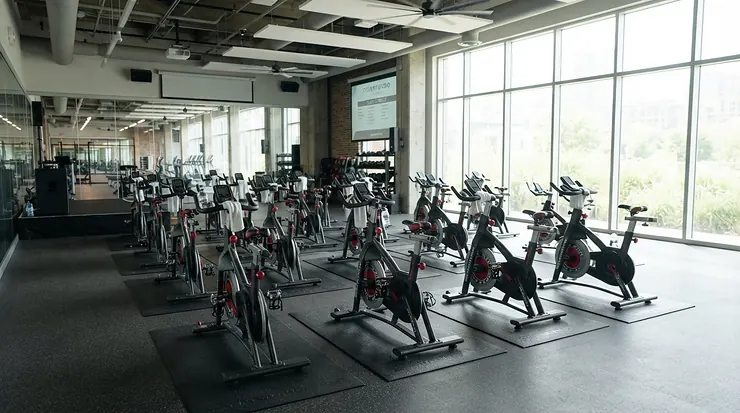
A heavy duty bike mat is a dense, thick, non-slip platform that sits under a stationary bike, spin bike, or trainer. It spreads the machine’s weight across a wider area, absorbs vibration, blocks sweat and debris, and keeps the frame from creeping across the floor. Think of it as a shock absorber for your whole workout space.
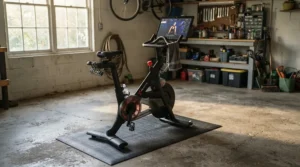
Here’s the thing most people learn the hard way. A 100-pound spin bike doesn’t rest on its whole body. It rests on four small feet. Add a rider pedaling hard, and those feet become tiny, relentless hammers. Hardwood dents. Carpet crushes. Tile cracks. The downstairs neighbor starts leaving notes.
This is why a thin yoga mat doesn’t cut it. A trainer quoted by Livestrong makes the point that a hard, durable surface beats something soft like a yoga mat, which breaks down faster and can’t handle a bike’s weight. That matches how stationary bicycles are built: heavy flywheels, rigid frames, concentrated contact points.
So what separates a mediocre pad from a true heavy duty bike mat? Density, thickness, and surface texture. We’ll dig into each of those below. Along the way, we’ll cover the thick bike mat question (how thick is thick enough?), the commercial bike mat tier for studios and gyms, and what makes a durable spin bike mat actually last. We’ll also look at high-density rubber mats, reinforced equipment pads, and the elusive promise of professional-grade protection.
One note on method. The picks below come from real product listings, published roundups, and aggregated reviewer sentiment. I haven’t ridden on any of them, and I won’t pretend otherwise. What I can do is read the specs closely and tell you what they mean for your floor.
Quick Comparison: The 7 Best Heavy Duty Bike Mat Options at a Glance
| Product | Size / Thickness | Material | Best For |
|---|---|---|---|
| SuperMats 12GS Heavy Duty Equipment Mat | 30″ x 72″ x 0.25″ | Vinyl | Recumbent and compact bikes |
| Gorilla Mats Premium Large Exercise Mat | Large format (verify size on listing) | Heavy-duty mat | Heaviest bikes, heavy daily use |
| BalanceFrom High Density Equipment Mat | 1/4″ thick; multiple sizes (24″ x 48″ smallest) | High-density mat | Budget-conscious buyers |
| CAP Barbell Premium Spin Bike Mat | 78″ x 36″ x 0.25″ | Pebble-textured mat | Spin bikes on hardwood |
| Peloton Bike Mat | Roughly 6 ft x 3 ft, about 4mm | High-density material | Peloton Bike and Bike+ owners |
| Cycleclub Bike Mat | 30″ x 60″ x 6mm | Sealed vinyl | Value-focused multi-machine homes |
| Amazon Basics High Density Equipment Mat | About 30″ x 72″ | High-density mat | Easy budget protection |
Reading across the table, the CAP Barbell Premium Spin Bike Mat and SuperMats 12GS Heavy Duty Equipment Mat share the same quarter-inch thickness, so the choice between them is mostly about texture and reviewer feel rather than raw protection. The Peloton Bike Mat is the thinnest of the group, which tells you it’s designed around fit and aesthetics as much as brute strength. If your bike is heavy or your floor is delicate, thicker generally wins.
💬 Just one click — help others make better buying decisions too!😊
Top 7 Heavy Duty Bike Mat Picks: Expert Analysis
Prices shift constantly, so every range below is approximate and based on research at the time of writing. Always check current price on the listing before you buy.
1. SuperMats 12GS Heavy Duty Equipment Mat — best for recumbent bikes and quiet apartments
The 30″ x 72″ footprint covers most upright and recumbent bikes without swallowing your room. At a quarter inch thick, it’s firmly in thick bike mat territory for a vinyl product.
On paper, that thickness means the mat can spread load across a wider area than thin 3-4mm options. In practice, it also means the bike’s feet won’t punch through to the floor during hard, out-of-the-saddle efforts. One roundup calls it the best value for large equipment and a strong noise-reduction upgrade for apartment dwellers.
Reviewers consistently report a non-slip surface and no overpowering rubber smell. A recurring complaint is softness: equipment sinks in slightly, and one long-term owner mentions noticeable dents after two years, though the mat was still holding up well. Handy to know before you wheel a heavy bike on and off.
Pros:
- ✅ Non-slip surface makes mounting and dismounting safer
- ✅ Quarter-inch thickness cushions vibration and noise
- ✅ Little to no strong odor, per reviewers
Cons:
- ❌ Softer feel means bike feet leave dents over time
- ❌ Repositioning heavy bikes can take two people
Expect a price in roughly the $50-$80 range depending on size. For a mat that quiets a second-floor bike room, that’s reasonable value.
2. Gorilla Mats Premium Large Exercise Mat — heaviest-duty option for daily use
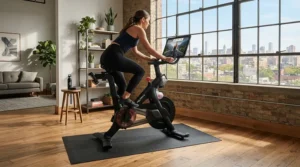
If your bike is a tank, or your household rides daily, this is the pick built for punishment. Livestrong’s cycling-instructor roundup names it the best heavy duty option, noting it handles heavy weight and heavy use.
The “large” in the name matters. A bigger mat gives you room to stand beside the bike, clip in, and mount without stepping onto bare floor. It also means you can park two machines on one surface if your setup demands it. Dimensions vary by listing, so measure your bike and verify the exact size before ordering.
The analytical take: when a mat is marketed on durability rather than price, you’re paying for material that resists compression over years, not months. That’s the core of the “buy once” logic behind any durable spin bike mat. I couldn’t verify a large enough pool of reviewer comments for this specific listing, so lean on the roundup recommendation and check recent buyer feedback yourself.
Pros:
- ✅ Recognized as a top heavy duty pick by instructors
- ✅ Large footprint gives mounting space
- ✅ Built for sustained, daily use
Cons:
- ❌ Premium price compared to basic equipment mats
- ❌ Size varies, so measuring first is essential
Budget roughly $60-$100 depending on dimensions. Pricey up front, but it’s the one that makes the most sense if the bike never leaves that spot.
3. BalanceFrom High Density Equipment Mat — best budget heavy duty bike mat for tight spaces
Livestrong’s roundup crowned this one “best overall” for solid construction at a great price, with two sizes to fit different spaces. The listing describes a quarter-inch, high-density mat with an anti-slip pattern that doesn’t bleed onto carpet and wipes clean with a damp cloth.
Here’s the spec-sheet translation. Quarter-inch high-density material is enough for a typical home spin bike, and the carpet-safe claim matters if you’re in a rental. But the smallest size listed, 24″ x 48″, is too short for most full-size spin bikes. Spend a minute confirming the larger dimension before you click.
The listing shows a healthy review base, with shoppers praising it as the mat they were looking for and good under a treadmill. The verifiable commentary I found is short, so treat this as a solid budget value rather than a proven long-haul workhorse.
Pros:
- ✅ Quarter-inch thickness at a budget price
- ✅ Wipes clean with a damp cloth
- ✅ Multiple sizes available
Cons:
- ❌ Smallest size is too short for most spin bikes
- ❌ Long-term durability data is thin
Plan on roughly $15-$40 depending on size. Hard to beat for the money, if you buy the right size.
4. CAP Barbell Premium Spin Bike Mat — best pebble-textured mat for hardwood
At 78″ x 36″ x 0.25″, this mat is generously sized, with a pebble texture and square edges. CAP Barbell backs it with a 30-day warranty and decades of fitness-industry history.
What stands out is the reviewer feedback on thickness. Owners describe it as thick enough to cushion a roughly 55-pound folding bike without being so thick that the bike shifts. One Sunny spin bike owner rolls the bike on and off the mat repeatedly, with no scuffs or nicks on the surface. A Peloton owner says it fits perfectly and doesn’t change how the ride feels.
The honest caveat: one reviewer points out it’s not as thick as interlocking gym tiles. That’s true, and it’s a useful reminder that this is a mat, not a floor. For most home riders, though, it hits a sweet spot.
Pros:
- ✅ Roomy 78″ length suits full-size spin bikes
- ✅ Resists scuffing when bikes are rolled on and off
- ✅ Wipes clean after sweaty rides
Cons:
- ❌ Thinner than interlocking gym tiles
- ❌ Only a 30-day warranty
Expect roughly $30-$50. For hardwood floors, it’s an easy value call.
5. Peloton Bike Mat — best brand-matched fit for Peloton Bike and Bike+
Livestrong names it best for Peloton, and the logic is straightforward. It’s sized for the Peloton Bike and Bike+ at roughly 182cm x 90cm (about 6 ft x 3 ft) per one retailer listing, and about 4mm thick.
That 4mm number is the key. This is the thinnest mat on the list, so it earns a “heavy duty” label through high-density material rather than raw thickness. The listing says it prevents scuff marks, blocks dust and carpet fibers from reaching mechanical parts, and adds stability against rocking.
What the spec sheet won’t tell you: if you’re on a floor with real dent risk, or you ride aggressively, a thicker third-party pad gives more margin. If aesthetics and perfect fit matter most, this one makes sense.
Pros:
- ✅ Sized specifically for Peloton Bike and Bike+
- ✅ High-density material blocks scuffs
- ✅ Matches the bike’s look
Cons:
- ❌ Thinner than most rivals here
- ❌ Brand premium over generic options
Budget roughly $50-$75. You’re paying for fit and styling more than raw protection.

6. Cycleclub Bike Mat — most popular multi-machine value pick
A July 2026 sales-volume ranking of Amazon’s bike mat category put this 6mm sealed-vinyl mat at the top of monthly sales. It measures 30″ x 60″, and the listing positions it for Peloton, ellipticals, treadmills, and generic spin bikes.
Popularity isn’t proof of quality, but it signals something. Thousands of buyers found the size, thickness, and price acceptable. A 6mm thickness gives meaningful cushioning without a gym-floor feel, and the listed size suits compact bikes. It’s less ideal for a long-wheelbase machine.
I couldn’t verify a deep pool of independent reviewer commentary specific to this listing, so treat it as a strong-seller pick rather than a proven long-term champion.
Pros:
- ✅ 6mm thickness handles most home spin bikes
- ✅ Works under multiple machine types
- ✅ Strong sales volume suggests broad satisfaction
Cons:
- ❌ 60″ length is tight for longer bikes
- ❌ Limited independent long-term feedback
Expect roughly $25-$45 depending on size. Excellent value for a compact setup.
7. Amazon Basics High Density Equipment Mat — easiest budget protection
This one measures about 0.76 x 1.83 meters (roughly 30″ x 72″), the same practical footprint as the SuperMats 12GS Heavy Duty Equipment Mat. A reviewer calls it the budget mat they recommend most often.
The same reviewer warns it may show indentations under very heavy loads. That’s the honest tradeoff of budget density: fine for typical bikes, less ideal for a 150-pound commercial-style machine.
Pros:
- ✅ Large 72″ length covers most upright bikes
- ✅ Budget-friendly entry point
- ✅ Familiar retailer and straightforward returns
Cons:
- ❌ May indent under very heavy loads
- ❌ Not built for commercial-grade use
Plan on roughly $30-$50. A reasonable starter pick.
Top 7 Heavy Duty Bike Mat Comparison Table
| Product | Thickness | Approx. Price Range | Reviewer Sentiment | Best For |
|---|---|---|---|---|
| SuperMats 12GS | 0.25″ | $50-$80 | Positive; some denting reported | Recumbent, quiet apartments |
| Gorilla Mats Premium | Verify listing | $60-$100 | Roundup-recommended | Heavy bikes, daily use |
| BalanceFrom | 0.25″ | $15-$40 | Positive | Budget buyers |
| CAP Barbell | 0.25″ | $30-$50 | Positive; durable | Hardwood floors |
| Peloton Bike Mat | About 4mm | $50-$75 | Brand-fit praised | Peloton owners |
| Cycleclub | 6mm | $25-$45 | Strong sales volume | Multi-machine homes |
| Amazon Basics | Not stated | $30-$50 | Budget favorite | Basic protection |
Looking at the table, Gorilla Mats Premium and SuperMats 12GS sit at the premium end because they target heavy loads and daily use. BalanceFrom and Cycleclub deliver the best protection per dollar for typical home riders. The Peloton Bike Mat is the choice when fit matters most.
How to Choose a Heavy Duty Bike Mat: 7 Steps
Short answer: match thickness, density, and footprint to your bike’s weight, your floor type, and how often you ride. Here’s the longer version.
- Measure the bike’s footprint first. Add 6-12 inches on each side so you can mount comfortably. A mat shorter than your frame defeats the purpose.
- Weigh your bike. Under 60 pounds, a quarter-inch mat is typically plenty. Above 100 pounds, step up to thicker rubber or a reinforced option.
- Match thickness to floor type. Hardwood and tile benefit from the thickest mat you can fit. Carpet needs firmness more than cushion.
- Check density, not just thickness. A thin dense mat can outperform a thick spongy one. Look for terms like high-density or compression-resistant.
- Evaluate surface grip. Textured tops and anti-skid bottoms keep both the bike and your shoes stable.
- Think about moisture and cleaning. Non-porous surfaces like vinyl and sealed rubber wipe clean after sweaty sessions.
- Plan for storage. Rolling a stiff mat is easier than folding it. Fold lines can weaken some materials.
Livestrong’s roundup also notes that your bike’s size affects the ideal mat size, which reinforces step one.
Thick Bike Mat: How Much Thickness Do You Actually Need?
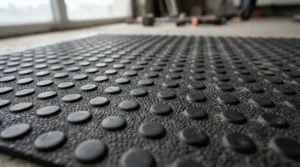
The phrase thick bike mat gets thrown around loosely, so let’s get specific.
3-4mm: Light protection. Fine for a lightweight bike on a forgiving floor. This is where the Peloton Bike Mat lives.
6mm: The mainstream sweet spot. The Cycleclub and similar vinyl mats offer genuine cushioning, noise dampening, and floor protection without making the bike feel unstable.
0.25 inch (about 6.35mm): Slightly thicker, and the standard for the SuperMats 12GS, CAP Barbell, and BalanceFrom. Roughly the same as 6mm in practice, though some buyers report these feel more substantial.
8-15mm: Commercial and rubber territory. Interlocking rubber tiles and utility mats at this thickness handle weight machines, commercial treadmills, and the heaviest spin bikes.
A quick caution: thicker isn’t always better. A very soft, thick mat can make a bike feel wobbly, especially during standing climbs. One CAP Barbell reviewer specifically praises that the thickness is right to hold the bike in place without letting it move around.
The practical rule: choose the thickest dense mat that still gives you a stable, planted feel. If you notice side-to-side rocking, the mat is too soft, not too thin.
High-Density Rubber Mats vs PVC and EVA: What Actually Wins?
Most bike mats fall into three material families. Each makes different tradeoffs.
Greatmats, a flooring specialist, argues that rubber flooring rolls and interlocking tiles are tougher than the average Peloton-style bike mat. Their view is that high-density rubber mats handle the weight of heavy bikes better and protect subfloors more reliably than basic mats. They also list vinyl and PVC options as capable alternatives for most home gear.
| Feature | High-Density Rubber | PVC / Vinyl | EVA Foam |
|---|---|---|---|
| Durability | Excellent | Good | Fair |
| Compression resistance | Best | Good | Lowest |
| Odor | Strong at first | Mild | Mild |
| Weight | Heavy | Moderate | Light |
| Price | Higher | Moderate | Lowest |
| Best For | Heavy bikes, studios | Most home riders | Light-duty use |
A heavy duty bike mat built from high-density rubber mats resists the creeping compression that makes cheaper foam mats look sad after a year. PVC and vinyl options like the SuperMats 12GS and Cycleclub offer easier cleaning and lighter weight. EVA works for occasional use but loses its shape under sustained load.
Notice the pattern: the more weight and the more frequent the use, the more the equation tilts toward rubber. The tradeoff is smell, weight, and price.
Commercial Bike Mat: What Studios and Gyms Actually Need
A commercial bike mat has to survive conditions no home mat faces: dozens of riders daily, bikes dragged and repositioned, sweat, cleaning chemicals, and years of continuous load.
That changes the requirements. Rubberco’s buying guide notes that mats supporting static loads over 200kg should use rubber with a density of at least 1,100 kg/m³ to avoid compression creep. For a spin bike or Peloton setup, they suggest a roughly 90cm x 90cm mat at 6-8mm thickness in recycled SBR, and thicker 10-15mm for commercial treadmills and weight machines.
Translation for studio owners: don’t buy retail-grade vinyl and hope. Source rubber rolls or tiles with documented density. Plan to wipe-clean daily. And consider whether individual mats or full-floor coverage makes more sense. Full coverage eliminates the edge-tripping hazard.
Home riders can borrow the lesson. If your bike sees daily use or lives in a basement with moisture, a commercial bike mat approach (dense rubber, documented specs) outlasts vinyl.
Durable Spin Bike Mat: Wear Patterns and Longevity
A durable spin bike mat isn’t defined by its marketing. It’s defined by what happens at month 18.
The failure points are predictable. Bike feet create dents, which become permanent if the material is too soft. Edges curl if the mat is stored rolled. Surface textures wear smooth where shoes land. And cheap materials release odor or discolor.
Reviewer evidence supports this. One SuperMats 12GS owner reports dents after two years but still praises how well it held up. A CAP Barbell buyer reports no scuffs or nicks despite rolling a spin bike on and off. Meanwhile, a roundup reviewer flags that the Amazon Basics mat may show indentations under heavy loads.
The takeaway: any mat will show some wear. The question is whether it stays flat, grippy, and protective. To extend life, rotate the bike’s position slightly every few months, avoid dragging, and keep it clean. Small habits, big payoff.
Reinforced Equipment Pads and Professional-Grade Protection: Marketing vs Reality
Product listings love phrases like reinforced equipment pads and professional-grade protection. What do they actually mean?
Honestly, often not much. Neither term has a regulated definition. A manufacturer can apply them to anything.
What genuinely signals reinforcement: published density figures, documented thickness, and construction details like multi-layer builds or tear-resistant sealed edges. The Cycleclub listing, for instance, mentions sealed vinyl, a concrete material claim. Compare that to vague language with no spec.
Real professional-grade protection means the mat survives repeated loads, resists chemicals, and doesn’t degrade under UV or moisture. For home use, you rarely need that. For studios, it’s non-negotiable.
My advice: treat these phrases as a prompt to ask questions. What’s the density? What’s the warranty? What do verified buyers say after a year? If a listing can’t answer, skip it.

Setup and Maintenance Guide: Getting the Most From Your Heavy Duty Bike Mat
Buying the mat is half the job. Setup determines whether it works.
Before first use: Unroll the mat and let it lay flat for 24-48 hours. Rolled mats hold curl memory, and a curled edge is a trip hazard. If there’s a new-material odor, ventilate the room.
Placement: Position the mat so the bike sits at least 6 inches from every edge. Mark the bike’s foot positions with painter’s tape if you plan to move it.
First 30 days: Watch for sliding, especially on polished floors. If the mat shifts, a thin non-slip rug pad underneath can help. Check for rocking. If the bike wobbles, the mat may be too soft.
Cleaning schedule: Wipe sweat after each ride with a damp cloth. Weekly, use mild soap and water. Skip harsh solvents, which can degrade vinyl and rubber.
Common mistakes: Dragging the bike across the surface, storing the mat folded, and using it outdoors. Each shortens lifespan.
Optimization trick: Place a thin anti-fatigue mat beside the bike for standing mounts. It keeps your shoes off the main mat’s edges and adds comfort.
Real-World Scenarios: Which Heavy Duty Bike Mat Fits Your Life?
The college student in a second-floor apartment. Budget is tight, noise matters, and the bike weighs about 50 pounds. A BalanceFrom in a spin-bike-appropriate size or a Cycleclub keeps costs low while dampening vibration. Verify the size, and you’re set.
The Peloton family with hardwood floors. Daily rides, a dented-floor worry, and a desire for a tidy look. The Peloton Bike Mat matches the aesthetic, while a CAP Barbell adds a thicker quarter-inch layer if protection is the bigger priority.
The home gym with a heavy recumbent bike. The rider mounts and dismounts carefully, and the bike sits in one spot for years. The SuperMats 12GS offers non-slip grip and noise reduction, while Gorilla Mats Premium is the pick if you want maximum durability.
The small studio owner. A commercial bike mat approach with rubber rolls or tiles at 6-8mm minimum, per Rubberco’s guidance, beats retail vinyl for daily wear.
Each profile shows the same principle: match the mat to the weight, floor, and frequency, not the other way around.
Problem to Solution: Fixing the Most Common Bike Mat Headaches
Problem: The mat slides on hardwood. Solution: Clean both mat bottom and floor. If it still moves, add a non-slip underlay. Check that the mat has an anti-skid backing, like the one the Cycleclub listing describes.
Problem: The mat has a strong smell. Solution: Air it out for several days in a ventilated room. Rubber smells more than vinyl initially. Reviewers say the SuperMats 12GS avoids an overpowering odor.
Problem: Curled edges. Solution: Flip the mat and lay it flat under weight for a day or two. Store unrolled when possible.
Problem: Dents from bike feet. Solution: Switch to a denser material, reposition periodically, and consider a thicker mat. The Gorilla Mats Premium targets this exact issue.
Problem: Bike feels wobbly. Solution: The mat is probably too soft. Choose a firmer, denser option.
Long-Term Cost and Value: Which Heavy Duty Bike Mat Pays Off?
Price per year is the metric that matters. A $20 mat replaced every year costs more than a $70 mat lasting five.
| Price Tier | Approx. Range | Example | Expected Life | Value Verdict |
|---|---|---|---|---|
| Budget | $15-$40 | BalanceFrom, Cycleclub | 1-3 years | Great for light use |
| Mid-range | $30-$75 | CAP Barbell, Amazon Basics, Peloton Bike Mat | 2-5 years | Balanced |
| Premium | $60-$100+ | Gorilla Mats Premium, SuperMats 12GS | 5+ years | Best for heavy use |
Lifespans are estimates based on reviewer reports and category norms, not guarantees. The analysis: for a light rider, BalanceFrom wins on cost-per-year. For daily riders with heavy bikes, Gorilla Mats Premium likely pays back through longevity. Factor in the cost of a repaired floor, and a mid-range mat looks cheap.
Common Mistakes When Buying a Heavy Duty Bike Mat
Buying too small is the classic error. A mat that only covers the bike’s footprint leaves you stepping on bare floor.
Next: ignoring thickness-versus-density. A thick, spongy mat feels luxurious in the listing but wobbles in practice.
Third: trusting buzzwords. Phrases like reinforced equipment pads and professional-grade protection don’t guarantee anything without specs.
Fourth: skipping the floor type. Carpet needs firmness. Hardwood needs scuff protection. Tile needs cushioning.
Finally: forgetting storage. If you plan to move your bike, choose a mat that rolls cleanly.
Avoid these five, and you’ve dodged most buyer’s remorse.

FAQ
❓ Do I need a heavy duty bike mat on carpet?
❓ How long does a heavy duty bike mat last?
❓ Can I use a treadmill mat under a spin bike?
❓ Will a bike mat stop noise from traveling downstairs?
❓ Is a commercial bike mat worth it for home use?
Conclusion
Here’s the bottom line. A heavy duty bike mat is cheap insurance against dented floors, noisy workouts, and wobbly rides. The right pick depends on your bike’s weight, your floor, and how often you ride.
For most home riders, the CAP Barbell and Cycleclub hit the sweet spot of thickness, size, and value. Budget shoppers should look hard at the BalanceFrom, as long as they confirm the larger size. Peloton owners who value fit will like the Peloton Bike Mat. If you’re hauling a heavy bike or riding daily, the Gorilla Mats Premium and SuperMats 12GS earn their higher price. And the Amazon Basics mat is the easy starter option.
Whatever you choose, remember the fundamentals: thick enough, dense enough, big enough. Everything else is marketing.
✨ Ready to protect your floors? Check current prices on your favorite pick today and ride with confidence!
Recommended for You
- Exercise Bike Mat: 7 Proven Picks That Protect Floors (2026)
- Platform Pedals For Spin Bike: 7 Ultimate Picks For 2026
- Dual Sided Bike Pedals: 7 Best Picks Compared For 2026
Disclaimer: This article contains affiliate links. As an Amazon Associate, I earn from qualifying purchases. If you purchase products through these links, we may earn a small commission at no additional cost to you.
✨ Found this helpful? Share it with your friends! 💬🤗
