
In This Article
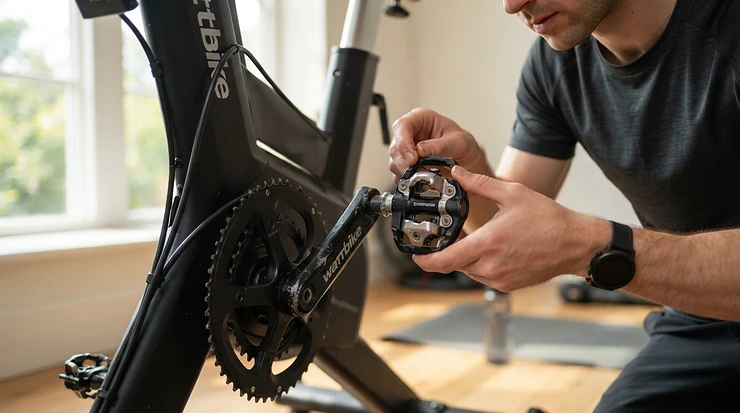
In plain English, spd pedals for spin bike setups are two-bolt clip-in pedals, built on Shimano Pedaling Dynamics, that lock a recessed cleat on your cycling shoe to the pedal. Your foot stays planted through every stroke. Because the cleat is recessed, you can still walk to the water fountain without skating across the floor.
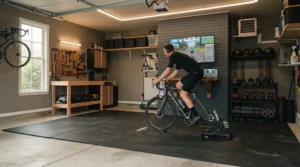
Here’s the thing about the pedals on many indoor bikes: they’re an afterthought. Flimsy cages, straps that never quite sit right, a bearing that starts grumbling by month six. Yet your feet are the only contact point between you and every watt you produce. Swap in a proper set of clip-in bike pedals and the ride sharpens. Your feet stop wandering, your stroke smooths out, and the flywheel finally gets your full attention.
Below are seven real, currently sold options, from the humble Shimano PD-M520 to the premium Shimano XT PD-M8100. You’ll also get the buying logic, cleat know-how, install steps and troubleshooting that product pages skip.
A quick note on sourcing: I haven’t clipped these onto my own bike. Everything here rests on published specs, manufacturer information and aggregated reviewer findings from cycling publications and retailer feedback. I’ll flag it when the evidence is thin. Whether you want clipless pedals for exercise bike use in a spare room or a studio-style home setup, the goal is the same: the right pedal, the right cleat, no drama.
Quick Comparison: SPD Pedals for Spin Bike at a Glance
| Pedal | Design | Approx. Price Range | Best For |
|---|---|---|---|
| Shimano PD-M520 | SPD on both sides | $35-$55 | Solo riders on a tight budget |
| Shimano PD-M540 | SPD on both sides, all-metal | $50-$75 | Daily riders who want longevity |
| Shimano PD-EH500 | SPD plus flat platform | $50-$80 | Beginners and shared bikes |
| Shimano XT PD-M8100 | SPD on both sides, wider platform | $100-$150 | Performance-minded riders |
| Wellgo WPD-E003 | SPD plus toe cage | $45-$70 | Budget households |
| BV 2-in-1 SPD + Cage | SPD plus toe cage | $40-$65 | Casual mixed-shoe use |
| Venzo 3-in-1 | SPD, Look Delta and removable cages | $60-$95 | Homes mixing cleat systems |
Looking at the table, the Shimano PD-M540 hits the sweet spot for riders who own SPD shoes and ride alone. Households where someone insists on sneakers should look at the Shimano PD-EH500 or the cage-based hybrids. Note that the Venzo 3-in-1 is the only option here that speaks both SPD and Look Delta, which is a real advantage in mixed-shoe homes.
💬 Just one click — help others make better buying decisions too!😊
Top 7 SPD Pedals for Spin Bike: Expert Analysis
Every pick below uses the standard 9/16-inch thread found on nearly all indoor bikes. Check your manual anyway; it takes thirty seconds.
1. Shimano PD-M520 — cheapest ticket into genuine SPD
Think of the Shimano PD-M520 as the sensible sedan of clip-in pedals: unglamorous, rarely broken, always starts. Its standout trick is being the lowest-cost door into Shimano’s proven SPD mechanism. It accepts a cleat from either side, so you never fumble for the right face mid-interval.
Published weights sit around 372-380 grams per pair, and release tension adjusts through two 3mm hex bolts. In practice, you can dial it soft while you learn, then firm it up once unclipping becomes muscle memory.
Here’s my read: this is a solo rider’s pedal. There’s no platform side, so anyone in sneakers is out of luck. Reviewers also note that the PD-M520 keeps wrench flats on the spindle. Opening it for service reportedly calls for a Shimano-specific tool, which only matters if you enjoy rebuilding things.
Reviewer sentiment is pleasantly dull. One long-term write-up describes thousands of miles before service, and comparison tests call it a basic, dependable pedal that simply works.
Pros:
- ✅ Lowest-cost entry into Shimano’s SPD system
- ✅ Clip in from either side, no flipping
- ✅ Adjustable release tension for beginners
Cons:
- ❌ No platform side for sneaker riders
- ❌ Servicing needs a specialty Shimano tool
Expect roughly $35-$55 (check current price); for solo riders with SPD shoes, the value is superb.
2. Shimano PD-M540 — the long-haul value sweet spot
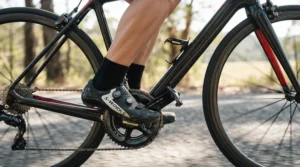
The Shimano PD-M540 is the PD-M520‘s more refined sibling. Its standout feature is all-metal construction with a sleek hex-only spindle. That combination invites years of use and easier home servicing.
Comparison testers put the weight gap between the two at only 25-28 grams, which vanishes against a heavy flywheel. The difference shows up in durability and repairability. BikeRadar’s review calls it the best-value SPD pedal Shimano makes and praises the wide availability of spares. Tension adjusts simply, and the pedal wipes clean fast, which helps when a sweaty session leaves salt on everything.
What most buyers overlook is that the extra cost buys longevity, not speed. If the bike gets ridden most days for years, the PD-M540 is a smart trade. If it’s an occasional companion, the cheaper model is plenty.
BikeRadar’s reviewer argued there’s little reason to pay for Shimano’s XT or XTR pedals over this one. Another comparison test found the PD-M540 and PD-M520 performed almost identically.
Pros:
- ✅ Excellent repairability and spare-part availability
- ✅ Same proven SPD mechanism as pricier Shimano models
- ✅ Simple, clear tension adjustment
Cons:
- ❌ Costs more than the near-identical PD-M520
- ❌ No sneaker-friendly platform side
Roughly $50-$75 at the time of research; prices vary, so check current listings. It’s the smartest “buy once” pick for SPD-only households.
3. Shimano PD-EH500 — SPD on one side, sneakers on the other
The Shimano PD-EH500 solves the shared-bike problem with one pedal. One face is a light-action SPD clip-in and the other is a grippy platform with threaded traction pins. Shimano describes it as designed with beginners in mind, and lists indoor cycling among its intended uses.
Reported weight lands around 376-383 grams per pair, nearly identical to the SPD-only PD-M520. So the dual function costs you almost nothing in mass. Shimano includes SM-SH56 multi-release cleats, which unclip in several directions. That matters for nervous first-timers, and it’s a thoughtful pairing.
Based on the specs, this is the most forgiving pedal in the roundup. You can warm up in athletic shoes, then clip in for the hard stuff. On Shimano’s own page, one owner who upgraded an indoor bike praised the easy engagement and the useful sneaker side for short warm-ups.
Complaints are consistent, though: the flat side tends to end up facing up when your foot leaves the pedal. Some riders also find the light binding too gentle for aggressive efforts.
Pros:
- ✅ Grippy flat side with traction pins for sneakers
- ✅ Beginner-friendly binding with SH56 cleats included
- ✅ Built on Shimano’s proven SPD mechanism
Cons:
- ❌ You must flip the pedal to find the clip side
- ❌ Light action may feel loose during sprints
Plan on roughly $50-$80 (check current price). It’s the best all-rounder for mixed-footwear households. Shimano’s product page has the official details.
4. Shimano XT PD-M8100 — widest, lightest Shimano platform here
The Shimano XT PD-M8100 is where “nice” becomes “premium.” Its standout is a broader shoe platform paired with a slim, mud-shedding body. Testers measured the platform around 59 x 43 mm and the weight around 340 grams per pair.
The binding gives 4 degrees of float and a 13-degree release angle, the same feel as the cheaper Shimano SPD pedals. Tension adjusts through 3mm hex bolts with detent clicks, so you can match left and right precisely. That last detail is genuinely useful for interval riders who care about symmetry.
Here’s where honest analysis matters. Indoors, the mud-shedding design earns you nothing, so you’re really paying for the extra contact area, the modest weight saving and a smoother spin. Among power transfer pedals in this list, it’s the one with the most platform under your foot. Yet as noted, one reviewer argued that value-minded riders needn’t step up from the PD-M540.
REI buyers were warm: one reported over 6,000 miles with no maintenance. A Shimano-page reviewer, however, said theirs began creaking after a couple of years and needed rebuilding.
Pros:
- ✅ Wider platform for a more stable feel
- ✅ Lighter than the budget Shimano models
- ✅ Precise, clicked tension settings
Cons:
- ❌ Priciest SPD-only option in this roundup
- ❌ Mud-shedding design offers no indoor advantage
Expect roughly $100-$150 (check current price). Worth it only if you’ll notice the platform and finish.
5. Wellgo WPD-E003 — SPD plus roomy toe cages, budget-friendly
The Wellgo WPD-E003 is a workhorse hybrid: SPD on one side, a generous toe cage on the other. That means the household can share one bike without swapping hardware.
It’s listed at around 770 grams per pair, which is heavy next to the Shimano SPD-only pedals. On a flywheel bike, though, that extra mass is barely felt. Tension is adjustable, and one reviewer reports SPD cleats included in the box.
Here’s what to weigh: the appeal is flexibility at a modest price, not refinement. Independent review coverage is thin, so I’m leaning on one detailed roundup. It noted the SPD tension felt stiff at first and loosened after a few rides. It also praised the cages as roomy and stable for casual riding, and mentioned a household getting four years of three-times-weekly use before a failure.
Treat that as one data point, not a guarantee. The main complaint was that removing the cages can be a fight with tight screws.
Pros:
- ✅ SPD clip-in and cage in one pedal
- ✅ Roomy cages fit varied shoe sizes
- ✅ SPD cleats reportedly included
Cons:
- ❌ Heavy at roughly 770 grams per pair
- ❌ Cages are hard to remove
Around $45-$70 (prices vary). A solid budget pick for families, provided you accept limited long-term evidence.
6. BV 2-in-1 SPD + Cage — simplest mixed-shoe fix
The BV 2-in-1 SPD + Cage aims squarely at shared bikes: clip in on one side, use the cage on the other. Its standout is simplicity, with an aluminum body and sealed bearings per the listing details.
The listed weight is around 730 grams per pair. Tension adjusts with a 3mm Allen key on the SPD side. Crucially, cleats are not included, so you either already own SPD shoes and cleats or must buy them separately. That’s the catch that trips up first-time buyers.
Based on the spec sheet, this is the pedal for a household where one person is committed to SPD and everyone else just wants to hop on. A single reviewer noted that most “won’t clip in” complaints trace to cleats mounted upside down or off-center rather than pedal faults. That’s a helpful reminder that setup, not hardware, causes many headaches. Packaging was described as basic shrink-wrap, which doesn’t affect performance.
Review depth is limited, so verify current customer feedback before buying.
Pros:
- ✅ Dual-purpose design for mixed footwear
- ✅ Adjustable clip-in tension
- ✅ Aluminum body with sealed bearings
Cons:
- ❌ Cleats are not included
- ❌ Heavy compared with SPD-only Shimano pedals
Roughly $40-$65 (check current price). Great value if you already own cleats.
7. Venzo 3-in-1 — SPD, Look Delta and cages in one
The Venzo 3-in-1 is the Swiss Army knife of the bunch. One face takes SPD cleats, the other takes Look Delta cleats, and removable cages handle sneakers. Listings vary between 3-in-1 and 4-in-1 bundles, so check whether a cage-removal tool comes in the box.
Listed weight is around 590 grams per pair, and tension reportedly adjusts on both cleat sides. That’s rare at this price, and it lets two riders with different cleat systems each tune their own feel. Because Look Delta is a three-bolt road-style standard, this matters if a partner’s shoes came from a road setup.
My honest take: it’s brilliant for the right household and wasteful for everyone else. One reviewer called the cages clunky and said the pedals squeaked until lubricated. The same reviewer reported good warranty support. Coverage is limited, so I’d treat these as informed impressions, not certainties.
Pros:
- ✅ Supports both SPD and Look Delta cleats
- ✅ Removable cages for sneaker riders
- ✅ Tension adjustable on both clip sides
Cons:
- ❌ Cages are fiddly to attach and remove
- ❌ Overkill if everyone uses the same shoes
Expect roughly $60-$95 (prices vary). Buy it only if you truly need all three modes.
| Pedal | Approx. Weight (Pair) | Interface | Cleats in Box | Best For |
|---|---|---|---|---|
| Shimano PD-M520 | ~372-380 g | SPD both sides | Usually (check listing) | Solo budget riders |
| Shimano PD-M540 | ~345-350 g | SPD both sides | Usually (check listing) | Daily riders, long life |
| Shimano PD-EH500 | ~376-383 g | SPD plus flat | SH56 included | Beginners, shared bikes |
| Shimano XT PD-M8100 | ~340-342 g | SPD both sides, wide | Yes (check cleat type) | Performance-minded riders |
| Wellgo WPD-E003 | ~770 g (listed) | SPD plus cage | Reportedly yes | Budget families |
| BV 2-in-1 SPD + Cage | ~730 g (listed) | SPD plus cage | No | Owners with cleats already |
| Venzo 3-in-1 | ~590 g (listed) | SPD, Delta, cages | Reportedly both types | Mixed cleat households |
I’ve left star ratings out because they shift daily; check current listings. The takeaway is that the Shimano trio without cages is about 200 grams lighter per pair than the cage hybrids. On a flywheel bike that’s academic, though. Choose by shoe situation first, then durability, and treat weight as a tiebreaker.
How to Install and Set Up Your Clip-In Pedals in 30 Minutes
This is the practical part Amazon listings skip. 🔧
- Check the thread. Nearly all spin bikes use 9/16-inch cranks, but confirm in your manual.
- Find the L and R marks. The left pedal is reverse-threaded, so it tightens counterclockwise. Cross-threading is the classic first-day mistake.
- Grease the threads lightly and hand-start each pedal before using a wrench. Depending on the model you may need a 15 mm pedal wrench or an 8 mm hex key, so check before you start.
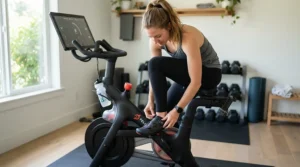
- Mount the cleats. Position the ball of your foot near the pedal spindle. Trace the old cleat position first if you’re replacing cleats, then follow a cleat setup guide from Cycling Weekly for float and rotation.
- Soften the tension before your first ride. You can firm it up later.
- Practice on a stationary bike. Clip in and out ten times per foot before you start pedaling.
For the first 30 days, expect a few awkward unclips. Most are caused by tension that’s too tight or cleats bolted on upside down. Wipe sweat off the pedals after rides, since salt is unkind to bearings and springs, and recheck cleat bolts weekly.
Real-World Scenarios: Which Pedal Fits Which Rider?
These are hypothetical profiles built from typical use cases, not real customers.
Scenario A: The garage grinder. Dana rides five mornings a week, owns SPD shoes and has about $100 to spend on the whole upgrade. The Shimano PD-M540 is the logical answer. It’s durable, serviceable and needs no cage.
Scenario B: The shared apartment bike. A couple and a teenager share one bike. Only one adult owns SPD shoes, and the others ride in sneakers. The Shimano PD-EH500 covers everyone with its beginner-friendly binding. If cash is tighter, the Wellgo WPD-E003 or BV 2-in-1 SPD + Cage do the same job cheaper, with a bit less refinement.
Scenario C: Two cleat systems under one roof. One partner clips into SPD, the other uses road-style Delta cleats. The Venzo 3-in-1 is the only pedal here that serves both without swapping.
For the performance-minded rider chasing interval numbers, the Shimano XT PD-M8100 offers the wider platform and the slight weight edge. Just be honest with yourself about whether you’ll feel the difference.
Problem → Solution Guide: When Clipping In Goes Wrong
Problem 1: You can’t clip in. Solution: check that the cleat isn’t upside down or badly off-center. Then loosen the pedal tension a notch.
Problem 2: You can’t get out. Solution: reduce tension, and consider multi-release SH56 cleats, which unclip in more directions than the SH51 single-release style.
Problem 3: Knee twinges. Solution: revisit cleat position and float. Guides note that too little float can stress the knee, while too much can cause inner-knee pain. Persistent pain is a cue to see a professional bike fitter.
Problem 4: Squeaks and creaks. Solution: clean and lightly lubricate the pedal body, and confirm the pedal is snug in the crank. One Venzo reviewer fixed a squeak this way. A creaking pedal that persists after years of use may just need a rebuild, as one Shimano XT PD-M8100 owner reported.
Problem 5: The flat side keeps facing up. Solution: that’s a known Shimano PD-EH500 quirk. Give the pedal a quick tap with your foot as you start; muscle memory fixes it in a week or so.
How to Choose SPD Pedals for Spin Bike Use
Follow these seven steps to narrow the field quickly:
- Confirm your thread size. Most indoor bikes take 9/16-inch pedals, but a two-minute manual check prevents a return.
- Decide who rides. Solo riders can go SPD-only; shared bikes benefit from platform or cage sides.
- Match your shoes. SPD is a two-bolt system. If your shoes have three bolts, you need a Delta or SPD-SL pedal, or a hybrid like the Venzo 3-in-1.
- Set your budget honestly. Include cleats and shoes if you don’t own them, because some pedals ship without cleats.
- Pick your release style. Beginners usually do better with multi-release cleats and a soft tension setting.
- Check what’s in the box. The BV 2-in-1 SPD + Cage ships without cleats, which changes the real cost.
- Weigh platform and weight last. They matter far less indoors than compatibility and comfort.
Clipless Pedals for Exercise Bike vs Toe Cages and Flat Pedals
Clipless pedals for exercise bike use connect you to the bike mechanically, so your foot can pull as well as push. Toe cages hold your foot loosely, and flat platforms just let you stand there. Each has a place, but they produce very different rides. The paradox is that the “clipless” name refers to old-school toe clips, not to a lack of clipping.
| Option | Foot Security | Off-Bike Ease | Learning Curve | Best For |
|---|---|---|---|---|
| SPD clip-in | High | Good (recessed cleat) | Moderate | Solo riders: Shimano PD-M540 |
| SPD plus platform | High on clip side | Excellent | Low | Shared bikes: Shimano PD-EH500 |
| Toe cages | Moderate | Excellent | Low | Casual riders: Wellgo WPD-E003 |
| Flat platform | Low | Excellent | None | Occasional warm-ups |
Looking at the table, dual-sided hybrids like the Shimano PD-EH500 deliver most of the clip-in benefit with almost none of the commitment. Full SPD-only pedals like the Shimano PD-M540 win on secure, quiet connection during hard efforts. Cages remain the cheapest way to share a bike, but they’re the least precise.
SPD vs SPD-SL and Delta: Professional Pedal Systems Explained
Professional pedal systems usually mean three-bolt road standards, such as Shimano SPD-SL and Look Delta or Keo. They use a larger, protruding cleat that spreads pressure across a bigger platform. BikeRadar’s SPD vs SPD-SL comparison covers the road-side trade-offs in detail. SPD-SL is offered with three float options: yellow at 6 degrees, blue at 2 degrees and red at 0 degrees.
The look Keo 2 Max, for example, has been described by BikeSize as having a 67 mm contact patch and multiple float options. That’s a serious platform for road riders.
So why bother with SPD indoors? Because walkability and forgiveness count for a lot at home. Recessed two-bolt cleats let you stroll across a hard floor, and the pedals tolerate imperfect setup. The trade-off is a smaller platform, so pressure concentrates under the cleat. If you’re comparing a Shimano XT PD-M8100 to a road pedal, the wider SPD platform closes some of that gap.
My analysis: if you already own road shoes and never walk in them, a Delta or SPD-SL pedal is perfectly reasonable. If your shoes are two-bolt, or you want walk-around comfort, SPD is the friendlier home for cycling cleats pedals.
Cycling Cleats Pedals: SH51 vs SH56 and Performance Cycling Cleats
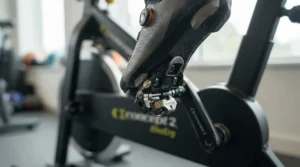
The pedal is half the system; the cleat is the other half. Shimano’s SH51 is a single-release cleat that unclips outward only, and it’s more secure once you’re used to it. The SH56 is a multi-release cleat that unclips outward, inward and upward, which is gentler for beginners. Both work with most standard SPD pedals.
In the Shimano SPD system, the binding provides about 4 degrees of float and a 13-degree release angle. Float is the free rotation you get while clipped in, and it’s the reason a well-set cleat shouldn’t fight your knee. Crankbrothers pedals also accept two-hole shoes, but they use their own cleat design with 6 degrees of float. So a two-hole shoe does not mean any pedal will work.
What counts as performance cycling cleats indoors? Usually lower float, firmer tension and a stable platform, not a magic material. Shimano cleats also have a reputation for long wear.
Practical advice: start with SH56 cleats and moderate float. Once unclipping is second nature, consider SH51 for a slightly more locked-in feel. The Shimano PD-EH500 ships with SH56, which is a sensible beginner default.
Power Transfer Pedals: Features That Actually Matter (And Those That Don’t)
Marketing loves the phrase power transfer pedals, but the physics indoors is refreshingly simple. Your legs drive a flywheel, and the pedal’s job is to hold your shoe steady so force goes where it should.
What matters:
- A secure, consistent connection. Any SPD pedal in good condition delivers this.
- Platform size. A wider platform, like the one on the Shimano XT PD-M8100, spreads load and feels steadier under hard efforts.
- Shoe sole stiffness. A stiff sole often matters more than the pedal, so a great pedal with a floppy shoe wastes the upgrade.
- Smooth bearings. Quiet, smooth pedals are noticeable in a quiet room.
What doesn’t matter much:
- Mud clearance. It’s irrelevant in your spare room.
- Small weight differences. A few dozen grams disappear against a heavy flywheel.
- Trail-oriented styling. Ignore it.
The best value power transfer pedals for most riders are the SPD-only Shimano models, since they give the same connection for a lot less money. The Shimano PD-M540 and Shimano XT PD-M8100 share the same core binding. The premium model mainly buys more platform and a lighter body.
Common Mistakes When Buying Clip-In Bike Pedals
Most regrets come from the same five errors.
- Assuming two-bolt shoes fit every pedal. SPD and Crankbrothers are different cleat designs, so match the system exactly.
- Forgetting cleats. The BV 2-in-1 SPD + Cage ships without them, so your real cost is higher than the sticker suggests.
- Overbuying for shared bikes. The Venzo 3-in-1 is brilliant, but only if you truly need three modes.
- Ignoring thread size. A quick manual check beats a return label.
- Starting with tension too tight. Loosen first; you can always tighten later.
Another mistake is skipping shoes. Sneakers on an SPD-only pedal is a recipe for slipping. Also don’t assume the cheapest option is the best long-term buy. The Shimano PD-M520 is superb value, but if you’ll ride daily for years, the Shimano PD-M540 may be the smarter spend.
Long-Term Cost & Maintenance
Let’s talk total cost of ownership. A pedal in the $50 range used three times a week for four years covers roughly 624 rides. That’s about eight cents per ride, which is hard to beat for anything that affects every single stroke.
Beyond the pedals, budget for shoes and cleats if you don’t own them. Cleats wear with walking, so replace them when engagement feels sloppy. Lubricate and check bolts occasionally, and wipe away sweat, since salt is hard on metal.
Serviceability affects long-term value too. The Shimano PD-M540 is all-metal and easier to service, while the Shimano PD-M520 reportedly needs a specialty tool. That’s a small point, but real if you plan to maintain the pedals yourself.
For the cage hybrids, the wildcard is durability evidence. The Wellgo WPD-E003, BV 2-in-1 SPD + Cage and Venzo 3-in-1 have less independent long-term coverage than the Shimano models. That doesn’t make them bad, but it does mean your risk is slightly higher.
Frequently Asked Questions
❓ Can I fit spd pedals for spin bike models like Peloton?
❓ Are dual-sided clip-in bike pedals better than SPD-only for a shared bike?
❓ Do I need special shoes for clipless pedals for exercise bike use?
❓ Which cycling cleats pedals combo is easiest for beginners?
❓ Are power transfer pedals worth the extra money on a spin bike?
Conclusion
Picking the right spd pedals for spin bike use comes down to one honest question: who rides, and in what shoes? Solo riders with SPD shoes should look at the Shimano PD-M520 for budget value or the Shimano PD-M540 for long-term durability. Shared households will love the flexibility of the Shimano PD-EH500, while the Wellgo WPD-E003 and BV 2-in-1 SPD + Cage offer cheaper cage-based alternatives. Mixed cleat homes have a natural answer in the Venzo 3-in-1. And if you’re chasing every last bit of platform stability among professional pedal systems, the Shimano XT PD-M8100 is the one to consider.
The bigger lesson is that setup beats hardware. Correct cleat position, sensible float, soft tension in week one and a quick 9/16-inch thread check will do more for your comfort than any premium badge. Buy the pedal that fits your shoes, your household and your patience, then enjoy the way a locked-in foot makes every interval feel a little smoother. 🚴♂️
Recommended for You
- Exercise Bike Pedals With Straps: 7 Proven Picks For 2026
- Ergonomic Exercise Bike Seat: 7 Best Picks For Back Pain 2026
- Bike Seat For Peloton: 7 Comfortable Saddle Upgrades In 2026
Disclaimer: This article contains affiliate links. As an Amazon Associate, I earn from qualifying purchases. If you purchase products through these links, we may earn a small commission at no additional cost to you.
✨ Found this helpful? Share it with your friends! 💬🤗
