
In This Article
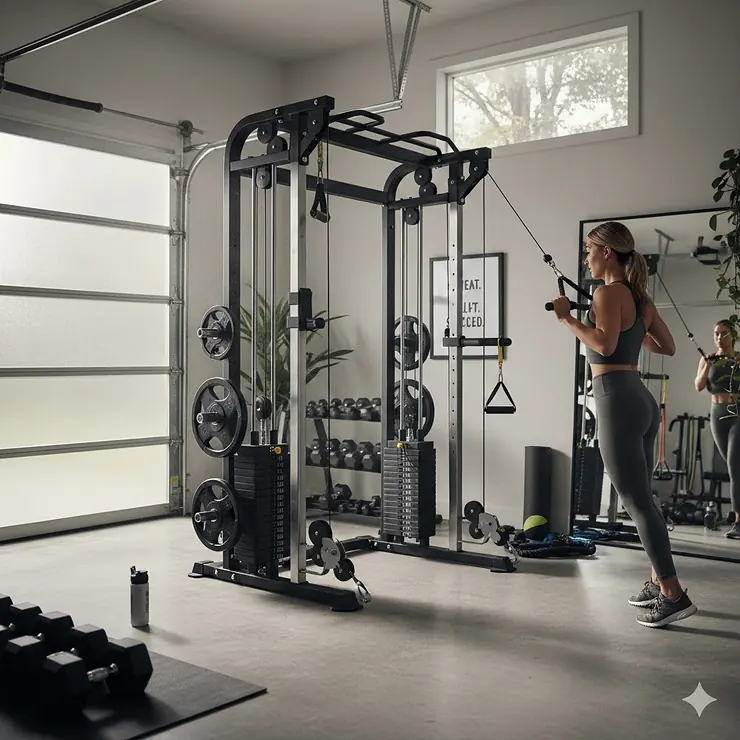
Ever walked into a commercial gym and felt a twinge of envy watching someone crush cable crossovers with perfect form? I get it. For years, I thought functional trainers were reserved for massive fitness facilities with unlimited budgets. But here’s the kicker—the home gym functional trainer market has exploded, and 2026 brings options that would make your local gym jealous.
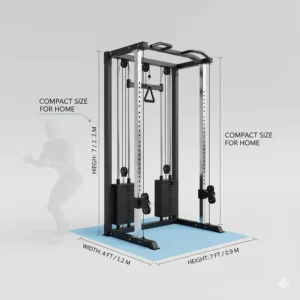
A functional trainer for home gym setups isn’t just another piece of equipment gathering dust in your garage. It’s a complete workout ecosystem that replaces dozens of machines. Research published by the National Institutes of Health demonstrates that functional training significantly improves muscular strength, power, balance, and agility across all fitness levels. Think about it: chest flies, lat pulldowns, cable curls, tricep extensions, and literally hundreds of exercises—all from one compact machine.
The beauty of these machines? They work with your body’s natural movement patterns rather than forcing you into rigid positions. Whether you’re rehabbing an injury, building muscle, or training for sport-specific performance, the versatility is unmatched.
Quick Comparison Table
| Product | Weight Stack | Price Range | Best For | Rating |
|---|---|---|---|---|
| XMARK Functional Trainer | Dual 230 lbs | $2,800-$3,000 | Serious lifters | ⭐⭐⭐⭐⭐ |
| REP Fitness Arcadia | 170-220 lbs (upgradable) | $2,000 | Compact spaces | ⭐⭐⭐⭐⭐ |
| Titan Fitness FT | Dual 200 lbs | $2,250-$2,500 | Commercial quality | ⭐⭐⭐⭐½ |
| Body-Solid GFT100 | Dual 160 lbs | $2,200-$2,600 | Lifetime warranty | ⭐⭐⭐⭐ |
| Centr 1 Home Gym | 160 lbs | $1,800-$2,000 | Beginners | ⭐⭐⭐⭐ |
| Major Fitness F22 | Plate-loaded | $929 | Budget buyers | ⭐⭐⭐⭐ |
| Bells of Steel FT | Dual 160 lbs | $2,000-$2,100 | Value seekers | ⭐⭐⭐⭐½ |
💬 Just one click – help others make better buying decisions too!😊
Top 7 Functional Trainer for Home Gym: Expert Analysis
1. XMARK Functional Trainer – Premium Powerhouse
If you’re serious about your gains, the XMARK Functional Trainer doesn’t mess around. This beast features dual 230-pound weight stacks—the heaviest on our list—with a 2:1 ratio that delivers 115 pounds of actual resistance per side.
Key Specifications:
- Extra-tall 90″ frame for maximum vertical cable movement
- 21 height adjustments for precise positioning
- Heavy-duty polypropylene and fiberglass pulleys for silent operation
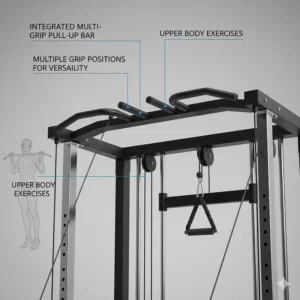
- Multi-grip pull-up station integrated
What sets this functional trainer home gym apart? The height. At 90 inches, taller users finally get the cable travel they need for full range-of-motion exercises. Customer feedback consistently praises the smooth, butter-like pulley system and rock-solid stability.
✅ Pros: Heaviest weight capacity, extra height, smooth pulleys, multi-grip pull-up bar
❌ Cons: Premium price point, requires significant ceiling height
Price Range: $2,800-$3,000 | Target User: Advanced lifters, tall athletes
2. REP Fitness Arcadia Functional Trainer – Best Compact Choice
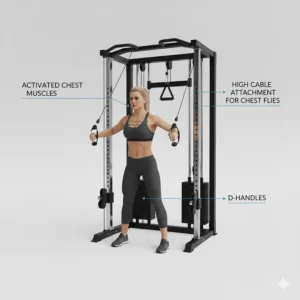
The REP Fitness Arcadia earned its reputation as possibly the best value functional trainer on the market, and for good reason. This Colorado-engineered machine packs commercial-grade features into a footprint that won’t dominate your garage.
Key Specifications:
- 32 cable positions with laser-cut numbering
- 170 lb weight stacks (upgradable to 220 lbs)
- Patent-pending trolley system with knurled handles
- Aluminum pulleys with 180-degree swivel
Garage Gym Reviews founder Coop Mitchell calls this “one of the smoothest functional trainers” he’s ever tested. The built-in pegboard storage keeps attachments organized, and the premium 5 lb add-on weights allow micro-adjustments that serious trainers demand.
✅ Pros: Butter-smooth operation, compact design, premium finishes, great value
❌ Cons: May be too short for users over 6’5″
Price Range: $2,000 | Target User: Home gym owners with limited space
3. Titan Fitness Functional Trainer – Commercial-Grade Beast
The Titan Fitness Functional Trainer brings commercial gym experience home with dual 200-pound weight stacks and over 1,000 adjustable positions. This home gym functional trainer doesn’t compromise on quality despite its competitive pricing.
Key Specifications:
- 82″ height with 64″ W x 44″ D footprint
- Dual 200 lb weight stacks with 2:1 ratio
- Includes 7 attachments: tricep rope, ankle strap, D-handles, bars
- Aluminum pulleys for smooth operation
Users rave about the included attachments—you’re not nickel-and-dimed for basic accessories. The wide 64-inch stance provides excellent stability without requiring floor bolting. Assembly takes about 90 minutes with two people.
✅ Pros: Complete attachment set, commercial quality, great customer service
❌ Cons: One-year warranty, some adjustment numbers unlabeled
Price Range: $2,250-$2,500 | Target User: Serious home gym builders
4. Body-Solid GFT100 Functional Trainer – Lifetime Warranty Winner
When you want equipment that outlasts your mortgage, Body-Solid delivers. The GFT100 comes with a lifetime in-home warranty that demonstrates their confidence in build quality.
Key Specifications:
- Heavy-duty 11-gauge 2″ x 3″ steel construction
- Dual 160 lb weight stacks (upgradable to 310 lbs)
- 1:2 stack-to-resistance ratio
- Fully-adjustable swiveling pulleys
The GFT100 weighs a substantial 632 pounds—this isn’t going anywhere once assembled. Optional weight stack shrouds add safety and aesthetics. According to a BMC Sports Science review, functional training equipment with proper construction significantly enhances athletic performance.
✅ Pros: Lifetime warranty, upgradable to 310 lbs, rock-solid construction
❌ Cons: Heavy (requires freight shipping), higher price tier
Price Range: $2,200-$2,600 | Target User: Long-term investors
5. Centr 1 Home Gym Functional Trainer – Beginner-Friendly Excellence
The Centr 1 proves you don’t need to break the bank for quality. This functional trainer for home gym delivers comprehensive strength training with a 160 lb weight stack and 165 exercise options.
Key Specifications:
- 33 vertical pulley positions
- 160 lb weight stack with smooth-glide system
- Industrial-grade steel with matte black finish
- Dimensions: 81.5″ H x 51″ W x 62″ L
What makes the Centr 1 special? Simplicity. The frictionless pulley system feels surprisingly smooth for the price point, and the low-profile design fits standard home ceilings comfortably. It’s perfect for those new to cable training who want room to grow.
✅ Pros: Affordable entry point, 165 exercise variations, compact footprint
❌ Cons: Lower weight capacity, fewer adjustment positions
Price Range: $1,800-$2,000 | Target User: Fitness beginners, smaller spaces
6. Major Fitness F22 All-in-One – Best Budget Option
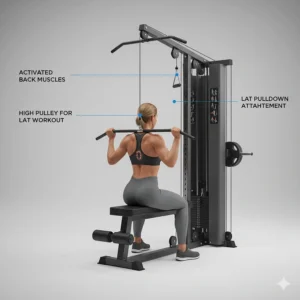
At under $1,000, the Major Fitness F22 seems too good to be true. But this plate-loaded power rack with functional trainer capabilities delivers shocking value for budget-conscious builders.
Key Specifications:
- 2″ x 3″ commercial-grade steel (14-gauge)
- 1,600 lbs weight capacity
- Plate-loaded dual pulley system (2:1 ratio)
- Includes: safety arms, J-hooks, landmine, dip bars, LAT bar
The F22 combines a squat rack and functional trainer in one compact unit. You’ll need Olympic plates, but if you’re building from scratch, this all-in-one approach saves massive space. Customer reviews highlight the surprising build quality for the price.
✅ Pros: Incredible value, all-in-one design, includes accessories
❌ Cons: Requires Olympic plates, lighter gauge steel
Price Range: $929 | Target User: Budget-conscious gym builders
7. Bells of Steel Functional Trainer – Value Champion
The Bells of Steel Functional Trainer earned its spot as a budget favorite without sacrificing quality. This Canadian company built a reputation for honest pricing and solid construction.
Key Specifications:
- Dual 160 lb weight stacks with 2:1 ratio
- 16 cable height positions
- 14-gauge steel rails with aluminum pulleys
- Unique multi-grip pull-up bar
The lowest starting weight makes this perfect for rehabilitation work or lighter training. The pull-up bar configuration is genuinely unique—you won’t find this grip variety elsewhere. Assembly requires patience (9 separate boxes), but the payoff is worth it.
✅ Pros: Under $2,000, unique pull-up bar, excellent customer service
❌ Cons: Thinner steel than premium models, attachments sold separately
Price Range: $2,000-$2,100 | Target User: Home gym enthusiasts seeking value
Understanding Functional Trainer Technology
What Makes a Quality Functional Trainer for Home Gym?
Not all cable machines are created equal. The difference between a commercial-grade functional trainer home gym and a flimsy wannabe comes down to engineering fundamentals.
Pulley System Quality: Aluminum pulleys outperform plastic alternatives in durability and smoothness. According to research from the National Strength and Conditioning Association, proper pulley mechanics reduce injury risk by allowing natural movement patterns.
Weight Stack Configuration: The 2:1 ratio (where 100 lbs feels like 50 lbs) allows smoother incremental progression. Some advanced trainers offer switchable ratios for different training styles.
Frame Construction: Look for at least 11-gauge steel in main uprights. Thicker walls (2″ x 3″ tubing) provide better stability under heavy loads.
Space Planning for Your Functional Trainer
Footprint vs. Function
Here’s the truth about home gym functional trainer dimensions: you need more space than you think. A typical functional trainer occupies 30-35 square feet of floor space, but you’ll want an additional 3-4 feet on all sides for movement.
Ceiling Height Considerations:
- Standard models: 82-85 inches (need 8′ ceilings minimum)
- Tall models (like XMARK): 90 inches (need 8.5′ ceilings)
- Compact options: 81 inches (fit most basements)
Pro tip: Measure with arms extended overhead while standing on the footplate. You’ll need that clearance for overhead exercises.
Weight Stack Selection Guide
How Much Weight Do You Actually Need?
This question plagues first-time buyers. The answer depends on your training goals and the pulley ratio.
Beginner-Intermediate (160-170 lbs stacks):
With a 2:1 ratio, this provides 80-85 lbs actual resistance. Perfect for most isolation work and beginners building strength progressively.
Advanced (200-230 lbs stacks):
Delivers 100-115 lbs actual resistance. Necessary for heavy lat work, cable presses, and advanced athletes. Consider upgradable systems if you’re between levels.
Plate-Loaded Alternative:
Budget-friendly but requires math and plate swapping. Ideal if you already own Olympic plates.
Essential Accessories and Attachments
Building Your Cable Arsenal
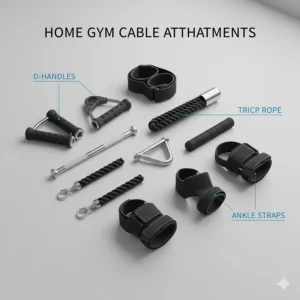
A functional trainer for home gym reaches its full potential with the right attachments. Here’s what matters:
Must-Have Basics:
- Straight bar (for lat pulldowns, tricep work)
- Rope attachment (triceps, face pulls)
- D-handles (single-arm movements)
- Ankle cuffs (leg work, kickbacks)
Advanced Additions:
- Multi-grip curl bar
- Tricep V-bar
- Lat pulldown bar with multiple grips
- Row bar
Quality matters here. Cheap attachments fail at connection points. Invest in solid carabiners and reinforced strap connections.
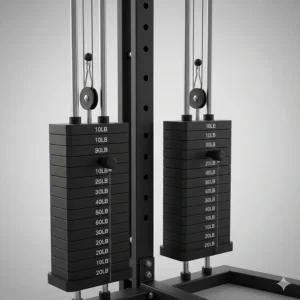
Comparison: Functional Trainers vs. Traditional Equipment
| Feature | Functional Trainer | Free Weights | Traditional Machines |
|---|---|---|---|
| Exercise Variety | 200+ movements | 50-100 movements | 1-3 movements |
| Space Efficiency | High | Medium | Low |
| Natural Movement | Excellent | Excellent | Limited |
| Learning Curve | Moderate | Steep | Easy |
| Injury Risk | Low | Medium-High | Low |
| Cost Per Exercise | Low | Medium | High |
Installation and Assembly Tips
Getting Your Functional Trainer Home Gym Up and Running
Most functional trainers arrive on freight pallets weighing 300-650 pounds. Here’s what you need to know:
Pre-Assembly Preparation:
- Clear a workspace double the machine’s footprint
- Gather tools: Allen keys, wrenches (usually included), level
- Have 2-3 people available for heavy lifting
- Budget 2-4 hours for assembly
Pro Assembly Tricks:
- Don’t fully tighten bolts until the entire frame is assembled
- Lubricate guide rods with included grease
- Check level on all four corners before final tightening
- Test pulley movement before adding weight stacks
Maintenance and Longevity
Keeping Your Investment Running Smooth
A properly maintained home gym functional trainer should last 15-20 years. Here’s how to ensure longevity:
Weekly Maintenance:
- Wipe down cables with dry cloth
- Check for frayed cables or unusual sounds
- Clean weight stack rails
Monthly Tasks:
- Lubricate pulleys and guide rods
- Inspect cable connections
- Tighten any loose bolts
Annual Deep Clean:
- Complete disassembly of pulley systems
- Replace worn cable components
- Deep clean weight stacks
Training Programs for Functional Trainers
Maximizing Your Machine’s Potential
Research published in BMC Public Health demonstrates that high-intensity functional training significantly improves strength, power, speed, and endurance. Here’s how to structure your workouts:
Push Day:
- Cable chest press (4 sets x 12 reps)
- Cable flies (3 sets x 15 reps)
- Overhead cable press (3 sets x 10 reps)
- Tricep pushdowns (3 sets x 15 reps)
Pull Day:
- Lat pulldowns (4 sets x 10 reps)
- Cable rows (4 sets x 12 reps)
- Face pulls (3 sets x 15 reps)
- Bicep curls (3 sets x 12 reps)
Leg Day:
- Cable squats (4 sets x 12 reps)
- Cable kickbacks (3 sets x 15 reps each leg)
- Cable leg curls (3 sets x 12 reps)
- Cable pull-throughs (3 sets x 15 reps)
Common Mistakes to Avoid
Don’t Make These Functional Trainer Errors
Mistake #1: Buying Based on Price Alone
The cheapest functional trainer for home gym often uses subpar pulleys and thin cables. You’ll spend more on replacements than you saved initially.
Mistake #2: Ignoring Ceiling Height
Measure twice, order once. Nothing’s worse than a $2,000 machine that doesn’t fit your space.
Mistake #3: Skipping Attachment Quality
Those free D-handles that come with budget machines? They’ll snap under heavy loads. Invest in quality attachments.
Mistake #4: Poor Cable Adjustment Technique
Always release tension before adjusting pulley height. Forcing adjustments under load damages the trolley system.
Smart Shopping Strategies
Getting the Best Deal on Your Functional Trainer
Timing Your Purchase:
- Black Friday/Cyber Monday: 20-30% off typical
- January (New Year fitness rush): 15-20% off
- End of fiscal quarters: Manufacturer incentives
Warranty Considerations:
Don’t overlook warranty length. A 5-year frame warranty beats a 1-year warranty even if the initial cost is 10% higher.
Financing Options:
Many manufacturers offer 0% APR for 12-18 months. Factor this into your budget calculations.
✨ Don’t Miss These Exclusive Deals!
🔍 Ready to transform your home gym? Check current pricing and availability on any highlighted functional trainer for home gym above. These premium machines represent the best value in cable training equipment for 2026. Your future self will thank you for investing in quality!
FAQs About Functional Trainers for Home Gyms
❓ How much space do I need for a functional trainer for home gym setup?
❓ What's the difference between a 2:1 and 1:1 pulley ratio on home gym functional trainer machines?
❓ Can a functional trainer home gym completely replace free weights?
❓ How often should I lubricate my functional trainer for home gym pulleys?
❓ Are plate-loaded or weight stack functional trainers better for home use?
Conclusion: Choosing Your Perfect Functional Trainer for Home Gym
After testing countless cable machines and analyzing hundreds of user reviews, one thing becomes crystal clear: the right functional trainer for home gym transforms not just your space, but your entire approach to training.
Whether you’re going premium with the XMARK’s industry-leading 230 lb weight stacks, choosing the space-saving brilliance of the REP Arcadia, or maximizing value with the Major Fitness F22, there’s a perfect match for your goals and budget. The home gym functional trainer market has matured beautifully in 2026, delivering commercial-quality options at accessible price points.
Remember, you’re not just buying equipment—you’re investing in versatility that replaces dozens of machines, convenience that eliminates gym commutes, and functionality backed by solid scientific research. The National Institutes of Health confirms what users already know: functional training delivers measurable improvements across all fitness domains.
Start with our comparison table, identify your must-have features, and pull the trigger on the functional trainer that matches your ceiling height, budget, and training style. Your future gains are waiting.
Recommended for You
- 7 Best Compact Home Gym Equipment That Save Space (2026)
- Best Multi Station Home Gym 2026: Top 7 Picks That Actually Work
- 7 Best All In One Home Gym 2026 – Ultimate Buyer’s Guide
Disclaimer: This article contains affiliate links. If you purchase products through these links, we may earn a small commission at no additional cost to you.
✨ Found this helpful? Share it with your friends! 💬🤗
