
In This Article
Picture this: You’re trying to build powerful legs at home, but bodyweight squats aren’t cutting it anymore, and setting up a barbell squat rack feels like an engineering project. Sound familiar?
That’s exactly where a leg press for home gym comes in—offering the muscle-building intensity of commercial equipment without the complexity or danger of free-weight squats. After testing dozens of machines and analyzing thousands of user experiences, I’ve discovered that the right leg press machine home gym can transform your lower body training.
What makes a leg press home gym essential? According to research published in the International Journal of Environmental Research, the vastus lateralis and vastus medialis muscles show the greatest activation during leg press exercises, making it one of the most effective tools for quadriceps development. Unlike squats, leg presses provide stable support that eliminates lower back stress while still delivering serious gains.
In this comprehensive guide, you’ll discover the 7 best home gym leg press options for 2026, from budget-friendly compact models to commercial-grade powerhouses. Whether you’re a beginner looking for safe strength building or an experienced lifter wanting progressive overload, I’ve got you covered.
Quick Comparison Table: Top 7 Leg Press Machines at a Glance
| Product | Type | Weight Capacity | Price Range | Best For |
|---|---|---|---|---|
| Body-Solid GCLP100 | Compact Seated | 1,000 lbs | $1,100-$1,195 | Space-conscious buyers |
| Mikolo LP05 | 45-Degree Press | 11 gauge steel | $600-$800 | Budget seekers |
| RitFit BLP01 | 2-in-1 Combo | 1,200 lbs | $650-$1,000 | Versatility lovers |
| GMWD DD07 Arete | Pro Series Combo | 1,250 lbs | $850-$1,100 | Advanced lifters |
| Powertec P-LP19 | Professional Press | 1,000 lbs | $1,349-$1,799 | Quality enthusiasts |
| Mikolo Band Peg Combo | Advanced Combo | 450 lbs/side | $700-$900 | Athletic training |
| Powertec Compact Sled | Compact Sled | 1,000 lbs | $999-$1,259 | Smooth operation fans |
✨ Just one click – help others make better buying decisions too!😊
Top 7 Leg Press for Home Gym: Expert Analysis
1. Body-Solid GCLP100 Compact Leg Press
If floor space is precious in your home gym, the Body-Solid GCLP100 might be your perfect match. At just 47.2″ wide and 67.1″ deep, this machine proves that compact doesn’t mean compromised.
Key Specifications:
- Weight capacity: 1,000 lbs
- Dimensions: 47.2″W x 67.1″D
- Features: Linear ball bearings, dual weight horns, adjustable backrest
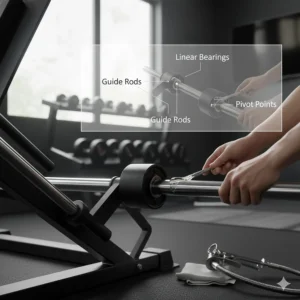
The GCLP100 glides on sealed linear ball bearings with case-hardened chrome-plated guide rods, delivering smoothness that rivals machines twice its price. Users consistently praise how the 11-gauge steel construction feels rock-solid even under heavy loads.
Customer Feedback: One verified buyer shared, “Assembly was challenging but the machine is absolutely amazing once complete. The dual leg bars eliminate the wobble common in competitors’ single-bar designs.”
✅ Pros:
- Space-efficient footprint perfect for garages
- Commercial-grade linear bearing system
- Lifetime warranty on frame
❌ Cons:
- Complex assembly process
- No hack squat functionality
Price: $1,100-$1,195
2. Mikolo LP05 45-Degree Leg Press Machine
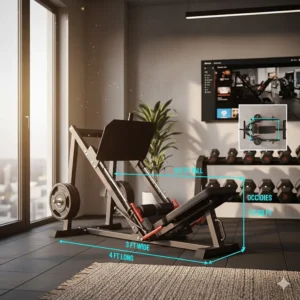
The Mikolo LP05 breaks the mold by offering 20% less space than traditional leg presses while maintaining full functionality. This 45-degree angle machine targets quadriceps with surgical precision.
Key Specifications:
- Construction: 11-gauge precision-welded steel frame
- Footprint: Takes 20% less space than standard models
- Backrest: 4-position adjustable
What sets this apart is the heavy-duty high-tensile steel paired with high-density foam padding. The 45-degree angle reduces joint stress while maximizing quad activation—perfect for athletes with developed hamstrings looking to strengthen quads.
Customer Feedback: Multiple reviews highlight the small footprint that “fits perfectly in space without affecting workout quality at all.”
✅ Pros:
- Exceptional space savings
- Superior build quality for the price
- Accommodates various user heights
❌ Cons:
- Only 8-month frame warranty
- Limited to leg press only
Price: $600-$800
3. RitFit BLP01 2-in-1 Leg Press and Hack Squat Machine
Value meets versatility in the RitFit BLP01, which has become one of the most popular home gym leg press machines for good reason. The ability to switch between leg press and hack squat in seconds doubles your training options.
Key Specifications:
- Weight capacity: 1,200 lbs
- Construction: 14-gauge steel (main areas)
- Features: 5 adjustable footplate angles, linear bearings
The BLP01 uses linear bearings instead of rolling bearings, creating ultra-smooth motion without jerk. The thick leather cushions wrapped in anti-slip material provide lasting comfort during extended sets.
Customer Feedback: A detailed user review noted, “The machine feels very reliable, solid, and stable—quite heavy duty for home gym equipment. I’m confident loading it up.”
✅ Pros:
- Incredibly affordable at $650-$1,000
- Quick mode switching mechanism
- Suitable for users 5’32” to 6’39”
❌ Cons:
- Dynamic weight capacity around 560 lbs (less than static)
- May need back pad extender for deep squatters
Price: $650-$1,000
4. GMWD DD07 Arete Leg Press Hack Squat Combo
The GMWD DD07 Arete represents 5 years of refinement in home leg press design. This commercial-grade machine features an industry-first 5 weight-loading posts for superior stability.
Key Specifications:
- Load capacity: 1,250 lbs
- Frame weight: 297 lbs for stability
- Footprint: 81″ x 34″
The Arete innovates with dual-position loading pins—higher for lighter days, lower for heavy training. This thoughtful design lets you load plates at chest level, protecting your back from awkward bending. The removable seat pad enables ATG (Ass To Grass) squats impossible on fixed-pad competitors.
Customer Feedback: A satisfied owner raved, “Build quality is outstanding. The transition between hack squat and leg press is extremely simple. My entire gym is turning into a GMWD showroom.”
✅ Pros:
- First and only 5-post design
- Accommodates 4’10” to 6’5″ users
- Band pegs for variable resistance
❌ Cons:
- Larger footprint than compact models
- Higher price point
Price: $850-$1,100
5. Powertec P-LP19 Leg Press
When quality trumps budget, the Powertec P-LP19 delivers professional-grade performance. This machine has earned cult status among serious home gym owners for its revolutionary carriage system.
Key Specifications:
- Weight capacity: 1,000 lbs
- Weight: 258 lbs
- Features: Roller system with bearing-driven nylon wheels
The P-LP19’s high-tensile strength carriage rides on nylon-reinforced wheels with sealed bearings, creating the smoothest motion in its class. Four stainless steel weight horns accommodate serious loading, while commercial-grade padding ensures comfort during marathon leg sessions.
Customer Feedback: One user detailed, “This has the quality of a commercial gym leg press. With proper assembly, this equipment is awesome and I recommend it to anyone looking for commercial quality.”
✅ Pros:
- Commercial-quality construction
- Exceptionally smooth operation
- Dual safety catches on each side
❌ Cons:
- Complex assembly with limited visual aids
- Higher investment required
Price: $1,349-$1,799
6. Mikolo Leg Press Hack Squat Machine Combo with Band Pegs
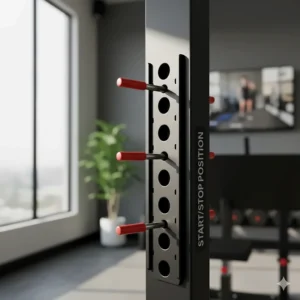
For athletes seeking explosive power development, the Mikolo Band Peg Combo stands alone. The rear and front band pegs add variable resistance that ramps tension at lockout.
Key Specifications:
- Weight horn capacity: 450 lbs per side
- Special feature: Upgraded 16mm magnetic locking pin
- Band pegs: Front and rear for progressive resistance
This machine pairs traditional plates with resistance bands to fine-tune the strength curve. The linear bearings deliver steady movement under combined loads, while the ladder-style footplate adjustment beats traditional pop-pins for faster setup.
Customer Feedback: Athletes appreciate how bands “add variable resistance which ramps tension at the top of the rep—great for exploding through lockout.”
✅ Pros:
- Unique band peg integration
- Triple-adjustable footplate
- Ideal for speed and strength work
❌ Cons:
- Requires understanding of band training
- Shipped in multiple boxes
Price: $700-$900
7. Powertec Compact Leg Sled
The Powertec Compact Leg Sled redefines what “compact” means with its specially designed carriage driven by ultra-low resistance nylon wheels. This is smoothness personified.
Key Specifications:
- Weight capacity: 1,000 lbs
- Features: 8-wheel carriage system
- Design: Adjustable angle footplate
Eight nylon bearing wheels hug solid steel guide rods, preventing lateral movement and providing precise motion from top to bottom. The seat and adjustable back pad lock you into perfect position, eliminating lower back stress completely.
Customer Feedback: Users consistently note the “incredibly smooth and quiet ride” compared to other compact models.
✅ Pros:
- Smoothest compact sled available
- Allows full calf raises
- Precise motion control
❌ Cons:
- Higher price for compact size
- Limited to leg press function
Price: $999-$1,259
✨ Don’t Miss These Exclusive Deals!
🔍 Take your leg training to the next level with these carefully selected products. Click on any highlighted item to check current pricing and availability. These machines will help you create authentic strength gains your training partners will notice!
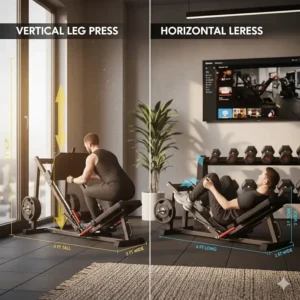
Understanding Leg Press Machine Types for Home Gyms
Choosing the right leg press for home gym use starts with understanding the main types available. Each design offers unique advantages depending on your space, budget, and training goals.
45-Degree Leg Press Machines
The most popular choice for home gym leg press setups, 45-degree models position you at an angle that balances effectiveness with comfort. This angle reduces spinal compression while maintaining excellent quad activation.
These machines typically feature a sled that travels along angled rails. The biomechanics closely mimic the squat pattern, making them excellent for building functional strength. Most 45-degree presses support 1,000+ pounds, giving you room to grow.
Seated Horizontal Leg Presses
Compact seated models like the Body-Solid GCLP100 save precious floor space by positioning you horizontally. While the footprint shrinks, the training effectiveness doesn’t—you’ll still hit quads, glutes, and hamstrings hard.
These work especially well in garage gyms where ceiling height or square footage limits your options. The trade-off? You’ll typically sacrifice some loading capacity and range of motion compared to 45-degree models.
Leg Press Hack Squat Combos
The ultimate versatility comes from 2-in-1 or 3-in-1 combos that switch between leg press, hack squat, and sometimes calf raises. These maximize your equipment investment by replacing multiple machines.
Modern combos like the RitFit BLP01 and GMWD Arete feature quick-change mechanisms that let you swap exercises in seconds. Perfect for home gyms where every square foot counts.
Vertical Leg Presses
Though less common in home setups, vertical presses position you lying flat while pressing weight straight up. These excel at isolating quads with minimal equipment footprint.
The challenge? Loading and unloading plates above your body requires careful safety protocols. Most home gym enthusiasts prefer angled or seated options for this reason.
Key Features to Consider When Buying a Leg Press Home Gym
Weight Capacity and Structural Integrity
Don’t just look at maximum weight capacity—understand static versus dynamic ratings. The RitFit BLP01, for example, lists 1,200 lbs static but around 560 lbs dynamic capacity for safety.
Frame construction matters enormously. Look for 11-gauge steel or thicker in high-stress areas. Machines like the Mikolo LP05 use precision-welded 11-gauge steel that handles serious loads without flexing.
Bearing Systems: Linear vs. Rolling
Linear bearing systems deliver superior smoothness compared to traditional rolling bearings. The GMWD and RitFit models specifically tout linear bearings for ultra-smooth, quiet motion.
Why does this matter? Smooth bearings mean consistent resistance throughout the movement, better muscle activation, and longer machine life. The difference becomes obvious once you load 400+ pounds.
Adjustability for Different Body Types
Your leg press machine home gym should accommodate various users. Look for multiple backrest positions (4-5 settings minimum) and adjustable footplate angles.
The GMWD Arete excels here, fitting users from 4’10” to 6’5″ thanks to extended guide rod travel. The RitFit BLP01 offers 5 footplate angles for customized ergonomics.
Safety Features That Matter
Premium machines include multiple safety mechanisms:
- Dual-sided stopper rails with 3-5 lockout positions
- Adjustable safety limiters for different exercises
- Non-slip footplates (diamond-plated preferred)
- Secure locking mechanisms
Never compromise on safety features. The peace of mind they provide enables you to push harder during training.
Footprint and Space Requirements
Measure your available space carefully before buying. Compact models like the Body-Solid GCLP100 (47.2″ x 67.1″) fit where full-size machines won’t.
The Mikolo LP05 saves 20% space compared to traditional designs—a game-changer for garage gyms. Conversely, the GMWD Arete’s 81″ x 34″ footprint requires dedicated space.
Leg Press vs. Squat: Making the Right Choice for Your Goals
Muscle Activation Patterns
Studies show that the vastus lateralis and vastus medialis quadriceps muscles demonstrate the greatest activation during leg press exercises. However, squats engage more stabilizer muscles and core musculature.
For pure quadriceps hypertrophy, leg presses excel. For overall athletic development, squats take the edge. The smart approach? Incorporate both in your program.
Safety and Lower Back Considerations
Leg presses shine for those with lower back concerns. The supported position eliminates spinal compression while still delivering intense leg stimulation. This makes them ideal for injury recovery or joint-friendly training.
According to Healthline’s research comparing the exercises, leg presses work the same muscle groups as squats but from different angles, suggesting that balancing workouts with both exercises may be the best approach.
Progressive Overload Potential
Loading a leg press for home gym use proves easier and safer than adding plates to a barbell. You can micro-load in smaller increments and bail safely if needed.
An 8-week study found that both squat and leg press groups achieved significant maximum strength gains, proving that progressive overload works effectively with machine-based training. BarBend’s analysis further notes that leg press training can improve squat performance since the quadriceps strength built carries over to heavy squats.
Transfer to Athletic Performance
Here’s where it gets interesting. Research published in PubMed demonstrates that leg press training improves balance recovery, vertical jump height, bodyweight squat performance, and short-distance sprinting ability—dispelling the myth that machine training doesn’t transfer to real-world performance.
The key? Progressive loading with good form creates adaptations that enhance overall lower body function.
Setting Up Your Home Gym Leg Press for Maximum Results
Proper Positioning Fundamentals
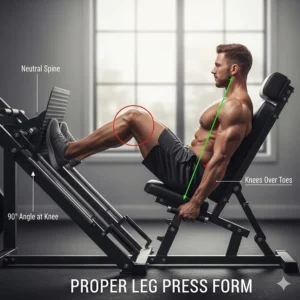
Start by adjusting the backrest so your hips align properly with the sled path. Your lower back should maintain contact with the pad throughout the movement—no arching or lifting.
Foot placement dramatically affects muscle emphasis. Mid-platform with shoulder-width stance targets quads evenly. Higher placement shifts emphasis to glutes and hamstrings. Lower placement intensifies quad activation.
Optimal Range of Motion
Full range of motion means lowering until your knees approach 90 degrees (or slightly beyond if flexibility allows). The GMWD Arete’s removable seat pad enables ATG squats for maximum range.
Recent research investigating knee flexion range of motion during leg press exercises found that different ROM protocols can effectively stimulate quadriceps hypertrophy, though deeper ranges generally produce superior results.
Progressive Programming Strategies
Start with 3 sets of 8-12 reps using moderate weight. Focus on controlled eccentric (lowering) phases of 3-4 seconds. This builds strength and muscle while protecting joints.
As strength increases, vary your rep ranges:
- Heavy days: 4-6 reps for strength
- Moderate days: 8-12 reps for hypertrophy
- Light days: 15-20 reps for endurance
Common Mistakes to Avoid
Locking knees at the top: Keep a slight bend to maintain tension and protect knee joints.
Incomplete range: Partial reps limit muscle development. Lower until knees reach 90 degrees minimum.
Bouncing at the bottom: This creates dangerous joint stress. Control the descent and pause briefly.
Letting knees cave inward: Track knees over toes throughout the movement to prevent injury.
Maintenance and Longevity Tips for Your Leg Press Machine
Regular Cleaning and Lubrication
Wipe down all padding and touchpoints after each session using gym equipment cleaner. Sweat and oils degrade vinyl over time if left untreated.
Lubricate linear bearings or roller systems every 3-6 months with silicone-based lubricant. The Powertec models’ sealed bearings require minimal maintenance, but occasional lubrication extends bearing life significantly.
Bolt Tightening and Inspection Schedule
Check all bolts and connections monthly, especially during the first six months. The vibration from heavy loading can loosen fasteners over time.
Pay special attention to weight horn connections and safety mechanism attachments. A loose safety catch could prove dangerous during heavy sets.
Pad and Upholstery Care
Quality machines like the GMWD Arete feature premium leather cushions that resist wear. Treat these with leather conditioner quarterly to prevent cracking.
Replace worn pads promptly. Compromised padding reduces comfort and can affect form during training.
Warranty Coverage Worth Knowing
Premium brands offer substantial warranties:
- Body-Solid: Lifetime frame warranty
- RitFit: 3-year frame, 1-year bearings
- GMWD: Lifetime frame on Pro series
- Powertec: Check specific model warranties
Keep purchase receipts and register products to activate full warranty protection.
Budget Breakdown: Investing in Quality vs. Saving Money
Entry-Level Options ($600-$800)
The Mikolo LP05 represents the sweet spot for budget-conscious buyers. At $600-$800, you get 11-gauge steel construction and solid performance without breaking the bank.
Trade-offs include shorter warranties and fewer adjustment options. But for beginners building strength, these machines deliver excellent value.
Mid-Range Champions ($850-$1,200)
This category offers the best balance of features, quality, and price. The RitFit BLP01 ($650-$1,000) and GMWD Arete ($850-$1,100) both provide commercial-grade construction with versatile 2-in-1 functionality.
You’ll get linear bearing systems, robust safety features, and capacities exceeding 1,200 lbs—everything needed for years of productive training.
Premium Investments ($1,300-$1,800)
Powertec’s professional models justify their premium pricing through superior engineering and lifetime durability. The P-LP19 ($1,349-$1,799) delivers commercial gym quality in your home.
If you’re serious about leg training and plan to use the machine for decades, premium options provide the smoothest operation and longest lifespan.
Cost Per Workout Analysis
Consider the long-term value. A $1,000 leg press used 3 times weekly for 10 years equals roughly $0.64 per workout. Gym memberships cost $30-$100 monthly, making home equipment remarkably cost-effective.
Quality machines appreciate in value through consistent use. Budget models may require replacement within 3-5 years of heavy use.
Space-Saving Strategies for Home Gym Leg Press Installations
Measuring Your Available Space
Before ordering, measure height (including ceiling clearance), width, and depth. Add 2 feet on all sides for comfortable loading and movement.
Don’t forget to measure doorways and staircases if assembling in a basement or second floor. The Body-Solid GCLP100 ships in manageable pieces, but some machines arrive partially assembled.
Compact Models That Deliver
The Powertec Compact Leg Sled proves you don’t need massive footprints for effective training. Its clever design compresses the sled mechanism while maintaining full functionality.
Similarly, the Mikolo LP05 saves 20% space through innovative engineering. Perfect for garages where every square foot matters.
Multi-Function Machines Worth Considering
Combo machines like the RitFit BLP01 replace both a leg press and hack squat machine. This doubles your training options while occupying the footprint of a single machine.
The GMWD Arete adds calf raise functionality, making it a complete lower body station. Three machines in one dramatically improves space efficiency.
Vertical Storage Solutions
When not in use, some compact leg presses can be tilted vertically against a wall (check manufacturer specifications first). This frees up floor space for other exercises.
Consider installing wall-mounted plate storage near your leg press. The GMWD and RitFit models include built-in plate holders, but additional wall storage keeps your gym organized.
Advanced Training Techniques for Home Gym Leg Press
Tempo Training for Maximum Hypertrophy
Manipulate time under tension by controlling rep speed. Try 4-second eccentric (lowering), 1-second pause, 2-second concentric (pressing) for brutal quad stimulation.
Research shows that the quadriceps muscles display different activation patterns throughout the movement, with the vastus lateralis and medialis showing peak activation during the concentric phase.
Pause Reps and Isometric Holds
Add 2-3 second pauses at the bottom position to eliminate momentum and maximize time under tension. This technique intensifies muscle recruitment dramatically.
Isometric holds at various points in the range challenge muscles differently than standard reps, creating unique growth stimuli.
Band-Resisted Variations
Machines like the Mikolo Band Peg Combo enable advanced variable resistance training. Bands add accommodating resistance that increases as you extend—perfect for developing explosive power.
This mimics the force-velocity relationship in sprinting and jumping, making it valuable for athletes.
Unilateral Training Benefits
Single-leg presses eliminate strength imbalances between legs. They also allow greater range of motion by removing the limitation of the weaker leg.
Start with 60% of your bilateral load and work up gradually. Unilateral training significantly improves balance and coordination.
Comparison: Leg Press Machine Benefits vs. Traditional Squats
| Aspect | Leg Press for Home Gym | Barbell Squats |
|---|---|---|
| Lower Back Stress | Minimal (supported) | Moderate to high |
| Learning Curve | Beginner-friendly | Requires coaching |
| Loading Capacity | Easy to add/remove | Awkward at heavy weights |
| Muscle Activation | High quad focus | Full-body engagement |
| Injury Risk | Lower | Higher if form breaks |
| Space Required | Machine footprint | Squat rack + clearance |
| Investment Cost | $600-$1,800 | $300-$1,500 |
Top Accessories to Enhance Your Leg Press Training
Resistance Bands and Chains
Add accommodating resistance using bands or chains. Attach to the frame and sled for variable loading that challenges muscles differently.
The Mikolo Band Peg Combo includes dedicated attachment points, but you can retrofit other models with carabiners and D-rings.
Olympic Weight Plates
Invest in quality bumper plates or iron plates depending on your machine’s specifications. Most leg presses accommodate 2″ Olympic plates.
Consider fractional plates (1.25 lb, 2.5 lb) for micro-loading. Small jumps enable consistent progressive overload without overwhelming jumps.
Workout Tracking Apps
Use apps like Strong, Fitbod, or JEFIT to log workouts. Tracking weight, reps, and sets over time reveals progress and identifies plateaus.
Many home gym owners photograph their plate loading for consistency across sessions—a simple but effective tracking method.
Foam Roller and Mobility Tools
Leg press training creates serious quad soreness. Keep a foam roller nearby for post-workout recovery and mobility work.
Massage guns provide targeted relief for tight quads and calves after heavy leg sessions.
FAQ: Your Leg Press for Home Gym Questions Answered
❓ How much weight can I leg press as a beginner?
❓ What's the difference between 45-degree and horizontal leg presses?
❓ Can a leg press machine home gym replace squats entirely?
❓ How often should I train on my home gym leg press?
❓ What safety features should I prioritize in a leg press for home gym?
Conclusion: Choosing Your Perfect Leg Press for Home Gym
After analyzing dozens of machines and thousands of user experiences, one truth emerges: the best leg press for home gym use depends entirely on your unique situation.
If space is your primary constraint, the Body-Solid GCLP100 or Powertec Compact Leg Sled deliver professional quality in minimal footprints. Budget-conscious builders will love the Mikolo LP05’s exceptional value proposition.
For versatility seekers, the RitFit BLP01 and GMWD Arete provide 2-in-1 functionality that replaces multiple machines. Athletes focused on explosive power should seriously consider the Mikolo Band Peg Combo’s unique variable resistance capabilities.
Remember that any leg press machine home gym beats no equipment at all. Progressive overload with consistent training produces results regardless of which model you choose. The key lies in selecting a machine you’ll actually use consistently.
Start by measuring your available space, setting a realistic budget, and identifying your primary training goals. Then match those requirements to the machines reviewed here. You’ll build powerful legs that turn heads and crush performance goals.
Your home gym leg press journey starts now. Choose wisely, train hard, and watch your lower body transform.
Recommended for You
- 7 Best Calisthenics Home Gym Setups That Transform Your Body (2026)
- 7 Best Functional Trainer for Home Gym 2026 (Expert Tested)
- 7 Best Compact Home Gym Equipment That Save Space (2026)
Disclaimer: This article contains affiliate links. If you purchase products through these links, we may earn a small commission at no additional cost to you.
✨ Found this helpful? Share it with your friends! 💬🤗
