
In This Article
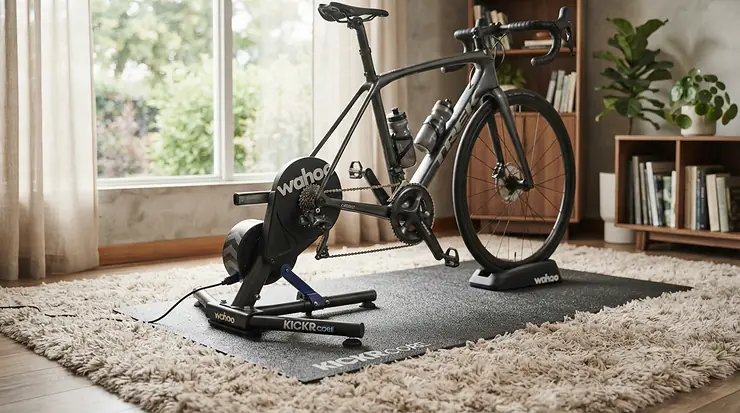
A bike mat for carpet is a dense, wipe-clean layer that sits under a stationary bike or trainer. It keeps sweat, dents, and vibration away from your carpet and pad. The good ones also steady the machine, so it doesn’t rock as the pile compresses underneath.
Carpet is the quiet villain of the home gym. Hardwood owners worry about scratches. Carpet owners get sneakier problems: a salty ring that soaks into the padding, two permanent dents where the trainer feet sat, and a bike that wobbles like a café table with one short leg. A mat fixes all three, but only if you pick the right kind.
That’s where most buying guides go wrong. They treat every floor the same. Cycling instructors quoted by Livestrong suggest a mat should cover at least six feet by two feet, and that the right thickness depends on your floor. On carpet, that second point is the whole game.
This guide covers seven real mats from CyclingDeal, Cycleclub, Peloton, Wahoo, Garmin Tacx, Saris, and Kinetic. It also covers how bike mat hardwood floors setups differ, how to work out the best floor type for bike mat use, and how to match material to surface. Prices are shown as ranges because they move constantly. Review notes are aggregated from retailer pages and rider forums as of October 2026. Nothing here is hands-on testing, and where reviews couldn’t be verified, we say so.
Quick Comparison: 7 Bike Mats for Carpet at a Glance
| Product | Thickness | Size | Price Range | Best For |
|---|---|---|---|---|
| CyclingDeal Bike Trainer Floor Mat | About 3 mm (high-density) or 6-7 mm (soft) | Multiple, including 30″ x 60″ and 30″ x 72″ | Budget, roughly $50-$80 | Best all-round value; high-density suits carpet |
| Cycleclub Exercise Bike Mat | 6 mm | 48″ x 24″ up to 84″ x 36″ | Budget, roughly $45-$75 | Size flexibility on low-pile carpet |
| Peloton Bike Mat | 4 mm | 72″ x 36″ | Mid, $70-$80 range | Peloton owners who want a stable base |
| Wahoo KICKR Trainer Mat | 6 mm | 78″ x 36″ | Mid, $70-$90 range | Smart trainer setups needing a grippy surface |
| Garmin Tacx Rollable Trainer Mat | 6 mm | About 71″ x 36″ | Mid, $75-$85 range | Shared living spaces that need quick storage |
| Saris Trainer Mat | About 4 mm (kit listing) | About 63-65″ x 36″ | Mid, $70-$90 range | Compact, dense, US-made protection |
| Kinetic Trainer Mat | About 1/4″ (reviewer-reported) | 78″ x 36″ | Mid, roughly $50-$80 | Fluid trainer users wanting noise damping |
Looking at the table, the CyclingDeal Bike Trainer Floor Mat gives you the widest choice of density and size for the least money. The thinner, denser options like the Peloton Bike Mat make more sense on carpet, because a squishy mat on squishy carpet is a recipe for wobble. If you plan to move the setup often, the Garmin Tacx Rollable Trainer Mat and the Kinetic Trainer Mat roll away without a crease line fighting you.
💬 Just one click — help others make better buying decisions too!😊
Top 7 Bike Mat for Carpet Picks: Expert Analysis
1. CyclingDeal Bike Trainer Floor Mat — widest choice of density and size
The standout here is options. CyclingDeal sells a soft version, listed around 6-7 mm, and a high-density version of roughly 3 mm, in several sizes including 30″ x 60″ and 30″ x 72″.
That split matters on carpet. A thick, soft mat stacked on soft pile creates a double cushion, which is exactly what makes a bike rock. The high-density version stays firmer and is the one roundups recommend for carpeted floors. The soft one is more comfortable under cleats and better at damping noise. Based on the spec comparison, carpet owners should lean high-density, while anyone riding over a hard subfloor under thin carpet can enjoy the softer feel.
Several roundups name this mat their best overall for value. We couldn’t verify individual customer reviews directly, so treat that as editorial consensus rather than owner feedback. The trade-off to know: the high-density version is thinner, so it absorbs less vibration and noise than thicker mats.
Pros:
- ✅ Two density options for different floors
- ✅ Many sizes, including long 72-inch versions
- ✅ Waterproof surface blocks sweat from carpet
Cons:
- ❌ High-density version damps noise less
- ❌ Soft version may compress on thick carpet
Pricing sits in the budget range, roughly $50-$80 depending on size, so check current price. For most carpet owners, it’s the best starting point.

2. Cycleclub Exercise Bike Mat — flexible sizing for tight spaces
Cycleclub wins on fit. The 6 mm PVC mat comes in sizes from 48″ x 24″ up to 84″ x 36″, so you can match the mat to a small apartment corner or a full trainer-plus-fan setup.
Six millimeters is a middle path. It’s thick enough to catch sweat and take the edge off vibration, but not so plush that it turns into a mattress. One roundup rates it for hardwood, tile, laminate, and low-pile carpet, and adds a useful warning: on high-pile carpet, slide a thin sheet of plywood underneath so the bike doesn’t rock as the carpet compresses. That tip applies to nearly every mat in this guide.
We couldn’t verify detailed owner reviews, so this entry rests on specs and one roundup’s guidance. Treat the plywood advice as practical, not guaranteed.
Pros:
- ✅ Sizes from compact to full-length
- ✅ Works across several floor types
- ✅ Waterproof 6 mm PVC surface
Cons:
- ❌ High-pile carpet needs a plywood base
- ❌ Limited verified owner feedback
Expect a budget-range price, around $45-$75 depending on size, so check current price. It’s a smart pick when space is the constraint.
3. Peloton Bike Mat — firm, sized for Peloton Bike and Bike+
Peloton designed this one around its own bikes, and it shows. The 72″ x 36″ mat is 4 mm of high-density material with a nonslip backing, and Peloton says you can trim it to fit.
For carpet, the 4 mm thickness is the point. A firmer, thinner mat resists compressing, so it helps stop the rocking owners otherwise report on soft floors. Peloton also notes that the mat helps keep dust and carpet fibers out of the bike’s moving parts. That’s a legitimate carpet-specific benefit, since carpet sheds lint.
Reviewers on retailer pages describe it as easy to clean and good at staying flat, with the right size for a Peloton Bike and tread. One reviewer said the material felt lighter than expected for the brand. A tester at Bustle also called it nice but pricier than rivals, and preferred a thicker alternative overall.
Pros:
- ✅ Firm 4 mm density resists carpet compression
- ✅ Nonslip backing keeps it planted
- ✅ Trimmable to fit your space
Cons:
- ❌ Costs more than similar generic mats
- ❌ Thinner, so less noise damping
List pricing falls in the $70-$80 range, so check current price. It’s a fair choice if you own a Peloton, and merely fine otherwise.
4. Wahoo KICKR Trainer Mat — grippy surface for smart trainers
If your trainer is the heavy, expensive kind, the Wahoo KICKR Trainer Mat is the safe, grown-up pick. It measures 78″ x 36″, is 6 mm thick, and is made from phthalate-free PVC, with beveled edges that sit flatter against the floor and cut down on curling and tripping.
The anti-slip texture is the feature that matters most. Smart trainers walk when you sprint, and a grippy top keeps the legs planted. At about 3.3 kg, the mat has enough heft not to drift across carpet.
Owner feedback is mostly positive. Reviewers describe it as durable, odor-free out of the box, and easy to wipe clean, and some say it stopped their trainer drifting. The complaints are real, though. A rider on a Zwift forum reported bunching on slick tile, one reviewer noted it’s stiff to roll up, and a TrainerRoad poster said cleats eventually tore holes in theirs.
Pros:
- ✅ Anti-slip texture holds trainer legs steady
- ✅ Beveled edges lie flat and cut tripping
- ✅ Odor-free reports out of the box
Cons:
- ❌ Stiff, awkward to roll for storage
- ❌ Cleats can eventually damage the surface
Expect a mid-range price, around $70-$90, so check current price. It’s a strong carpet performer for heavy smart trainers.
5. Garmin Tacx Rollable Trainer Mat — rolls up fast for shared rooms
The hook is in the name. The Garmin Tacx Rollable Trainer Mat rolls rather than folds, so there’s no crease line running through the middle, and it deploys in seconds.
The 6 mm high-density foam measures about 71″ x 36″. That’s a good footprint for a trainer plus bike, and it’s described as water-repellent and noise-reducing. It’s a sensible choice if the training spot is also your living room, because you can tuck it away when guests arrive.
Here’s an honest gap: the retailer pages we checked showed no written customer reviews, though one European retailer lists a review count without displaying the content. So there’s no verified owner sentiment to report. What we can say is that the specs look well matched to carpet: firm foam, moderate thickness, and a stable base.
Pros:
- ✅ Rolls flat without a crease line
- ✅ 6 mm foam balances comfort and firmness
- ✅ Good coverage for trainer plus bike
Cons:
- ❌ Written owner reviews are hard to find
- ❌ Priced above generic budget mats
Pricing sits in the $75-$85 range, so check current price. It’s a good pick for shared spaces, though the review gap is worth knowing about.
6. Saris Trainer Mat — dense, compact, and made in the USA
The Saris Trainer Mat is the small, solid option. It’s PVC foam, listed at roughly 63-65″ x 36″, and one Saris kit listing gives the mat 4 mm thickness and a Made in USA label.
That thinner, denser build fits carpet logic. It won’t squash down and rock, and reviewers on Saris’s own pages repeatedly say it protects carpet and floors, keeps the trainer from walking, and feels denser than a yoga mat. One reviewer wished it were thicker, based on what they’d read in the description. A retailer listing showed a high average rating from a modest review pool, though much of that content was posted on Saris’s own site, so weigh it accordingly.
The smaller footprint is the catch. Measure first, because there’s little spare room around a trainer and a front wheel block.
Pros:
- ✅ Dense build resists carpet compression
- ✅ Reviewers praise floor protection
- ✅ Made in USA per listing
Cons:
- ❌ Smaller footprint leaves little margin
- ❌ Some reviewers expected more thickness
Typical pricing is in the $70-$90 range, so check current price. It’s a solid fit for compact setups on carpet.
7. Kinetic Trainer Mat — quiet closed-cell foam for fluid trainers
Quiet is the selling point. The Kinetic Trainer Mat uses closed-cell PVC foam, measures 78″ x 36″, and rolls up for storage.
Closed-cell foam doesn’t soak up sweat, which is useful over carpet where wicking is the enemy. Reviewers describe it as thick enough to absorb vibration, well sized for a trainer and bike, and easy to clean. Several note that trainer indentations in the mat fade within about half an hour, or after a repositioning every few weeks.
The caveats: more than one reviewer warned about cleats, and one buyer who expected something thicker than roughly 1/4 inch planned to return it. One reviewer also noted that the noise still comes from the fluid unit itself, not the floor.
Pros:
- ✅ Closed-cell foam resists sweat soak-through
- ✅ Dents in the mat recover over time
- ✅ Rolls up for easy storage
Cons:
- ❌ Cleats can wear the surface
- ❌ Not thick enough for some buyers
Pricing runs roughly $50-$80, so check current price. It’s a practical choice for fluid trainers on carpet.
How to Choose a Bike Mat for Carpet
Choosing well comes down to six decisions. Here’s the order that avoids regret.
- Measure your footprint first. Add trainer feet, rear wheel, front wheel block, and a little spare room. Instructors cited by Livestrong suggest at least 72″ x 24″ as a baseline.
- Match thickness to pile height. Low-pile carpet tolerates 4-6 mm. High-pile calls for a firmer base or a plywood sheet, or the whole stack compresses unevenly.
- Prioritize density over cushion. A softer mat feels nicer for about a week. A denser one keeps your bike level for years.
- Check the underside grip. Carpet fibers can let a smooth mat creep, so look for a nonslip backing or texture.
- Confirm the surface wipes clean. Closed-cell or waterproof tops keep sweat out of the padding.
- Plan storage. If you’ll roll it up daily, weigh the stiff mats against the rollable ones.
A mat that scores well on 1, 3, and 5 will outperform a fancier one that ignores them. And if you’re unsure between two, the denser one is the safer bet on carpet.

Bike Mat Hardwood Floors: What Changes When the Carpet Goes Away
Moving from carpet to hardwood flips your priorities. On bike mat hardwood floors setups, the enemy isn’t compression. It’s scratches, sliding, and trapped moisture, so a softer, thicker mat earns its keep and a grippy underside becomes non-negotiable. A product like the CyclingDeal Bike Trainer Floor Mat in its soft version shines here, and the 6 mm Wahoo KICKR Trainer Mat and Garmin Tacx Rollable Trainer Mat are natural fits for bike mat hardwood floors use.
Best Floor Type for Bike Mat Setups
If we’re ranking the best floor type for bike mat use, concrete or a low-pile carpet over a firm subfloor comes out on top, because both give a stable base. A forum rider pairing a Wahoo setup with a concrete floor reported it worked well, and reviewers of the Kinetic Trainer Mat say the noise reduction is most noticeable on concrete garages. Hardwood is next, with moderate risk from sweat and scratches. Tile is slippery, and high-pile carpet is the hardest of all, because it moves under load.
Flooring Compatibility Checklist
Run through this before you buy. Is the floor firm or springy underneath? Does the backing grip it? Will sweat reach the padding? The Carpet and Rug Institute notes that heavy equipment can leave indentations, and recommends spreading the weight rather than concentrating it. A wide mat does exactly that. Good flooring compatibility means the mat spreads load, grips the surface, and keeps moisture out.
Material Selection Guide: PVC, Foam, or Rubber?
This material selection guide boils down to three families, and each behaves differently on carpet.
PVC mats dominate the list above. Most CyclingDeal, Cycleclub, Peloton, Wahoo, and Saris mats are PVC or PVC foam. They’re waterproof, light, and affordable. Look for phthalate-free labeling, as the Wahoo KICKR Trainer Mat states.
Closed-cell foam is what the Kinetic Trainer Mat and Garmin Tacx Rollable Trainer Mat lean on. It resists sweat soak-through and rolls flat, but it can dent under heavy feet and recover slowly.
Rubber is the heavy option. Forum riders use gym mats, stall mats, and interlocking garage tiles, which are dense and stay put but are heavy and can smell. One roundup from Cyclists Hub argues that it barely matters which mat you buy as long as it’s big enough, thick enough, and made from quality PVC.
On carpet, I’d prioritize density first, then waterproofing, then softness. In this material selection guide, that ordering rarely steers you wrong.
Protective Bike Mat Comparison: Surface-Specific Protection at a Glance
This protective bike mat comparison shows how the same mats behave on different floors. Surface-specific protection is about matching the failure mode to the fix.
| Surface | Main Risk | Best Match | Why |
|---|---|---|---|
| Low-pile carpet | Sweat in padding, dents | CyclingDeal Bike Trainer Floor Mat (high-density) or Peloton Bike Mat | Firm, resists compression |
| High-pile carpet | Rocking, uneven load | Cycleclub Exercise Bike Mat plus plywood | Plywood spreads load and stabilizes |
| Hardwood | Scratches, slipping | Wahoo KICKR Trainer Mat or Garmin Tacx Rollable Trainer Mat | Grippy, thicker, cushions feet |
| Tile or concrete | Sliding, noise | Kinetic Trainer Mat or Saris Trainer Mat | Dense and noise-damping |
The pattern is clear. Carpet rewards firm and dense, while hard floors reward grippy and cushioned. The Peloton Bike Mat and the high-density CyclingDeal are the strongest picks for low-pile carpet, and the 6 mm options handle hardwood and concrete best. In short, the best surface-specific protection comes from matching density to the floor, not buying the thickest mat you can find.
Bike Mat vs Alternatives: Do You Really Need One?
Riders do improvise. Forum threads mention yoga mats, interlocking garage tiles, horse stall mats, and car-carpet tiles with a towel on top. Some of these work. Many don’t.
| Option | Pros | Cons | Best For |
|---|---|---|---|
| Yoga mat | Cheap, already owned | Often too narrow, thin, slides | Light use only |
| Garage floor tiles | Dense, modular, wipeable | Heavy, fiddly to level | Permanent spots |
| Stall mat | Very dense, durable | Heavy, may smell | Garage or basement |
| Dedicated CyclingDeal Bike Trainer Floor Mat or similar | Right size, waterproof | Costs more than a yoga mat | Most carpet owners |
A yoga mat can protect against a damp patch, but one forum rider noted theirs was too narrow to cover the trainer’s feet, leaving bare metal on the floor. For carpet, a purpose-built mat in a bike-shaped size beats improvisation for most people. Dense garage tiles or a stall mat are the exception, if you have a permanent spot and a strong back.
Common Mistakes When Buying a Bike Mat for Carpet
Buying the thickest mat available. Thick feels premium, but on carpet it stacks softness on softness. A forum rider on thick carpet struggled to get a trainer level and eventually considered plywood and rubber. Density beats thickness.
Ignoring size. A mat that covers only the trainer leaves the wheel block on bare carpet. Measure the whole footprint.
Skipping the underside grip. A smooth-backed mat can creep on carpet, and riders on slick floors report bunching.
Forgetting cleats. Multiple reviewers warn that cleats damage softer mats, including the Kinetic Trainer Mat, and one Wahoo owner described cleat tears after about three years. Step on and off carefully, or add a small shoe-friendly patch.
Leaving the setup untouched for months. Even with a mat, long-term pressure in one place compounds. Shift the position occasionally.
Long-Term Cost & Maintenance
The cheapest mat isn’t always the cheapest. A budget mat around $50 that cracks in two years costs more per year than a $75 mat that lasts five. Cleat wear, edge curling, and surface degradation are the usual failure points.
Maintenance is easy. The Wahoo KICKR Trainer Mat retailer guidance suggests wiping with a damp, soapy cloth and letting it dry fully before rolling it up. The Peloton Bike Mat suggests occasional wipes. Skip harsh solvents, since they can dull or stiffen PVC.
Total cost of ownership also includes what the mat prevents. A deep sweat stain or a crushed pile patch can mean professional cleaning or even carpet repair. Compared to that, a mat in the $50-$90 range is cheap insurance. Replace it when the surface cracks, curls permanently, or loses grip.
Practical Usage Guide: Setting Up Your Bike Mat on Carpet
A good setup takes ten minutes and saves months of annoyance.
Step 1: Vacuum first. Grit under a mat grinds into carpet fibers and into the mat itself.
Step 2: Let it relax. Mats that arrive rolled often curl. Lay it flat for a day, or weigh the corners down. Reviewers of the Kinetic Trainer Mat note it took a couple of days to fully relax.
Step 3: Add a base for high-pile carpet. A thin plywood sheet underneath, as one roundup suggests for the Cycleclub Exercise Bike Mat, spreads weight and stops rocking.
Step 4: Position for airflow. Keep a towel handy. One Kinetic reviewer mentioned that a large towel on top solved sweat problems entirely.
Step 5: Check level. Press on each corner of your bike or trainer. If it rocks, the carpet is compressing unevenly.
Step 6: Move it monthly. Shift the setup a few inches every few weeks so dents can recover, a tactic multiple Kinetic reviewers describe.
Common first-30-day mistakes: dragging the bike across the mat (it creates bunching), skipping the wipe-down, and leaving cleats to scuff the surface.
Real-World Scenarios: Which Bike Mat Fits Your Life
The apartment renter on thin, low-pile carpet. Budget matters and the deposit is on the line. A high-density CyclingDeal Bike Trainer Floor Mat keeps the pile firm and the deposit safe. Ride three or four times a week, and wipe it after each session.
The Peloton owner with a bedroom carpet. The bike is heavy and rocks easily, so the Peloton Bike Mat gives a firm, correctly sized base. It also keeps carpet fibers out of the bike’s mechanics, per Peloton’s own description.
The smart trainer rider in a shared living room. Daily setup and teardown means storage matters. The Garmin Tacx Rollable Trainer Mat or the Kinetic Trainer Mat rolls up quickly, and the Wahoo KICKR Trainer Mat suits heavy smart trainers if you can live with the stiffness.
The cold-weather commuter with a basement. On concrete or thin carpet over concrete, the Saris Trainer Mat and the Kinetic Trainer Mat deliver the noise damping and stability that matter most. Winter riding means long sessions, so choose a mat that wipes clean fast.
Problem → Solution Guide: Fixing Common Carpet Headaches
Problem: the bike rocks. Carpet is compressing unevenly. Switch to a denser mat, or add plywood underneath. Forum riders also suggest dense gym mats under the trainer legs.
Problem: the mat bunches or creeps. Pull it flat, check the underside grip, and consider a mat with a nonslip backing like the Peloton Bike Mat. One Wahoo forum rider reported bunching on tile.
Problem: dents in the carpet. Dents are reversible if caught early. Sources note that dents from short-term loads often recover, and that grooming with a carpet rake helps. Move the setup regularly.
Problem: sweat smell. Closed-cell or waterproof surfaces help. Wipe after every session and let the mat air-dry before rolling.
Problem: cleat damage. Mount and dismount carefully, or add a small hard patch where your feet land. Several reviewers across brands flag this.
Safety and Air Quality: What to Know About New PVC Mats
New PVC mats can smell. That’s off-gassing, the release of volatile organic compounds from new materials. A Polish study of 29 PVC floor coverings found emissions dropped sharply after about nine days and stayed very low afterward. That suggests an unrolled new mat should settle within a couple of weeks, though the study tested floorings, not trainer mats specifically.
Practical steps: unroll the mat in a ventilated room for a few days before use, look for phthalate-free labeling like the Wahoo KICKR Trainer Mat states, and choose products from brands that describe their material clearly. If a strong chemical smell persists, consider returning it. Third-party certifications, like FloorScore or GREENGUARD, are worth looking for when a manufacturer lists them.
FAQ
❓ What thickness works best for a bike mat on carpet?
❓ Can a bike mat damage carpet?
❓ Do I need a bike mat if my trainer has rubber feet?
❓ Is a bike mat for carpet different from a treadmill mat?
❓ How often should I replace my bike mat?
Conclusion
The best bike mat for carpet isn’t the thickest or the fanciest. It’s the one that stays firm, covers your whole footprint, and wipes clean. For most carpet owners, a high-density CyclingDeal Bike Trainer Floor Mat or the Peloton Bike Mat delivers that balance. The Cycleclub Exercise Bike Mat works well when size flexibility matters, and the Wahoo KICKR Trainer Mat suits heavy smart trainers. The Garmin Tacx Rollable Trainer Mat and the Kinetic Trainer Mat make life easier when storage matters, and the Saris Trainer Mat fits compact, dense setups.
Think of the mat as a small tax on your training that saves a big bill on your floor. Match density to your carpet, plan for plywood on high pile, check the grip, and move the setup now and then. Do that, and your carpet will look the same in a year as it does today. Check current prices before you buy, and pick the one that fits your space and your ride.
✨ Ready to protect your floors?
🚴♂️ Check current prices on your favorite pick above and give your carpet the shield it deserves!
Recommended for You
- Noise Reduction Bike Mat: 7 Best Picks For Quiet Rides In 2026
- Heavy Duty Bike Mat: 7 Best Picks For 2026
- Exercise Bike Mat: 7 Proven Picks That Protect Floors (2026)
Disclaimer: This article contains affiliate links. As an Amazon Associate, I earn from qualifying purchases. If you purchase products through these links, we may earn a small commission at no additional cost to you.
✨ Found this helpful? Share it with your friends! 💬🤗
