
In This Article
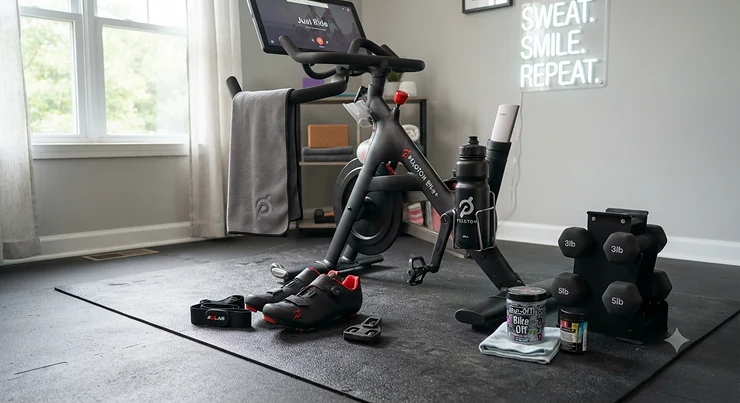
peloton accessories must have lists tend to read like a shopping cart dump — a pile of product names with no reasoning behind any of them. That’s not what you’re getting here. A Peloton accessory, broadly speaking, is any add-on that improves comfort, safety, or performance beyond what ships in the box: think cleats, floor protection, resistance tools, or biometric tracking. Some of these are genuinely non-negotiable. Others are nice-to-haves dressed up as essentials. After digging through real product specs, verified retailer listings, and aggregated review sentiment across shoes, mats, weights, and heart rate monitors, I put together a list of seven products that actually earn a spot in your setup, with honest analysis of who should buy what and why.
If you’re newer to the bike, essential peloton accessories usually fall into four buckets: footwear that clips in properly, a mat that protects your floor and stabilizes the frame, weights for strength segments, and a way to track your heart rate without guessing. The seven picks below cover all four buckets, and I’ve broken down the trade-offs so you’re not just buying whatever ranks first on a random Amazon search. Whether you’re outfitting a brand-new Bike+ or finally replacing gear that’s three years overdue, this guide walks through real peloton bike accessories with actual specs, not marketing fluff. The current physical activity guidelines for adults call for at least 150 minutes of moderate-intensity activity a week, and the right gear is what makes hitting that number sustainable instead of a chore. Let’s get into the peloton gear recommendations that are worth your money.
Quick Comparison Table: Peloton Accessories at a Glance
| Accessory | Category | Price Range | Best For |
|---|---|---|---|
| Peloton Cycling Shoes | Shoes | $70–$125 range | Plug-and-play Delta compatibility |
| Shimano RC1 Indoor Cycling Shoes | Shoes | Under $100 | Budget-conscious riders |
| TrubliFit Replacement Delta Cleats | Cleats | $20–$30 range | Upgrading worn stock cleats |
| Peloton Bike Mat | Mat | $70–$90 range | Exact-fit floor protection |
| CyclingDeal Trainer Protection Mat | Mat | $40–$60 range | Larger floor coverage on a budget |
| Peloton Dumbbells | Weights | $25–$70 range per pair | Bootcamp and arms classes |
| Polar H10 Heart Rate Monitor | Heart Rate Monitor | Around $90 | Accuracy-focused riders |
Looking at the table, the split isn’t really budget-vs-premium in the way most gear roundups frame it — it’s plug-and-play versus assemble-it-yourself. The Peloton Cycling Shoes and Peloton Bike Mat cost more because they’re built to the bike’s exact dimensions and cleat pattern, while the Shimano RC1 and CyclingDeal Trainer Protection Mat trade a little convenience for real savings. If you’re outfitting your bike for the first time, start with the mat and shoes; the Polar H10 and Peloton Dumbbells can wait until you know which class formats you’ll actually ride regularly.
💬 Just one click — help others make better buying decisions too!😊
Top 7 Peloton Accessories Must Have: Expert Analysis
1. Peloton Cycling Shoes — easiest plug-and-play fit for your bike
The Peloton Cycling Shoes ship with Delta-compatible cleats already sized for the brand’s own pedals, which means zero guesswork on install day. Peloton’s Look Delta pedal system is a three-bolt design, and the shoe’s ratchet clip plus hook-and-loop straps let you dial in fit without needing a bike shop visit. That matters more than it sounds — the Look Delta system is a widely used three-bolt cleat design valued for its stiffness and efficient power transfer, so buying the shoe built around it removes a common source of first-week frustration.
Sizing runs true to your everyday shoe, narrow to normal fit, and the mesh vents on the sole help with breathability during 45-plus minute rides. Based on the spec comparison against third-party alternatives, this is the pick for anyone who wants one box to open and zero cleat-matching math. Reviewers consistently note that returns are common among people who size down instead of sizing up, so trust the true-to-size guidance rather than your instinct to go snug.
Pros:
- ✅ Cleats pre-matched to Peloton’s own pedal system
- ✅ Adjustable ratchet clip plus hook-and-loop straps
- ✅ Breathable mesh vents reduce mid-ride discomfort
Cons:
- ❌ Costs more than third-party Delta-compatible alternatives
- ❌ Narrow-to-normal fit runs tight for wide feet
Price sits in the $70–$125 range depending on retailer promotions, and given the zero-assembly convenience, it’s a fair value for anyone who doesn’t want to think about cleat compatibility twice.
2. Shimano RC1 Indoor Cycling Shoes — best budget shoe under $100
The Shimano RC1 trades a little bit of polish for a genuinely lower price point, and it still clips into Delta-compatible pedals without issue once you add cleats. These shoes are lightweight, built with a synthetic leather upper and mesh texture for a comfortable fit, and use three durable hook-and-loop straps across the top for easy wear and removal. That combination of light weight and secure strapping is exactly what most riders actually need — nothing fancy, just a stable connection to the pedal.
What most buyers overlook about this model is that the cleats aren’t included, so factor that into your total cost before comparing it head-to-head with the Peloton Cycling Shoes. Aggregated review sentiment points to strong comfort and breathability scores, with the main gripe being the extra purchase step for cleats. For a rider who just wants a reliable clip-in shoe without brand markup, this is hard to beat.
Pros:
- ✅ Lightweight synthetic leather with breathable mesh panels
- ✅ Three secure hook-and-loop straps for a stable fit
- ✅ Noticeably lower price than brand-name alternatives
Cons:
- ❌ Cleats sold separately, adding to total cost
- ❌ Fewer color and width options than pricier competitors
Expect to pay under $100 for the shoe itself, plus a small additional cost for cleats — still one of the more affordable ways into a proper clip-in setup.
3. TrubliFit Replacement Delta Cleats — smoothest upgrade for stock pedals
Cleats wear out long before shoes do, and the TrubliFit Replacement Delta Cleats are built specifically to restore that crisp clip-in feel once your stock set starts slipping. Crafted with a 9-degree float, these cleats offer a comfortable range of motion that reduces stress on your joints while providing a smoother pedaling experience, and the upgraded Allen key bolts resist stripping far better than the Phillips-head hardware many stock cleats ship with.
Here’s what to weigh: a worn cleat doesn’t just feel loose, it can genuinely affect your form by letting your foot rock mid-pedal-stroke, which over months can contribute to knee strain. Reviewers who installed these note the float feels noticeably smoother within the first few rides compared to degraded factory cleats. If your bike is more than a year or two old and you haven’t touched the cleats, this is one of the cheaper, higher-impact upgrades on this list.
Pros:
- ✅ 9-degree float reduces joint stress during pedaling
- ✅ Allen key hardware resists stripping over time
- ✅ Straightforward install with included wrench and instructions
Cons:
- ❌ Requires basic tool comfort for a clean install
- ❌ Not compatible with SPD or Keo pedal systems
Priced in the $20–$30 range, replacing cleats this way costs a fraction of buying entirely new shoes just because the old cleats wore down.
4. Peloton Bike Mat — exact-fit protection with zero guesswork
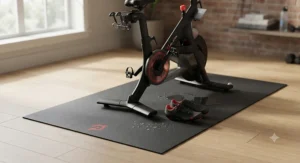
The Peloton Bike Mat is sized specifically for the Bike and Bike+, so there’s no measuring or trimming involved — it’s a 72-by-36-inch mat cut to match the bike’s footprint. It’s made with high-density material that prevents the bike from leaving scuff marks and protects floors during sweaty workouts, and it helps prolong the life of the bike by blocking dust and carpet fibers from entering mechanical parts. That dust-blocking detail is easy to dismiss until you’ve had a bike’s resistance mechanism start grinding from carpet fiber buildup.
On carpet especially, the added stability keeps the frame from rocking during standing climbs, which matters more than most first-time buyers expect. Reviewers consistently note the mat’s grip and easy-clean surface, though a handful mention the price feels steep for a rubber mat — a fair critique if you’re comparing it strictly on material cost rather than fit precision.
Pros:
- ✅ Exact 72×36-inch fit for Bike and Bike+ frames
- ✅ Blocks dust and carpet fibers from mechanical parts
- ✅ Sweat and salt resistant surface wipes clean easily
Cons:
- ❌ Premium price relative to generic PVC mats
- ❌ Limited to one size, no small-space option
Expect a price in the $70–$90 range, which is the “pay for exact fit” tax — reasonable if precision matters to you, less so if you just want floor protection.
5. CyclingDeal Trainer Protection Mat — most coverage for the money
If you want a bigger footprint for less money, the CyclingDeal Trainer Protection Mat covers considerably more floor space than the official option, at 30 by 72 inches with a thicker 6mm PVC build. That extra coverage means room for off-bike floor work — planks, stretches, arm segments — without stepping off the mat entirely, which the standard-size Peloton Bike Mat doesn’t really allow for.
Based on the spec comparison, the thicker 6mm profile does more to dampen vibration and noise on hardwood than a 4mm mat, which is a genuine advantage for anyone riding early morning or late at night in an apartment. Reviewers report it stays flat without curling at the edges over time, and the reinforced top layer tolerates cleats without denting — a detail cheaper mats often get wrong.
Pros:
- ✅ Thicker 6mm PVC dampens noise and vibration better
- ✅ Larger surface gives room for off-bike strength work
- ✅ Reinforced top layer holds up under cleats
Cons:
- ❌ Slightly awkward to roll and store in tight closets
- ❌ Not custom-cut to the Peloton’s exact frame width
Priced in the $40–$60 range, this is the better value pick if your workouts include off-bike segments and you don’t need an exact frame match.
6. Peloton Dumbbells — square ends that won’t roll away
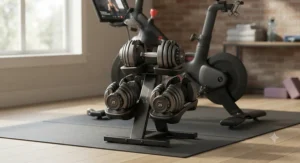
Strength segments are a bigger part of Peloton’s catalog than most new riders expect, and the Peloton Dumbbells are purpose-built for that — cast iron cores wrapped in a non-slip urethane coating, with square ends specifically designed so they don’t roll off the mat between sets. They come in increments ranging from 5 lb to 30 lbs, letting you start light and gradually increase intensity as you build strength, with lighter neoprene-covered 1-5 lb weights also available for Arms and Light Weights classes.
What the spec sheet won’t tell you, but reviewers note, is how much that square-end design actually matters during floor-based supersets — a rolling dumbbell mid-set is a genuine tripping hazard on a shared mat. Aggregated feedback highlights the cushioned end caps as a small but appreciated detail during exercises like chest presses, where weights typically clang together. Muscle-strengthening activity on two or more days a week is part of the standard federal activity recommendation, and having the right weight increments on hand makes it far easier to actually hit that target consistently.
Pros:
- ✅ Square ends prevent rolling between sets
- ✅ Urethane coating protects grip and floors alike
- ✅ Cushioned end caps reduce clanging noise
Cons:
- ❌ Individual pairs cost more than generic neoprene sets
- ❌ Heavier pairs require separate purchases, not one bundle
Individual pairs typically run $25–$70 depending on weight, with a fuller stacking range landing in the $150–$200 total range — a real investment, but one that holds up over years of bootcamp classes.
7. Polar H10 Heart Rate Monitor — lab-grade accuracy for serious data
For riders who actually train off heart rate zones rather than just glancing at the number, the Polar H10 is the accuracy benchmark. Independent testers have repeatedly called it their editor’s choice among chest strap heart rate monitors for cyclists, citing a secure fit and consistently accurate data, with dual Bluetooth connectivity and roughly 400 hours of battery life.
Here’s what to weigh: chest straps like this one measure electrical signals directly off the skin, which is inherently more accurate than optical armbands or wrist trackers, especially during high-intensity intervals when optical sensors tend to lag. Target heart rate training only works if the number on screen is trustworthy, and wrist-worn optical monitors are typically less accurate than chest or armband sensors — a trade-off worth knowing before you assume your smartwatch is giving you the full picture. If a chest strap genuinely bothers you, the Wahoo TICKR FIT armband is a solid compromise that sacrifices a little precision for comfort. Reviewers consistently praise the H10’s dual-device pairing, letting you send data to both the bike’s screen and a separate watch simultaneously.
Pros:
- ✅ Chest-strap ECG accuracy beats optical alternatives
- ✅ Roughly 400 hours of battery life per charge
- ✅ Dual Bluetooth pairing to two devices at once
Cons:
- ❌ Chest strap comfort won’t suit every rider
- ❌ Requires occasional washing to avoid odor buildup
Priced around $90, it’s a premium pick, but for anyone training zone-based intervals seriously, the accuracy gap versus wrist-based tracking is worth the cost.
Practical Usage Guide: Setting Up Your Peloton Accessories the Right Way
Getting new gear is only half the job — setup determines whether it actually performs. Start with the mat: lay it flat for 24 hours before rolling the bike onto it, since fresh PVC often needs time to relax out of its shipping curl, or it’ll bunch under the frame’s front leg. Next, install cleats before you ever clip in for a real ride — do a few dry runs clipping in and out while holding onto a wall, since first-time tension adjustment on Delta pedals catches almost everyone off guard the first week.
For the heart rate monitor, dampen the strap’s electrode pads with a little water before the first few rides; a bone-dry strap is the single most common cause of “my heart rate reading jumped to 220 out of nowhere” complaints in owner forums. Common mistakes in the first 30 days include over-tightening cleat bolts (strip risk), skipping the mat’s initial cleaning wipe-down (residue from manufacturing can make early rides slippery), and grabbing the heaviest dumbbells available instead of starting light and building up. A quick monthly maintenance habit — wiping the mat, hand-washing the chest strap, and checking cleat bolt tightness — keeps this gear performing like new for years instead of months.
Real-World Scenarios: Which Peloton Accessories Fit Your Life
Picture a college student squeezing rides into a shared apartment between classes: budget matters, floor noise matters even more, and a full weight rack isn’t realistic. For that rider, the CyclingDeal Trainer Protection Mat and Shimano RC1 shoes cover the essentials without the brand markup, and a single pair of 5-pound Peloton Dumbbells handles most arms segments.
Now picture a parent in their 40s riding four mornings a week before the house wakes up, chasing structured heart-rate training: the Polar H10 earns its price here, since zone-based interval accuracy actually changes how effective those short sessions are. Pair it with the Peloton Cycling Shoes for the plug-and-play convenience of not troubleshooting cleats before a 6 a.m. ride.
Finally, consider a household with two riders sharing one bike, alternating bootcamp and endurance rides: this is where a fuller Peloton Dumbbells range (5, 10, 15, 20 lb pairs) and the exact-fit Peloton Bike Mat make sense, since the household is putting more cumulative wear on the equipment and benefits from the mat’s dust-blocking properties protecting shared hardware.
Problem → Solution Guide
Problem: My cleats feel loose or slip mid-ride. Worn contact points are the usual culprit — swap in the TrubliFit Replacement Delta Cleats rather than assuming it’s a shoe issue.
Problem: My heart rate monitor reads wildly inaccurate numbers. Dry electrodes are almost always to blame. Dampen the strap before riding, and if readings still spike randomly, the Polar H10‘s dual-electrode design solves this more reliably than budget straps.
Problem: My floor is getting scuffed even with a mat down. The mat may be undersized for the bike’s actual footprint — the CyclingDeal Trainer Protection Mat‘s larger dimensions solve overhang issues that a snug-fit mat can’t.
Problem: My dumbbells keep rolling off the mat between sets. Switch to square-ended weights like the Peloton Dumbbells instead of round hex or vinyl-coated sets.
Problem: My shoes feel great in class but hurt walking around after. This usually means a stiff-soled shoe was oversized to compensate for width — go true-to-size per the manufacturer’s fit guidance rather than sizing up.
Buyer’s Decision Framework: Which Peloton Accessories Should You Buy First?
If you’re brand new to the bike, choose shoes and a mat first, because those affect every single ride from day one. If you already have both but keep skipping strength segments, choose a light dumbbell pair next — the barrier to bootcamp classes is almost always “I don’t have weights within reach.” If you’re already riding consistently and want to train smarter rather than just longer, choose a heart rate monitor, because zone-based training is where a lot of intermediate riders plateau without realizing it. And if your current cleats are more than 18 months old and you’ve never replaced them, choose replacement cleats before anything else — that’s the cheapest fix with the most noticeable ride-quality improvement.
How to Choose Essential Peloton Accessories
- Match cleat type to your pedals first. Nearly all compatibility complaints trace back to buying shoes before confirming Delta compatibility.
- Prioritize floor protection early. A mat prevents both cosmetic floor damage and mechanical debris issues that show up months later.
- Buy weights in a range, not a single pair. Classes call for wildly different loads, so one weight limits which workouts you can fully join.
- Decide between chest strap and armband based on intensity. High-intensity interval riders benefit more from chest-strap accuracy than casual riders do.
- Check true-to-size guidance before ordering shoes. Sizing up “just in case” is the most common return reason across cycling shoe reviews.
- Budget for cleats separately if the shoe doesn’t include them. This catches new buyers off guard more than any other line item.
- Replace, don’t just clean, worn cleats. Cleaning restores appearance but doesn’t restore the float and grip that wear away over time.
Common Mistakes When Buying Peloton Bike Accessories
The single most common mistake is buying a heavy dumbbell set before ever taking a strength class, only to discover most bootcamp segments call for lighter weights moved quickly rather than heavy weights moved slowly. A close second is assuming any chest strap heart rate monitor will “just work” — ANT+ and Bluetooth compatibility both matter, and not every budget strap supports both. Buyers also frequently underestimate mat sizing, picking a snug-fit option and then finding it doesn’t leave room for off-bike floor segments that many class formats now include. Finally, sizing cycling shoes like street sneakers — rather than following the brand’s specific true-to-size guidance — accounts for a disproportionate share of returns across every shoe brand covered in this guide.
Cycling Shoes and Cleats vs Riding in Regular Sneakers
Riding in regular sneakers on Peloton’s platform pedals works, technically, but it sacrifices real performance. Clipping in with proper cycling shoes and cleats locks your foot to the pedal through the entire rotation, meaning you generate power on both the downstroke and the upstroke rather than only pushing down and coasting back up. Cycling shoes can improve pedaling performance by transferring more energy from each stroke to the bike, making rides more efficient, and purpose-made cycling shoes can reduce injury risk, particularly the chance of a foot slipping off the pedal.
There’s also a stability argument: a stiff-soled cycling shoe spreads pressure evenly across the pedal, while a cushioned running shoe compresses unevenly, which over long rides can contribute to knee tracking issues. On the other hand, sneakers cost nothing extra if you already own them, and they’re the obvious choice for someone testing whether they’ll stick with the bike before investing further. If you’re three or more rides in and enjoying the format, the efficiency and safety gains from clipping in easily justify the shift.
What to Expect: Real-World Performance From Your Peloton Gear
On paper, specs like “9-degree float” or “400-hour battery life” don’t mean much until you’re mid-ride. In practice, a properly floated cleat means your knee doesn’t feel locked into one exact angle through the pedal stroke, which matters most during 30-plus-minute endurance rides where micro-adjustments in foot angle add up. A quality mat’s real-world impact shows up less during the ride and more the next morning — no fresh scuff marks, no dust bunnies pulled into the bike’s resistance mechanism.
Heart rate accuracy has the most immediately obvious real-world impact of anything on this list: riders who switch from a wrist-based reading to a chest strap often report their “max effort” zones were previously miscalculated by ten or more beats per minute, which changes how their entire interval structure should be built. Dumbbells, meanwhle, mostly change what you’re capable of joining — without a weight range on hand, entire categories of Peloton’s class catalog simply aren’t accessible.
Peloton Gear Recommendations by Rider Type
Beginners should prioritize the Peloton Cycling Shoes or Shimano RC1 plus a mat, and hold off on the heart rate monitor until they’ve settled into a consistent riding schedule — there’s little value in zone data before you know your baseline effort level. Intermediate riders chasing structured training benefit most from the Polar H10, since that’s the point where imprecise heart rate data starts genuinely limiting progress. Families sharing one bike across different fitness levels should invest in a fuller dumbbell range early, since the barrier to entry for strength classes is almost always “we only have one weight and it’s wrong for half of us.” Apartment dwellers and anyone riding at odd hours should prioritize the CyclingDeal Trainer Protection Mat‘s thicker, noise-dampening build over the standard-fit option.
Long-Term Cost and Maintenance
Cleats are the most overlooked recurring cost in this entire category — expect to replace them every 12-18 months of regular riding, at $20-30 a pair, which is a fraction of buying new shoes but adds up if ignored for years. Mats hold up considerably longer, often three-plus years before edges start curling or surfaces crack, provided they’re wiped down regularly rather than left to air-dry sweat into the material. Dumbbells are effectively a one-time purchase; cast iron and urethane coatings don’t degrade meaningfully with home use. Heart rate monitor straps typically need replacing every one to two years as the elastic loses tension and the electrode contacts wear down, while the sensor module itself often outlives several straps. Looked at over a three-year ownership window, the total cost of ownership favors buying quality once on shoes and mats, and budgeting for periodic replacement on the smaller wear items like cleats and straps.
FAQ
❓ What are the must have accessories for a Peloton bike?
❓ Do I need special shoes for a Peloton bike?
❓ What size mat do I need for a Peloton bike?
❓ Is a chest strap heart rate monitor more accurate than a wrist tracker?
❓ How much weight do I need in dumbbells for Peloton classes?
Conclusion
The honest version of a peloton accessories must have list is shorter than most marketing pages suggest: shoes that clip in properly, a mat that protects your floor and stabilizes the bike, a weight range that matches your class formats, and a heart rate monitor if you’re training with any real intent. Everything else is a refinement, not a requirement. Start with the Peloton Cycling Shoes or budget-friendly Shimano RC1 alongside either mat option, add the Peloton Dumbbells once you’re consistently taking strength segments, and pick up the Polar H10 when you’re ready to actually train off your numbers instead of guessing. Buying in that order avoids the common trap of over-investing in gear before you know which class formats you’ll stick with. Whatever you choose, prioritize fit and function over brand names — the analysis above should give you enough to shop with confidence rather than second-guessing every listing you scroll past.
Recommended for You
- Peloton Bike Subscription Prices 2026: 7 Plans Ranked
- Used Peloton Bike: 7 Real Deals Worth Buying in 2026
- 7 Peloton Bike Alternatives in 2026 That Won’t Wreck Your Budget
Disclaimer: This article contains affiliate links. As an Amazon Associate, I earn from qualifying purchases. If you purchase products through these links, we may earn a small commission at no additional cost to you.
✨ Found this helpful? Share it with your friends! 💬🤗
