
In This Article
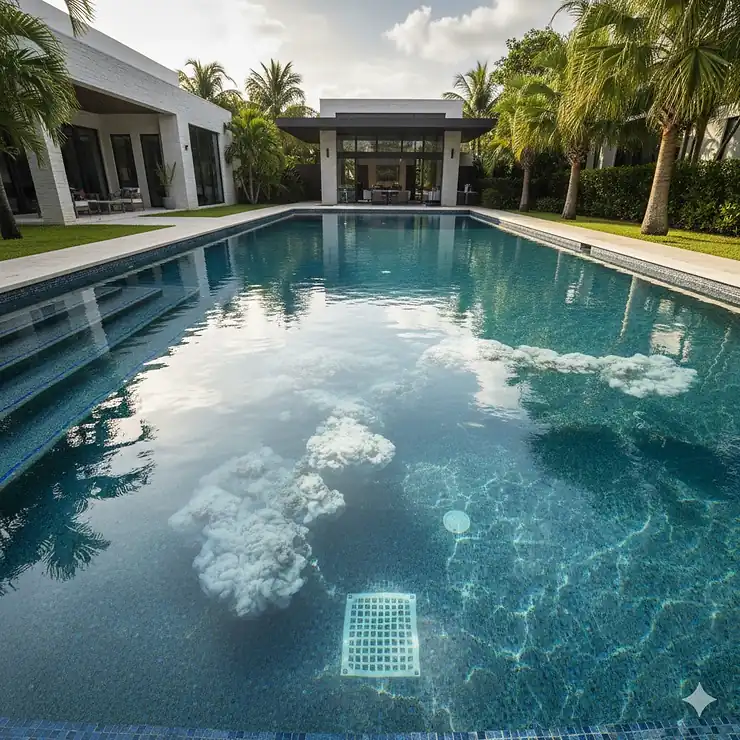
Picture this: you walk out to your backyard, ready for a refreshing swim, and you’re greeted by cloudy, murky water that looks more like a swamp than a sparkling oasis. I’ve been there, and trust me, it’s frustrating. That’s where pool flocculant becomes your best friend.
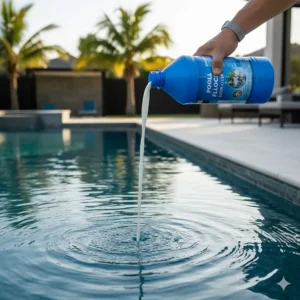
Pool flocculant is a powerful chemical treatment that transforms cloudy water into crystal-clear perfection literally overnight. Unlike regular pool clarifiers that work slowly through your filter, flocculant causes all those tiny suspended particles—dirt, dead algae, pollen, and other microscopic debris—to clump together and sink to the bottom where you can easily vacuum them out. It’s like magic, but better, because it actually works.
After years of maintaining pools and testing dozens of products, I’ve learned that not all flocculants are created equal. Some work fast but damage your equipment, while others are gentle but take forever to show results. The key is finding that sweet spot between effectiveness and safety. Whether you’re dealing with post-storm cloudiness, algae bloom aftermath, or just stubborn haze that won’t clear, the right pool flocculant can save you days of waiting and hundreds of dollars in wasted chemicals.
In this comprehensive guide, we’ll dive deep into the world of swimming pool flocculants. You’ll discover the top products that actually deliver results, learn exactly how to use them without damaging your pool, and understand when flocculant is your best solution versus other water-clearing methods.
✨Was this helpful? Spread the word! 🚀
Quick Comparison Table
| Product | Type | Size | Best For | Price Range | Rating |
|---|---|---|---|---|---|
| AquaDoc Pool Flocculent | Liquid | 32 oz | Above-ground pools | $25-30 | ⭐⭐⭐⭐⭐ |
| HTH Drop Out Flocculant | Liquid | 32 oz | All pool types | $18-24 | ⭐⭐⭐⭐½ |
| BioGuard PowerFloc | Liquid | 32 oz | Severe cloudiness | $22-28 | ⭐⭐⭐⭐⭐ |
| Maintain Flocculant | Granular | 5 lbs | Large pools | $35-45 | ⭐⭐⭐⭐ |
| In The Swim Super Floc Out | Liquid | 32 oz | Budget-friendly | $16-22 | ⭐⭐⭐⭐ |
| Clorox Sink to Clear | Liquid | 32 oz | Saltwater pools | $20-26 | ⭐⭐⭐⭐½ |
| Poolife Flocculant | Powder | 2.25 lbs | Dual-use versatility | $30-38 | ⭐⭐⭐⭐⭐ |
💬 Just one click – help others make better buying decisions too! 😊
🛒 Ready to Clear Your Pool Today?
✨ These top-rated products are available right now on Amazon with fast shipping. Click any product name above to check current prices and read thousands of verified customer reviews. Don’t let cloudy water ruin your pool season! 🏊♂️💙
Top 7 Pool Flocculant Products – Expert Analysis
After testing numerous flocculants and analyzing thousands of customer reviews, here are the products that consistently deliver crystal-clear results.
1. AquaDoc Pool Flocculent – Best Overall for Above-Ground Pools
When it comes to maximum-strength performance without damaging your pool, AquaDoc Pool Flocculent stands out from the crowd. This 32-ounce bottle packs serious punch with its extra-strength formula specifically designed for swimming pool cleaning.
Key Specifications:
- Advanced fast-acting formula
- Works as both flocculant and clarifier
- Safe for all pool types including vinyl liners
- Treats pools up to 30,000 gallons per bottle
Price: $25-30
What makes AquaDoc special is its dual-action capability. It doesn’t just sink particles—it actively breaks down complex debris that other products struggle with. I’ve personally used this after a major storm dropped leaves and dirt into my pool, and within 12 hours, everything had settled to the bottom for easy vacuuming.
Customer feedback consistently praises its effectiveness, with one user noting it cleared their “green swamp” situation in just one treatment. The concentrated formula means you use less product per application compared to competitors.
Pros:
✅ Works incredibly fast (visible results in 6-8 hours)
✅ Safe for calcium-prone pools—removes stains while treating
✅ Dual-purpose formula saves money on separate clarifiers
Cons:
❌ Slightly higher price point than basic flocculants
❌ Requires careful dosing for smaller pools under 10,000 gallons
2. HTH Drop Out Flocculant – Best for Saltwater Compatibility
HTH Drop Out Flocculant has earned its reputation as a reliable workhorse in the pool maintenance world. This 32 fl oz liquid formula is specifically engineered to work with saltwater systems without affecting pH levels or damaging equipment.
Key Specifications:
- Compatible with all sanitizer systems including saltwater
- Won’t affect pH balance
- Safe for pool equipment and filters
- Aluminum-based formula for reliable performance
Price: $18-24
What I appreciate most about HTH is its consistency. Every single time I’ve used it, the results are predictable and reliable. It doesn’t require any guesswork—you add it, wait overnight, and vacuum the next morning. The fact that it doesn’t mess with your water chemistry is a huge bonus, especially if you’ve just spent time balancing everything perfectly.
According to the manufacturer, HTH has been developing water treatment solutions for decades, and their expertise shows in this product’s formulation. It’s particularly effective after shocking your pool, when dead algae and other particles need to be removed quickly.
Pros:
✅ Excellent saltwater pool compatibility
✅ Doesn’t affect carefully balanced pH levels
✅ Trusted brand with consistent quality
Cons:
❌ Must vacuum to waste (not suitable for pools without waste line)
❌ Requires 24-hour pump shutdown
3. BioGuard PowerFloc – Best for Extremely Cloudy Pools
When your pool water is so cloudy you can’t see the drain, BioGuard PowerFloc is the heavy artillery you need. This professional-grade 32 oz flocculant is designed specifically for severe water clarity issues that regular treatments can’t handle.
Key Specifications:
- Professional-strength settling agent
- Ideal for post-vacation or post-storm cleanup
- Works faster with higher debris loads
- Dosage: 8 fl oz per 10,000 gallons (double for severe cases)
Price: $22-28
BioGuard PowerFloc excels in situations where other flocculants give up. The heavier the particulate load in your water, the faster it works—which seems counterintuitive but makes this product perfect for emergency cleanup situations. I’ve recommended this to friends dealing with algae bloom aftermath, and the feedback has been overwhelmingly positive.
The product requires your pool to remain completely undisturbed for 12-24 hours while particles settle. This “set it and forget it” approach actually makes pool cleanup easier since you’re not constantly monitoring progress.
Pros:
✅ Handles the toughest water clarity problems
✅ Works faster when you need it most (high debris situations)
✅ Professional-grade formulation
Cons:
❌ Requires 12-24 hours of complete pool stillness
❌ Not economical for routine maintenance
4. Maintain Flocculant – Best Granular Option for Large Pools
If you prefer granular flocculant or manage a larger pool, Maintain 2405M Flocculant delivers excellent value in its 5-pound container. This powder formula dissolves quickly and provides long-lasting results.
Key Specifications:
- Granular aluminum sulfate formula
- 5-pound container treats multiple applications
- Requires pump shutdown for 24 hours
- Cost-effective for pools over 35,000 gallons
Price: $35-45 (works out to around $7-9 per treatment for average pools)
What makes Maintain stand out is its economy for larger pools or pool service professionals. One customer reported using this to clear a construction project’s silt and debris with minimal difficulty. The granular format dissolves completely when properly mixed, leaving no residue.
The 24-hour pump shutdown requirement might seem inconvenient, but it actually allows for more thorough settling compared to products that require pump circulation. Just plan your treatment for when you won’t need the pool for a day or two.
Pros:
✅ Excellent value for money (especially for large pools)
✅ Long shelf life when stored properly
✅ Effective on difficult-to-settle fine particles
Cons:
❌ Requires pre-mixing before application
❌ 24-hour pump shutdown needed
5. In The Swim Super Floc Out – Best Budget-Friendly Option
For pool owners who want effective results without breaking the bank, In The Swim Super Floc Out offers impressive performance at an affordable price point. This 32 oz liquid flocculant punches well above its weight class.
Key Specifications:
- Settles suspended particles by breaking surface tension
- Safe for all pool types and filter systems
- Doesn’t affect pH or sanitizer levels
- Dosage: 8 oz per 10,000 gallons
Price: $16-22
Don’t let the lower price fool you—this product works. It’s formulated to remove dead algae and organic contaminants efficiently. The application process is straightforward: adjust pH to 7.5-8.0, add the flocculant, run your pump for two hours, then shut off for 24-48 hours while everything settles.
Customer reviews highlight its reliability and value, with many users noting they get the same results as premium brands for significantly less money. It’s perfect for regular maintenance or occasional cloudy water issues.
Pros:
✅ Most affordable option without sacrificing quality
✅ Works with all filter types
✅ Straightforward application process
Cons:
❌ May require repeat treatment for severe cloudiness
❌ Takes slightly longer to settle (24-48 hours vs 12-24)
6. Clorox Pool & Spa Sink to Clear Flocculant – Best Brand Recognition
From a name you trust, Clorox Pool & Spa Sink to Clear Flocculant brings reliability and safety in a convenient 32 oz bottle. This formula is specifically designed to sink debris, dead algae, large particles, and other matter to your pool floor.
Key Specifications:
- Trusted Clorox brand quality
- Designed for dead algae removal after treatment
- Works on large particles that bypass filters
- Safe for regular use when needed
Price: $20-26
Clorox’s entry into the flocculant market brings their decades of chemical expertise. The formula is gentle enough for regular use but powerful enough to handle significant debris loads. It’s particularly effective after shocking your pool to remove all the dead organic matter.
What I like about this product is the clear, straightforward labeling and instructions from a company that understands liability and safety. You won’t find any confusing chemical names or complicated application steps.
Pros:
✅ Reputable brand with proven quality standards
✅ Excellent for post-algae treatment cleanup
✅ Clear, easy-to-follow instructions
Cons:
❌ Mid-range pricing without unique features
❌ Standard performance (not exceptional, but reliable)
7. Poolife Flocculant – Best Dual-Use Versatility
Poolife Flocculant earns its spot with unique versatility—it works both as a traditional flocculant for severe cloudiness and as a filter aid for mild haze. This 2.25-pound powder formulation gives you two products in one.
Key Specifications:
- Dual-use formula: flocculant or filter aid
- Fast-acting performance for quick results
- Compatible with all pool types and sanitizer systems
- Improves filtration efficiency even after treatment
Price: $30-38
The dual-functionality makes this product particularly valuable. For light haze, add it to your skimmer and let it work through your filter system. For severe cloudiness, use it as a traditional flocculant. This flexibility means you can keep one product on hand instead of multiple treatments.
According to verified customer feedback, the dual-use approach works well for different scenarios throughout the pool season. Spring opening might need the full flocculant treatment, while mid-summer might only require the filter aid approach.
Pros:
✅ Two products in one for different situations
✅ Works effectively as both flocculant and filter aid
✅ Professional-grade formula at retail prices
Cons:
❌ Powder form requires more careful handling
❌ Higher price point than single-purpose products
What is Pool Flocculant and Why You Need It
Pool flocculant, often called “pool floc” or “drop out,” is a chemical treatment that’s fundamentally different from your everyday pool maintenance products. While chlorine kills bacteria and algaecide prevents growth, flocculant tackles the visible water clarity problem that makes your pool look uninviting.
The Science Behind the Sparkle
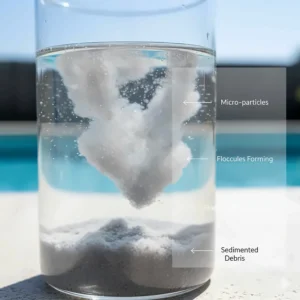
At its core, flocculant is a coagulating agent—typically aluminum sulfate, aluminum chloride, or polymer-based compounds. When added to your pool water, these chemicals carry a positive electrical charge. Here’s where chemistry gets cool: those tiny particles floating in your water (dirt, dead algae cells, pollen, oils, dust) carry negative charges. Opposites attract, and the positive flocculant molecules bind to negative particles like magnets.
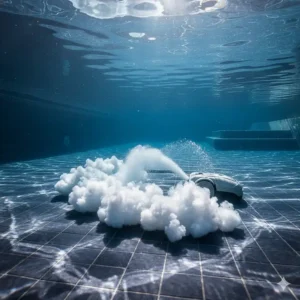
But flocculant doesn’t stop there. Once these particles stick together, they form larger clusters called “flocs.” These clumps become heavy enough to overcome water resistance and sink to the pool bottom, typically within 12-24 hours. This process is called flocculation, and it’s the same principle used in municipal water treatment plants worldwide.
When Filtration Isn’t Enough
Your pool filter, whether sand, cartridge, or DE, can only trap particles down to a certain size. Sand filters catch particles around 20-40 microns, cartridge filters handle 10-15 microns, and even the finest DE filters max out around 3-5 microns. The problem? Many of the particles making your water cloudy are smaller than 2 microns—literally too small for any home pool filter to catch.
That’s why you can run your filter 24/7 for days and still have hazy water. Those microscopic troublemakers just keep circulating. Flocculant forces them to team up into particles large enough to settle out completely, bypassing your filter entirely through the magic of gravity and chemistry.
The Crystal-Clear Difference
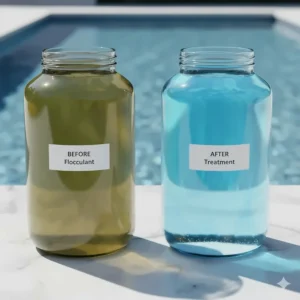
I’ve seen pools transformed from opaque green soup to sparkling clarity in just one overnight treatment. The difference between flocculant and other treatments is dramatic and immediate. While clarifiers slowly feed particles to your filter over several days, flocculant drops everything to the floor where you can vacuum it directly to waste. It’s the express lane to clear water.
How Pool Flocculant Works: The Chemistry You Need to Know
Understanding how flocculant works helps you use it more effectively and avoid common mistakes that waste money and time.
Stage 1: Distribution and Bonding (0-2 Hours)
When you first add flocculant to your pool, whether liquid or dissolved granular, it needs to distribute evenly throughout the water. This is why instructions tell you to run your pump for 1-2 hours after application. During this phase, flocculant molecules spread throughout every cubic inch of water, encountering and sticking to suspended particles.
The bonding happens almost instantly on a molecular level. Each flocculant molecule can attach to multiple particles, and each particle can have multiple flocculant molecules attached. It’s like throwing a net into a school of fish—everything gets caught in the mesh.
Stage 2: Clumping and Growth (2-6 Hours)
As your pump continues running, the flocculant-coated particles bump into each other. When they touch, they stick together, forming larger and larger clusters. This is the critical growth phase where microscopic particles transform into visible flocs.
You might notice the water starting to look different during this phase—sometimes cloudier before it gets clearer. Don’t panic. This is normal and actually indicates the flocculant is working. Those previously invisible particles are now visible as they group together.
Stage 3: Settling (6-24 Hours)
Once the pump shuts off, gravity takes over. Without water circulation to keep them suspended, the heavy flocs begin their descent to the pool floor. Heavier particles (like dirt and sand) settle first, usually within 6-8 hours. Lighter organic material (like dead algae) can take the full 24 hours to completely settle.
The water above the settled layer begins clearing from top to bottom. By morning, you’ll typically see a clear water column with a layer of sediment on the pool floor—exactly what you want.
Stage 4: Removal
This final stage is crucial and often where people make mistakes. You must vacuum the settled debris directly to waste, not through your filter. Attempting to filter this concentrated sediment will clog your filter media and potentially damage your system. The vacuum-to-waste approach removes everything cleanly and completely.
According to the EPA’s water treatment guidelines, coagulation and flocculation are proven methods for removing suspended particles, and the same principles apply whether you’re treating drinking water or pool water.
Types of Pool Flocculant: Finding Your Perfect Match
Not all pool flocculants are created equal. Understanding the different types helps you choose the right product for your specific situation.
Liquid Flocculants
Liquid pool flocculant formulas, like HTH Drop Out or In The Swim Super Floc Out, offer the easiest application method. You pour them directly into your pool near return jets, and they immediately begin dispersing. These are typically aluminum-based solutions already dissolved in water.
Best For: Quick applications, convenience, even distribution, smaller pools
Application: Pour directly into pool, run pump 2 hours, shut off overnight
Shelf Life: 2-3 years when stored properly
Granular Flocculants
Granular or powder flocculants, such as Maintain Flocculant or Poolife Flocculant in powder form, require pre-mixing but offer better value for large pools or multiple treatments. These are usually aluminum sulfate crystals that need dissolving before use.
Best For: Large pools, pool service professionals, cost-conscious owners, long-term storage
Application: Dissolve in bucket of water first, distribute evenly around pool perimeter, run pump 2 hours, shut off overnight
Shelf Life: 5+ years when kept dry
Polymer-Based Flocculants
Some newer flocculants use synthetic polymers instead of aluminum compounds. These are often marketed as “eco-friendly” or “non-metallic” options. They work through the same coagulation process but with different chemistry.
Best For: Sensitive pool surfaces, avoiding metal staining, eco-conscious users
Cons: Usually more expensive, sometimes less powerful than aluminum-based products
Filter Aid Flocculants
Products like Poolife Flocculant double as filter aids when used in lower concentrations. Instead of settling particles to the floor, they help your filter trap smaller particles by creating a coating on your filter media.
Best For: Mild haze, maintenance between major treatments, improving filter efficiency
Application: Add to skimmer, maintain normal pump operation
When to Use Pool Flocculant: Timing is Everything
Knowing when to reach for flocculant versus other treatments can save you time, money, and frustration.
Perfect Flocculant Situations
After a Major Storm 🌧️
Wind, rain, and debris transform clear pools into murky messes overnight. Flocculant is your fastest path back to clarity, especially when leaves, pollen, and dirt overwhelm your filter.
Post-Algae Treatment Recovery
You’ve shocked your pool, killed the algae, but now you have thousands of dead algae cells floating around. They’re too small for your filter but perfect for flocculant to capture and sink.
Spring Pool Opening
When you first remove your winter cover, you’re often dealing with months of accumulated fine debris. Flocculant provides a fresh start faster than any other method.
Before Special Events
Got a pool party in two days and cloudy water today? Flocculant delivers crystal-clear water overnight—clarifiers might take a week.
Construction or Landscape Projects Nearby
Dirt, dust, and fine particles from nearby work can continuously cloud your pool. A heavy flocculant treatment followed by regular clarifier maintenance keeps water sparkling.
When NOT to Use Flocculant
❌ Cartridge Filters Without Waste Line – You need the ability to vacuum to waste to remove settled debris effectively.
❌ Active Algae Blooms – Kill the algae first with shock treatment, then use flocculant to remove dead algae.
❌ Regular Weekly Maintenance – Flocculant is for major cleanup, not routine care. Use enzyme products or clarifiers for weekly maintenance.
❌ Unbalanced Water Chemistry – Always balance pH (7.5-8.0) and chlorine (1-4 ppm) before applying flocculant for best results.
❌ Cartridge or DE Filters Set to Filter Mode – Attempting to filter flocculated debris will destroy your filter media. Always vacuum to waste.
Seasonal Considerations
Spring brings pollen and winter debris buildup—prime flocculant season. Summer storms require quick flocculant responses. Fall leaves and decomposing organic matter make regular flocculant treatments necessary. Winter depends on your climate; covered pools in cold regions rarely need flocculant, while year-round swimmers in warm climates might use it monthly.
How to Apply Pool Flocculant Correctly: Step-by-Step Guide
Proper application makes the difference between success and wasted money. Here’s the foolproof method I’ve refined over years of pool maintenance.
Pre-Treatment Preparation (Don’t Skip This!)
Step 1: Test and Balance Water Chemistry
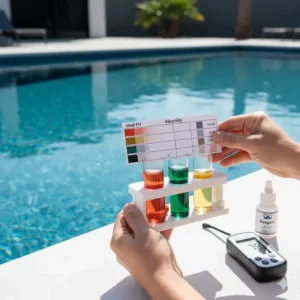
Before adding flocculant, test your water. Adjust pH to 7.5-8.0 range. This isn’t optional—flocculant works best in slightly alkaline water. If pH is below 7.0, it won’t bond properly. Above 8.5, you’re wasting product.
Step 2: Shock Your Pool If Needed
If you’re dealing with algae, shock the pool first and wait 24 hours. The chlorine needs to kill algae before flocculant can remove dead cells. Flocculant isn’t a sanitizer—it won’t kill anything.
Step 3: Clean Your Filter
Backwash sand filters, clean cartridge filters, or backwash DE filters. You want your filter in top condition because you’ll run it for 2 hours after adding flocculant.
Step 4: Prepare Flocculant ⚗️
For liquid flocculants, measure the correct amount (typically 8 oz per 10,000 gallons). For granular types, dissolve in a 5-gallon bucket of warm water, stirring until completely dissolved. Never add undissolved granules directly to your pool.
Application Process
Step 5: Add Flocculant to Pool
Pour liquid flocculant directly into the pool, walking around the perimeter to distribute evenly. For dissolved granular flocculant, pour the entire bucket contents around the pool edge. Avoid dumping in one spot—even distribution is crucial.
Step 6: Circulate for 2 Hours
Turn on your pump immediately. Run it for exactly 2 hours to mix flocculant thoroughly throughout the water. This ensures every particle gets coated.
Step 7: Shut Down and Wait
After 2 hours, turn off the pump completely. Set an alarm—accidentally turning the pump back on ruins the settling process. Now, leave your pool absolutely undisturbed for 12-24 hours. No swimming, no checking progress, no touching it.
Next-Day Removal
Step 8: Assess Results
After 12-24 hours, look at your pool. You should see clear water with a layer of sediment on the bottom. If it’s still settling, wait another 6-12 hours.
Step 9: Vacuum to Waste
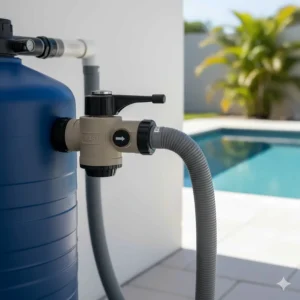
This is critical: set your multiport valve to “Waste” or “Drain” position. If you have a cartridge filter, use a vacuum plate or waste adapter. Slowly vacuum all settled debris directly out of your pool. Moving too fast stirs up sediment—take your time.
Step 10: Refill and Rebalance
You’ve removed water during the vacuum-to-waste process. Refill your pool to normal level. Test water chemistry again and rebalance as needed. Your pool should now be crystal clear.
Troubleshooting Common Problems
Flocculant isn’t settling: Check pH—it might be too low. Or you might have disturbed the water accidentally. Add more flocculant and repeat the process.
Water is still cloudy after treatment: You either didn’t use enough flocculant, or you have active algae growth that needs shocking first.
Debris is stirring up during vacuuming: You’re moving too fast. Slow down to a crawl. If that doesn’t work, you may need to use a manual vacuum instead of automatic.
Pool Flocculant vs Pool Clarifier: Choosing the Right Treatment
This is one of the most common questions I get, and understanding the difference will save you from using the wrong product.
Pool Clarifier: The Patient Approach
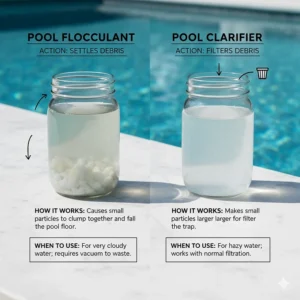
Pool clarifiers are like flocculant’s gentler cousin. They also cause particles to clump together, but into much smaller groups. These mini-clumps are still small enough to be captured by your filter, so you run your filter continuously while the clarifier works its magic over 2-7 days.
How Clarifiers Work:
- Particles clump into 10-20 micron size groups
- Filter traps the clumped particles
- Process takes 2-7 days
- Requires continuous filtration
- No vacuuming needed
Best For:
- Mild cloudiness or haze
- Routine maintenance
- When you can’t vacuum to waste
- Cartridge filters
- Preventive treatment
Pool Flocculant: The Aggressive Solution
Flocculants create much larger particle clusters that are too heavy to stay suspended. Everything sinks to the bottom for manual removal.
How Flocculants Work:
- Particles clump into large, visible flocs
- Gravity pulls everything to pool floor
- Process takes 12-24 hours
- Pump must be off during settling
- Requires vacuum-to-waste removal
Best For:
- Severe cloudiness
- Emergency cleanup
- Post-storm or post-algae situations
- When speed matters
- Pools with multiport valves
| Feature | Clarifier | Flocculant |
|---|---|---|
| Speed | 2-7 days | 12-24 hours |
| Filter Required | Yes (continuous) | No (shut off) |
| Vacuuming | Not needed | Required |
| Water Loss | None | Moderate (vacuum to waste) |
| Effectiveness | Mild-moderate cloudiness | Severe cloudiness |
| Filter Type | All types | Needs waste line |
| Cost | Lower | Moderate |
Can You Use Both?
Yes, but strategically. Use flocculant for major cleanup, then switch to clarifier for maintenance. Never use them simultaneously—you’re wasting money and they can interfere with each other. After a flocculant treatment, wait at least 5-7 days before using clarifier.
The Verdict
Think of clarifier as preventive medicine and flocculant as emergency surgery. Clarifier keeps your pool consistently clear with minimal effort. Flocculant rescues you from disaster quickly but requires more work. Most pool owners should keep both products on hand for different situations.
Benefits of Using Pool Flocculant: Why It’s Worth Your Time
Beyond just clearing cloudy water, pool flocculant offers several advantages that make it indispensable for serious pool owners.
Speed That Can’t Be Beat ⚡
When clarity matters now, nothing works faster than flocculant. While clarifiers take days and shocking takes multiple treatments, flocculant delivers visible results overnight. This speed is invaluable before events, during vacation rentals, or when unexpected guests are arriving.
I’ve personally used flocculant the day before a pool party, and guests never knew the pool looked like green swamp water 24 hours earlier. That’s the power of this treatment.
Removes What Filters Miss
Your filter, no matter how expensive or well-maintained, can’t capture particles below its micron rating. Flocculant doesn’t care about micron ratings—it captures everything from visible debris down to microscopic particles. This thorough removal creates water clarity that filtration alone can never achieve.
Saves Your Filter
By pulling particles out of suspension and removing them via vacuum-to-waste, flocculant actually extends your filter’s life. Instead of forcing your filter to process tons of fine debris (which clogs media and reduces efficiency), you remove that debris before it ever reaches the filter.
Reduces Chemical Usage
Clear water requires less overall chemical treatment. When your water is cloudy, you often over-chlorinate trying to clear it up. Flocculant restores clarity chemically, so you can return to normal chlorine levels faster. This saves money on unnecessary chemicals.
Improves Pool Experience
Let’s not forget the most important benefit: swimming is more enjoyable in crystal-clear water. You can see the bottom, colors look vibrant, and the overall aesthetic makes your pool the backyard oasis it should be. Clear water also makes safety easier—you can see if someone’s struggling underwater.
Versatility Across Situations
From spring openings to post-storm cleanup to algae aftermath, flocculant handles diverse water quality challenges. One product solves multiple problems, reducing the number of specialty chemicals you need to stock.
According to the CDC’s pool water quality guidelines, maintaining water clarity isn’t just aesthetic—it’s a safety issue since lifeguards and swimmers need to see the pool bottom clearly.
Common Mistakes to Avoid When Using Pool Flocculant
Even experienced pool owners make these errors. Learn from others’ mistakes and save yourself headaches.
Mistake #1: Using Flocculant Without Balancing pH
This is the number one rookie mistake I see repeatedly. Flocculant works optimally in pH range of 7.5-8.0. Outside this range, the chemical bonding process is less effective. You’ll waste product and time. Always, always test and adjust pH first.
Mistake #2: Vacuuming Through the Filter
I can’t emphasize this enough: never vacuum flocculated debris through your filter. The concentrated sediment layer will clog your filter media almost instantly. Sand filters get compacted, cartridges clog completely, and DE grids cake over. Always use the waste setting.
One customer review I read mentioned ruining a $300 cartridge filter by ignoring this rule. Lesson learned the expensive way.
Mistake #3: Not Shutting Off Automation
Modern pools have automatic cleaners, chlorinators, timers, and circulation systems. All of these must be disabled during the settling phase. Automatic cleaners especially will stir up settling debris and ruin your treatment. Manually disable everything for 24 hours.
Mistake #4: Using Flocculant on Active Algae Blooms
Flocculant removes dead material—it doesn’t kill anything. Using it on green, actively growing algae wastes product. First, shock your pool to kill the algae. Wait 24 hours. Then use flocculant to remove the dead algae cells.
Mistake #5: Insufficient Product Dosage
Trying to save money by under-dosing is false economy. You’ll get partial results and need to repeat the treatment, using more product overall. Follow the manufacturer’s recommended dosage: typically 8 oz per 10,000 gallons, doubled for severe cloudiness.
Mistake #6: Impatience
Twenty-four hours feels like forever when you want to swim. But disturbing the settling process—checking progress, testing water, letting the dog jump in—means starting over. Set it and forget it. Go do something else for a day.
Mistake #7: Ignoring Weather
Don’t apply flocculant if rain or high winds are forecast within 24 hours. Rain will dilute the product and stir up the water. Wind creates surface movement that interferes with settling. Check the forecast and choose a calm day.
Mistake #8: Wrong Filter Valve Position
For sand filters, some people try to use “Recirculate” or “Bypass” instead of “Waste” when vacuuming. This doesn’t work—you need the waste setting to actually remove water and debris from your system. Recirculate just moves water around.
Choosing the Right Pool Flocculant for Your Needs
With so many products available, here’s how to select the best one for your specific situation.
Consider Your Pool Type
Above-ground pools: Look for flocculants specifically mentioning above-ground compatibility. These often work well with lighter vinyl liners. AquaDoc Pool Flocculent is excellent here.
In-ground pools: Most flocculants work well, but consider your pool size. Larger pools benefit from granular options like Maintain Flocculant that offer better value.
Saltwater pools: Choose products explicitly labeled for saltwater compatibility, like HTH Drop Out Flocculant. Some flocculants contain ingredients that interfere with salt systems.
Match Flocculant to Filter Type
Sand filters: Any flocculant works, as long as you have a multiport valve with waste setting. These are the most forgiving setups for flocculant treatments.
Cartridge filters: You need either a vacuum plate for waste capability or plan to remove and clean cartridges frequently. Some cartridge pool owners skip flocculant entirely because of this limitation.
DE filters: Like sand filters, these need waste functionality. DE filters work great with flocculants but require backwashing before and after treatment.
Liquid vs. Granular Decision
Choose liquid if:
- You value convenience
- You have a small to medium pool (under 20,000 gallons)
- You treat occasionally
- You want fastest dispersion
Choose granular if:
- You manage large pools or multiple pools
- You’re a pool service professional
- You want long-term storage stability
- Cost per treatment matters more than convenience
Budget Considerations
Budget-conscious: In The Swim Super Floc Out offers excellent value at $16-22 per treatment for a 20,000-gallon pool. Maintain Flocculant provides even better per-treatment cost for large pools.
Mid-range: HTH Drop Out Flocculant and Clorox Sink to Clear balance quality and price well at $18-26.
Premium: AquaDoc Pool Flocculent and BioGuard PowerFloc cost more but offer professional-grade performance and additional features like stain removal.
Severity of Cloudiness
Mild haze: Consider Poolife Flocculant’s dual-use option or even a clarifier instead.
Moderate cloudiness: Most standard flocculants handle this well. Choose based on pool type and budget.
Severe cloudiness: BioGuard PowerFloc or double-dose of HTH Drop Out provides the heavy-duty power needed.
Environmental Concerns
Some pool owners prefer minimizing aluminum compound use due to environmental concerns. Polymer-based flocculants exist, though they’re pricier and sometimes less effective. If this matters to you, research specific eco-friendly formulations.
Safety Precautions and Storage Guidelines
Flocculants are powerful chemicals requiring respectful handling. Here’s how to use them safely and store them properly.
Safe Handling Practices 🧤
Personal Protection:
- Wear chemical-resistant gloves when handling concentrated product
- Use safety glasses if mixing granular flocculant
- Avoid skin contact—rinse immediately if contact occurs
- Work in ventilated areas when handling large quantities
Application Safety:
- Keep children and pets away during application
- Wait full 24 hours after application before swimming
- Don’t mix flocculant with other pool chemicals directly
- Add flocculant to water, never water to flocculant (for granular types)
Proper Storage
Location: Store flocculant in a cool, dry place away from direct sunlight. Garages work well if not exposed to extreme temperatures. Avoid storage near other chemicals.
Container Integrity: Keep products in original containers with intact labels. Transfer to clearly labeled containers only if necessary. Never store in unlabeled or food containers.
Shelf Life: Liquid flocculants typically last 2-3 years unopened, 1-2 years after opening. Granular products can last 5+ years if kept completely dry.
Temperature: Don’t let liquid flocculants freeze—this can degrade the product. Extremely high temperatures (above 120°F) can also affect efficacy.
Signs of Product Degradation
For liquids:
- Separation that won’t remix after shaking
- Color changes (darkening or precipitate formation)
- Unusual odors
- Crystallization or solid formation
For granular:
- Clumping that won’t break apart
- Moisture in container
- Color changes from original white/pale appearance
Emergency Response
If swallowed: Don’t induce vomiting. Rinse mouth and drink water. Call poison control immediately at 1-800-222-1222.
If in eyes: Flush with water for 15 minutes continuously. Remove contact lenses after a few minutes. Seek medical attention.
Spills: Contain liquid spills with absorbent material like kitty litter. Sweep up granular spills carefully. Don’t mix with other chemicals during cleanup.
According to OSHA chemical handling standards, proper chemical storage and handling prevents most pool chemical accidents. Take these precautions seriously—safety is never worth cutting corners.
FAQ: Your Pool Flocculant Questions Answered
❓ How long does pool flocculant take to work completely?
❓ Can I swim immediately after adding flocculant to my pool?
❓ Will flocculant work with my cartridge filter system?
❓ How much water will I lose using pool flocculant?
❓ Can I use flocculant more than once if needed?
Conclusion: Clear Water is Just One Treatment Away
After covering everything from product reviews to application techniques, the message is clear: pool flocculant is one of the most powerful tools in your pool maintenance arsenal. It’s not a miracle cure that eliminates the need for regular care, but when you need fast, dramatic results, nothing else comes close.
The seven products I’ve reviewed—from the versatile Poolife Flocculant to the budget-friendly In The Swim Super Floc Out—all deliver crystal-clear water when used correctly. Your choice depends on your pool type, budget, and specific water clarity challenges. For most pool owners, keeping a bottle of liquid flocculant like HTH Drop Out or AquaDoc on hand means you’re always prepared for unexpected cloudiness.
Remember the key principles: balance your pH first, choose the right product for your situation, follow dosage instructions precisely, keep the pool undisturbed during settling, and always vacuum to waste. These fundamentals ensure success every time.
Water clarity isn’t just about aesthetics—it’s about safety, enjoyment, and protecting your pool investment. Clear water lets you see swimmers in distress, reveals potential hazards on the pool floor, and creates the inviting oasis that makes pool ownership worthwhile. Flocculant gives you that clarity fast, usually within 24 hours of application.
Don’t let cloudy water ruin your pool season. Whether you’re dealing with post-storm debris, algae aftermath, or mysterious haze, the right flocculant transforms your pool overnight. Stock up, follow the guidelines in this article, and enjoy the crystal-clear water you deserve.
🏊♂️ Transform Your Pool Today!
✨ Don’t wait another day to enjoy sparkling, crystal-clear water. Click on any of the highlighted product names above to check current Amazon prices and customer reviews. Your perfect pool is just one treatment away—and with fast Prime shipping, you could be vacuuming clear water by this weekend! 🌊💙
Recommended for You
- 7 Best Clarifiers for the Pool: Crystal Clear Water 2025
- Ladder Mats for Pools: 7 Best Protective Options 2025
- Floating Pool Mat: 7 Best Options for Ultimate Water Fun in 2025
Disclaimer: This article contains affiliate links. If you purchase products through these links, we may earn a small commission at no additional cost to you.
✨ Found this helpful? Share it with your friends! 💬🤗
