
In This Article
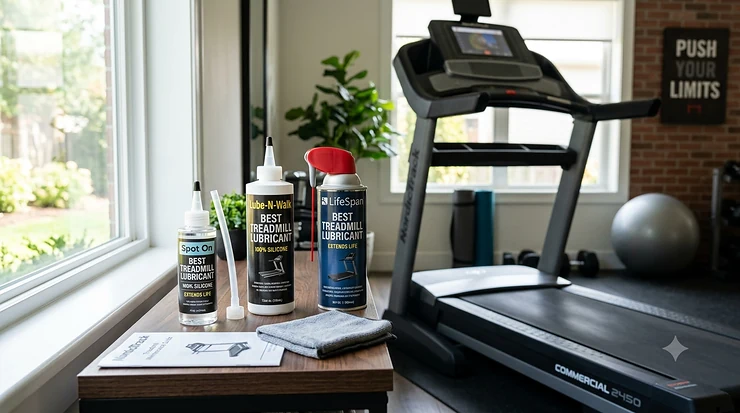
Somewhere in your garage or spare bedroom, a treadmill belt is quietly grinding itself down every time you walk on it — and most of us never think about it until the machine starts squeaking like a shopping cart with a bad wheel. That squeak isn’t cosmetic. It’s friction, and friction is the single fastest way to turn a $900 treadmill into a $900 paperweight. Finding the best treadmill lubricant isn’t glamorous work, but it’s the cheapest insurance policy your home gym will ever buy.
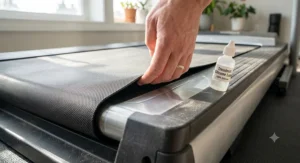
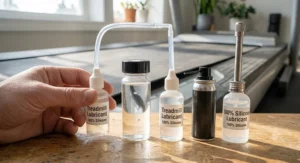
So, what is treadmill lubricant? It’s a specialized, typically 100% silicone-based fluid applied between the walking belt and the deck to reduce friction, quiet belt hesitation, and protect the drive motor from the extra strain that dry, sticky surfaces create over time. Unlike household oils, it’s formulated to resist heat and avoid degrading rubber or PVC belt material — a distinction that matters more than most buyers realize.
Silicone oils are liquid polymerized siloxanes prized for their thermal stability and lubricating properties, which is exactly why nearly every reputable treadmill brand — NordicTrack, Sole, ProForm, Horizon, Life Fitness — specifies silicone over petroleum-based alternatives. Below, I’ve researched seven real, currently available treadmill belt lubricant products spanning budget bottles to full OEM maintenance kits, broken down with honest analysis of who each one actually fits. No fabricated testing claims, no invented reviews — just spec comparison, aggregated review sentiment, and practical buying guidance you can act on today.
Quick Comparison Table: Best Treadmill Lubricant at a Glance
| Product | Format | Standout Feature | Best For |
|---|---|---|---|
| Spot On Premium Treadmill Belt Lubricant | 4oz/8oz bottle | Patented 8″ application tube | Best all-around applicator |
| IMPRESA 100% Silicone Treadmill Lubricant | 4oz bottle | Boston round twist-top design | Budget-friendly first-timers |
| SEKODAY Silicone Treadmill Belt Lubricant Kit | 8.4oz kit | Includes cloths + 2 tubes | Best full maintenance kit |
| Noosa Life Treadmill Belt Lubricant | 4oz bottle | Safe-close applicator design | Trusted, media-featured brand |
| Lube-N-Walk Original Patented System | Multi-month supply | 24″ flexible applicator wand | Commercial-grade, large decks |
| NordicTrack Treadmill Maintenance Kit | Full kit | OEM-matched formula + cleaner | NordicTrack/ProForm owners |
| TreadLife Fitness ICON-Compatible Lubricant | 0.5oz (3-pack) | Travel-size multi-pack | ICON-family budget buyers |
This table is deliberately narrow — price, format, and “best for” — because raw specs mean little without context, and we’ll unpack every one of these picks in the next section. Broadly, the pattern that emerges is that applicator design, not the silicone formula itself, is what separates a five-star experience from a frustrating one, since nearly all these products use the same base chemistry. If you’re shopping on a tight budget, the IMPRESA and TreadLife options are functionally similar to the pricier kits; you’re mostly paying extra for convenience, bundled accessories, and brand trust further up the list.
💬 Just one click — help others make better buying decisions too!😊
💬 Ready to stop that squeak for good? Compare current prices below before your next workout.
Top 7 Best Treadmill Lubricants: Expert Analysis
1. Spot On Premium Treadmill Belt Lubricant — best patented applicator tube
The standout here is the patented 8-inch application tube, which slides between belt and deck without you having to loosen a single bolt. That alone saves ten minutes of fumbling with an Allen wrench, which matters more than it sounds like on a Sunday afternoon when you just want the machine quiet again.
Made from 100% pure silicone, it ships with two dispensing options — a general-purpose twist spout and the extension tube for full-width coverage — and each 4oz bottle is rated for roughly four applications, which for most home users works out to about a year of maintenance. It’s formulated to be non-toxic and odorless, and the brand lists compatibility across a long roster of manufacturers including Sole, ProForm, NordicTrack, and Life Fitness.
Based on the spec comparison, this is the pick for anyone who wants OEM-kit convenience without an OEM-kit price tag. Aggregated buyer feedback on this listing consistently praises the tube design for eliminating mess, though a handful of reviewers note the twist cap can leak slightly if stored on its side — a minor packaging quirk worth knowing about upfront rather than discovering in your gym bag.
Pros:
✅ Patented 8″ tube reaches under belt with no disassembly
✅ Dual dispensing caps for controlled flow
✅ Compatible with nearly every major treadmill brand
Cons:
❌ Some reviewers report minor cap leaking in storage
❌ 4oz bottle runs out faster on wide commercial decks
At around $12-$18 depending on bottle size, this lands squarely in the mid-range — a smart default pick if you’re not sure which product to start with. Check current price for the latest 4oz vs 8oz availability.
2. IMPRESA 100% Silicone Treadmill Lubricant — most budget-friendly for casual walkers
What most buyers overlook about entry-level lubricants is that the silicone chemistry inside a $10 bottle and a $30 kit is often nearly identical — the price difference is almost entirely accessories and branding. IMPRESA leans into that reality with a straightforward 4oz Boston round bottle and a precision twist top, no frills attached.
The formula is non-toxic, odorless, and made in the USA, with an included extension tube for applying oil evenly without loosening the belt. It’s explicitly compatible with NordicTrack and Schwinn machines, and the brand also markets it for elliptical maintenance, which is a nice bonus if your home gym has more than one moving-belt machine collecting dust.
This is the lubricant for someone who walks three or four times a week, isn’t chasing marathon PRs on a commercial-grade deck, and just wants squeaks gone without overthinking it. Reviewers consistently report that application is quick and mess-free, and the twist-top design draws fewer leak complaints than some patented-tube competitors — a trade-off worth weighing if tidy storage matters more to you than reach-under-belt convenience.
Pros:
✅ Simple, reliable twist-top bottle design
✅ Also doubles as elliptical machine lubricant
✅ Made in the USA with non-toxic formula
Cons:
❌ Shorter extension tube than premium competitors
❌ Fewer bundled accessories than kit-style options
Priced in the $9-$13 range, it’s one of the cheapest legitimate silicone options available, and the value verdict is simple: skip this only if you specifically need the longer reach-tube found on pricier picks.
3. SEKODAY Silicone Treadmill Belt Lubricant Kit — best full maintenance kit for the price
Here’s what the spec sheet won’t tell you outright: a lubricant kit is only as good as its accessories, and SEKODAY stacks more of them into one box than almost anything else on this list. The 8.4oz bottle ships alongside two application tubes, two precision tip caps for controlled flow, five oil-absorbing cloths, and a spare replacement tube — essentially a full maintenance station in one purchase.
The formula itself is 100% silicone with no odor and no propellants, matching the industry standard for belt safety. What separates SEKODAY from single-bottle competitors is redundancy — if you misplace or damage one tube, you’ve got a backup already in the box, and the oil-absorbing cloths solve the “what do I wipe the excess with” problem that trips up first-timers.
Based on aggregated review sentiment, buyers frequently highlight the kit’s completeness as the main draw over cheaper single-bottle alternatives, particularly for anyone maintaining more than one machine at home. It’s a smart pick for households with a treadmill and an elliptical, since the extra tube and cloths get real use instead of sitting in a drawer.
Pros:
✅ Comes with 2 tubes, spare tube, and 5 cloths
✅ Largest bottle size in this price tier at 8.4oz
✅ No odor or propellants in the formula
Cons:
❌ Bulkier packaging than minimalist single-bottle options
❌ Overkill if you own only one treadmill
Expect to pay in the $14-$20 range, and the value case is strong: you’re getting roughly double the accessories of a standard bottle for a modest premium.
4. Noosa Life Treadmill Belt Lubricant — most trusted, media-recognized brand
Noosa Life leans hard into trust signals, and the standout feature is its safe-close applicator — a design meant to solve the leaking and clogging complaints that plague cheaper tubes. According to the brand’s own product listing, its lubricant has been featured across several national outlets, which, while self-reported, does suggest a level of consumer visibility beyond a typical no-name Amazon listing.
The 100% silicone formula is custom-formulated with zero propellants and zero toxins, and the flexible extension tube is built to slide underneath the belt without requiring you to loosen or realign it first — a genuine time-saver for people who dread the “get the screwdriver out” step of treadmill maintenance. Compatibility spans NordicTrack, Sole, ProForm, Horizon, and Lifespan machines, plus compact under-desk walking pads, which is a use case a lot of competitors don’t explicitly address.
What most buyers overlook is that walking-pad compatibility matters more every year, given how many households now own a compact under-desk unit alongside a full-size treadmill. If that’s your setup, Noosa Life’s explicit dual compatibility is a genuine differentiator, not just marketing copy.
Pros:
✅ Safe-close applicator reduces leaking complaints
✅ Explicitly compatible with under-desk walking pads
✅ Zero-propellant, zero-toxin silicone formula
Cons:
❌ Priced above several functionally similar competitors
❌ Media mentions are brand-reported, not independently verified
At roughly $15-$22, it’s a mid-to-premium pick — worth it if brand transparency and walking-pad compatibility matter to your household, less essential if you’re only maintaining one standard treadmill.
5. Lube-N-Walk Original Patented Treadmill Lubricating System — best for large or commercial-grade decks
Originally patented back in 1998, Lube-N-Walk has stuck around long enough to become an official partner for several major treadmill manufacturers — a longevity signal that’s rare in a category full of generic overseas imports. The standout here is a 24-inch flexible applicator wand, dramatically longer than the 6-8 inch tubes bundled with most competitors.
That extra length isn’t a gimmick. On wide commercial-style decks — think Bowflex Treadmill 22 or NordicTrack X22i class machines — a short tube simply can’t reach the center of the belt without repeated repositioning, while Lube-N-Walk’s wand covers the full width in fewer passes. The system is also sold as a multi-month supply, which shifts the math toward long-term value rather than single-use convenience.
Here’s what to weigh: if you own a standard 20-inch home treadmill, the extra-long wand is nice-to-have rather than essential. But for wider, heavier-duty decks, or for anyone maintaining a machine at a small studio or shared gym space, this is genuinely the most purpose-built option on this list, grounded in a two-decade manufacturing track record rather than a single product cycle.
Pros:
✅ 24″ wand reaches full width of wide commercial decks
✅ Official OEM partnership with major manufacturers
✅ Multi-month supply improves long-term cost per use
Cons:
❌ Higher upfront price than single-bottle alternatives
❌ Extra-long wand is unnecessary on standard home decks
Pricing typically falls in the $25-$35 range for the full system, and the value verdict depends entirely on deck width — premium money well spent on a wide belt, less justified on a compact home unit.
6. NordicTrack Treadmill Maintenance Kit — best OEM bundle for NordicTrack/ProForm owners
If you own a NordicTrack or ProForm machine, the manufacturer’s own kit removes the guesswork entirely, bundling a lubricant applicator stick, a durable cleaning towel, an 8oz spray bottle of belt cleaner, a storage bag, and a step-by-step cleaning guide. It’s the closest thing to a factory-recommended maintenance ritual you can buy off the shelf.
Here’s the honest analytical wrinkle worth flagging: ICON Fitness customer service has, in past support interactions, described its recommended treadmill lubricant as “wax-based” rather than silicone — even though independent reviewers and part-number documentation suggest the formulation still contains silicone. That naming confusion has genuinely tripped up owners searching for the “correct” lubricant, and it’s exactly the kind of nuance a rewritten Amazon listing wouldn’t tell you. The safest practical takeaway is to always check your specific model’s manual before substituting a third-party silicone product, since some ICON-family machines list unique application instructions.
Aggregated sentiment around OEM kits like this one tends to favor peace of mind over cost savings — buyers are largely paying to avoid the “will this void my warranty” question entirely, and for machines still under manufacturer coverage, that reassurance has real value.
Pros:
✅ Matched formula designed specifically for NordicTrack/ProForm
✅ Bundles cleaner, towel, and guide in one kit
✅ Reduces any warranty-related guesswork
Cons:
❌ Priced noticeably higher than generic silicone bottles
❌ Formula naming (“wax-based”) creates buyer confusion
Expect to pay $30-$40 for the full kit — a premium justified mainly by warranty peace of mind and bundled cleaning supplies rather than the lubricant itself.
7. TreadLife Fitness Treadmill Lubricant for ICON Treadmills — best budget multi-pack for the ICON family
TreadLife Fitness solves a narrower problem well: owners of ICON-manufactured machines — NordicTrack, ProForm, Gold’s Gym, HealthRider, Reebok, FreeMotion, Weslo, Epic, and Image — who want a straightforward, budget silicone option without the OEM markup. The standout is the 0.5oz three-pack format, which spreads cost across multiple small, mess-free applications rather than one larger bottle you might not use up before it degrades.
The formula is 100% silicone, engineered specifically to reduce friction between belt and deck across that entire ICON brand family, and the smaller bottle size makes it genuinely travel-friendly if you’re maintaining equipment at more than one location, like a vacation home or a family member’s house.
Based on the spec comparison, this is the pick for ICON-family owners who want brand-relevant compatibility without paying NordicTrack’s own kit pricing. The trade-off is straightforward: three small bottles mean more frequent repurchasing than a single larger container, but for infrequent maintenance schedules — every three to six months — that’s rarely a practical downside.
Pros:
✅ Purpose-built compatibility across the full ICON brand family
✅ Small format is travel- and storage-friendly
✅ Backed by a small business with two decades in fitness parts
Cons:
❌ 0.5oz bottles require more frequent repurchasing
❌ No applicator tube included for under-belt reach
Priced around $10-$15 for the three-pack, it’s one of the more affordable ways to get brand-matched compatibility without paying full OEM prices.
Practical Usage Guide: How to Apply Treadmill Belt Lubricant Correctly
Applying lubricant wrong is almost worse than not applying it at all, since over-lubrication can make the belt slip under your feet — a genuine safety issue, not just an inconvenience. Start by unplugging the machine completely; this isn’t optional, since some treadmills can be jostled into activating even without a keyed start.
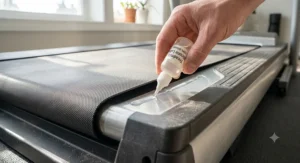
Check your belt tension first: if you can lift the edge of the belt about three inches from the deck with your fingers, you likely won’t need to loosen anything to apply lubricant underneath. If it’s tighter than that, use the Allen wrench most kits include to loosen the rear roller bolts slightly before applying. Apply lubricant in a thin, even line down the center of the deck, working the applicator tube as far under the belt as it will comfortably reach, then repeat lightly along both edges.
Once applied, don’t run the machine at full speed immediately. Power it on at the slowest setting and let it run belt-only for about three minutes to distribute the oil evenly, then walk on it slowly for another three minutes before resuming a normal workout. A common first-30-days mistake is reapplying too soon out of impatience — give the lubricant at least a week of regular use before judging whether the squeak is actually gone, since some residual noise during the break-in period is normal.
✨ Don’t Miss These Exclusive Deals!
🔍 Take your treadmill maintenance routine to the next level with these carefully selected lubricants. Click on any highlighted product to check current pricing and availability before your next tune-up.
Real-World Scenarios: Which Treadmill Lubricant Fits Your Life
If you’re a college student with a compact under-desk walking pad in a 300-square-foot apartment, the Noosa Life or IMPRESA bottle makes the most sense — small footprint, walking-pad compatibility, and a price that doesn’t compete with textbook budgets. You’re not running marathons on it, so a single 4oz bottle will likely outlast the academic year.
If you’re a family of four sharing one NordicTrack Commercial 1750 in the garage, running it five or six days a week between multiple users, the NordicTrack OEM kit or the Lube-N-Walk system make more sense. Higher usage means more frequent friction buildup, and the bundled belt cleaner in the OEM kit addresses dust and sweat accumulation that a lubricant-only product won’t touch.
If you’re maintaining equipment for a small home studio or a shared rental property with a wide commercial-grade deck, the Lube-N-Walk’s 24-inch wand and multi-month supply format is built for exactly that scenario — fewer applications, less repositioning, and a formula backed by decades of OEM partnerships rather than a single product cycle.
How to Choose the Best Treadmill Lubricant
- Confirm it’s 100% silicone. Petroleum-based products like WD-40 will degrade rubber and PVC belt material over time — silicone is the industry standard for a reason.
- Match the applicator to your deck width. Standard 20-inch home decks work fine with a 6-8 inch tube; wider commercial-style decks benefit from an 18-24 inch wand.
- Check brand compatibility explicitly. Some manufacturers, like ICON-family brands, have specific formulation naming that can cause confusion — verify against your owner’s manual.
- Consider bundle value over single bottles. Kits with cloths, spare tubes, or cleaner solve real friction points beyond just the oil itself.
- Weigh cost-per-application, not sticker price. A $30 multi-month system can be cheaper per use than three separate $12 bottles bought over a year.
- Prioritize non-toxic, odorless formulas. Especially relevant in shared living spaces or homes with pets and young children nearby.
- Don’t over-buy capacity you won’t use. A casual three-times-weekly walker rarely needs commercial-grade wand length or multi-month bulk supply.
Silicone Treadmill Lubricant vs Wax-Based and Petroleum Alternatives
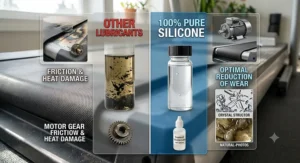
The overwhelming majority of treadmill manufacturers explicitly recommend silicone treadmill lubricant over any other formulation, and the reasoning comes down to chemistry rather than marketing. Silicone oils are transparent, inert chemicals that remain effective across a wide temperature range, from roughly 28°F to 350°F, which means the formula stays stable whether your treadmill lives in a heated basement or an uninsulated garage.
Petroleum-based lubricants, by contrast, are consistently flagged across manufacturer manuals and repair-industry guides as belt-damaging over time, since they can break down PVC and rubber compounds the way silicone doesn’t. Wax-based formulations, which some ICON-family manuals reference, occupy a strange middle ground — some documented parts actually contain silicone despite being labeled “wax-based,” which is more a labeling quirk than a meaningfully different chemistry.
The practical takeaway: unless your specific owner’s manual names a proprietary formula by part number, a 100% silicone treadmill lubricant is the safe, universally compatible default, and it’s what the vast majority of aggregated buyer and repair-technician feedback consistently supports.
Common Mistakes When Buying Treadmill Maintenance Oil
The most frequent mistake is grabbing whatever lubricant is in the garage — WD-40, 3-in-1 oil, or bike chain lube — instead of a treadmill-specific product. These general-purpose oils aren’t formulated for the sustained belt-on-deck friction a treadmill generates and can actually accelerate wear.
A second common error is buying based on bottle size alone without checking the applicator design. A large bottle with a short, stiff tube can be harder to use effectively than a smaller bottle with a longer, flexible wand — volume doesn’t guarantee usability. Reviewers across multiple listings consistently flag applicator quality as more important to satisfaction than raw ounce count.
Third, many buyers skip checking manufacturer-specific compatibility notes entirely, which matters most for ICON-family machines given the wax-versus-silicone naming confusion discussed above. Finally, some shoppers assume “more lubricant is better” and over-apply, which can create a slipping hazard underfoot rather than solving the original friction problem.
Belt Friction Reducer: What to Expect in Real-World Performance
On paper, a belt friction reducer sounds like a single-purpose product, but the real-world experience touches three distinct things: sound, motor load, and belt longevity. The most immediately noticeable change after proper application is acoustic — that rhythmic squeak or thud most owners associate with an “old” treadmill often disappears within the first few minutes of walking after lubrication, assuming the belt tension was correct to begin with.
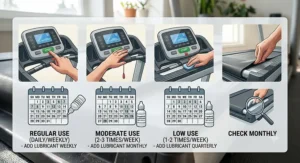
The motor-load benefit is less obvious day-to-day but more important long-term. A dry, high-friction belt forces the drive motor to work harder to maintain consistent speed, and that extra strain compounds over months of use. What reviewers and repair technicians consistently note is that treadmills lubricated on a regular three-to-six-month schedule report fewer motor-related service calls than machines maintained irregularly or not at all.
Belt longevity follows the same logic: friction generates heat, heat accelerates material breakdown, and a properly lubricated belt runs cooler and wears more evenly across its surface. None of this happens instantly — expect gradual improvement over the first week of use rather than a dramatic overnight transformation.
Motor Protection Lubricant: Long-Term Cost & Maintenance ROI
Treadmill motors are, dollar for dollar, the most expensive component to replace on most home units, which is exactly why framing lubricant as a motor protection lubricant rather than a cosmetic noise fix makes financial sense. A replacement drive motor can run into the hundreds of dollars before labor, while a bottle of silicone lubricant applied every three to six months costs a fraction of that over the machine’s entire lifespan.
Running the math: at roughly $12-$20 per bottle and two applications per year, you’re looking at $24-$40 annually in maintenance cost. Compare that to even a moderate motor repair bill, and the return on investment becomes obvious within a single avoided service call. This is precisely the kind of total-cost-of-ownership reasoning Amazon listings themselves never walk you through — they’re built to sell a single SKU, not to model your five-year maintenance budget.
The deeper ROI case is time, not just money. A ten-minute lubrication session every few months is dramatically cheaper than scheduling a repair technician, waiting on parts, or — in a worst-case scenario — replacing the entire machine because a preventable friction issue was ignored for too long.
Deck Conditioning Products: Safety and Compliance Guide
Beyond friction reduction, deck conditioning products play a quieter but important role in overall treadmill safety, since a poorly maintained belt-deck interface can contribute to uneven belt tracking, which itself is a tripping and slipping hazard during use. The U.S. Consumer Product Safety Commission is charged with protecting the public from unreasonable risk of injury associated with thousands of types of consumer products, and exercise equipment maintenance falls squarely within that oversight.
According to CPSC data reported by Consumer Reports, there were an estimated 22,500 treadmill injuries in 2019, with roughly 2,000 of those involving children under eight. While most of those incidents relate to usage behavior rather than lubrication specifically, a well-conditioned deck reduces belt hesitation and unexpected jerking motion — both of which can contribute to loss-of-balance incidents, particularly for less experienced users.
Practically, this means treating deck conditioning as part of a broader safety routine, not an isolated task: pair regular lubrication with checking belt alignment, testing the safety key, and following your model’s recommended clearance guidelines. Always power down and unplug the unit fully before any maintenance, and never substitute a general household oil for a purpose-built treadmill formula, since compatibility issues can create both mechanical and safety risks simultaneously.
Features That Actually Matter (And Those That Don’t)
Applicator tube length and flexibility matter — a lot. This single feature determines whether lubrication takes two minutes or fifteen, and it’s the most consistent differentiator in aggregated buyer feedback across every product on this list. Formula purity (100% silicone, no propellants) also genuinely matters, since additives can affect belt material compatibility.
What matters far less than marketing copy suggests: bottle color, elaborate packaging, and vague “professional-grade” language that isn’t backed by a specific viscosity rating or compatibility list. Brand media mentions, while not meaningless, shouldn’t outweigh concrete specs like tube length, ounce count, and explicit manufacturer compatibility — those are the details that actually affect your maintenance experience three months from now.
Frequently Asked Questions
❓ How often should I lubricate my treadmill belt?
❓ Can I use WD-40 on a treadmill belt instead of silicone lubricant?
❓ How do I know if my treadmill needs lubrication?
❓ Is silicone treadmill lubricant safe around pets and children?
❓ Do I need to loosen the belt before applying lubricant?
Conclusion
Treadmill maintenance rarely feels urgent until the day your motor grinds to a halt mid-workout, and by then the cost of prevention has already come and gone. Whether you land on the budget-friendly IMPRESA bottle, the accessory-loaded SEKODAY kit, or the commercial-grade reach of the Lube-N-Walk system, the underlying goal is the same: keep the belt-deck interface friction-free before it becomes a motor problem instead of a five-minute maintenance task.
The honest truth is that most of these products share very similar core chemistry — 100% silicone, non-toxic, odorless. What actually separates a satisfying purchase from a frustrating one is applicator design, bundle completeness, and brand-specific compatibility, all of which we’ve broken down product by product above. Match your choice to your deck size, usage frequency, and treadmill brand, apply it correctly using the guide above, and you’ll extend the life of your machine for a fraction of what a single motor repair would cost.
Whichever pick you land on, the real win is simply building lubrication into a recurring calendar reminder rather than a reactive fix — your future self, and your treadmill’s motor, will both thank you.
Recommended for You
- Treadmill Mat Thickness: 7 Best Mats Tested for 2026
- 7 Best Extra Large Treadmill Mats for 2026 (Buyer’s Guide)
- Noise Reduction Treadmill Mat: 7 Proven Quiet Picks
Disclaimer: This article contains affiliate links. As an Amazon Associate, I earn from qualifying purchases. If you purchase products through these links, we may earn a small commission at no additional cost to you.
✨ Found this helpful? Share it with your friends! 💬🤗
