
In This Article
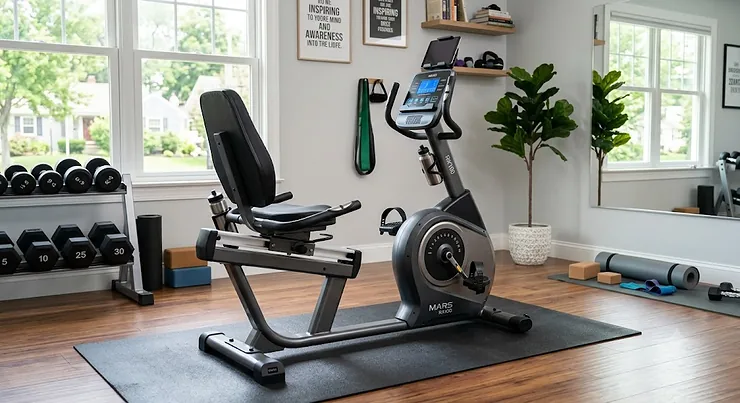
Somewhere between “I should really move more” and “my knees are staging a quiet rebellion,” a lot of people land on the same machine: the recumbent bike. Not the upright kind that makes your sit bones file a formal complaint after ten minutes — the laid-back, bucket-seat, pedal-from-a-recliner kind. And if you’ve started shopping, you’ve probably noticed one word showing up again and again: magnetic.
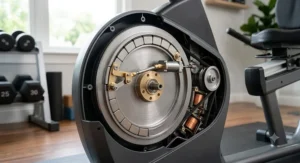
A magnetic recumbent bike uses magnets positioned near (but never touching) a spinning flywheel to create resistance — no felt pads, no brake shoes, no friction wearing down over time. That’s the whole trick, and it’s a good one. It’s why these bikes tend to run quieter, feel smoother, and need less fiddling than their friction-braked cousins. For anyone sharing a wall with a napping toddler, a sleeping night-shift spouse, or a downstairs neighbor with opinions, that quiet matters more than any spec sheet number.
This guide breaks down seven real, currently available models spanning bare-bones budget builds to touchscreen-equipped machines that would look at home in a boutique gym. We’ll get into resistance levels, weight capacities, what reviewers actually report after months of use, and — because a spec sheet only tells half the story — which bike fits which kind of rider. According to the CDC’s physical activity guidelines, adults 65 and older should aim for at least 150 minutes of moderate aerobic activity weekly, and a magnetic recumbent bike happens to be one of the easiest ways to rack up those minutes without your joints sending you a strongly worded memo.
Quick Comparison Table
Before we dig into full reviews, here’s the express-lane version — useful if you already have a rough budget in mind and just want to see who’s in the running.
| Product | Resistance Levels | Weight Capacity | Best For |
|---|---|---|---|
| Marcy ME-709 | 8 levels | 300 lbs | Tightest budget, simple needs |
| Sunny Health & Fitness SF-RB4616 | 8 levels | 300 lbs | Easiest step-through entry |
| YOSUDA RC-PRO | 16 levels | 350 lbs | Quietest operation overall |
| Schwinn 230 | 16 levels | 300 lbs | Best all-around value |
| Horizon Fitness 5.0R | 100 levels | 350 lbs | Most granular resistance control |
| NordicTrack 10 | 26 levels | 350 lbs | Interactive, trainer-led workouts |
| Sole LCR | 40 levels | 350 lbs | Commercial-grade durability |
Look closely and a pattern emerges: resistance-level count roughly tracks price, but it’s not a straight line. What most buyers overlook is that flywheel weight matters just as much as the number of levels — a heavier flywheel (like the Sole LCR’s 30 pounds versus the Marcy’s featherweight internals) delivers a smoother, more momentum-driven pedal stroke regardless of how many notches the dial has. If your priority is simply “quiet and cheap,” the Marcy or Sunny cover it. If you’re planning serious, structured cardio, the Horizon, NordicTrack, or Sole earn their higher price tags.
💬 Already have a favorite from the table above? Scroll down to its full review — or keep reading for the details that actually decide the purchase.
Top 7 Magnetic Recumbent Bikes: Expert Analysis
1. Marcy ME-709 — quietest budget pick under $200
The Marcy ME-709 strips a magnetic recumbent bike down to its essentials, and that simplicity is precisely the point. Its 8 preset resistance levels won’t satisfy anyone chasing a heart-pounding interval session, but for the audience this bike is actually built for, that’s a feature, not a shortfall.
The frame is 14-gauge steel tubing with a powder-coat finish, rated for a 300-pound weight capacity, and the whole unit is light enough — well under 40 pounds — that one person can reposition it without recruiting help. The LCD console tracks time, speed, distance, and calories, nothing more, and the resistance knob sits within easy reach under the handlebars. Based on the spec comparison against pricier machines, you’re trading workout variety for a genuinely tiny footprint and an even tinier price.
This is squarely a rehab-and-recovery bike, or a “just get me moving” first step for someone who hasn’t exercised in a while. Reviewers consistently report that the Marcy ME-709 is quiet enough to use during a phone call and simple enough that a first-time user has zero learning curve. A recurring theme in aggregated feedback: several buyers specifically mention using it post-knee-surgery or with a hip replacement, praising how unintimidating it feels compared to gym equipment.
Pros:
- ✅ Extremely quiet magnetic resistance, even at max level
- ✅ Lightweight frame is easy to move and store
- ✅ Simple step-through design suits limited mobility
Cons:
- ❌ Only 8 resistance levels limits long-term challenge
- ❌ Plastic adjustment components feel less durable
At around $185–$220, the Marcy ME-709 is one of the least expensive genuinely magnetic (not friction) recumbent bikes on the market — solid value if your goal is gentle, consistent movement rather than an athletic training tool.
2. Sunny Health & Fitness SF-RB4616 — easiest step-through entry for beginners
If the Marcy is minimalist, the Sunny Health & Fitness SF-RB4616 is minimalist with a slightly more generous features list. It shares the 300-pound weight capacity and step-through frame design, but adds a digital monitor tracking heart rate alongside the usual time, speed, distance, and calorie metrics.
The one-piece main chassis (rather than a two-piece frame some competitors use) contributes to a sturdier overall feel, and the belt-drive mechanism pairs with adjustable magnetic resistance for a workout that ramps smoothly rather than jumping in jarring increments. Here’s what to weigh: at roughly 59 pounds assembled, it’s light enough to reposition solo, yet stable enough that reviewers don’t report the wobble sometimes associated with ultra-budget bikes.
Who should care about this one specifically? Anyone prioritizing ease of mounting and dismounting above all else. The step-through design — no bar to swing a leg over — removes a real barrier for people managing balance concerns or recovering from surgery. Aggregated review sentiment skews strongly toward “quiet operation” and “easy assembly,” with the recurring caveat that the exercise meter is basic and the workout guidance is essentially nonexistent.
Pros:
- ✅ Sturdy one-piece frame despite the low price
- ✅ Step-through design ideal for limited mobility
- ✅ Quiet belt-driven magnetic resistance system
Cons:
- ❌ Minimal console feedback compared to smart models
- ❌ Resistance range skews toward light-to-moderate only
Priced in the $220–$280 range depending on retailer promotions, the Sunny Health & Fitness SF-RB4616 is a fair pick for anyone who wants a no-nonsense entry point without sacrificing the smooth pedal feel magnetic resistance is known for.
3. YOSUDA RC-PRO — quietest operation in this lineup
Here’s a spec worth sitting with for a second: the YOSUDA RC-PRO is rated under 15 decibels during operation. For context, that’s quieter than a whispered conversation and well below the ambient hum of a typical refrigerator. This is genuinely whisper-quiet operation, not marketing shorthand for “pretty quiet.”
Sixteen resistance levels give it real range — enough to start gentle and progress meaningfully over months, supporting up to 60 pounds of resistance load at the top end. The 350-pound weight capacity outpaces both budget picks above, and the frame is built from what YOSUDA describes as light commercial-grade steel. Seat and backrest adjust via a side handle you can operate mid-workout, without dismounting to fumble with a pin.
What most buyers overlook about this model is the inclusion of detachable resistance bands, letting you fold upper-body work into the same session — a small but genuinely useful transformation from “just legs” to a fuller-body low-impact circuit. The brand, which has been manufacturing exercise equipment for roughly two decades, clearly built this specifically with rehab and senior use cases in mind. Reviewers consistently note the near-silent ride and describe being able to watch TV or take calls mid-workout without raising the volume.
Pros:
- ✅ Noise level under 15dB — quietest bike in this roundup
- ✅ 16 resistance levels with real progression range
- ✅ Detachable bands enable upper-body engagement
Cons:
- ❌ Console lacks app-based workout programming
- ❌ Assembly instructions get mixed feedback on clarity
Expect a price somewhere in the $290–$360 range. For anyone whose top priority is silent recumbent exercise bike performance — apartment dwellers, shared households, early-morning or late-night riders — this is the standout in its price tier.
4. Schwinn 230 — best all-around value for daily use
The Schwinn 230 occupies a comfortable middle ground: not the cheapest, not the fanciest, but consistently the bike reviewers recommend when someone just wants a reliable daily-use machine without overpaying for features they’ll never touch.
Sixteen levels of magnetic resistance run through a perimeter-weighted flywheel, which — based on the spec comparison with lighter competitors — keeps in-workout noise and vibration low even at higher settings. Thirteen built-in programs range from genuinely gentle to legitimately demanding, and Bluetooth connectivity pairs with heart-rate straps (though not with music or streaming apps, a distinction worth knowing before you assume otherwise). The 300-pound weight capacity sits mid-pack, and the 80-pound frame weight strikes a fair balance between stability and portability.
The independent testing at BarBend found the flywheel-driven resistance kept mechanical noise minimal across the full resistance range, which lines up with what everyday owners report. This is the bike for someone who wants a “just works” daily cardio habit — not a data-obsessed quantified-self project, but a dependable machine that survives years of regular use. A common thread in aggregated feedback: buyers like the vented, contoured seat for long sessions, but wish the console had backlighting for dim rooms.
Pros:
- ✅ Smooth, quiet resistance across 16 levels
- ✅ 13 workout programs suit varied fitness goals
- ✅ Ventilated seat improves comfort on long rides
Cons:
- ❌ No backlit display makes low-light reading harder
- ❌ Bluetooth limited to heart-rate straps only
At around $450–$550, the Schwinn 230 delivers the best cost-per-feature ratio in this entire lineup — the model we’d point a first-time buyer toward if they refuse to overthink the decision.
5. Horizon Fitness 5.0R — most granular resistance control
Where most recumbent bikes offer a dial with a dozen or two clicks, the Horizon Fitness 5.0R offers 100 discrete resistance levels through an electronically controlled magnetic system. In practice, this means resistance changes arrive in tiny, almost imperceptible increments rather than noticeable jumps — useful for anyone doing interval training who wants precise control rather than “level 6 feels like a wall after level 5.”
A 15-pound flywheel is heavier than the Schwinn’s or Yosuda’s, translating to a smoother, more momentum-carried pedal stroke, and the 350-pound weight capacity plus lifetime frame warranty signal a machine built for the long haul. USB charging, a built-in cooling fan, and Bluetooth round out the feature set, though — like the Schwinn — this isn’t a touchscreen, app-driven experience.
Here’s what the spec sheet won’t tell you outright: that jump from 16 or 20 levels to 100 sounds like a marketing gimmick until you actually use it for progressive overload training over several months, at which point the fine-grained control becomes genuinely valuable rather than a vanity number. This is the pick for someone who’s outgrown entry-level bikes and wants to keep progressing without upgrading to a $1,500 machine. On paper this means slower resistance jumps translate to a workout that scales more naturally as your fitness improves — you’re not stuck choosing between “too easy” and “brutal.”
Pros:
- ✅ 100 resistance levels allow ultra-fine intensity control
- ✅ Heavier 15 lb flywheel smooths the pedal stroke
- ✅ Lifetime frame warranty signals long-term confidence
Cons:
- ❌ Heavier unit (123 lbs) is harder to reposition
- ❌ No touchscreen or streaming workout content
Pricing generally lands in the $600–$900 range depending on promotions. If maintenance-free resistance and long-term progression matter more to you than flashy tech, the Horizon Fitness 5.0R quietly outperforms machines that cost considerably more.
6. NordicTrack 10 Recumbent Bike — best for interactive, trainer-led workouts
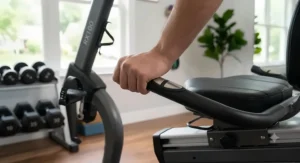
The NordicTrack 10 Recumbent Bike is where this category starts looking less like home gym equipment and more like a small entertainment system that happens to have pedals. A 10-inch HD touchscreen streams iFIT’s library of trainer-led sessions, and Silent Magnetic Resistance automatically adjusts across 26 levels to match whatever the on-screen trainer is doing — climb a hill in a Scottish Highlands ride, and the resistance quietly ramps with the terrain.
That automation is the real differentiator here. Rather than manually dialing resistance up or down, SmartAdjust technology personalizes future sessions based on how you’ve responded to past ones. An AutoBreeze fan syncs its speed to workout intensity, and the 350-pound weight capacity plus Bluetooth heart-rate compatibility round out a genuinely feature-dense package. What most buyers overlook is that the iFIT subscription (around $39 monthly after a 30-day trial) is where the real value lives — without it, you still get a competent manual-mode magnetic recumbent bike, but a meaningfully less interesting one.
Reviewers who’ve spent extended time on it consistently describe the resistance system as close to silent, something borne out by independent testing from Garage Gym Reviews, which rated it the top overall recumbent bike in its category. The tradeoff is bulk: at 186 pounds and over 5.5 feet long, this is not a bike you casually shuffle out of the way after each session.
Pros:
- ✅ 26-level Silent Magnetic Resistance auto-adjusts to workouts
- ✅ 10-inch touchscreen streams thousands of guided sessions
- ✅ AutoBreeze fan and heart-rate tracking add real polish
Cons:
- ❌ Full experience requires an ongoing iFIT subscription
- ❌ Heavy and large — not easily repositioned solo
Expect a price in the $1,400–$1,600 range for the hardware alone. This is the choice for someone who wants structure, coaching, and variety built directly into the ride rather than supplied by willpower alone.
7. Sole LCR Recumbent Bike — commercial-grade build for serious daily riders
If the NordicTrack sells the experience, the Sole LCR Recumbent Bike sells the engineering. A 30-pound flywheel — nearly double the weight of the Horizon’s — combined with 40 resistance levels produces what reviewers repeatedly describe as the smoothest pedal stroke in the recumbent category at any price. The frame, built from roughly 125 pounds of steel tubing with an aluminum layer, supports a 350-pound weight capacity and is backed by a lifetime frame warranty alongside multi-year coverage on parts and electronics.
Console-wise, a 10.1-inch touchscreen pairs with the Sole+ app (no subscription required to use its base content), wireless device charging, and Bluetooth speakers. Ten preset programs plus custom user-defined workouts give structure without locking you into a monthly fee the way the NordicTrack does. Based on the spec comparison, the frictionless magnetic system here is virtually silent regardless of resistance level — a direct byproduct of that heavier flywheel doing more of the mechanical work.
This is the bike for someone who plans to use it daily for years, potentially in a light-commercial setting like a small studio, physical therapy clinic, or multi-person household, and wants the reassurance of near-indestructible hardware. Aggregated reviewer sentiment is consistently strong on comfort and quiet operation, with the most common critique being that the backrest angle isn’t adjustable — a minor gripe against an otherwise premium package.
Pros:
- ✅ 40 levels of smooth, whisper-quiet magnetic resistance
- ✅ Heavy-duty steel frame with lifetime warranty
- ✅ No subscription required to use onboard workout content
Cons:
- ❌ Backrest angle is fixed, not adjustable
- ❌ Among the heaviest and priciest bikes here (~150 lbs)
Pricing typically sits around $1,400–$1,600. For buyers who see this as a long-term investment rather than a trial purchase, the Sole LCR is arguably the best-built magnetic recumbent bike money can currently buy in the home category.
Real-World Scenarios: Which Magnetic Recumbent Bike Fits Your Life
Specs matter, but they mean little until you match them to an actual person’s actual living room. Consider three composite profiles drawn from common buyer patterns.
The recovering knee-replacement patient, roughly 68, living alone, needs low resistance, an easy step-through mount, and near-silent operation so early-morning sessions don’t wake anyone. The Marcy ME-709 or Sunny Health & Fitness SF-RB4616 fit this brief precisely — cheap enough that the investment feels low-risk, gentle enough that early rehab sessions aren’t intimidating.
The budget-conscious remote worker squeezing in 30-minute rides between video calls wants something quiet enough to use mid-workday without becoming a background-noise problem on Zoom. Both the YOSUDA RC-PRO, with its sub-15dB rating, and the Schwinn 230 handle this well, though the Yosuda edges ahead purely on noise floor.
The serious home-gym builder training five days a week for months on end wants a machine that won’t feel outgrown by month four. Here, the Horizon Fitness 5.0R‘s 100-level resistance, or the Sole LCR‘s heavyweight flywheel and commercial-grade warranty, make more financial sense than a budget bike that gets abandoned once its resistance ceiling stops being challenging.
Matching your actual routine — not your aspirational one — to the right resistance range and build quality prevents the single most common regret buyers report: outgrowing a bike within the first year.
Problem → Solution Guide for Magnetic Recumbent Bike Owners
Even a well-reviewed bike runs into predictable snags. Here’s how to handle the five most common ones.
Problem: The resistance feels inconsistent between sessions. This is usually a calibration or seating issue rather than a hardware fault — on most magnetic systems, the resistance dial or digital setting resets to a default level after power-off, so double-check your selected level each time rather than assuming the machine remembers.
Problem: The seat feels uncomfortable after 20+ minutes. Look at seat-slider adjustment before blaming the padding; on bikes like the Schwinn 230 or YOSUDA RC-PRO, a seat positioned too far forward or back changes knee angle and pressure distribution significantly.
Problem: The console display is hard to read. Several budget and mid-range models, including the Schwinn 230, skip backlighting entirely — positioning the bike away from direct glare or adding a small clip-on light solves this cheaply.
Problem: The bike wobbles slightly on hard flooring. Nearly every model in this guide ships with adjustable stabilizer feet; re-leveling them after moving the bike, even a few inches, resolves the vast majority of reported wobble complaints.
Problem: Heart-rate readings from grip sensors seem inaccurate. Grip-based sensors are inherently less precise than chest straps — if accuracy matters for your training, pair a Bluetooth chest strap with models like the NordicTrack 10 or Horizon 5.0R rather than relying on handlebar contacts alone.
How to Choose a Magnetic Recumbent Bike
What is a magnetic recumbent bike? It’s a stationary exercise bike with a reclined seating position and a resistance system that uses magnets — rather than friction pads — to control pedaling difficulty, producing a quieter, smoother, lower-maintenance ride than older friction-braked designs.
Choosing between models gets easier once you rank these criteria in order of personal priority:
- Weight capacity — confirm the bike’s rated limit comfortably exceeds your body weight; most models here range from 300 to 350 pounds.
- Resistance range and increments — more levels generally mean finer control, but a heavier flywheel matters just as much for smoothness.
- Noise level — critical if you live in an apartment, share walls, or plan to exercise early or late; look specifically for stated decibel ratings.
- Seat and step-through design — a step-through frame meaningfully reduces mounting difficulty for anyone with balance or mobility concerns.
- Console features and connectivity — decide honestly whether you’ll use a touchscreen and subscription service, or whether a simple LCD display covers your needs.
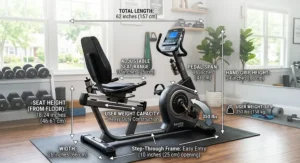
- Footprint and portability — measure your space before assuming a bike will fit, especially with heavier, non-folding models like the Sole LCR.
- Warranty length — a lifetime frame warranty, common among the pricier picks here, signals real manufacturer confidence in long-term durability.
Common Mistakes When Buying a Magnetic Recumbent Bike
The most frequent misstep is buying based on resistance-level count alone. A bike with 100 levels but a light flywheel can feel less substantial under load than one with 40 levels and heavier internals — the number on the box doesn’t tell the whole story.
A second common error: ignoring footprint until after delivery. Recumbent bikes are inherently longer than upright models, and a 67-inch machine simply doesn’t fit in every corner of a small apartment. Measure first.
Third, buyers frequently underestimate ongoing costs. A NordicTrack 10 purchase price doesn’t include the iFIT subscription that unlocks most of its advertised value — factor that recurring cost into your total budget rather than discovering it after the free trial ends.
Finally, some buyers assume “quiet” is universal across all magnetic bikes. It isn’t. Noise levels vary meaningfully by flywheel design and build quality, which is exactly why the YOSUDA RC-PRO’s sub-15dB rating is worth calling out specifically rather than assuming every magnetic system performs identically.
Magnetic Recumbent Bike vs Upright Exercise Bike
The core tradeoff comes down to body position. A magnetic recumbent bike positions you in a reclined seat with back support and pedals extended forward, distributing weight across a wider seat and reducing pressure on the lower back and knees. An upright bike mimics traditional cycling posture — pedals below you, more core engagement, generally a smaller footprint.
For anyone managing joint pain, recovering from surgery, or simply prioritizing comfort over calorie-burn-per-minute, the recumbent format wins clearly. Research summarized by Harvard Health found that lower-impact aerobic exercise, cycling included, was the most effective exercise category for easing knee osteoarthritis pain across more than 200 clinical trials. That evidence lines up with why recumbent bikes dominate senior-focused and rehab-focused buying guides.
Upright bikes still win on space efficiency and, for some riders, a slightly higher calorie burn at matched effort due to greater core and stabilizer-muscle involvement. But for the audience shopping specifically for a magnetic recumbent bike — usually prioritizing comfort, joint-friendliness, and quiet — the format’s tradeoffs (larger footprint, marginally lower calorie burn) are typically an acceptable price for the comfort gained.
What to Expect: Real-World Performance
Spec sheets describe potential; real-world performance describes what actually happens when you sit down and pedal. Across every bike in this guide, the honest experience breaks down consistently: budget models (Marcy, Sunny) deliver genuinely smooth, quiet resistance but plateau quickly for anyone building fitness over months. Mid-range picks (YOSUDA, Schwinn) hold up well for daily use over a year or more, with noise staying low even as resistance increases. Premium models (Horizon, NordicTrack, Sole) maintain smoothness at their highest resistance settings in a way cheaper flywheels simply can’t replicate — heavier moving mass translates directly into steadier momentum.
Noise deserves a specific callout, since “quiet” gets thrown around loosely in product descriptions. The YOSUDA RC-PRO’s documented sub-15dB rating sits below normal library-level ambient noise. For context on that scale, a NIOSH-published noise reference puts an ordinary whisper at roughly 30 decibels — meaning a magnetic recumbent bike rated under 15dB is genuinely operating below whisper-level sound, not just “quieter than a treadmill.”
Magnetic Recumbent Bike for Seniors
Recumbent design solves two problems seniors care about most: fall risk and joint strain. The reclined seat with full back support removes the balance demands of an upright bike, while the seated, supported position reduces impact on hips, knees, and ankles compared to walking or running.
For noise-free senior cardio specifically, the YOSUDA RC-PRO and Marcy ME-709 stand out — both operate quietly enough for early-morning or shared-household use, and both feature step-through frames that eliminate the need to swing a leg over a center bar. The Arthritis Foundation specifically recommends cycling as a low-impact option that strengthens muscles supporting the knees and hips without the pounding associated with higher-impact cardio.
Practical guidance for older riders: start at the lowest resistance level regardless of prior fitness, prioritize models with adjustable seat depth to protect knee alignment, and favor step-through frames over models requiring a higher mounting motion. A grip-based pulse sensor, standard across most models here, gives a reasonable heart-rate estimate for pacing purposes without requiring a separate chest strap.
Long-Term Cost & Maintenance
One underappreciated advantage of magnetic resistance: it’s largely maintenance-free resistance by design. Because the magnets never physically contact the flywheel, there’s no friction pad wearing down, no brake shoe replacement, and no gradual resistance drift the way older friction-braked bikes experience over years of use.
Realistic total cost of ownership still includes a few line items. Budget models like the Marcy or Sunny typically need nothing beyond occasional bolt tightening and pedal strap replacement over a multi-year lifespan. Mid-range and premium bikes with electronics — Bluetooth modules, touchscreens, cooling fans — carry a small risk of component failure, which is precisely why warranty length matters so much in the buying decision. The NordicTrack 10’s ongoing iFIT subscription is the one genuinely recurring cost in this lineup, running about $39 monthly, and should be weighed against the hardware price when comparing total value against subscription-free models like the Sole LCR.
Across a five-year ownership window, a $250 budget bike and a $1,500 premium bike can end up surprisingly close in true cost-per-year once you factor in subscription fees versus a longer usable lifespan — the math depends entirely on how heavily and how long you actually ride.
Price Range & Value Analysis
| Product | Price Range | Value Verdict |
|---|---|---|
| Marcy ME-709 | Under $220 | Best entry price for light rehab use |
| Sunny Health & Fitness SF-RB4616 | $220–$280 | Strong value for step-through ease |
| YOSUDA RC-PRO | $290–$360 | Best noise-to-price ratio |
| Schwinn 230 | $450–$550 | Best overall daily-use value |
| Horizon Fitness 5.0R | $600–$900 | Best long-term progression value |
| NordicTrack 10 | $1,400–$1,600 | Best if you’ll actually use iFIT |
| Sole LCR | $1,400–$1,600 | Best build quality per dollar long-term |
The clearest value inflection point sits between the Schwinn 230 and the Horizon Fitness 5.0R — roughly $150–$300 more buys you a meaningfully heavier flywheel and tenfold the resistance granularity, which matters if you plan to train consistently for years rather than months. Above that, the jump to NordicTrack or Sole pricing is really a bet on either interactive coaching (NordicTrack) or raw mechanical longevity (Sole), not a linear improvement in “workout quality.”
✨ Don’t Miss These Exclusive Deals!
🔍 Ready to stop scrolling and start pedaling? Click through to check current pricing and availability on any bike above — availability and promotions shift often, so it’s worth a quick look before you decide.
Buyer’s Decision Framework
If you’re recovering from surgery or managing joint pain, choose a step-through model with low starting resistance (Marcy or Sunny) because ease of mounting and gentle progression matter more than resistance ceiling.
If noise is your top concern — apartment living, shared walls, early workouts — choose the YOSUDA RC-PRO because its sub-15dB rating is the quietest documented spec in this category.
If you want a dependable daily-use bike without overpaying, choose the Schwinn 230 because it balances price, resistance range, and comfort better than anything cheaper or pricier in this lineup.
If you’re training seriously and expect to outgrow entry-level resistance within a year, choose the Horizon Fitness 5.0R or Sole LCR because their heavier flywheels and higher resistance ceilings support long-term progression.
If structured, coached workouts keep you motivated more than self-directed training, choose the NordicTrack 10 because its iFIT integration automates resistance and program selection for you.
Frequently Asked Questions
❓ How loud is a magnetic recumbent bike?
❓ Do magnetic recumbent bikes need maintenance?
❓ Is a magnetic recumbent bike good for bad knees?
❓ What resistance level should beginners start on?
❓ How much does a good magnetic recumbent bike cost?
Conclusion
A magnetic recumbent bike isn’t a glamorous purchase, and that’s sort of the appeal. It’s the piece of equipment that quietly — literally — earns its keep by making daily movement feel achievable instead of punishing. Whether that means the no-frills Marcy ME-709 getting someone through the first shaky weeks after knee surgery, or the Sole LCR anchoring a five-day-a-week training habit for the next decade, the right pick comes down to matching resistance range, noise tolerance, and budget to how you’ll actually use it — not how you imagine you might.
If you take one thing from this guide, let it be this: don’t buy for the fitness level you wish you had. Buy for the one you’re starting from, with room to grow. Every bike here does its core job — smooth, quiet, low-impact cardio — reliably well. The differences are really about how much runway you want built in.
Recommended for You
- Recumbent Bike With Arm Exercisers: 7 Best Picks for 2026
- 7 Best Recumbent Bikes for Back Pain in 2026
- Recumbent Bike vs Upright: 7 Best Options Compared (2026)
Disclaimer: This article contains affiliate links. As an Amazon Associate, I earn from qualifying purchases. If you purchase products through these links, we may earn a small commission at no additional cost to you.
✨ Found this helpful? Share it with your friends! 💬🤗
