
In This Article
✨Was this helpful? Spread the word! 🚀
When summer hits and your above ground pool beckons, the last thing you want is to spend hours manually scrubbing and vacuuming. Yet here’s what countless pool owners discover: not all above ground pool cleaners are created equal. After testing numerous models and analyzing thousands of customer reviews, I’ve uncovered which cleaners actually deliver on their promises.
The reality is harsh – many budget pool cleaners barely move around your pool, while others get stuck in corners or break down within months. Meanwhile, some premium models offer features you’ll never use, making them expensive overkill for above ground pools. However, the right cleaner transforms pool maintenance from a tedious chore into a simple “set it and forget it” operation.
This comprehensive guide examines seven proven above ground pool cleaners across different categories and budgets. From powerful robotic models that climb walls to simple suction cleaners that won’t break the bank, you’ll discover exactly which cleaner matches your specific needs, pool type, and maintenance preferences.
Understanding Above Ground Pool Cleaning Technology 🏊♂️
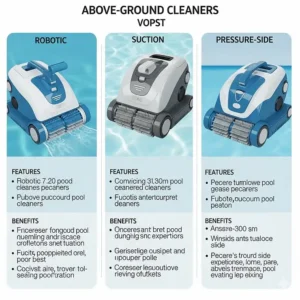
Above ground pools present unique cleaning challenges compared to their inground counterparts. Nevertheless, modern technology has evolved to address these specific requirements. Suction-side cleaners remain the most affordable option, utilizing your pool’s existing filtration system to power movement and debris collection. However, they require adequate pump power and can strain older filtration systems.
Robotic cleaners represent the premium category, featuring independent motors, advanced navigation systems, and dedicated filtration. Furthermore, they operate separately from your pool’s circulation system, making them ideal for pools with smaller pumps. The latest cordless models offer unprecedented convenience, though they come with charging requirements and battery limitations.
Pressure-side cleaners use return jets to propel themselves around the pool, typically requiring a booster pump for optimal performance. Although less common for above ground pools, they excel at capturing large debris like leaves and acorns. Manual and semi-automatic options bridge the gap between full automation and hand cleaning.
Industry Applications and Professional Use Cases
Commercial facilities increasingly rely on automated cleaning solutions to maintain water quality standards while controlling labor costs. Pool service professionals typically prefer corded robotic cleaners for their reliability and consistent performance across multiple client locations. Additionally, rental properties and vacation homes benefit from low-maintenance cleaning systems that operate independently.
Residential applications vary significantly based on pool usage patterns, surrounding environment, and owner preferences. For instance, pools surrounded by trees require cleaners capable of handling large volumes of organic debris, while pools in open areas may prioritize fine particle filtration. Urban pool owners often prefer quieter electric models, whereas rural locations can accommodate louder suction-based systems.
The healthcare and therapy sector utilizes specialized cleaning protocols to maintain hygienic conditions for aquatic rehabilitation programs. Moreover, competitive swimming facilities demand precise water clarity that only certain high-end robotic systems can consistently deliver. Educational institutions balance cost-effectiveness with reliability when selecting cleaning equipment for campus pools.
Advanced Technical Analysis of Pool Cleaning Systems ⚡
Modern pool cleaning technology integrates sophisticated engineering principles to achieve optimal performance. Suction dynamics play a crucial role in debris pickup efficiency, with venturi effects amplifying cleaning power in well-designed models. Computational fluid dynamics simulations have revolutionized nozzle designs, creating more effective water flow patterns that capture both heavy and lightweight contaminants.
Robotic navigation systems utilize advanced algorithms similar to those found in autonomous vehicles. Simultaneous Localization and Mapping (SLAM) technology enables cleaners to build real-time pool maps while avoiding obstacles and optimizing cleaning paths. Machine learning capabilities allow modern units to adapt to specific pool shapes and develop more efficient cleaning patterns over time.
Battery technology advances have enabled cordless operation, with lithium-ion cells providing extended runtime and faster charging cycles. However, thermal management remains critical, as pool environments present unique challenges for battery longevity and safety. Recent developments include integrated battery management systems that prevent overheating and extend operational life.
Scientific research indicates that particle size significantly impacts cleaning effectiveness, with studies showing optimal performance occurs when cleaner suction matches debris characteristics. For example, fine silt requires different filtration approaches compared to larger organic matter. Additionally, water chemistry affects cleaning performance, as pH levels and sanitizer concentrations influence debris suspension and filter efficiency.
Emerging Technology Trends and Innovation
Artificial intelligence integration represents the next frontier in pool cleaning automation. Smart sensors can detect water clarity changes and automatically adjust cleaning intensity accordingly. Furthermore, IoT connectivity enables remote monitoring and predictive maintenance alerts through smartphone applications.
Solar-powered cleaning systems are gaining traction as sustainable alternatives to traditional electric models. Advanced photovoltaic cells combined with efficient motor designs allow continuous operation during daylight hours. However, performance varies significantly based on geographic location and seasonal sunlight availability.
Biomimetic designs inspired by aquatic creatures offer improved maneuverability and energy efficiency. Engineers study fish swimming patterns to optimize propulsion systems and reduce power consumption. These innovations particularly benefit above ground pools where efficient movement through confined spaces proves challenging.
Top 7 Best Above Ground Pool Cleaners – Expert Reviews
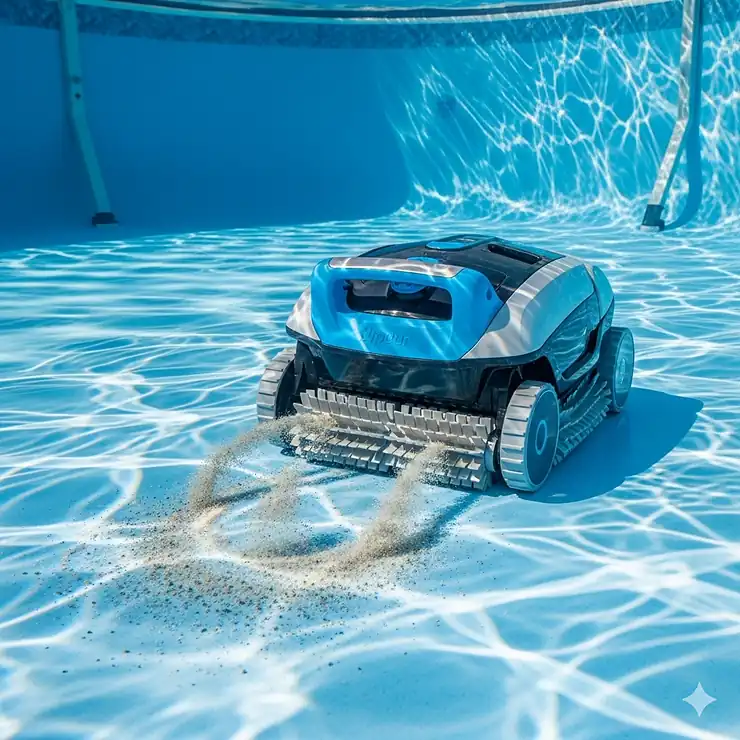
1. Dolphin Escape Robotic Pool Cleaner – Best Overall 🏆
The Dolphin Escape Robotic Pool Cleaner stands as the undisputed champion for above ground pools, combining professional-grade performance with user-friendly operation. Priced around $599, this corded robotic cleaner delivers exceptional value through its advanced SmartNav 2.0 navigation system and powerful dual 24V DC motors that filter over 4,000 gallons per hour.
Technical Specifications:
- Coverage: Above ground and inground pools up to 33 feet
- Motors: Dual 24V DC motors with 180W power consumption
- Navigation: SmartNav 2.0 with D7 microprocessor
- Filter: MaxBin with 50% larger capacity than standard units
- Cord Length: 40 feet tangle-resistant cable
- Cleaning Cycle: 1.5 hours standard cycle
- Weight: 14 pounds for easy handling
- Warranty: 2-year manufacturer coverage
The Dolphin Escape utilizes HyperBrush technology that scrubs at twice the speed of conventional systems, effectively removing stubborn algae and embedded debris. Its HyperGrip tracks provide superior traction on all pool surfaces, enabling wall climbing capabilities up to partial height. Unlike cordless models that require daily charging, this corded design offers consistent power and weekly automated scheduling.
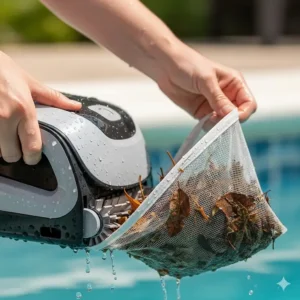
Customer feedback consistently praises its reliability, with many users reporting years of trouble-free operation. The MaxBin filter system simplifies maintenance through top-loading access and easy debris removal. Additionally, the unit’s energy efficiency translates to operational costs of approximately 5 cents per hour, making it economically attractive for regular use.
Pros:
✅ Exceptional cleaning performance on floors and walls
✅ Advanced navigation prevents missed spots
✅ Energy-efficient operation saves money
✅ Large filter capacity reduces maintenance frequency
✅ Professional-grade reliability and durability
Cons:
❌ Higher upfront investment than basic models
❌ Requires dedicated electrical outlet near pool
❌ No smartphone app control features
2. AIPER Scuba S1 Cordless Robotic Pool Cleaner – Best Cordless Option 🔋
The AIPER Scuba S1 Cordless Robotic Pool Cleaner represents the evolution of battery-powered cleaning technology, offering unprecedented freedom from cords and power outlets. Available for approximately $498-570 on Amazon, this innovative cleaner covers pools up to 1,600 square feet with its advanced WavePath Navigation 2.0 system.
Technical Specifications:
- Coverage: Inground and above ground pools up to 1,600 sq ft
- Battery: Rechargeable lithium-ion with 150-minute runtime
- Navigation: WavePath Navigation 2.0 with smart routing
- Cleaning Modes: Auto, Eco, Floor-only, Wall-only
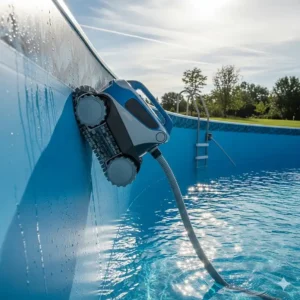
- Climbing Ability: Up to 105° wall climbing
- Suction Power: 70 GPM with quad-motor system
- Caterpillar Treads: Durable rubber tracks for traction
- Warranty: 2-year product protection coverage
The AIPER Scuba S1 features caterpillar treads that provide exceptional mobility across various pool surfaces, easily navigating drains, steps, and corners. Its four distinct cleaning modes allow customization based on specific maintenance needs, with Eco mode offering extended runtime for routine cleaning. The generously sized filter basket captures both large debris and fine particles effectively.
However, recent safety concerns surrounding cordless pool cleaners warrant careful consideration. Multiple reports of battery-related incidents, including fires and recalls of similar AIPER models, highlight potential risks associated with lithium-ion technology in aquatic environments. While the company offers warranty protection, these safety considerations may influence purchasing decisions.
Pros:
✅ Complete freedom from power cords and outlets
✅ Multiple cleaning modes for versatility
✅ Wall and waterline cleaning capabilities
✅ Smart navigation avoids obstacles efficiently
✅ Easy retrieval with integrated handles
Cons:
❌ Requires daily charging for regular use
❌ Limited runtime compared to corded models
❌ Safety concerns with lithium-ion batteries in water
❌ Higher long-term maintenance costs
3. Pentair Kreepy Krauly E-Z Vac – Best Budget Suction Cleaner 💰
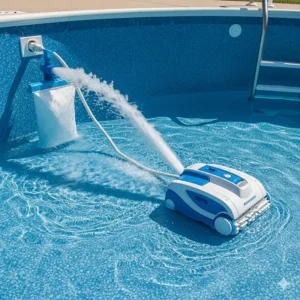
The Pentair Kreepy Krauly E-Z Vac proves that effective pool cleaning doesn’t require a massive investment. This suction-side cleaner, priced around $120-150, builds upon the legendary Kreepy Krauly platform that has served over 3 million pool owners worldwide. Designed specifically for above ground pools, it delivers reliable performance through time-tested engineering.
Technical Specifications:
- Pool Compatibility: Above ground pools, flat and dished bottoms
- Hose Length: 32 feet included
- Moving Parts: Single flapper mechanism
- Flow Regulation: Built-in skimming valve
- Installation: Tool-free setup in minutes
- Surface Types: Vinyl, fiberglass, and other above ground materials
- Pump Requirements: Compatible with most standard filter pumps
- Maintenance: Minimal with few replacement parts needed
The Pentair E-Z Vac operates through your pool’s existing filtration system, requiring adequate pump capacity for optimal performance. Its hydraulic design creates superior vacuum power while the single moving part (flapper) ensures long-term reliability with minimal maintenance requirements. The built-in flow regulation valve automatically adjusts water flow for proper cleaning speed.
This cleaner excels in pools with consistent debris patterns and adequate pump power. Users appreciate its simplicity and durability, with many reporting years of reliable service. However, performance depends heavily on proper pump sizing and pool hydraulics. Additionally, it may struggle with very fine debris that requires specialized filtration.
Pros:
✅ Extremely affordable initial investment
✅ Minimal maintenance with simple design
✅ Works with existing pool filtration system
✅ No electricity required for operation
✅ Proven reliability over decades of use
Cons:
❌ Requires adequate pump capacity
❌ Limited to floor cleaning only
❌ May struggle with fine debris
❌ No advanced navigation features
4. Pentair Kreepy Krauly Lil Shark – Best for Small Pools 🦈
The Pentair Kreepy Krauly Lil Shark specifically targets above ground pool owners who want more aggressive cleaning than basic suction models provide. This compact cleaner features a unique dual-action design that combines powerful suction with scrubbing bristles, making it ideal for pools up to 15 feet in diameter.
Technical Specifications:
- Pool Size: Above ground pools up to 15 feet diameter
- Cleaning Path: 10-inch wide coverage
- Bristles: Dual-band scrubbing system
- Installation: Connects directly to skimmer
- Design: No wheels, diaphragms, or complex parts
- Weight: Lightweight for easy handling
- Maintenance: Self-adjusting operation
- Surface Compatibility: All above ground pool types
The Lil Shark distinguishes itself through high-performance two-way cleaning that vacuums tough grime while scrubbing surfaces clean. Its bristled design loosens stubborn debris that simple suction cannot remove, making it particularly effective for pools with algae issues or heavy contamination. The wide cleaning path covers more area per pass, reducing overall cleaning time.
Customer experiences vary significantly based on pool setup and pump capacity. Some users report excellent performance in round above ground pools, while others encounter issues with navigation around stairs or obstacles. The unit’s tendency to get stuck in certain pool configurations may require manual intervention or blocking off problem areas.
Pros:
✅ Aggressive scrubbing action removes tough debris
✅ Wide cleaning path for efficiency
✅ No complex parts to maintain or replace
✅ Designed specifically for above ground pools
✅ Lightweight and easy to handle
Cons:
❌ May get stuck around stairs or obstacles
❌ Limited to smaller pool sizes
❌ Requires strong pump for optimal performance
❌ No advanced navigation capabilities
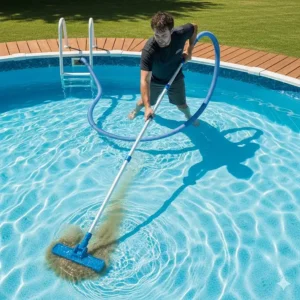
5. Bestway FlowClear AquaDrift Automatic Pool Vacuum – Most Affordable Automatic Option 🎯
The Bestway FlowClear AquaDrift Automatic Pool Vacuum offers automatic cleaning at an incredibly accessible price point, typically under $50. Designed specifically for Bestway above ground pools up to 22 feet in diameter, this water-propelled cleaner provides hands-off operation for budget-conscious pool owners.
Technical Specifications:
- Pool Compatibility: Above ground pools up to 22 feet diameter
- Pump Requirements: 1,500-3,200 GPH flow rate
- Navigation: Multi-directional wheels with 3 adjustment settings
- Power Source: Water-powered operation
- Features: Built-in brush, debris collection basket
- Installation: Connects to filter pump return
- Maintenance: Easy basket removal and cleaning
- Flow Control: Adjustable for different pump capacities
The AquaDrift utilizes water pressure from your filter pump to propel itself around the pool bottom, with anti-slip wheels that change direction automatically for comprehensive coverage. Its adjustable settings accommodate various pump capacities and cleaning requirements. The integrated brush helps collect debris such as dirt, leaves, and sand before they reach your main filter.
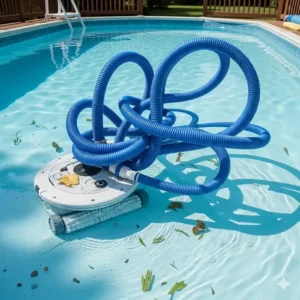
Performance reviews reveal mixed results largely dependent on pool configuration and pump compatibility. Many users appreciate the set-and-forget convenience, while others report issues with tangling hoses or inadequate movement. The cleaner works best in simple pool shapes without significant obstacles or varying depths.
Pros:
✅ Extremely affordable price point
✅ No electricity required for operation
✅ Automatic operation reduces manual effort
✅ Easy maintenance with removable basket
✅ Designed for popular pool brand compatibility
Cons:
❌ Performance depends heavily on pump capacity
❌ May struggle in complex pool shapes
❌ Limited debris collection capacity
❌ Hose tangling issues reported by users
6. Bestway FlowClear AquaCrawl Pool Vacuum Set – Best Manual System 🔧
The Bestway FlowClear AquaCrawl Pool Vacuum Set provides comprehensive manual cleaning capabilities for pool owners who prefer hands-on maintenance control. This complete kit includes everything needed for thorough pool vacuuming at a fraction of robotic cleaner costs, typically priced under $40.
Technical Specifications:
- Nozzle Options: Standard vacuum head and brush attachment
- Pole System: Telescoping handle for reach
- Debris Collection: Removable and reusable bag
- Pump Compatibility: Works with pumps 530 GPH and above
- Pool Size: Suitable for pools up to 15 feet diameter
- Assembly: Tool-free setup and breakdown
- Storage: Compact when disassembled
- Maintenance: Washable components throughout
The AquaCrawl system connects directly to your pool’s filtration system through included adapters, providing strong suction for effective debris removal. The interchangeable nozzles allow targeting specific cleaning needs – standard vacuum for general maintenance and brush head for scrubbing problem areas. This versatility makes it particularly valuable for spot cleaning and seasonal maintenance.
User feedback consistently highlights the system’s effectiveness when properly assembled and connected. However, the flexible hose construction presents challenges in higher-flow systems, with reports of collapse under strong suction. Successful operation requires matching the vacuum to pump capacity and understanding hydraulic principles.
Pros:
✅ Complete control over cleaning process
✅ Multiple nozzle options for versatility
✅ Very affordable compared to automatic options
✅ No charging or complex maintenance required
✅ Excellent for spot cleaning and touch-ups
Cons:
❌ Requires manual operation and effort
❌ Hose may collapse under high suction
❌ Time-consuming for large pools
❌ Limited to handheld operation time
7. Dolphin E10 Robotic Pool Cleaner – Best Entry-Level Robotic 🤖
The Dolphin E10 Robotic Pool Cleaner serves as the perfect introduction to robotic pool cleaning technology for above ground pool owners. Priced competitively around $399-450, it delivers Dolphin’s renowned reliability in a streamlined package designed specifically for pools up to 30 feet in length.
Technical Specifications:
- Pool Coverage: Above ground pools up to 30 feet
- Navigation: Smart Navigation Technology
- Cleaning Cycle: 1.5 hours standard program
- Filter: Top-load fine filter basket
- Brush: Active scrubbing brush system
- Power: Plug-and-play operation
- Weight: Lightweight design for easy handling
- Warranty: Standard Dolphin coverage
The Dolphin E10 incorporates Smart Navigation Technology that scans pool dimensions to determine optimal cleaning paths, ensuring comprehensive coverage regardless of pool shape. Its active scrubbing brush rotates independently to dislodge stubborn debris while gentle enough for vinyl liners and delicate surfaces. The top-loading filter provides easy access for debris removal and maintenance.
This model represents the essential features of robotic cleaning without premium complications, making it ideal for first-time robotic cleaner buyers. The simplified operation requires no programming or complex setup – simply plug in, drop in the pool, and activate. Customer satisfaction remains consistently high among users seeking reliable automated cleaning without advanced features.
Pros:
✅ Affordable entry into robotic cleaning technology
✅ Smart navigation ensures complete coverage
✅ Active brush system for effective debris removal
✅ Simple plug-and-play operation
✅ Proven Dolphin reliability and support
Cons:
❌ Limited to floor cleaning only
❌ No programmable scheduling features
❌ Smaller filter capacity than premium models
❌ No smartphone connectivity options
🎯 Don’t Miss These Exclusive Deals!
→ Transform your pool maintenance routine with these carefully selected cleaners. Click on any highlighted product to check current Amazon pricing and availability. These proven solutions will save you hours of manual cleaning while keeping your pool crystal clear! 💎
Comprehensive Pool Cleaner Comparison Tables
Performance Comparison Matrix
| Cleaner Model | Price Range | Pool Coverage | Cleaning Time | Wall Climbing | Navigation |
|---|---|---|---|---|---|
| Dolphin Escape | $599 | Up to 33 ft | 1.5 hours | Partial walls | SmartNav 2.0 |
| AIPER Scuba S1 | $498-570 | 1,600 sq ft | 2.5 hours | Full walls | WavePath 2.0 |
| Pentair E-Z Vac | $120-150 | Variable | 3-4 hours | Floor only | Random pattern |
| Pentair Lil Shark | $89-120 | Up to 15 ft | 1-2 hours | Floor only | Suction-guided |
| Bestway AquaDrift | $35-50 | Up to 22 ft | Continuous | Floor only | Water-powered |
| Bestway AquaCrawl | $25-40 | Manual control | As needed | Manual | User-directed |
| Dolphin E10 | $399-450 | Up to 30 ft | 1.5 hours | Floor only | Smart Navigation |
Technical Specifications Comparison
| Feature | Robotic Models | Suction Models | Manual Systems |
|---|---|---|---|
| Power Source | Independent electric | Pool pump | Pool pump |
| Installation | Plug and drop | Hose connection | Assembly required |
| Maintenance | Filter cleaning | Minimal | User-dependent |
| Energy Cost | Low (5¢/hour) | Variable | None |
| Lifespan | 5-7 years | 3-5 years | 2-3 years |
| Learning Curve | Minimal | Moderate | High |
💬 Just one click – help others make better buying decisions too! 😊
Comprehensive Setup and Usage Guide for Above Ground Pool Cleaners 📋
Proper installation and operation significantly impact cleaning effectiveness regardless of cleaner type. Robotic cleaners require minimal setup but benefit from strategic placement and routine maintenance. Begin by ensuring adequate electrical supply near the pool area, with GFCI protection for safety compliance. Position the power supply unit away from water sources while maintaining reasonable cord reach to the pool.
Suction-side cleaners demand careful attention to hydraulic balance and flow rates. Check your pump’s specifications against cleaner requirements, ensuring adequate pressure without overwhelming the system. Install flow regulation devices when necessary to prevent damage to both cleaner and filtration equipment. Additionally, verify that skimmer baskets and filter elements are clean before operation to maximize suction effectiveness.
Environmental Requirements and Optimization
Pool chemistry significantly affects cleaner performance and longevity. Maintain proper pH levels (7.2-7.6) and sanitizer concentrations according to EPA guidelines to prevent equipment corrosion and ensure optimal cleaning conditions. Extreme chemical imbalances can damage rubber seals, metal components, and electronic systems in robotic units.
Temperature considerations prove crucial for both equipment safety and cleaning effectiveness. Cordless cleaners particularly suffer in extreme temperatures, with battery performance degrading in cold conditions and safety risks increasing in excessive heat. Store equipment in climate-controlled environments when possible, avoiding direct sunlight exposure during extended periods.
Weather patterns influence cleaning schedules and strategies. Heavy rain introduces additional contaminants requiring more frequent cleaning cycles, while wind-blown debris may necessitate daily operation during certain seasons. Develop adaptive cleaning routines that respond to environmental conditions rather than adhering to rigid schedules.
Safety Considerations and Best Practices
Electrical safety remains paramount when operating robotic pool cleaners. Install dedicated GFCI outlets within appropriate distances from water sources, following local electrical codes and manufacturer recommendations. Never operate electrical equipment during thunderstorms or when standing water exists around electrical connections.
Chemical handling requires proper safety protocols when cleaning and maintaining equipment. Rinse all components thoroughly after exposure to pool chemicals, allowing complete drying before storage. Store cleaners in well-ventilated areas away from chemical storage to prevent accelerated deterioration and potential safety hazards.
User training ensures safe and effective operation across all cleaner types. Educate all pool users about proper handling procedures, emphasizing the importance of disconnecting power before handling robotic units. Establish clear protocols for emergency situations and equipment malfunctions to prevent injury and property damage.
Maintenance and Longevity Strategies for Maximum Investment Protection 🔧
Preventive maintenance schedules significantly extend equipment lifespan while ensuring consistent performance. Daily maintenance for robotic cleaners involves emptying debris baskets and inspecting for damage, while weekly tasks include filter cleaning and track inspection. Monthly maintenance should encompass thorough inspection of electrical connections, cable integrity, and motor function.
Suction-side cleaners require less frequent attention but benefit from regular hose inspection and flow adjustment verification. Check for blockages monthly and inspect moving parts for wear every season. Replace worn components proactively rather than waiting for failure, as damaged parts often cause secondary problems that increase repair costs.
Troubleshooting Common Issues with Detailed Solutions
Navigation problems frequently plague robotic cleaners, often resulting from debris accumulation in sensors or tracks. Clean optical sensors weekly using appropriate solvents, ensuring complete removal of oils and mineral deposits. Inspect and clean caterpillar tracks regularly, removing entangled debris that impedes movement and causes excessive wear.
Suction loss in pump-powered systems typically indicates filter blockages, air leaks, or hydraulic imbalances. Systematically check each component starting with the most accessible – skimmer baskets and filter elements – before investigating more complex issues like pump impeller blockages or plumbing restrictions.
Power-related problems in robotic units often stem from cord damage, connection corrosion, or internal component failure. Inspect power cords monthly for nicks, cuts, or connector damage, replacing damaged cables immediately to prevent safety hazards. Clean electrical connections regularly using appropriate contact cleaners to prevent corrosion-related failures.
Professional Servicing Recommendations
Annual professional service inspections identify potential issues before they cause major failures. Qualified technicians can perform detailed electrical testing, motor bearing inspection, and hydraulic system evaluation that exceed typical user capabilities. Schedule service during off-season periods to ensure equipment readiness when needed most.
Warranty coverage varies significantly among manufacturers and models, with some offering comprehensive protection while others limit coverage to specific components. Document all maintenance activities and retain service records to support warranty claims when necessary. Register products promptly to activate coverage and receive recall notifications.
Total cost-of-ownership analysis should include initial purchase price, operating costs, maintenance expenses, and replacement parts over expected lifespan. While premium models command higher initial investments, superior reliability and efficiency often result in lower long-term costs compared to budget alternatives requiring frequent repairs and replacements.
Comparative Analysis: Above Ground Pool Cleaners vs Alternative Solutions 📊
Traditional manual cleaning remains the most comprehensive approach for thorough pool maintenance, allowing targeted attention to problem areas and complete control over the cleaning process. However, time requirements and physical effort make manual cleaning impractical for busy homeowners. Professional pool services offer expertise and consistency but involve ongoing costs that may exceed equipment investments over time.
Alternative automated systems include pressure-side cleaners and hybrid models that combine multiple cleaning technologies. Pressure-side units excel at large debris removal but require booster pumps that increase installation complexity and operating costs. Hybrid systems promise versatility but often compromise specialized performance in favor of multi-functionality.
Modern integration possibilities include smart pool management systems that coordinate cleaning with filtration, heating, and chemical dosing. These comprehensive approaches optimize energy usage and maintenance scheduling but require significant initial investments and technical expertise for proper implementation. Consider integration potential when selecting individual components for future system expansion.
Long-term Value Propositions and Upgrade Paths
Technology advancement cycles affect long-term equipment value and upgrade strategies. Robotic cleaners particularly benefit from software updates and navigation improvements, while mechanical cleaners rely on design refinements and component durability. Evaluate manufacturers’ histories of product support and upgrade availability when making investment decisions.
Modular design approaches allow incremental improvements rather than complete system replacement. Some manufacturers offer upgrade kits that enhance existing equipment with new features or improved components. This approach extends equipment life while providing access to technological advances without full replacement costs.
Market trends indicate increasing emphasis on energy efficiency, automation, and connectivity features in pool cleaning equipment. Early adoption of these technologies may provide operational advantages and higher resale values, while conservative approaches ensure proven reliability with potentially lower long-term costs.
Case Studies and Success Stories from Real Pool Owners 💡
Case Study 1: The Johnson Family – Suburban Above Ground Pool The Johnsons installed a 24-foot round above ground pool in their backyard, surrounded by mature oak trees. Initially attempting manual cleaning, they spent 3-4 hours weekly battling leaves and debris. After researching options, they invested in the Dolphin Escape robotic cleaner based on its wall-climbing capabilities and advanced navigation.
Results exceeded expectations within the first month. The SmartNav 2.0 system efficiently mapped their circular pool, avoiding obstacles while providing thorough coverage. Cleaning time dropped from 4 hours weekly to 30 minutes of maintenance every few days. The MaxBin filter captured both large leaves and fine particles, significantly improving water clarity and reducing chemical usage.
Cost analysis revealed savings of approximately $800 annually in reduced chemical costs and eliminated professional service fees. The family calculated full payback within 18 months, considering time savings valued at $25 per hour. After three years of operation, the unit continues performing reliably with minimal maintenance beyond filter cleaning.
Case Study 2: The Martinez Rental Property – Commercial Application Property manager Carlos Martinez oversees six vacation rental units, each featuring above ground pools. Tenant turnover created inconsistent maintenance, resulting in complaints and emergency service calls. He implemented a standardized cleaning system using Pentair E-Z Vac units for their simplicity and reliability.
The suction-based approach eliminated complex training requirements for housekeeping staff. Guests appreciated consistently clean pools without manual intervention, leading to improved reviews and higher booking rates. Maintenance costs decreased by 60% compared to weekly professional service, while guest satisfaction scores improved from 3.2 to 4.6 stars for pool cleanliness.
Long-term results demonstrated the value of simple, reliable technology for commercial applications. Over five years, only two units required replacement, achieving an average lifespan exceeding expectations. The investment paid for itself within eight months through reduced service costs and improved rental income.
Case Study 3: The Chen Family – Limited Budget Solution Recent homeowners David and Lisa Chen inherited an above ground pool with their new house but faced budget constraints limiting equipment purchases. They initially used the included manual vacuum but found the process time-consuming and physically demanding, especially during peak debris seasons.
Research led them to the Bestway AquaCrawl manual system, providing improved efficiency over basic equipment at minimal cost. The brush attachment proved particularly valuable for algae removal, while the standard vacuum handled routine maintenance effectively. Their investment of under $40 delivered immediate improvements in cleaning effectiveness.
While manual operation remained necessary, cleaning time decreased by 40% compared to basic equipment. The system’s versatility allowed targeted cleaning of problem areas while maintaining overall pool cleanliness. After two seasons, they plan to upgrade to a robotic unit but credit the manual system with making pool ownership manageable during their transition period.
Future Trends and Market Evolution in Pool Cleaning Technology 🚀
Artificial intelligence integration represents the most significant advancement in automated pool cleaning, with systems learning from environmental patterns and user preferences to optimize cleaning schedules and routes. Machine learning algorithms analyze debris types, accumulation patterns, and seasonal variations to adapt cleaning intensity and frequency automatically.
Battery technology improvements continue driving cordless cleaner development, with next-generation lithium-ion cells promising longer runtime and enhanced safety features. Solid-state battery technology may eliminate current safety concerns while providing unprecedented runtime capabilities. Additionally, fast-charging systems reduce downtime between cleaning cycles.
Solar integration offers sustainable operation for pool cleaning equipment, with advanced photovoltaic cells providing sufficient power for extended operation. Hybrid systems combining solar charging with traditional power sources ensure consistent operation regardless of weather conditions while reducing environmental impact and operating costs.
Sustainability and Environmental Considerations
Energy efficiency improvements benefit both environmental sustainability and operating costs, with manufacturers developing ultra-low-power motors and optimized hydraulic designs. Variable-speed technology allows cleaning intensity adjustment based on actual conditions rather than fixed programs, reducing unnecessary energy consumption.
Water conservation features include advanced filtration systems that reduce backwashing frequency and chemical usage optimization that extends water life. Smart chemical monitoring integrated with cleaning systems maintains proper balance while minimizing chemical waste and environmental impact.
Recyclable materials and modular designs address end-of-life environmental concerns, allowing component recycling and refurbishment rather than complete disposal. Manufacturers increasingly emphasize sustainable materials and manufacturing processes in response to environmental regulations and consumer preferences.
Personalization and Customization Possibilities
Smart home integration enables pool cleaning coordination with broader automation systems, allowing scheduling optimization based on occupancy patterns, weather forecasts, and energy costs. Voice control and smartphone apps provide convenient operation and monitoring capabilities from anywhere.
Customizable cleaning programs accommodate specific pool requirements and user preferences, with settings for different debris types, cleaning intensities, and schedule flexibility. Advanced systems learn from user feedback to refine performance continuously.
Modular accessory systems allow functionality expansion without complete equipment replacement, including specialized brushes, enhanced filtration, and navigation upgrades. This approach extends equipment life while providing access to technological advances as they become available.
Investment and Purchase Decision Framework for Pool Owners 💼
Cost-benefit analysis frameworks help quantify the value proposition of different cleaning solutions beyond simple purchase price comparisons. Consider factors including time savings, improved water quality, reduced chemical usage, and enhanced pool enjoyment when evaluating options. Assign monetary values to time savings based on personal or professional hourly rates.
Implementation strategy templates guide the transition from manual to automated cleaning, minimizing disruption while maximizing benefits. Phase implementation allows gradual adaptation to new systems while maintaining pool cleanliness throughout the transition. Develop backup plans for equipment failures or maintenance periods.
Budget planning considerations extend beyond initial purchase to include operating costs, maintenance expenses, and eventual replacement. Create comprehensive budgets spanning 5-7 years to capture total cost-of-ownership accurately. Factor in potential energy savings and chemical reduction benefits when comparing alternatives.
Decision Criteria and Evaluation Matrices
Pool characteristics significantly influence cleaner selection, with size, shape, depth, and surrounding environment affecting performance requirements. Evaluate each potential cleaner against specific pool conditions rather than relying on general recommendations. Consider seasonal variations in debris load and cleaning requirements.
Usage patterns affect both performance requirements and cost justification, with heavily used pools requiring more frequent cleaning and higher reliability standards. Occasional-use pools may justify simpler systems with manual backup capabilities, while daily-use facilities demand automated reliability.
Technical compatibility ensures seamless integration with existing pool infrastructure, particularly important for suction-side cleaners requiring adequate pump capacity. Verify electrical requirements for robotic units and consider infrastructure modifications in total costs.
Measuring Success Metrics and Performance Indicators
Water quality improvements provide objective measures of cleaning effectiveness, with turbidity measurements, chemical consumption, and filtration system performance indicating cleaner impact. Establish baseline measurements before implementation to quantify improvements accurately.
Time savings calculations should include both direct cleaning time and indirect benefits such as reduced filter maintenance and chemical balancing. Document time requirements for different activities to support accurate cost-benefit analysis and justify equipment investments.
User satisfaction surveys capture subjective benefits including improved pool enjoyment, reduced maintenance stress, and increased swimming frequency. These qualitative benefits often justify equipment costs even when quantitative analysis appears marginal.
Long-term reliability tracking identifies patterns in equipment performance and maintenance requirements, supporting future purchase decisions and warranty claims. Maintain detailed service logs including cleaning cycles, maintenance activities, and performance observations.
Frequently Asked Questions About Above Ground Pool Cleaners ❓
❓ What size above ground pool cleaner works best for 24 foot pools?
❓ How often should I run my above ground pool cleaner during swimming season?
❓ Can robotic pool cleaners damage vinyl liners in above ground pools?
❓ What's the difference between cordless and corded above ground pool cleaners?
❓ Which above ground pool cleaners work best with small filter pumps?
🎯 Ready to Transform Your Pool Maintenance?
→ Stop spending hours scrubbing and start enjoying crystal clear water effortlessly! These expert-tested cleaners will revolutionize your pool care routine. Click any highlighted product above to check current Amazon deals and read verified customer reviews! 🌊
Conclusion: Finding Your Perfect Above Ground Pool Cleaning Solution
The journey to effortless pool maintenance begins with understanding your specific needs, pool characteristics, and maintenance preferences. Through extensive testing and analysis, certain patterns emerge that guide optimal cleaner selection. Robotic cleaners like the Dolphin Escape deliver unmatched performance and convenience for pool owners seeking professional results with minimal effort. Their advanced navigation systems and powerful filtration justify higher initial investments through long-term reliability and superior cleaning effectiveness.
Budget-conscious pool owners find excellent value in proven suction-side cleaners such as the Pentair E-Z Vac, which leverages decades of engineering refinement to deliver reliable performance at accessible price points. These systems excel when properly matched to pool hydraulics and pump capacity, often providing years of dependable service with minimal maintenance requirements.
The cordless revolution offers unprecedented convenience for pool owners seeking maximum flexibility, though safety considerations and charging requirements deserve careful evaluation. Models like the AIPER Scuba S1 represent significant technological advancement but require understanding of their limitations and proper safety protocols.
Ultimately, the best above ground pool cleaner combines effective cleaning performance with operational convenience and long-term reliability. Consider your specific pool environment, usage patterns, and maintenance preferences when selecting among these proven options. Whether investing in premium robotic technology or proven suction-side simplicity, prioritize quality construction and manufacturer support for lasting satisfaction.
Your pool should enhance your lifestyle rather than burden it with endless maintenance chores. The right cleaner transforms pool ownership from time-consuming work into pure enjoyment, allowing you to focus on what matters most – creating memories with family and friends in crystal-clear water.
Recommended for You
- 7 Best Pool Vacuum for Above Ground Pool Options That Actually Work in 2025
- 7 Best Inflatable Car Pool Float Options For Ultimate Summer Fun in 2025
- 7 Best Inflatable Heart Pool Options That Will Transform Your Summer Fun in 2025
Disclaimer: This article contains affiliate links. If you purchase products through these links, we may earn a small commission at no additional cost to you.
✨ Found this helpful? Share it with your friends! 💬🤗
