
In This Article
Picture this: It’s 5 AM, your alarm screams, and instead of dragging yourself to a crowded commercial gym, you walk into your own training sanctuary. No waiting for equipment, no judgmental stares, just you and your squat rack for home gym setup. Sounds pretty good, right?
I’ll let you in on something I learned the hard way after wasting money on flimsy equipment—not all squat racks are created equal. That cheap rack I bought three years ago? It wobbled during heavy squats and made me question every rep. Fast forward to today, and I’ve tested enough racks to know exactly what separates the champions from the pretenders.
Whether you’re a powerlifting enthusiast pushing serious weight or someone just starting their fitness journey, choosing the right squat rack for home gym use can make or break your training experience. According to research published by the National Strength and Conditioning Association, proper strength training equipment allows you to develop strength and power through unique training protocols, making your equipment selection crucial for long-term success.
In this comprehensive guide, you’ll discover the 7 best home gym squat rack options for 2026, complete with honest reviews, price comparisons, and expert insights. I’ve done the heavy lifting (pun intended) so you can make an informed decision without the buyer’s remorse I experienced.
Quick Comparison Table
| Product | Weight Capacity | Price Range | Cable System | Best For |
|---|---|---|---|---|
| REP PR-4000 Power Rack | 1,000 lbs | $800-$1,200 | Optional Add-on | Serious lifters wanting customization |
| Titan T-3 Power Rack | 1,100 lbs | $520-$650 | No | Budget-conscious buyers |
| Major Fitness F22 | 1,600 lbs | $700-$900 | Yes (Dual Pulley) | All-in-one seekers |
| Fitness Reality 810XLT | 800 lbs | $350-$450 | Optional LAT Add-on | Beginners on tight budget |
| Mikolo K6 Power Cage | 1,500 lbs | $650-$800 | Yes (Cable Crossover) | Mid-range versatility |
| Rogue RML-3W Folding | 1,000 lbs+ | $610-$820 | No | Space-limited garages |
| Marcy Home Gym Rack | 650 lbs | $280-$350 | No | Casual fitness enthusiasts |
💬 Just one click – help others make better buying decisions too!😊
Top 7 Squat Racks for Home Gym: Expert Analysis
1. REP PR-4000 Power Rack – Premium Choice for Serious Lifters
When you’re ready to stop messing around with entry-level equipment, the REP PR-4000 stands tall as the gold standard. This beast is constructed from 3×3-inch 11-gauge steel that could probably survive an earthquake (okay, slight exaggeration, but you get the point).
Key Specifications:
- Weight capacity: 1,000 lbs rackable capacity
- Frame: 3×3″ 11-gauge steel uprights
- Height options: 80″ or 93″
- Depth options: 24″, 30″, or 41″
- Hole spacing: 1″ Westside spacing in bench zone
What makes this rack special is its insane level of customization. You can choose from multiple pull-up bar options (standard, multi-grip, or globe grip), select your safety system (strap, pin-pipe, or flip-down), and even pick your favorite color. It’s like building your dream car, except it helps you build your dream physique.
Customer feedback has been overwhelmingly positive, with users praising its rock-solid stability and expandability. One verified buyer mentioned using it for over five years with zero issues—now that’s what I call durability.
✅ Pros:
- Exceptional build quality with lifetime durability
- Extensive customization options
- Compatible with vast ecosystem of attachments
- 1″ Westside hole spacing for precise adjustments
❌ Cons:
- Price increases quickly with customizations
- Requires bolting down for maximum stability
- Not readily available on Amazon (direct purchase recommended)
Price: Starting at $800 (base model) up to $2,000+ with attachments
2. Titan T-3 Power Rack – Budget-Friendly Workhorse
Let’s talk about getting maximum bang for your buck. The Titan T-3 has earned its reputation as the people’s champion—affordable without being cheap, sturdy without breaking the bank.
Key Specifications:
- Weight capacity: 1,100 lbs
- Frame: 2×3″ 11-gauge steel construction
- Height options: 82″ or 91″
- Interior depth: 24″ or 36″
- Includes both standard and fat pull-up bars
Here’s the reality check: This rack uses 2×3″ tubing instead of the more common 3×3″ square tubing. Does that matter? For most home gym warriors, absolutely not. Unless you’re an elite powerlifter regularly squatting 800+ pounds, this rack will handle everything you throw at it.
The powder coating has improved dramatically over the years. Early models had some quality control issues, but Titan has stepped up their game with laser-cut holes and robotic welding. At around $550, it’s honestly hard to beat.
✅ Pros:
- Outstanding value proposition
- Solid 11-gauge steel construction
- Westside hole spacing for bench work
- Customizable height and depth
❌ Cons:
- 2×3″ tubing limits attachment compatibility
- No laser-cut numbers for height reference
- Should be bolted down for safety
Price: $520-$650 depending on configuration
3. Major Fitness F22 – All-in-One Powerhouse
If you’re the type who wants everything in one package, the Major Fitness F22 is your answer. This power rack with cable system essentially gives you a commercial gym experience in a 68×82-inch footprint.
Key Specifications:
- Weight capacity: 1,600 lbs
- Frame: 2×3″ 14-gauge steel (front), 12-gauge (upgraded version)
- Dual independent pulley system
- Multi-grip pull-up bar
- 360° landmine attachment included
- Six band pegs for resistance training
The cable crossover system alone makes this rack stand out. You’re getting lat pulldowns, cable flyes, tricep pushdowns, and countless other cable exercises without needing separate equipment. The dual triangle base design eliminates wobbling—something cheaper all-in-one systems struggle with.
Real users rave about the smooth aluminum pulleys and the comprehensive accessory package. Everything arrives ready to transform your garage into a serious training facility.
✅ Pros:
- Complete gym in single footprint
- Dual cable system for versatile training
- Excellent stability with triangle base
- Includes extensive accessory package
❌ Cons:
- Assembly can take 4-6 hours
- Heavier than standard racks (230+ lbs)
- 2:1 pulley ratio means 50 lbs feels like 25 lbs
Price: $700-$900 (often on sale)
4. Fitness Reality 810XLT – Entry-Level Champion
Starting your home gym journey? The Fitness Reality 810XLT proves you don’t need to drop a mortgage payment to train effectively. This adjustable squat rack home setup delivers surprising quality at an entry-level price.
Key Specifications:
- Weight capacity: 800 lbs
- Frame: 2×2″ heavy-duty steel tubing
- Multi-grip pull-up bar
- Optional LAT pulldown attachment
- Compact footprint: 42×42″ interior
What I love about this rack is how it democratizes strength training. For under $400, you get a legitimate power cage that can grow with you. The optional LAT pulldown and cable crossover attachment transforms it into a more comprehensive system when you’re ready to expand.
Customer reviews consistently mention the easy assembly (2-3 hours solo) and impressive stability. One user called it a “solid rack at a solid price,” which sums it up perfectly.
✅ Pros:
- Extremely affordable entry point
- Optional LAT pulldown increases versatility
- Easy assembly with clear instructions
- 360° landmine and weight storage included
❌ Cons:
- Lower weight capacity than premium options
- 2×2″ tubing offers less rigidity
- May need upgrading as you get stronger
Price: $350-$450
5. Mikolo K6 Power Cage – Mid-Range Marvel
The Mikolo K6 occupies that sweet spot where quality meets affordability. This 8-in-1 home gym combines a power rack, cable crossover machine, lat pulldown, low row station, chin-up station, dip station, core trainer, and resistance station.
Key Specifications:
- Weight capacity: 1,500 lbs
- Frame: 2×2″ commercial-grade steel (2mm thickness)
- Interior dimensions: 41×60″
- Aluminum pulley system
- Weight: 230 lbs
The upgraded sliding sleeve system deserves special mention—four white rollers glide along the riser, protecting it from wear while ensuring smooth cable movement. This attention to detail sets it apart from competitors in the same price range.
Users appreciate the true cage design (four-post) rather than a half rack, providing better safety for solo training. The in-cage workout capability means you can squat and bench with confidence, even when training alone.
✅ Pros:
- Comprehensive 8-in-1 functionality
- Smooth aluminum pulley system
- True cage design for maximum safety
- Space-saving pedal that flips flat
❌ Cons:
- Assembly requires patience (arrives in 2 packages)
- 2×2″ frame limits some attachment options
- Cable ratio is 2:1 (resistance feels lighter)
Price: $650-$800
6. Rogue RML-3W Folding Wall Mount – Space-Saver’s Dream
Got a garage that pulls double duty? The Rogue RML-3W literally folds away when not in use, leaving just 5 inches protruding from your wall. It’s engineering genius meets practical necessity.
Key Specifications:
- Weight capacity: 1,000 lbs+
- Frame: 3×3″ 11-gauge Monster Lite steel
- Depth options: 21.5″ or 41.5″
- Westside hole spacing
- UHMW plastic protective feet
This squat rack with pull up bar functionality represents Rogue’s commitment to solving real-world problems. The unique hinge-and-pin system allows folding inward or outward, and the rock-solid construction matches their full-size power racks. We’re talking American-made quality with laser-cut precision.
Installation does require wall studs or concrete mounting, and Rogue’s optional stringer ($110 extra) makes the process significantly easier. Think of it as insurance for a proper, safe installation.
✅ Pros:
- Folds to just 5″ from wall
- Commercial-grade 3×3″ steel construction
- Made in USA with lifetime warranty
- Compatible with Monster Lite attachments
❌ Cons:
- Requires removing pull-up bar to fold
- Professional installation recommended
- Higher price point than standalone racks
Price: $610-$820 (depending on depth and accessories)
7. Marcy Home Gym Squat Rack – Budget Basic Done Right
Sometimes simple is better. The Marcy Home Gym Squat Rack strips away the bells and whistles to deliver a straightforward training solution that just works.
Key Specifications:
- Weight capacity: 650 lbs
- Compact space-saving design
- Multi-grip pull-up bar
- Includes dip handles
- Reinforced J-hooks
Currently selling for under $300 on Amazon (down from $450), this rack targets casual lifters and those new to strength training. It’s not trying to be a commercial gym replacement—it’s being honest about what it offers.
Reviews consistently praise its sturdiness for the price point, with one buyer noting: “The rack is sturdy and allows me to do just about every lift.” That’s the beauty of simplicity done right.
✅ Pros:
- Very affordable price point
- Compact footprint fits tight spaces
- Easy assembly (2-3 hours)
- Includes essential accessories
❌ Cons:
- Lower weight capacity limits progression
- Basic features only
- May outgrow it quickly with serious training
Price: $280-$350
Understanding Power Rack Weight Capacities
Not all weight ratings are created equal. When a manufacturer claims a 1,000-pound capacity, they’re typically referring to the static load the frame can support—not necessarily what you should actually lift. Here’s what you need to know:
Rackable Weight vs. Static Weight:
- Static capacity: Total weight the structure can hold without moving
- Rackable capacity: Safe working load for dynamic exercises
- Safety factor: Always aim for 2-3x your maximum planned load
For example, if you’re planning to squat 400 pounds, look for racks with at least 800-1,200 pound capacities. This safety margin accounts for the dynamic forces generated when re-racking weight aggressively or failing a rep.
Essential Features to Consider
Frame Construction and Stability
The foundation of any good power rack for home gym use starts with the frame. Here’s what separates the contenders from the pretenders:
Steel Gauge Matters:
- 11-gauge steel (0.1196″ thick): Premium standard for serious lifting
- 12-gauge steel (0.1046″ thick): Solid mid-range option
- 14-gauge steel (0.0747″ thick): Entry-level but adequate for most
- Anything higher than 14-gauge: Approach with caution
Thicker doesn’t always mean better, but it does mean more rigidity and less flex under heavy loads. Combined with proper welds and powder coating, good steel equals longevity.
Cable Systems: Do You Really Need One?
The power rack with cable system trend has exploded, but is it worth the extra cost? According to strength training research, power racks allow you to do well over 30 exercises in their most basic form, and many more if you buy the right attachments.
Benefits of Integrated Cable Systems:
- Eliminates need for separate cable machine
- Saves significant floor space
- Enables isolation exercises (flyes, curls, tricep work)
- Adds variety to prevent training plateau
Drawbacks:
- Increases overall cost by $200-$400
- More complex assembly
- Additional maintenance requirements
- Often uses 2:1 pulley ratios (resistance feels lighter)
My take? If you have the budget and space constraints, integrated cables provide incredible value. If you’re purely focused on compound movements (squats, deadlifts, presses), save your money for quality barbells and plates instead.
Space Requirements and Ceiling Height
Let’s talk about the elephant in the garage—will it actually fit? Here’s a reality check on dimensions:
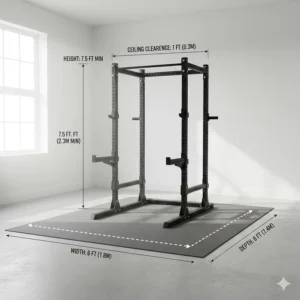
Standard Power Rack Footprint:
- Width: 47-50″ (outside to outside)
- Depth: 48-72″ (depending on configuration)
- Height: 82-93″ (choose wisely!)
Critical Measurements:
- Ceiling clearance: Add 12″ minimum to rack height for pull-ups
- Bar clearance: Account for 7ft barbell plus collar width
- Walking space: Minimum 36″ on all sides for safety
Pro tip: Measure twice, order once. I’ve seen too many people order an 93″ rack for a 96″ garage only to realize they can’t actually do pull-ups or overhead presses without smacking the ceiling.
Budget Breakdown: What to Expect
Entry-Level ($300-$500):
- Basic squat stands or compact cages
- 2×2″ or 2×3″ tubing
- Limited attachment compatibility
- Examples: Fitness Reality 810XLT, Marcy Rack
Mid-Range ($500-$900):
- Solid 2×3″ or 3×3″ construction
- Cable systems often included
- Good attachment ecosystem
- Examples: Titan T-3, Mikolo K6, Major Fitness F22
Premium ($900-$2,000+):
- Heavy-duty 3×3″ 11-gauge steel
- Extensive customization options
- American-made quality
- Examples: REP PR-4000, Rogue RML-3W
Remember: Your best home gym squat rack is the one you’ll actually use consistently. A $500 rack that fits your space and budget beats a $2,000 rack you can’t afford or accommodate.
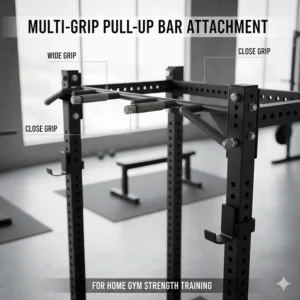
Safety Features You Can’t Ignore
Training solo in your garage gym means you are your own spotter. These safety features aren’t optional—they’re essential:
J-Hooks and Safety Systems
J-Hook Types:
- Standard plastic-lined: Adequate for most lifters
- Roller J-hooks: Easier barbell placement, reduce wear
- Sandwich J-cups: Wider landing area for safer re-racks
Safety Catches:
- Pin-pipe safeties: Budget-friendly, effective
- Strap safeties: Quieter, gentler on barbells
- Flip-down safeties: Premium option, most versatile
Research indicates that adjustable safety pins or straps that catch the barbell if the lifter fails to complete a lift prevent accidents and injuries. Never skimp on safety features.
Assembly and Installation Tips
Most racks arrive partially assembled and require 2-6 hours of work. Here’s how to make it painless:
Before You Start:
- Clear a 10×10ft workspace minimum
- Gather tools: Socket wrench, level, measuring tape, drill (for wall mounts)
- Watch manufacturer’s assembly video first
- Recruit a helper for lifting uprights
Installation Best Practices:
- For freestanding racks: Consider bolting to floor for stability
- For wall mounts: Use proper stringer and locate studs accurately
- Level everything: An unlevel rack puts uneven stress on joints
- Tighten gradually: Don’t fully tighten bolts until entire frame is assembled
One customer shared his experience: “I assembled it in about 2.5 hrs following the instructions. The entire rack is solid and slides easily into the folding position.”
Comparing Squat Racks vs Power Racks vs Half Racks
| Feature | Squat Stand | Half Rack | Power Rack |
|---|---|---|---|
| Footprint | Smallest | Medium | Largest |
| Safety | Requires spotter | Moderate | Excellent |
| Exercise variety | Limited | Good | Excellent |
| Stability | Requires bolting | Good | Best |
| Price | Lowest | Medium | Highest |
| Best for | Tight spaces | Intermediate lifters | Serious training |
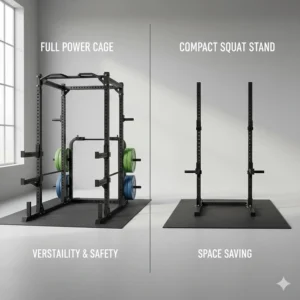
Power racks offer the safest solo training environment, while squat stands work for those with extreme space limitations. Half racks split the difference.
Attachment Compatibility Guide
Not all attachments fit all racks. Here’s the compatibility breakdown:
Tubing Size Matters:
- 2×2″ racks: Limited to specific brand attachments
- 2×3″ racks: Better compatibility, but still brand-specific
- 3×3″ racks: Most universal, wider selection
Hole Spacing Standards:
- Westside spacing: 1″ holes through bench zone
- Standard spacing: 2″ throughout
- Metric spacing: 75mm (compatibility issues with inch-based attachments)
Pin Hole Diameter:
- 5/8″ holes: Most common, good selection
- 1″ holes: REP PR-5000 and similar premium racks
- Metric holes: Limited compatibility
Before buying attachments, verify both tubing size AND hole pattern match your rack.
Maintenance and Longevity
A well-maintained rack should last decades. Here’s how to protect your investment:
Regular Maintenance Schedule:
Monthly:
- Check all bolts for tightness
- Inspect welds for cracks
- Clean powder coating with mild soap
- Lubricate moving parts (pulleys, hinges)
Quarterly:
- Deep clean entire frame
- Inspect J-hooks for wear
- Check safety catches for damage
- Tighten any loose hardware
Annually:
- Full structural inspection
- Replace worn UHMW plastic liners
- Touch up any paint chips to prevent rust
- Verify wall mount integrity (for folding racks)
Powder-coated finishes protect against rust and corrosion, common concerns in garage gym environments. However, chips in the coating expose bare steel to moisture. Touch them up promptly with matching paint.
Making the Right Choice for Your Goals
Your ideal rack depends on your specific situation. Let me break it down:
Choose a Budget Rack ($300-$500) if:
- You’re new to strength training
- Space and budget are extremely limited
- You’re testing the waters before committing
- Maximum lift will stay under 300 lbs
Choose Mid-Range ($500-$900) if:
- You’re serious about progression
- Want cable system versatility
- Need balance of quality and value
- Planning 5+ year investment
Choose Premium ($900+) if:
- Lifting is a primary hobby
- Want buy-it-for-life quality
- Require extensive customization
- Training for competition
Special Considerations:
For powerlifters: Prioritize weight capacity, Westside spacing, and attachment compatibility For CrossFit athletes: Look for good power rack for home gym with pull-up bar versatility For general fitness: Mid-range options with cable systems provide best variety For small spaces: Wall-mounted folding racks or compact designs
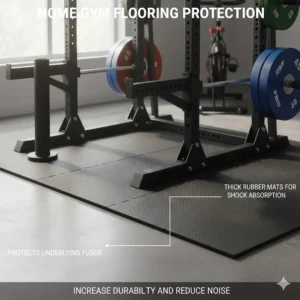
Top Brands Comparison
REP Fitness
Strengths: Customization, value, free shipping
Weaknesses: Manufactured overseas, not on Amazon
Best for: Serious home gym builders
Titan Fitness
Strengths: Budget-friendly, improving quality
Weaknesses: Some compatibility limitations
Best for: Cost-conscious lifters
Rogue Fitness
Strengths: American-made, lifetime warranty, best resale value
Weaknesses: Premium pricing
Best for: Those wanting absolute best quality
Major Fitness
Strengths: All-in-one systems, good value
Weaknesses: Newer brand, less attachment ecosystem
Best for: Home gym with squat rack and cables in one
Mikolo
Strengths: Smooth cable systems, competitive pricing
Weaknesses: 2×2″ tubing limits compatibility
Best for: Cable enthusiasts on budget
Common Mistakes to Avoid
After reviewing hundreds of customer experiences, these mistakes keep appearing:
❌ Not measuring ceiling height accurately Reality check: You need rack height PLUS 12-18 inches for pull-ups and overhead pressing
❌ Ignoring attachment compatibility That attachment you want might not fit your rack’s tubing or hole spacing
❌ Choosing 2×2″ tubing when planning heavy lifting If you’re serious about progression, invest in 2×3″ or 3×3″ now
❌ Skipping the stringer on wall-mounted racks The $110 stringer makes installation infinitely easier and safer
❌ Not accounting for barbell length A 7ft barbell needs about 90 inches of horizontal space with collars
❌ Buying attachments before the rack Get your base rack first, then add attachments as budget allows
Warranty and Customer Service
Premium doesn’t always mean better service. Here’s what each brand offers:
Lifetime Warranties:
- Rogue Fitness (frame only)
- REP Fitness (frame only)
Limited Warranties:
- Titan Fitness: 1 year
- Major Fitness: 1 year parts
- Fitness Reality: 1 year limited
- Mikolo: 1 year
Customer Service Quality (based on user reviews):
- Highest rated: Rogue Fitness, REP Fitness
- Good: Titan Fitness (improved significantly)
- Variable: Budget brands depend on seller
Always purchase from authorized dealers to maintain warranty validity.
Environmental Considerations
Building a home gym is actually more sustainable than you might think:
Reduced Carbon Footprint:
- Eliminates daily gym commutes
- Typically saves 30-60 minutes daily driving
- One rack replaces multiple machines
Material Sustainability:
- Steel is 100% recyclable
- Powder coating lasts decades
- Quality racks have excellent resale value
Long-term Economics: Average gym membership: $60/month = $720/year Quality power rack: $800 one-time investment Break-even: 13 months (plus you own the equipment)
The Science of Strength Training at Home
Research consistently supports home strength training effectiveness. A study in PMC found that power training offers more potential for improving muscle power and performance on activity tests compared to strength training alone.
What this means for your home gym: Progressive overload—the gradual increase of stress on your musculoskeletal system—works identically whether you’re in a commercial gym or your garage. The key is having reliable equipment that allows safe progression.
Your squat rack provides the foundation for this progression by:
- Enabling safe failure on heavy sets
- Allowing precise height adjustments
- Supporting multiple exercise variations
- Accommodating progressive weight increases
According to Wikipedia’s entry on strength training, proper equipment and progressive resistance are fundamental to neuromuscular adaptation and muscle hypertrophy.
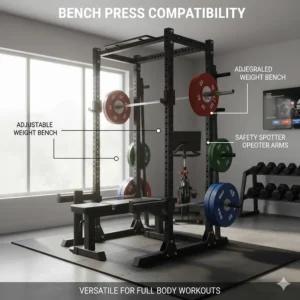
❓ FAQ
❓ What's the difference between a power rack and squat rack for home gym use?
❓ Can I use an adjustable squat rack home setup without bolting it down?
❓ How much ceiling height do I need for a power rack with pull up bar?
❓ Is a power rack with cable system worth the extra cost?
❓ What weight capacity do I need for a good power rack for home gym?
Conclusion
Choosing your squat rack for home gym isn’t just about finding the cheapest option or the flashiest features. It’s about matching the right equipment to your specific goals, space, and budget while prioritizing safety above all else.
Here’s what we’ve covered:
The REP PR-4000 stands as the premium choice for serious lifters who value customization and lifetime durability. Yes, it’s pricey, but it’s literally the last rack you’ll ever need to buy.
For budget-conscious builders, the Titan T-3 delivers exceptional value without compromising on essential features. It’s proof that you don’t need to drop $2,000 to train effectively.
Want everything in one footprint? The Major Fitness F22 with its integrated dual cable system transforms your garage into a legitimate commercial-style gym.
Space at a premium? The Rogue RML-3W folds flat against your wall when not in use while maintaining the structural integrity of a full-size power rack.
Remember: The best rack isn’t the one with the most features or the lowest price—it’s the one that fits your training style, accommodates your space, and encourages consistent use. A $500 rack you use religiously beats a $2,000 rack collecting dust.
Take your time with this decision. Measure your space twice, read real user reviews, and consider where you want to be in five years. Your future self will thank you for investing wisely in equipment that supports your strength journey for decades to come.
Now stop researching and start lifting. Your perfect home gym with squat rack setup awaits.
Recommended for You
- 7 Best Pulley System for Home Gym 2026
- 7 Best Cable Machine for Home Gym 2026
- 7 Best Smith Machine Home Gym Systems Transform Your Workouts (2026)
Disclaimer: This article contains affiliate links. If you purchase products through these links, we may earn a small commission at no additional cost to you.
✨ Found this helpful? Share it with your friends! 💬🤗
