
In This Article
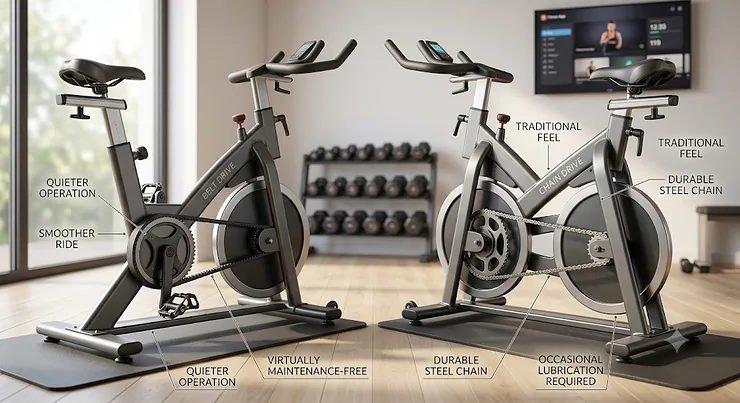
Somewhere between the whirring hum of a belt and the metallic clink of a chain sits one of the most underrated decisions in home fitness. A belt drive vs chain drive bike is essentially a choice between two different ways of turning your legs into flywheel momentum — a belt drive uses a reinforced rubber loop, while a chain drive uses metal links over sprockets, the same setup found on an outdoor bicycle. Neither is objectively “wrong.” They just solve different problems.
If you’ve spent any time scrolling through indoor cycling bikes, you’ve probably noticed that most modern models default to belt drives, while a smaller, scrappier segment still swears by chains for their authentic road-bike feel. I get why the confusion sets in — spec sheets throw around terms like “poly-v belt” and “sprocket tension” without ever explaining what any of it means for your actual 6 a.m. workout. That’s what we’re untangling here.
We’re going to walk through 7 real, currently available spin bikes spanning budget to premium, break down what the drive system actually changes about your ride, and hand you a framework for deciding which side of the belt drive vs chain drive bike debate you belong on. According to the CDC’s Physical Activity Guidelines, adults need at least 150 minutes of moderate aerobic activity weekly — and the bike that actually gets ridden consistently is the one that fits your space, your patience for maintenance, and your ears.
Quick Comparison Table
| Drive Type | Noise Level | Maintenance | Typical Price Range | Best For |
|---|---|---|---|---|
| Belt Drive | Near silent | Minimal — no lubrication | $180-$2,500 range | Apartments, quiet mornings, low-fuss owners |
| Chain Drive | Noticeable clink | Periodic lubrication & tightening | Under $400 range | Riders who want an authentic outdoor-bike pedal feel |
Looking at this table, the split isn’t really about which drive is “better” in a vacuum — it’s about what you’re optimizing for. Belt-driven models dominate the current market because most buyers prioritize quiet operation over anything else, especially in shared living spaces. Chain drives persist in a smaller, budget-friendly niche precisely because that mechanical connection between pedal and flywheel replicates the road-bike sensation that some riders genuinely miss.
💬 Just one click — help others make better buying decisions too!😊
Top 7 Belt and Chain Drive Bikes: Expert Analysis
We dug through spec sheets, aggregated review sentiment, and long-term owner reports to land on seven real, purchasable models. Budget, mid-range, and premium tiers are all represented, along with both drive types, so you can see exactly how the belt drive vs chain drive bike trade-off plays out at every price point.
1. Sunny Health & Fitness SF-B1002C — most authentic outdoor-bike pedal feel
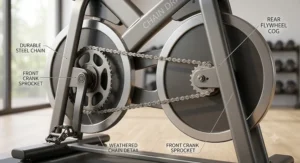
The Sunny Health & Fitness SF-B1002C is the rare modern spin bike that still runs a genuine chain drive, and that single design choice defines the entire ride. The steel-alloy frame pairs a fully-guarded chain with a heavy flywheel, giving you that familiar tug-and-release sensation every time the sprocket engages — something belt systems simply can’t replicate. Based on the spec comparison against belt models in this price bracket, the chain here is the whole point, not a compromise.
Who should care: riders who grew up on outdoor bikes and find belt-driven bikes feel artificially smooth. Reviewers consistently note that the chain guard keeps most of the mechanical noise contained, though a faint clink emerges once the chain naturally loosens between lubrication cycles — a known trait of chain drive systems generally. Aggregated owner feedback also flags the flywheel as reassuringly heavy and stable, even for standing climbs.
Pros:
- ✅ Genuine outdoor-bike pedal sensation
- ✅ Heavy flywheel adds stability on climbs
- ✅ Lowest entry price among tested models
Cons:
- ❌ Needs occasional lubrication and chain tightening
- ❌ Noticeably louder than any belt-drive competitor
At a price point typically under $400, the Sunny Health & Fitness SF-B1002C is the value pick specifically for anyone chasing that road-bike feel without spending premium money.
2. Yosuda Indoor Cycling Bike — quietest budget belt-drive pick
The Yosuda Indoor Cycling Bike swaps the chain for a belt and pairs it with a 35-pound flywheel and continuous friction-based resistance. What most buyers overlook about friction resistance is that it isn’t infinitely adjustable like magnetic systems — you’re turning a dial against a pad rather than sliding magnets closer to the flywheel — but at this price, it’s a reasonable trade-off for near-silent operation.
The compact 40.5 x 20.5-inch footprint makes it a strong fit for small apartments, and at 68.8 pounds, one person can move it without help. Reviewers consistently praise the saddle comfort and frame stability, though taller riders (6 feet and up) have reported the seatpost maxing out before reaching a comfortable height, since Yosuda doesn’t publish official height specs.
Pros:
- ✅ Near-silent belt drive suits thin apartment walls
- ✅ Lightweight and easy to relocate solo
- ✅ Simple one-person assembly
Cons:
- ❌ Friction resistance feels less refined than magnetic systems
- ❌ Seatpost may fall short for riders over 6 feet
Priced in the budget tier — generally under $250 — the Yosuda Indoor Cycling Bike earns its spot as the quiet-apartment starter option.
3. MaxKare Magnetic Belt Drive Indoor Cycling Bike — best value magnetic resistance under $300
The MaxKare Magnetic Belt Drive Indoor Cycling Bike upgrades from friction to magnetic resistance while staying in budget territory, and that upgrade matters more than the spec sheet suggests. Magnetic resistance means the brake pad never physically touches the flywheel, so there’s nothing to wear down or replace over years of use — a meaningful long-term maintenance win over friction-based competitors.
Depending on the exact model variant, the flywheel runs in the 20-40 pound range with a poly-v belt keeping things quiet. Here’s what to weigh: the console is basic, with no Bluetooth or app pairing, so this is a bike for people who want a clean workout, not a connected one. Reviewers consistently mention quick assembly, around 30 minutes, and solid stability even near the 300+ pound weight capacity ceiling on higher-spec versions.
Pros:
- ✅ Magnetic resistance means zero brake-pad wear
- ✅ Quiet poly-v belt drive
- ✅ High weight capacity relative to price
Cons:
- ❌ Basic LCD console with no app connectivity
- ❌ Resistance levels aren’t numbered or calibrated on entry models
At a price generally under $300, the MaxKare Magnetic Belt Drive Indoor Cycling Bike is the smart step up from friction resistance without jumping into mid-range pricing.
4. JOROTO X2 Magnetic Indoor Cycling Bike — budget Peloton alternative with 300 lb capacity
The JOROTO X2 Magnetic Indoor Cycling Bike has earned its “budget Peloton alternative” reputation honestly — a 35-pound bidirectional flywheel, magnetic resistance, and a belt drive combine for a smooth, quiet ride, while 4-way adjustable handlebars and seat accommodate a wide range of body types. The 300-pound weight capacity matches Peloton’s own rating, which is a genuinely rare spec at this price.
What the spec sheet won’t tell you, but user reports suggest, is that the flywheel lacks a protective cover, meaning sweat can drip directly onto it during longer sessions — something to wipe down after every ride. With more than 5,800 Amazon reviews averaging 4.5 stars, sentiment leans strongly positive, though a recurring theme in negative reviews involves durability concerns surfacing around the one-year mark for some units.
Pros:
- ✅ 300 lb weight capacity rivals premium bikes
- ✅ Fully adjustable 4-way seat and handlebars
- ✅ Quiet magnetic-resistance belt drive
Cons:
- ❌ No flywheel cover, so sweat exposure requires regular wipe-downs
- ❌ Some owners report durability issues after roughly a year
Typically priced in the $350-$450 range, the JOROTO X2 Magnetic Indoor Cycling Bike is the mid-tier pick for buyers who want Peloton-like ergonomics without the Peloton price tag.
5. Schwinn IC4 Indoor Cycling Bike — best all-around belt drive for app connectivity
The Schwinn IC4 Indoor Cycling Bike runs a 40-pound perimeter-weighted flywheel on a belt drive, with 100 levels of micro-adjustable magnetic resistance controlled by a single knob. Perimeter weighting pushes mass to the outer edge of the flywheel, which is the mechanical reason this bike builds momentum that feels like coasting down a real incline rather than grinding against a static brake.
Based on the spec comparison, the standout feature here is Bluetooth connectivity that works across Peloton’s app, Zwift, and other platforms — you’re not locked into one ecosystem the way you are with a proprietary touchscreen bike. One long-term tester logged 1,200 hours on a single unit with zero drive-system replacement cost, though the stock saddle was consistently flagged as uncomfortable enough that most owners swap it within the first month.
Pros:
- ✅ 100-level magnetic resistance with true micro-adjustment
- ✅ Multi-app Bluetooth compatibility, not locked to one brand
- ✅ Proven long-term flywheel and belt durability
Cons:
- ❌ Stock saddle is firm and often needs replacing
- ❌ No motorized auto-resistance during app-guided classes
In the roughly $800-$1,000 range, occasionally lower during sales, the Schwinn IC4 Indoor Cycling Bike is the sweet-spot pick for households that want flexibility across multiple training apps.
6. Keiser M3i Indoor Cycle — premium belt drive with commercial-grade eddy current resistance
The Keiser M3i Indoor Cycle takes a completely different engineering approach: an 8-pound rear-mounted flywheel paired with eddy current magnetic resistance instead of a heavy front flywheel. What most buyers overlook is that a lighter flywheel isn’t a downgrade here — it’s the design. Two magnets shift closer to or farther from the flywheel via a gear lever, delivering resistance changes with zero friction and zero brake-pad contact.
Here’s what to weigh: rear-mounted flywheel placement keeps it out of your sweat’s flight path, meaningfully reducing corrosion risk over years of daily use, which is part of why more than 300,000 M-Series bikes have sold into commercial gyms. Reviewers consistently note the ride as whisper-quiet even under maximum tension, though a few flag the wide Q-factor (pedal stance width) as less comfortable for narrower-hipped riders, and the console itself is basic for a bike at this price.
Pros:
- ✅ Eddy current resistance with zero brake-pad wear
- ✅ Rear flywheel placement resists sweat corrosion
- ✅ Commercial-grade durability trusted by gyms worldwide
Cons:
- ❌ Wide Q-factor may not suit narrower-hipped riders
- ❌ Console lacks a touchscreen despite the premium price
At more than $2,000, the Keiser M3i Indoor Cycle is the premium pick for serious, frequent riders who value mechanical reliability over entertainment features.
7. Peloton Bike+ — premium belt drive with immersive touchscreen ecosystem
The Peloton Bike+ pairs a 38-pound magnetic-resistance flywheel and belt drive with a rotating 23.8-inch HD touchscreen and Auto-Follow resistance, which automatically adjusts difficulty in real time to match an instructor’s callouts. On paper this means less manual fiddling mid-workout, though the honest trade-off is less rider control — some users describe a love-hate relationship with resistance changing without their input.
The bike itself shares its frame, flywheel, and magnetic resistance system with the standard Peloton Bike, so the Bike+ premium is really paying for the interactive screen, Apple GymKit integration, and upgraded 16-watt speakers. Reviewers consistently highlight the depth of the on-demand class library as the main draw, while the recurring criticism centers on the mandatory $44/month All-Access membership and the added cost of compatible clip-in cycling shoes.
Pros:
- ✅ Auto-Follow resistance syncs automatically to instructor cues
- ✅ Rotating touchscreen works for on-bike and floor workouts
- ✅ Frame and flywheel proven to hold up past 5 years
Cons:
- ❌ Requires an ongoing paid membership for full functionality
- ❌ High upfront cost plus separate cycling-shoe expense
Priced around $2,495, the Peloton Bike+ is the premium pick specifically for households that want a subscription-based class structure built into the hardware.
Setting Up and Maintaining Your Bike: A Practical Usage Guide
Getting a belt drive vs chain drive bike running smoothly starts well before your first workout. Assembly on most of these models takes 30-60 minutes with included tools — the JOROTO X2 Magnetic Indoor Cycling Bike and MaxKare Magnetic Belt Drive Indoor Cycling Bike both ship mostly pre-assembled, needing only handlebars, seat, and console attached.
During the first 30 days, the most common mistake is skipping saddle and handlebar fine-tuning because “it feels close enough.” Take the extra 10 minutes: seat height should let your knee sit at a slight bend at the bottom of the pedal stroke, and handlebar height should keep your shoulders relaxed, not hunched. On the Sunny Health & Fitness SF-B1002C, add a light chain lubrication after the first week of use — new chains stretch slightly and benefit from early attention.
For ongoing maintenance, belt-drive bikes like the Schwinn IC4 Indoor Cycling Bike and Keiser M3i Indoor Cycle need almost nothing beyond wiping sweat off the frame and flywheel after each ride. Chain-drive owners should build a habit of checking chain tension monthly and applying a drop of bike-specific lubricant every few weeks, tightening if you notice slack hitting the guard. A common oversight across every model: forgetting to check pedal and crank bolts for looseness after the first 10-15 rides, once components have had time to seat properly.
Real-World Scenarios: Which Rider Needs Which Drive System
Picture three different households shopping for the same general category of bike, and you’ll see how differently the belt drive vs chain drive bike decision plays out.
First, a college student in a shared apartment, riding early mornings before class, on a tight budget. Noise and price dominate every other consideration, which points straight at the Yosuda Indoor Cycling Bike — quiet enough not to wake a roommate through thin walls, and priced low enough not to dent a student budget.
Second, a former road cyclist in a house with a dedicated home gym, riding 5 days a week and craving the pedal-stroke feel of outdoor cycling. Noise matters less here since there’s no shared wall to worry about, and mechanical authenticity matters more. The Sunny Health & Fitness SF-B1002C‘s chain drive delivers that familiar tug, and the modest maintenance routine is a fair trade for the riding experience.
Third, a family of four sharing one bike across different fitness levels and body sizes, wanting app-based classes everyone can follow independently. The Schwinn IC4 Indoor Cycling Bike‘s wide Bluetooth compatibility and adjustable geometry make it the practical fit — nobody is locked into one training app, and the frame accommodates a broad height range.
Common Drivetrain Problems and How to Fix Them
Even a well-built belt drive vs chain drive bike runs into predictable hiccups. Here’s how to solve the ones we see most often.
Problem: chain hitting the guard, creating a rattling noise. This almost always means the chain has loosened slightly with use. Tighten it per the manual’s tension spec, and the rattle typically disappears immediately — this is a known trait of models like the Sunny Health & Fitness SF-B1002C.
Problem: belt squeaking under high resistance. A squeak usually signals the belt needs re-tensioning rather than replacement. On bikes like the JOROTO X2 Magnetic Indoor Cycling Bike, a quarter-turn adjustment at the tensioner bolt resolves most cases; if squeaking persists after tensioning, the belt itself may be nearing end-of-life.
Problem: resistance not engaging fully at high levels. On magnetic systems like the MaxKare Magnetic Belt Drive Indoor Cycling Bike, this often traces back to magnets not seating close enough to the flywheel — check the resistance cable or gear-lever alignment before assuming a defect.
Problem: flywheel wobble at higher cadence. This is typically a bearing or pedal-crank issue rather than the drive system itself. Tighten crank bolts first; if the wobble persists on a premium model like the Keiser M3i Indoor Cycle, it likely warrants a warranty claim rather than a DIY fix.
Problem: saddle discomfort during longer rides. Not a drive-system issue at all, but common enough to mention — an aftermarket gel or cutout saddle resolves this on nearly any bike, including the frequently-flagged stock seat on the Schwinn IC4 Indoor Cycling Bike.
How to Choose a Drive vs Chain Drive Bike
Cutting through the spec sheets, here’s the actual decision process worth following:
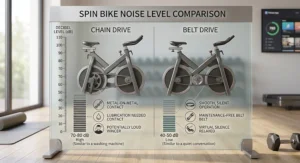
- Start with your living situation. If you share walls or ride before sunrise, belt drive wins by default — chain drives are simply louder, full stop.
- Set a real budget ceiling. Chain drives cluster at the low end; if you’re under $400, a chain-drive bike like the Sunny Health & Fitness SF-B1002C may outperform a belt-drive bike at the same price.
- Decide how much maintenance you’ll actually do. Be honest — if lubrication schedules will get skipped, belt drive removes that variable entirely.
- Weigh authenticity against convenience. Riders who miss real cycling often prefer the mechanical feel of a chain; everyone else typically prefers the smoothness of a belt.
- Check flywheel weight and placement. Heavier front-mounted flywheels feel more like momentum-driven outdoor cycling; lighter rear-mounted designs, like the Keiser M3i Indoor Cycle, prioritize quick response and joint comfort.
- Confirm app or ecosystem needs before buying. If you want flexibility across Zwift, Peloton’s app, and others, prioritize Bluetooth-open bikes over closed ecosystems.
- Match weight capacity to every household user, not just yourself. A shared bike needs the highest capacity among its riders, not the average.
Belt Drive vs Chain Drive Comparison: Which Drive System Is Better
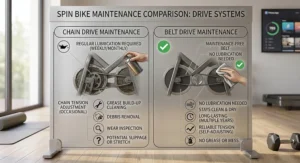
There’s no universal winner here, and honestly, anyone claiming otherwise is oversimplifying. Mechanically, research comparing belt and chain power transmission shows chain drives can edge out belts on raw efficiency under high load, since positive sprocket engagement minimizes slippage. But for a home spin bike, you’re rarely pushing anywhere near the load thresholds where that efficiency gap becomes noticeable in your legs.
What actually separates the two in daily use is noise, maintenance, and feel — not efficiency. Belt drives eliminate the lubrication cycle entirely and run dramatically quieter, which is why the Schwinn IC4 Indoor Cycling Bike, JOROTO X2 Magnetic Indoor Cycling Bike, and both premium picks all default to belts. Chain drives, represented here by the Sunny Health & Fitness SF-B1002C, trade that convenience for a pedal-stroke sensation that many longtime outdoor cyclists say belt-driven bikes just can’t fully replicate.
If you’re deciding between the two as pure workout tools, both will get you an equally effective cardio session — the choice comes down to lifestyle fit, not fitness outcomes.
✨ Don’t Miss These Exclusive Deals!
🔍 Take your indoor cycling setup to the next level with these carefully selected bikes. Click on any highlighted model to check current pricing and availability. The right drive system will help you build an authentic home workout routine your whole household will actually stick with!
Common Mistakes When Buying a Spin Bike Drive System
The single biggest mistake is choosing based on price alone without checking noise tolerance in your specific living situation — a chain-drive bike that’s perfectly fine in a detached house can become a household conflict in a thin-walled apartment.
A close second: assuming all “magnetic resistance” bikes are equally smooth. Magnetic resistance describes how the brake engages, not the drive system connecting pedals to flywheel — you can pair magnetic resistance with either a belt or, less commonly, a chain, and the drive type still determines noise and maintenance separately from resistance feel.
Buyers also frequently underestimate flywheel weight’s impact on ride quality, assuming heavier always means better. As the Keiser M3i Indoor Cycle‘s 8-pound rear flywheel demonstrates, light flywheels paired with strong magnetic resistance can feel smoother and more joint-friendly than a heavy front flywheel — it depends on your priorities, not a universal hierarchy.
Finally, skipping weight capacity checks for every household member is a frequent and costly oversight, especially on shared family bikes where the lightest user isn’t the only one who’ll ride it.
Long-Term Cost & Maintenance: Drivetrain Comparison
| Factor | Belt Drive | Chain Drive |
|---|---|---|
| Ongoing maintenance cost | Near $0 for years | Occasional lubricant, low cost |
| Replacement frequency | Rare — often lasts bike’s lifetime | More frequent tightening needed |
| Time investment | Minimal | 5-10 minutes monthly |
| Best For | Low-maintenance owners | Hands-on riders who don’t mind upkeep |
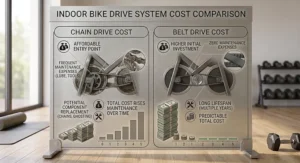
Analyzing the table, belt drives carry a real long-term cost advantage simply because there’s nothing scheduled to maintain — no lubricant to buy, no tension to check on a calendar. Chain drives aren’t expensive to maintain, but they do demand consistency; skipped maintenance is what leads to the loosening and noise complaints that show up in aggregated reviews of chain-drive models like the Sunny Health & Fitness SF-B1002C. Total cost of ownership over 5 years typically favors belt drives slightly, though the gap is small enough that maintenance habits matter more than the drive type itself.
Features That Actually Matter (And Those That Don’t)
Cutting through marketing language, a few features genuinely change your workout, and several are mostly noise.
Actually matters: flywheel weight and placement, resistance system type (magnetic vs friction), and drive noise level — these three factors shape every single ride you’ll ever do on the bike.
Actually matters: weight capacity headroom. Buying right at your weight limit shortens the bike’s functional lifespan; the JOROTO X2 Magnetic Indoor Cycling Bike‘s 300-pound rating gives real headroom for most households.
Doesn’t matter much: resistance level counts beyond roughly 20-24 well-calibrated steps. The Schwinn IC4 Indoor Cycling Bike‘s 100 levels sound impressive, but the Keiser M3i Indoor Cycle‘s 24 commercial-grade levels are arguably more useful because each increment is precisely calibrated rather than marketing-driven granularity.
Doesn’t matter much: touchscreen size, unless you’re specifically committing to a subscription ecosystem like Peloton’s. A tablet holder and a $15/month app subscription accomplishes nearly the same thing for a fraction of the hardware cost.
Spin Bike Drive Types for Different Riders
Beginners generally do best with belt-driven, magnetic-resistance bikes like the MaxKare Magnetic Belt Drive Indoor Cycling Bike — there’s no maintenance learning curve, and the smooth resistance ramp is forgiving while you build cardio base fitness.
Serious or returning cyclists, especially those who used to ride outdoors regularly, often gravitate toward chain drives or heavy front-mounted flywheels for the more authentic pedal-stroke feedback — the Sunny Health & Fitness SF-B1002C fits this profile well.
Budget-conscious households benefit most from belt-drive bikes in the sub-$450 range, since they avoid ongoing maintenance costs entirely, letting the Yosuda Indoor Cycling Bike or JOROTO X2 Magnetic Indoor Cycling Bike stretch further over years of use than their upfront price alone suggests.
Seniors or riders managing joint sensitivity tend to respond best to lighter flywheels with smooth magnetic engagement, which is precisely the Keiser M3i Indoor Cycle‘s design philosophy — less initial torque required to start pedaling.
Belt and Chain Drive Bikes vs Traditional Outdoor Cycling
| Factor | Indoor Belt/Chain Drive Bike | Traditional Outdoor Bike |
|---|---|---|
| Weather dependency | None | Fully weather-dependent |
| Maintenance scope | Drive system only | Drive, tires, brakes, gears |
| Safety risk | Controlled indoor environment | Traffic, road hazards |
| Best For | Consistent year-round training | Riders wanting outdoor terrain variety |
The table makes the appeal fairly obvious: an indoor bike, whichever drive type you pick, removes weather and traffic as excuses to skip a workout, which is a meaningful factor when the engineering literature on drivetrain choice consistently emphasizes that maintenance burden — not raw performance — is what determines whether a system stays reliable long-term. For pure workout consistency, an indoor bike with either drive type will outperform an outdoor bike that sits unused on rainy weeks.
Price Range & Value Analysis
Budget-tier bikes (Sunny Health & Fitness SF-B1002C, Yosuda Indoor Cycling Bike) deliver strong value-per-dollar for basic cardio needs but sacrifice smart features. Mid-range bikes (MaxKare Magnetic Belt Drive Indoor Cycling Bike, JOROTO X2 Magnetic Indoor Cycling Bike) add magnetic resistance and better build quality without crossing into four-figure pricing. Upper-mid bikes (Schwinn IC4 Indoor Cycling Bike) hit a genuine sweet spot of features versus cost. Premium bikes (Keiser M3i Indoor Cycle, Peloton Bike+) justify their price primarily through either commercial-grade durability or a full software ecosystem — not through drive-system performance alone, since belt drives cost roughly the same to manufacture regardless of the bike’s overall price tag.
Frequently Asked Questions
❓ Which is better, belt drive or chain drive on a spin bike?
❓ Do belt drive exercise bikes need any maintenance?
❓ Are chain drive spin bikes too noisy for apartments?
❓ How long does a spin bike belt typically last?
❓ Is a heavier flywheel always better than a lighter one?
Conclusion
The belt drive vs chain drive bike decision really comes down to three honest questions: how much noise can your space tolerate, how much maintenance are you actually willing to do, and how much do you care about replicating an outdoor pedal stroke indoors. Belt drives dominate the current market because they solve the first two questions cleanly for most households, while chain drives like the Sunny Health & Fitness SF-B1002C persist because that mechanical authenticity genuinely matters to a specific kind of rider.
Across the seven bikes covered here, there’s no single “best” pick — the Yosuda Indoor Cycling Bike and MaxKare Magnetic Belt Drive Indoor Cycling Bike serve budget-conscious, low-maintenance buyers; the JOROTO X2 Magnetic Indoor Cycling Bike and Schwinn IC4 Indoor Cycling Bike cover the mid-range sweet spot most households land in; and the Keiser M3i Indoor Cycle and Peloton Bike+ justify their premium pricing for riders who want either commercial-grade reliability or a full connected-fitness ecosystem. Whichever direction you go, prioritize fit over hype — the bike that matches your space, budget, and patience for upkeep is the one you’ll actually ride consistently.
✨ Ready to Find Your Perfect Match?
🔍 Compare current pricing on any of these seven picks and lock in the drive system that fits your home, your budget, and your workout goals. Consistency beats specs every time — pick the bike you’ll actually hop on tomorrow morning!
Recommended for You
- 7 Best Belt Drive Spin Bikes for 2026: Quiet & Maintenance-Free
- 7 Best Semi Recumbent Bike Picks for 2026
- Recumbent Bike Benefits: 7 Proven Perks for 2026 Cardio
Disclaimer: This article contains affiliate links. As an Amazon Associate, I earn from qualifying purchases. If you purchase products through these links, we may earn a small commission at no additional cost to you.
✨ Found this helpful? Share it with your friends! 💬🤗
