
In This Article
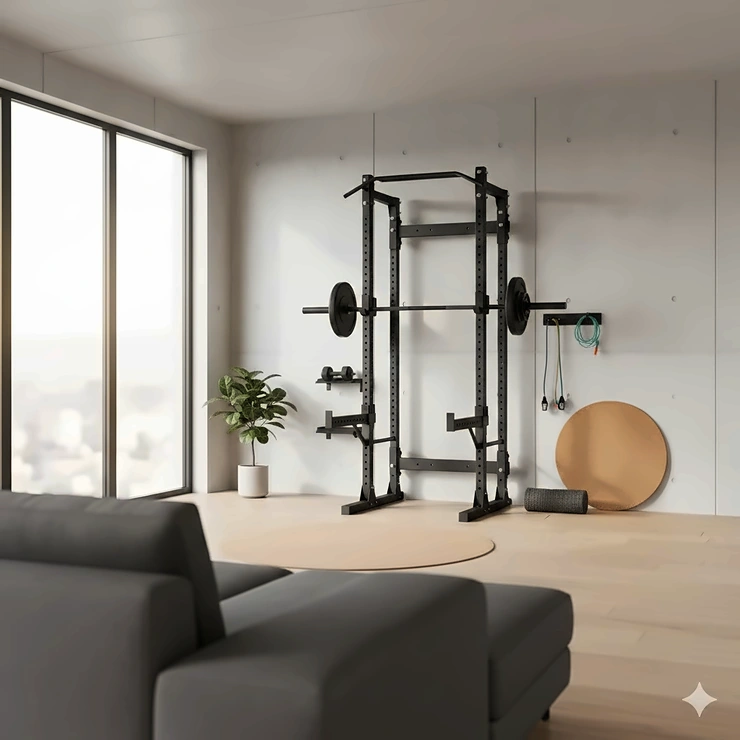
Picture this: you’re living in a cozy apartment, staring at that cramped corner where your dumbbells awkwardly share space with last year’s bicycle. You want a proper home gym, but the idea of sacrificing your entire living room to a massive power rack feels like giving up on life as you know it. Sound familiar?
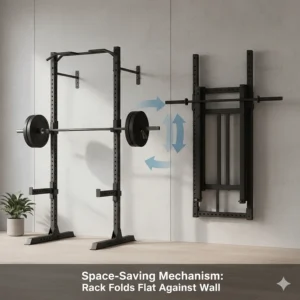
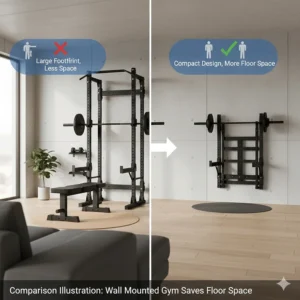
Here’s where the magic happens. A wall mounted home gym isn’t just equipment, it’s a complete mindset shift. These ingenious systems fold flat against your wall when you’re done sweating, taking up as little as 4 inches of space. That means you can finally host dinner parties AND crush your fitness goals in the same room. According to recent data from the Centers for Disease Control and Prevention, adults need at least 150 minutes of moderate-intensity physical activity weekly, plus muscle-strengthening activities twice per week for optimal health. A wall mounted home gym makes hitting these targets remarkably convenient.
The best part? Modern wall mounted power rack system units have evolved beyond simple squat racks. We’re talking full functional trainers with cable systems, murphy rack home gym setups that disappear completely, and fold away squat rack configurations that would make a commercial gym jealous. Whether you’re working with a spare bedroom, garage corner, or even a walk-in closet, there’s a space saving wall rack solution that fits your situation.
In this guide, I’ll walk you through seven real products currently dominating Amazon’s fitness equipment category in 2026, breaking down everything from build quality and weight capacity to installation quirks and long-term durability. No fluff, no affiliate nonsense disguised as advice, just honest assessments to help you make the smartest purchase for your space and budget.
Quick Comparison Table
| Product | Type | Weight Capacity | Folded Depth | Price Range | Best For |
|---|---|---|---|---|---|
| PRx Performance Profile PRO | Folding Squat Rack | 1,000 lbs | 4 inches | $1,095-$1,395 | Premium quality seekers |
| Titan Fitness T-3 Series | Folding Power Rack | 1,000 lbs | 5 inches | $699-$899 | Budget-conscious buyers |
| Mikolo 60x60mm Rack | Folding Squat Rack | 1,000 lbs | 6 inches | $459-$599 | Mid-range value |
| Mappding Folding Rack | Wall Mounted Cage | 1,100 lbs | 15 seconds fold | $389-$499 | Quick setup enthusiasts |
| Liksodo 2×2 Rack | Multi-Functional | 1,100 lbs | Compact design | $349-$429 | Budget beginners |
| Valor Fitness Cable Machine | Dual Pulley System | 200 lbs | Wall mounted | $299-$399 | Cable exercise fans |
| Wall Mount Cable Station | Dual Pulley Tower | 400 lbs | Fixed mount | $349-$479 | Full-body workouts |
💬 Just one click – help others make better buying decisions too!😊
Top 7 Wall Mounted Home Gyms: Expert Analysis
1. PRx Performance Profile PRO Squat Rack
When you’re talking about the gold standard in folding wall mounted squat rack technology, PRx Performance consistently dominates the conversation. This isn’t your typical budget rack, it’s a precision-engineered piece of American-made equipment that actually justifies its premium price tag.
Key Specifications:
- Frame: 3×3 inch 11-gauge steel with powder coat finish
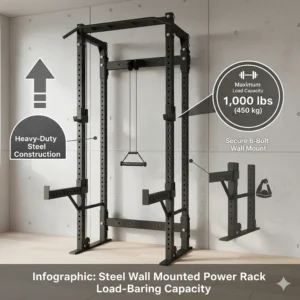
- Weight capacity: 1,000 lbs rackable
- Folded depth: Just 4 inches from wall
- Height options: 81″ or 89″
The hydraulic-assisted folding mechanism is what separates this from cheaper alternatives. You literally pull it down with one hand, and it glides into position like butter. When you’re done, push it back up and the hydraulics do the heavy lifting. Customer feedback consistently praises the numbered holes on the uprights, which eliminate the guesswork when adjusting J-cups between exercises.
Pros:
✅ Smoothest folding mechanism on the market
✅ Made in USA with exceptional build quality
✅ Laser-cut numbered uprights for easy adjustments
Cons:
❌ Premium pricing may stretch some budgets
❌ Requires precise stud spacing for installation
2. Titan Fitness T-3 Series Folding Power Rack
Titan Fitness has built a reputation on delivering commercial-grade equipment at prices that don’t require a second mortgage. The T-3 Series embodies this philosophy perfectly, offering a robust garage gym wall mount solution that competes with racks costing twice as much.
Key Specifications:
- Frame: 2×3 inch 11-gauge steel construction
- Weight capacity: 1,000 lbs
- Folded depth: 5 inches
- Depth options: 21.5″ or 41.5″
The pin-and-hinge folding system works reliably, though it requires a bit more muscle than PRx’s hydraulic setup. What you save in price, you sacrifice slightly in convenience. Still, for most home gym enthusiasts, this represents an excellent value proposition. The Westside hole spacing through the bench press zone is a thoughtful touch that serious lifters appreciate.
Pros:
✅ Exceptional value for money
✅ Solid construction that handles heavy weight
✅ Compatible with extensive Titan accessory ecosystem
Cons:
❌ Manual folding requires more effort
❌ Some users report minor finish inconsistencies
3. Mikolo 60x60mm Folding Wall Mounted Squat Rack
Mikolo entered the market as a value-focused brand and quickly gained traction among budget-conscious fitness enthusiasts. This particular model bridges the gap between ultra-cheap imports and premium American brands, landing in that sweet spot where quality meets affordability.
Key Specifications:
- Frame: 60x60mm (2.36×2.36 inch) steel
- Weight capacity: 1,000 lbs
- Includes: Flat weight bench and 7ft barbell
- Quick-attach pull-up bar: 89″ height
What makes this package particularly appealing is the included bench and barbell. You’re essentially getting a complete starter setup rather than just the rack. The J-cups feature UHMW plastic inserts to protect your barbell’s knurling, and the 360-degree dual-size T-bar row attachment accommodates both Olympic and standard bars. Installation typically takes 15-30 minutes with included stringers and metal studs.
Pros:
✅ Complete package includes bench and barbell
✅ UHMW plastic inserts protect equipment
✅ One-year parts replacement warranty
Cons:
❌ Slightly less refined than premium options
❌ Assembly instructions could be clearer
4. Mappding Folding Squat Rack Wall Mounted
Sometimes you need equipment that just works without overthinking it. Mappding’s offering falls squarely into this category, delivering straightforward functionality at a price point that makes sense for apartment dwellers and garage gym beginners.
Key Specifications:
- Frame: 60x60mm heavy steel uprights
- Weight capacity: 1,100 lbs
- Fold/unfold time: 15 seconds
- Dimensions: 53″×86.2″ (folded), 53″×22.8″×86.2″ (open)
The secure locking mechanisms and four-pin system provide confidence during heavy lifts. You get professional J-hooks, an 80-inch height pull-up bar, and a 360-degree detachable landmine attachment. Customer reviews frequently mention the surprisingly quick setup process and stable feel during use. The powder-coated black finish holds up well to typical garage humidity and temperature swings.
Pros:
✅ Lightning-fast 15-second fold mechanism
✅ Includes landmine attachment
✅ Strong value for the capacity offered
Cons:
❌ Finish quality can show minor imperfections
❌ Hardware included is adequate but not exceptional
5. Liksodo 2″x2″ Folding Wall Mounted Squat Rack
For those entering the home gym world on a tighter budget, Liksodo offers a surprisingly capable entry point. While it doesn’t match the refinement of premium options, it delivers essential functionality without breaking the bank.
Key Specifications:
- Frame: 2×2 inch alloy steel
- Weight capacity: 1,100 lbs
- Features: 4-pin lock system with long spotter arms
- Adjustability: 23 hole positions for J-hooks
The 47-inch width accommodates most 6ft and 7ft barbells comfortably. The 180-degree rotatable pull-up bar and 360-degree rotatable landmine provide versatility beyond basic squatting and pressing. Installation is relatively straightforward, with three height adjustments to avoid baseboard interference. Users appreciate the wood rear panel option and the clear 30-minute assembly timeline.
Pros:
✅ Very competitive pricing
✅ Adequate for most home gym applications
✅ Includes useful accessories out of box
Cons:
❌ Build quality not quite premium level
❌ Some reports of shipping/packaging issues
6. Valor Fitness Wall Mount Cable Machine
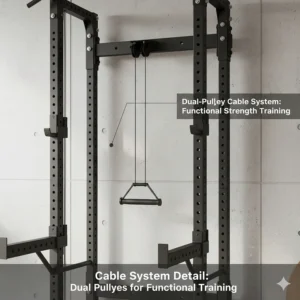
Shifting gears from squat racks to cable systems, Valor Fitness delivers a compact dual-pulley setup that transforms any wall into a functional training station. This represents a different approach to the wall mounted home gym concept, focusing on isolation movements and muscle building rather than heavy compound lifts.
Key Specifications:
- Frame: Heavy-duty alloy steel
- Weight capacity: 200 lbs
- Pulley positions: 16 adjustable
- Includes: LAT bar, V-handle, triangle chest pull, tricep rope
The dual-pulley system with independent movement allows both bilateral and unilateral exercises. The 200-lb capacity suits most muscle-building applications, though serious strength athletes might outgrow it. What you gain in versatility for movements like cable flies, face pulls, and tricep pushdowns, you trade in maximum loading potential. The dual-point wall mounting at top and bottom ensures stability during use.
Pros:
✅ Excellent for isolation exercises
✅ Comprehensive attachment bundle included
✅ Space-efficient wall-mounted design
Cons:
❌ 200 lb limit restricts some exercises
❌ May require bottom anchor reinforcement
7. Wall Mount Cable Machine Dual Pulley System
Rounding out our list is a heavy-duty cable machine that pushes capacity limits while maintaining the space-saving wall-mount philosophy. This unit targets serious home gym enthusiasts who want cable functionality without the floor footprint of traditional cable crossover machines.
Key Specifications:
- Frame: 11-gauge steel with powder coating
- Weight capacity: 400 lbs
- Pulley positions: 20 adjustable
- Design: H-shaped reinforced base
The 2:1 pulley ratio provides extended travel distance and greater movement range for natural exercise execution. Commercial-grade nylon-coated aircraft steel cables ensure smooth, shake-free operation. The integrated footplate facilitates seated rows, while the universal weight sleeve accommodates both 1-inch and 2-inch plates. Installation requires secure dual-point mounting for optimal stability.
Pros:
✅ High 400 lb weight capacity
✅ Commercial-grade construction
✅ Complete attachment set included
Cons:
❌ Requires solid wall mounting surface
❌ Higher price point in category
Understanding Wall Mounted Home Gym Systems
The concept of a wall mounted home gym evolved from a simple problem: traditional power cages consume 16-25 square feet of precious floor space. Multiply that by the average U.S. home’s increasing cost per square foot, and you’re looking at equipment that essentially costs you thousands in real estate value. Smart engineers recognized this inefficiency and developed folding systems that maintain structural integrity while dramatically reducing spatial footprint.
Modern fold away squat rack designs utilize one of three primary mechanisms. Pin-and-hinge systems are the most common, employing heavy-duty steel pins that lock the rack in extended position and release for folding. Hydraulic-assisted mechanisms, like those in PRx racks, incorporate gas struts that counterbalance the rack’s weight for effortless operation. Spring-loaded systems split the difference, offering some assistance without the complexity of full hydraulics.
The engineering challenge lies in maintaining rigidity during use while enabling smooth folding motion. Quality racks achieve this through reinforced mounting points, typically requiring installation into wall studs 16 or 24 inches on center. The mounting hardware bears significant stress, particularly during exercises with eccentric loading like pull-ups or failed squat attempts caught by safety bars.
Material selection matters considerably in these applications. Premium racks use 11-gauge steel in their uprights, providing adequate strength without excessive weight. Powder coating protects against corrosion while offering grip texture. J-cups and safety bars often incorporate UHMW (ultra-high molecular weight) plastic inserts to prevent damage to Olympic barbell knurling during re-racking.
When evaluating murphy rack home gym options, consider how the folding mechanism integrates with your planned exercises. A rack that takes 30 seconds to fold might seem convenient until you’re doing supersets that require quick transitions. Similarly, racks that fold to just 4 inches from the wall provide maximum space recovery but may require removing accessories like landmine attachments before folding.
Installation Considerations for Wall Mounted Systems
Successfully installing a wall mounted power rack system demands more than basic DIY skills. You’re essentially anchoring hundreds of pounds of steel to your wall with the expectation it’ll support thousand-pound loads without budging. This isn’t a job for drywall anchors or wishful thinking.
First, identify your wall structure. Traditional wood-framed homes with 2×4 or 2×6 studs at 16-inch spacing represent the ideal installation environment. Confirm stud locations using a quality stud finder, then verify by drilling small pilot holes. Metal studs require different hardware and potentially reinforcement with backing plates. Concrete or brick walls need appropriate masonry anchors rated for the rack’s specifications.
Most manufacturers supply lag bolts or lag screws for wood stud installation. These typically measure 3/8 inch to 1/2 inch in diameter and 3-4 inches in length. Pre-drilling pilot holes at the correct diameter prevents wood splitting while ensuring proper thread engagement. Torque specifications matter, under-tightening risks rack movement during use, while over-tightening can strip threads or crack lumber.
Ceiling height plays a crucial role often overlooked until installation day. Standard racks require 8-foot ceilings minimum, though 9-foot ceilings accommodate taller users more comfortably. Pull-up bars typically position 80-90 inches from the floor, leaving precious little clearance in basement installations with dropped ceilings or floor joists.
Uneven stud spacing presents installation challenges that require creative solutions. Some manufacturers offer stringer kits, essentially horizontal mounting boards that span multiple studs to accommodate off-center equipment mounting. Alternatively, installing a dedicated mounting board across several studs before attaching the rack distributes load more evenly and provides installation flexibility.
Consider electrical considerations too. Wall-mounted cable machines may require routing cables around electrical boxes or avoiding circuit breaker panels. Plumbing within walls similarly constrains mounting locations. A quick scan with a wall sensor can save you from expensive mistakes and potential safety hazards.
Professional installation services typically charge $200-500 depending on complexity and location. While this adds to initial costs, peace of mind knowing the installation meets structural safety standards often justifies the expense. Many manufacturers void warranties if installation doesn’t follow their specifications precisely.
Comparing Folding Racks vs. Cable Systems
Choosing between a folding wall mounted squat rack and a cable machine system fundamentally depends on your training priorities and fitness goals. These represent distinct approaches to strength development, each with specific advantages and limitations.
Folding squat racks excel at heavy compound movements: squats, bench press, overhead press, deadlifts (with appropriate space), and pull-ups. These exercises form the foundation of strength training programs and deliver exceptional results for building overall muscle mass and functional strength. According to physical activity guidelines, muscle-strengthening activities should work all major muscle groups at least twice per week. If your primary goal involves progressive overload with barbells, a folding rack is non-negotiable.
Cable machines, conversely, specialize in isolation work and muscle hypertrophy. The constant tension throughout movement ranges creates different stimulus than free weights. Exercises like cable flies, face pulls, cable curls, and tricep pushdowns target specific muscles with precision difficult to achieve with barbells alone. Bodybuilders and physique athletes particularly value cable systems for detail work.
From a space perspective, both mount to walls and fold away, but their footprints differ. Squat racks typically extend 21-42 inches from the wall when deployed, requiring clearance for the barbell plus your body positioning. A 7-foot barbell with plates adds another 4 feet on each side, meaning you need roughly 8-10 feet of clearance perpendicular to the wall.
Cable machines generally require less depth but more height. They mount flush to walls but need 7+ feet of clearance around the unit for cable exercises. The actual floor space while using cables varies considerably depending on the exercise. Cable crossovers for chest require standing 2-3 feet from the machine, while lat pulldowns need an additional footprint for benches or seats.
Weight capacity considerations differ substantially. Squat racks commonly handle 1,000+ lbs, accommodating serious strength athletes for years as they progress. Cable machines typically max out at 200-400 lbs resistance, which sounds like plenty until you realize the 2:1 pulley ratio means 400 lbs of plates only delivers 200 lbs of actual resistance at the handle.
Cost comparison reveals interesting patterns. Entry-level folding racks start around $350-400 with basic functionality. Premium models reach $1,200-1,500 but offer superior build quality and features. Cable machines occupy a similar range, with budget options at $300-400 and commercial-grade units approaching $1,000.
The hybrid approach combining both offers maximum versatility but doubles costs and space requirements. Some advanced wall-mounted systems integrate squat rack functionality with cable attachments, though these combo units often compromise on one aspect or the other. True optimization generally requires dedicating space to whichever training modality aligns with your primary goals.
Maximizing Space Efficiency in Small Home Gyms
Creating an effective garage gym wall mount setup in limited space requires strategic thinking beyond simply buying folding equipment. Every square foot demands purposeful allocation, and vertical space becomes as valuable as floor area.
Start by mapping your available space accurately. Measure wall dimensions, ceiling height, door swing clearances, and any permanent fixtures like electrical panels or HVAC systems. Create a simple floor plan showing these constraints before selecting equipment. This prevents costly mistakes like ordering a 91-inch rack when you have 90-inch ceiling clearance.
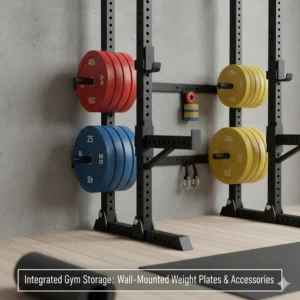
Utilize vertical storage aggressively. Wall-mounted plate storage racks keep weight plates organized and accessible while consuming minimal floor space. Barbell holders attach directly to rack uprights or walls, eliminating the need for separate stands. Resistance bands, jump ropes, and small accessories hang from pegboards or wall hooks.
Consider dual-purpose furniture and equipment. Plyo boxes double as seating or storage. Adjustable benches fold or stand vertically when not in use. Some creative gym owners use weight plates as doorstops or decorative elements rather than hiding them away.
Lighting dramatically impacts perceived space. Dark garages or basements feel cramped regardless of actual dimensions. Installing bright LED fixtures, ideally 4,000-5,000 lumens for a 100-square-foot space, makes areas feel larger and more inviting. Natural light from windows or doors provides additional psychological benefits.
Mirrors expand space visually while serving practical training purposes. A single 4×6 foot mirror costs $100-200 but makes small gyms feel significantly larger. Plus you can check form during exercises, reducing injury risk.
Flooring choices affect both function and aesthetics. Rubber horse stall mats at 3/4 inch thickness protect floors while providing cushioning. At 4×6 feet per mat and roughly $50 each, they’re affordable and durable. Lighter interlocking foam tiles work for gentler activities but lack the durability for heavy barbell work.
Climate control in garage installations matters more than people anticipate. Summer heat makes workouts miserable and degrades equipment. Winter cold makes metal unbearable to touch. A simple box fan and space heater provide basic comfort. Insulating garage doors and walls optimizes temperature management.
Organization systems prevent clutter accumulation. Designated spots for every piece of equipment ensure quick setup and breakdown. When your wall mounted home gym folds away in minutes, you’re more likely to use it consistently rather than procrastinating due to setup hassle.
Essential Accessories for Wall Mounted Home Gyms
A folding wall mounted squat rack provides the foundation, but accessories transform it into a truly functional training environment. Selecting the right additions maximizes your equipment investment and training variety.
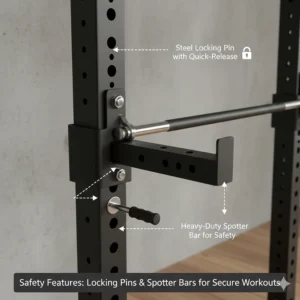
Starting with J-cups and safety bars, these components deserve careful consideration. Standard J-cups suffice for general use, but UHMW plastic-lined versions protect barbell knurling during aggressive re-racks. Adjustable safety bars, also called spotter arms, provide crucial protection during solo training sessions. Look for options that extend 18-24 inches from the rack face, giving adequate catch range for failed squats or bench presses.
Olympic barbell selection impacts your training quality significantly. Entry-level bars start around $150 and work fine for beginners. Serious lifters benefit from specialty bars: a good power bar ($300-400) handles heavy squats and deadlifts, while a bearing bar ($200-300) improves Olympic lift technique. Women’s bars with smaller diameter shafts provide better grip for female lifters or those with smaller hands.
Weight plates come in numerous varieties beyond basic cast iron. Bumper plates enable deadlifts and Olympic lifts with floor drops. Standard cast iron plates cost less but limit some exercises. Competition plates offer precise weight tolerances for serious training. Calculate total weight needs realistically, most home gym users function well with 300-400 lbs in plates.
Collars secure plates during exercises but vary widely in quality. Spring collars cost $10-20 and work adequately. Competition collars ($50-80 per pair) provide faster plate changes and absolute security. OSO collars ($70-90) offer the most secure grip available, though they’re overkill for most applications.
Resistance bands add versatility at minimal cost. A quality set spanning 10-100 lbs resistance costs $40-80 and enables band-assisted exercises, speed work, and accessory movements. They’re particularly valuable for warming up and cooling down.
Landmine attachments mount to rack bases or walls, enabling rotational exercises often impossible with traditional equipment. At $40-80, they add significant exercise variety. Exercises like landmine presses, rows, and rotational core work complement traditional barbell movements.
Pull-up assistance bands help users build toward unassisted pull-ups. A set of 3-4 bands with varying resistance levels ($30-50) enables progressive overload. Combined with your rack’s pull-up bar, these create complete upper body pulling capabilities.
For cable systems, attachment variety matters immensely. Beyond basic bars and ropes, specialized handles target specific movements. D-handles for rows, tricep rope, LAT bar, and straight bar form the essential quartet. Budget $150-200 for a complete set of quality attachments.
Flooring protection extends beyond aesthetics to structural necessity. Rubber mats under the rack prevent floor damage from dropped weights and provide sound dampening. Platform builds with plywood and rubber create designated deadlift areas that protect both floor and weights.
Workout Programming for Wall Mounted Systems
Owning a space saving wall rack demands programming that maximizes its capabilities while acknowledging limitations compared to fully-equipped commercial facilities. Effective home training requires strategic exercise selection and progressive overload planning.
Full-body training three times weekly suits most wall-mounted setups perfectly. This frequency allows adequate recovery while maintaining consistent strength stimulus. Each session targets major movement patterns: squat variations, horizontal press, horizontal pull, vertical press, vertical pull, and hip hinge. Supplementary work addresses smaller muscle groups and weak points.
A sample session structure might include: back squats 4 sets of 5 reps, bench press 4 sets of 6 reps, bent-over rows 3 sets of 8 reps, overhead press 3 sets of 8 reps, pull-ups 3 sets to failure, and Romanian deadlifts 3 sets of 10 reps. This hits all major muscle groups efficiently in 60-75 minutes including warm-up and cool-down.
Progressive overload drives strength gains over time. Track every workout, recording weight, sets, and reps. Increase weight when you successfully complete target reps across all sets. Small 5-lb increments work for upper body, 10-lb jumps for lower body. This systematic progression yields consistent gains over months and years.
Cable system programming emphasizes hypertrophy and muscle building. Higher rep ranges (8-15 reps) with moderate weights build muscle size effectively. Training split approaches work well here: push days (chest, shoulders, triceps), pull days (back, biceps), and leg days. This allows training 4-6 times weekly with adequate recovery.
Deload weeks every 4-6 weeks prevent overtraining and allow recovery. Reduce weight by 40-50% while maintaining movement patterns. This might feel counterproductive, but recovery weeks actually enhance long-term progress by preventing burnout and injury.
Periodization structures training into blocks with specific goals. A basic linear periodization might progress from hypertrophy (8-12 reps, moderate weight) to strength (3-5 reps, heavy weight) to power (explosive movements, moderate weight). Each block lasts 4-6 weeks before transitioning.
Cardio integration depends on goals. Strength-focused athletes minimize interference with short high-intensity intervals. General fitness enthusiasts add moderate steady-state cardio 2-3 times weekly. The beauty of folding equipment is quickly clearing space for cardio activities like jump rope, burpees, or agility drills.
Flexibility and mobility work prevents injuries and improves movement quality. Dedicate 10-15 minutes post-workout to static stretching major muscle groups. Foam rolling before sessions addresses tight areas and improves blood flow. Dynamic warm-ups prepare joints and muscles for training loads.
Maintenance and Safety Best Practices
Proper maintenance ensures your murphy rack home gym remains safe and functional for years. Neglecting basic care invites equipment failure, injury risk, and premature replacement costs.
Monthly inspections should examine all bolt connections, ensuring proper torque and no loosening from vibration. Folding mechanism pivot points require particular attention, checking for play or binding. Lubricate moving parts with lithium grease or similar high-pressure lubricant. Cable systems need regular cable tension checks and pulley inspection for wear or damage.
Powder coating damage demands immediate attention. Small chips expose bare metal to moisture, initiating rust. Touch-up paint designed for metal surfaces prevents further damage. Major coating failures may require professional refinishing, though quality racks rarely experience this with normal use.
Safety protocols prevent accidents and injuries. Always use collars on loaded barbells to prevent plate slippage. Never lift maximum weights without properly adjusted safety bars. Inspect equipment before each use, specifically checking J-cup security and rack stability. If something feels wrong, investigate before continuing.
Loading and unloading barbells follows specific procedures. Load both sides evenly, alternating plates side to side. Avoid creating significant weight imbalances that could tip the bar. When unloading, reverse the process, removing weights evenly from both sides.
Proper exercise technique supersedes all other safety considerations. Learn movement patterns thoroughly before adding significant weight. Consider working with a qualified coach initially to establish proper form. Recording sets on your phone allows reviewing technique and identifying flaws.
Spotting becomes challenging in home gyms without training partners. Safety bars set at appropriate heights catch failed lifts. For bench pressing, position safety bars just below chest level at the bottom of the movement. For squats, set them just below your lowest squat depth. This allows completing full-range movements while providing safety net for failures.
Emergency procedures should be planned before they’re needed. Know how to safely dump a failed squat by stepping forward and letting the bar fall onto safeties. For bench press failures, roll the bar down your torso to your hips, then sit up. These techniques prevent injuries when training alone.
Children and pets present unique safety considerations. Wall-mounted equipment, while folded, remains accessible. Consider installing locking mechanisms to prevent unauthorized operation. Store weight plates in secure locations preventing accidents from falling plates. Establish clear rules about gym area access when equipment is deployed.
Insurance coverage for home gyms varies by policy. Some homeowners insurance automatically covers personal fitness equipment, others require specific riders. Document equipment purchases and installation costs. Liability concerns arise if others use your equipment, consider whether your policy adequately protects against potential claims.
Frequently Asked Questions
❓ How much weight can a wall mounted home gym really support safely?
❓ Can I install a folding wall mounted squat rack in an apartment without damaging walls?
❓ What's better for building muscle, a wall mounted power rack system or cable machine?
❓ How long does it take to fold and unfold a murphy rack home gym between exercises?
❓ Do wall mounted home gyms work with standard ceiling heights?
Conclusion: Making Your Space Work Harder
The wall mounted home gym revolution fundamentally changed what’s possible in limited spaces. Where traditional power racks demanded 20+ square feet of permanent real estate, modern folding systems reclaim that space when not in use. This isn’t just about physical space, it’s about mental space, the freedom to live in your home without constant reminders of fitness equipment dominating your environment.
Throughout this guide, we’ve explored seven proven systems currently available on Amazon in 2026. From PRx Performance’s premium hydraulic-assisted racks to budget-friendly Liksodo options, there’s truly a solution for every space and budget. The key is matching equipment capabilities to your specific training goals and spatial constraints.
Remember that the best equipment is the equipment you’ll actually use consistently. A $1,500 premium rack gathering dust helps nobody, while a $400 budget system used three times weekly transforms fitness outcomes. According to the CDC’s physical activity guidelines, consistency matters more than perfection. Creating a space you genuinely enjoy using increases adherence dramatically.
Installation quality determines success more than equipment selection in many cases. Take time to locate studs properly, use appropriate hardware, and follow manufacturer specifications precisely. When in doubt, hiring professional installation removes stress and ensures structural safety. This isn’t the place to cut corners.
As you build your garage gym wall mount setup, think long-term. Quality equipment lasts decades with proper maintenance. That initial investment, while significant, breaks down to pennies per workout over years of use. Compare this to commercial gym memberships at $50-100 monthly, and home equipment pays for itself in 1-2 years.
The physical health benefits are obvious, but don’t underestimate the mental and emotional advantages of home training. Research shows that regular physical activity improves brain health, reduces anxiety, and enhances sleep quality. No commute time, no waiting for equipment, no judgmental stares from other gym goers. Just you, your equipment, and your goals. This simplicity often yields better results than fancy commercial facilities.
Finally, remember that equipment enables training, but knowledge and consistency drive results. Learn proper technique, follow progressive programming, prioritize recovery, and trust the process. Your fold away squat rack provides the tools, you provide the effort. Together, they create transformation that extends far beyond physical appearance into confidence, health, and capability that enriches every aspect of life.
Recommended for You
- 7 Best Half Rack for Home Gym (2026) – Space-Saving Power Racks
- 7 Best Squat Racks for Home Gym 2026
- 7 Best Pulley System for Home Gym 2026
Disclaimer: This article contains affiliate links. If you purchase products through these links, we may earn a small commission at no additional cost to you.
✨ Found this helpful? Share it with your friends! 💬🤗
