
In This Article
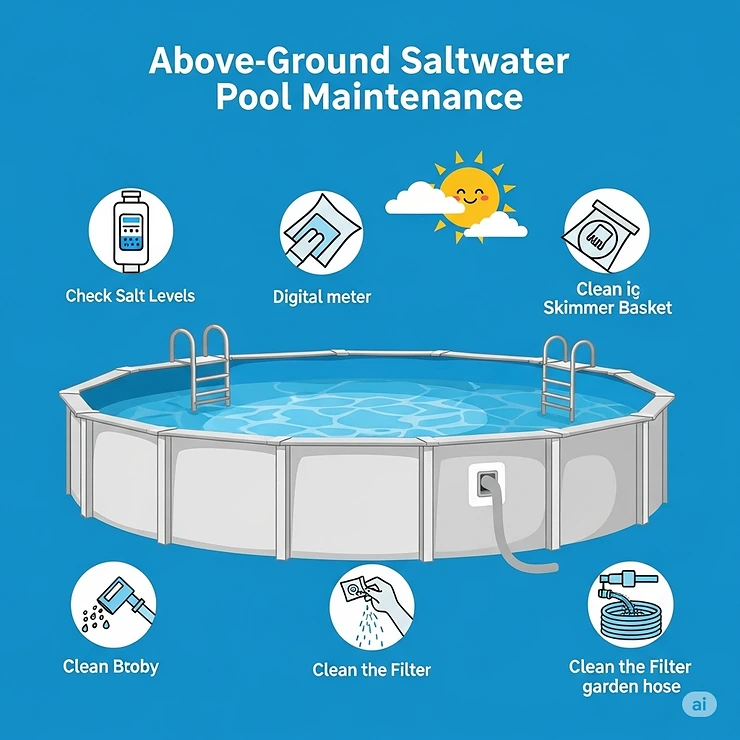
An above ground saltwater pool is an ordinary above-ground pool that makes its own chlorine. Dissolved salt passes through an electrolytic cell, the cell converts it into chlorine, and the chlorine sanitizes the water before reverting to salt. The result is chlorine-clean water without the jugs, tablets, and weekly dosing ritual.
Here’s the part the glossy ads skip. Salt is a mild troublemaker for metal, and above-ground pools are full of metal: walls, uprights, rails, screws. So buying an above ground saltwater pool setup is really two decisions at once. One is the generator. The other is whether the pool around it can live with salt.
The chemistry itself is well documented. Salt water chlorination typically runs on roughly 1,000 to 4,000 ppm of dissolved salt, a fraction of what the ocean holds. That is why the water feels soft instead of briny. Salt cells still need cleaning and the water still needs balancing, and the “never touch a chemical again” pitch is marketing.
This guide skips the brochure talk. We narrowed the field to seven real options: complete kits, conversion systems, and one salt-ready resin pool. For each, we explain what the specs mean in practice, summarize what reviewers report, and flag where the marketing gets ahead of the evidence. Prices appear as ranges only, so check current pricing before you buy.
Here is the fast version.
Quick Comparison: Top Above Ground Saltwater Pool Options for 2026
| Product | Type | Rated Capacity | Standout Trait | Best For |
|---|---|---|---|---|
| Intex Ultra XTR 26373EH | Complete pool set with salt system | Salt system rated to 15,000 gal | Everything in one box | First-timers wanting a turnkey above ground saltwater pool |
| Intex Krystal Clear 26669EG | Conversion system | Up to 15,000 gal | Easy add-on for an existing pool | Owners upgrading a compatible pool |
| Intex Krystal Clear 26667EG | Conversion system | Up to 7,000 gal | Lowest entry cost | Small pools on a tight budget |
| Intex QX2600 26679EG | Sand pump + salt system combo | Up to 15,000 gal | Replaces your pump and sanitizer in one step | People upgrading an aging filter setup |
| Hayward AquaTrol | Pool-specific salt generator | Up to 18,000 gal | Built-in pump timer | Owners who want a brand with dealer support |
| Solaxx Saltron Retro Jet RJ | Salt generator | Up to 25,000 gal | Largest rated capacity here | Big pools and low-salt-light convenience |
| Wilbar Venture Salt 52 | Salt-ready resin hybrid pool | Pool only (pair with a generator) | Resin rails and boot plates | Buyers building a long-term, corrosion-conscious setup |
Looking at the table, the Intex Ultra XTR 26373EH is the simplest path if you’re starting from nothing, while the Intex Krystal Clear 26669EG is the cheapest way to convert a pool you already own. The Solaxx Saltron Retro Jet RJ and Hayward AquaTrol earn their keep when your pool is large enough to strain the Intex ratings. Notice that only one entry is a pool built from the ground up for salt. That matters more than most shoppers realize.
💬 Just one click — help others make better buying decisions too!😊
Top 7 Above Ground Saltwater Pool Picks: Expert Analysis
1. Intex Ultra XTR 26373EH — the turnkey rectangular kit
This is the “open the boxes and go” option. The 32-by-16-foot, 52-inch-deep rectangular frame set ships with a sand filter pump and the Krystal Clear saltwater system, so you never play matchmaker between brands. A rectangle also gives you a real lap lane, which a round pool of similar footprint doesn’t.
The key spec is the salt system’s 15,000-gallon ceiling. A pool this large can sit near that limit, so check the listed water volume against the generator’s rating before ordering. A generator running at its maximum ages faster than one with headroom. Because Intex sells these frame sets bundled with its own salt system, that is a reasonable signal the steel frame is intended to tolerate salt, but read the warranty language rather than assuming.
This is the right pick for families who want one purchase and one set of instructions. Roundups consistently describe the pool as sturdy and complete. The recurring complaints are slow customer service on claims, thin stock covers that catch wind, and occasional liner-durability worries.
Pros:
- ✅ Pool, pump, and salt system arrive as one kit
- ✅ Rectangular shape suits lap swimming
- ✅ Sturdy steel frame with a reinforced liner
Cons:
- ❌ Salt system sits near its rated limit
- ❌ Customer service gets repeated complaints
Price: premium tier among kits, so check current price. Value verdict: strong if you want simplicity, weaker if you already own a pool.
2. Intex Krystal Clear 26669EG — the easiest conversion upgrade
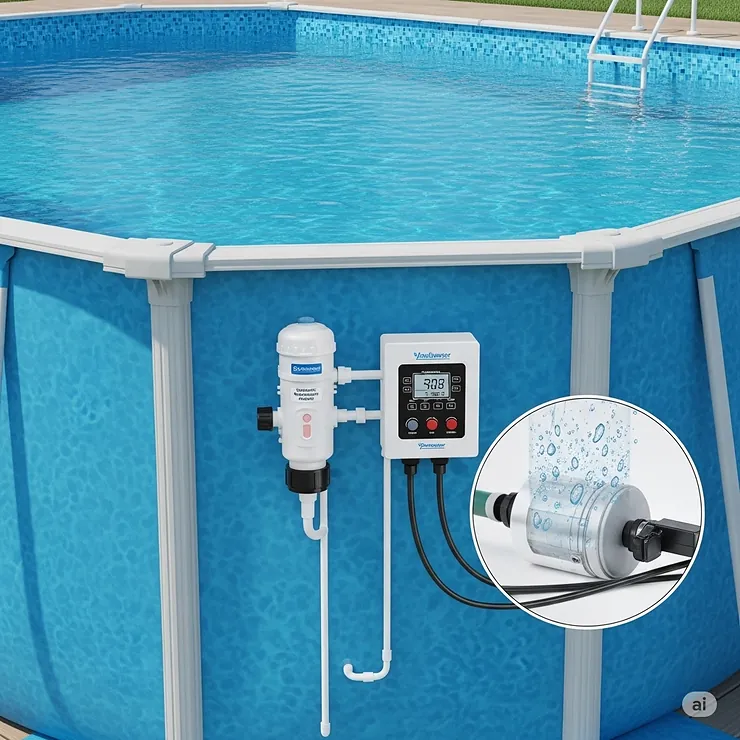
If you already own a compatible pool, this is the most direct route to an above ground saltwater pool. It connects after your filter, handles pools up to 15,000 gallons, and works with filter pumps in the 800 to 3,000 GPH range. It also supersedes the older 28669EG, so expect current parts to match this model.
Intex describes its E.C.O. (electrocatalytic oxidation) process as producing extra oxidizers alongside chlorine, which it says lets the unit run at lower chlorine levels. Treat that as a manufacturer claim. The practical benefit is a compact box with a simple control panel and a two-year limited warranty on the system.
One detail to know: the unit has no salt reservoir. You dissolve salt directly into the pool to roughly 3,000 ppm and let the cell do the rest. Reviewer sentiment is mostly positive, with one persistent theme. Error codes 91 and 92, flagged as too much or too little salt, often trace to scale on the cell plates rather than a dead unit, and a vinegar-style cleaning is the usual fix.
Pros:
- ✅ Compact box that bolts onto existing plumbing
- ✅ Two-year limited warranty on the system
- ✅ Handles pools up to 15,000 gallons
Cons:
- ❌ Low-salt and high-salt errors are a common complaint
- ❌ No built-in pump timer or reservoir
Price: roughly in the mid-$300s range. Value verdict: the best balance of cost and capacity if your pool is already salt-compatible.
3. Intex Krystal Clear 26667EG — the budget starter for small pools
The Intex Krystal Clear 26667EG is the entry ticket. It’s rated for pools up to 7,000 gallons, which covers most 12-to-15-foot rounds, and it runs on standard 110-120V power with a GFCI plug. Retail listings point to three self-cleaning modes, a 24-hour auto-clock cycle, and a weight around 15 pounds. Your filter pump needs to deliver between 700 and 3,000 GPH.
Think of it as the right-sized tool for a small pool, not a bargain version of the bigger unit. Put it on a 12,000-gallon pool and you’ll be fighting it every week. Match it honestly to your volume, with a little headroom.
Verifiable reviews are a small, mixed sample. Buyers praise the savings over liquid chlorine and the gentler water feel, and at least one reports a unit that never worked. That is typical of low-cost electronics, so register the warranty and test it right away.
Pros:
- ✅ Lowest cost of entry in this lineup
- ✅ Simple control panel with auto-clock cycle
- ✅ Works with a wide pump flow range
Cons:
- ❌ Only suitable for small pools
- ❌ Warranty is shorter than the larger Intex model
Price: around the $200 to $250 range. Value verdict: excellent for small pools, a poor fit for anything larger.
4. Intex QX2600 26679EG — pump and salt system in one purchase
The Intex QX2600 26679EG combines a Krystal Clear sand filter pump with the saltwater chlorine system for pools up to 15,000 gallons. Roundups pair the 2,650 GPH sand-filter class with pools between about 4,800 and 15,000 gallons. If your pump is old, mismatched, or underpowered, replacing two components with one makes sense.
The upside of sand filtration is lower ongoing cost and less fuss than swapping cartridges all summer. Experienced owners lean toward sand filters, and that preference shows up repeatedly in pool communities. The downside is that you’re locked into one ecosystem. If something fails, you’re troubleshooting a bundled unit rather than swapping one part.
Independent review volume for this specific combo is thin, so expect general Intex trends: easy setup, occasional error-code frustration, and service that can be slow.
Pros:
- ✅ One purchase replaces pump and sanitizer
- ✅ Sand filtration reduces cartridge hassles
- ✅ Rated for pools up to 15,000 gallons
Cons:
- ❌ Bundled design limits mix-and-match repairs
- ❌ Little independent review data available
Price: mid-range, so check current price. Value verdict: smart when your pump is due for replacement anyway.
5. Hayward AquaTrol — the dealer-supported brand pick
Hayward has the strongest professional footprint in pool equipment, and the Hayward AquaTrol is its dedicated above-ground generator. It’s rated up to 18,000 gallons, which gives room that the Intex units can’t offer. It also has an integral 24-hour timer that controls the filter pump in 15-minute segments.
That timer is quietly the best feature. Many above-ground pools have a single outlet, and the unit supplies a timer-controlled outlet for the pump to plug into. Salt levels run around 2,700 to 3,400 ppm, and the control panel is galvanized steel with a white enamel finish.
Forum owners running generators on above-ground pools report steady results around 2,800 to 3,200 ppm and say corrosion looked similar to non-salt pools of the same age. That is anecdotal, though, and rust can appear on any older above-ground pool. Retail review volume is limited, so we can’t summarize a verified star rating.
Pros:
- ✅ Rated up to 18,000 gallons
- ✅ Built-in 24-hour pump timer
- ✅ Established brand with wide dealer support
Cons:
- ❌ Costs several times more than Intex conversion units
- ❌ Often sold through specialty pool retailers
Price: around $1,400 to $1,600 range. Value verdict: worth it for big pools and for owners who value dealer backup.
6. Solaxx Saltron Retro Jet RJ — the big-capacity workhorse
The Solaxx Saltron Retro Jet RJ is rated for above-ground pools up to 25,000 gallons, the highest figure in this lineup. It uses your existing pump and filter, and a low-salt indicator light tells you when to add more. Solaxx also states that it needs less than a teaspoon of salt per gallon. Its retailer lists it as its most popular above-ground generator.
The practical meaning: large pool owners can buy with real headroom, so the cell isn’t pushed to its limit all summer. Headroom is how you extend cell life. The “return jet” design also fits straight into your plumbing.
Retailer descriptions say you recoup the upfront cost by no longer buying chlorine. That is plausible, but the payback depends on how much chlorine you used before. Independent review volume is limited, so we can’t verify a consensus beyond the manufacturer’s and retailer’s descriptions.
Pros:
- ✅ Highest rated capacity in this roundup
- ✅ Low-salt indicator light is easy to read
- ✅ Works with your existing filter and pump
Cons:
- ❌ Limited independent review data
- ❌ No built-in pump timer
Price: mid-range, so check current price. Value verdict: the best pick for large pools that need generator headroom.
7. Wilbar Venture Salt 52 — the salt-ready resin hybrid pool
This is the odd one out, and arguably the most important. The Wilbar Venture Salt 52 is a pool, not a generator, built around salt compatibility from the start. It uses 7-inch resin top rails, resin bottom rails, and resin boot-style bottom plates, so the parts most prone to rust are plastic. The steel uprights are coated and hardware-free, snapping into place.
Resin matters because salt accelerates corrosion on steel parts but doesn’t affect resin. Here’s the honest caveat from pool forums: even resin-railed pools often have steel walls, so “resin” doesn’t mean “rust-proof.” The Wilbar Venture Salt 52 reduces exposure rather than removing it, and it’s still far better than a steel-railed pool run on salt.
Verified owner reviews are sparse, so we’re basing this on spec analysis and forum commentary. This is a long-term purchase for owners who want the pool and the sanitizer designed to coexist.
Pros:
- ✅ Resin rails and boot plates resist salt corrosion
- ✅ Designed and marketed for salt use
- ✅ Oval shape with a clean, finished look
Cons:
- ❌ Far higher cost than frame-pool kits
- ❌ Steel walls can still rust over time
Price: often north of $5,000 depending on size and configuration. Value verdict: worth the premium only if you plan to keep the pool for many seasons.
How the Seven Picks Stack Up Head to Head
| Product | Rated Capacity | Pump Notes | Warranty Notes | Best For |
|---|---|---|---|---|
| Intex Ultra XTR 26373EH | Salt system to 15,000 gal | Sand filter pump included | Verify kit terms | Turnkey buyers |
| Intex Krystal Clear 26669EG | 15,000 gal | Needs 800-3,000 GPH | 2-year limited | Conversions |
| Intex Krystal Clear 26667EG | 7,000 gal | Needs 700-3,000 GPH | 1-year listed | Small pools |
| Intex QX2600 26679EG | 15,000 gal | Pump included | Verify terms | Pump upgrades |
| Hayward AquaTrol | 18,000 gal | Built-in 24-hour timer | Verify with dealer | Large pools, dealer support |
| Solaxx Saltron Retro Jet RJ | 25,000 gal | Uses existing pump | Verify terms | Largest pools |
| Wilbar Venture Salt 52 | Pool only | Not included | Verify pool warranty | Long-term builds |
The table makes one pattern obvious: capacity and cost climb together, and the jump from Intex to Hayward or Solaxx buys headroom rather than features. If your pool holds 8,000 to 12,000 gallons, the Intex Krystal Clear 26669EG covers you with room to spare, and paying more won’t make your water cleaner. For pools above 15,000 gallons, the Solaxx Saltron Retro Jet RJ and Hayward AquaTrol are the only sensible ratings here. Use the “Warranty Notes” column as homework, not as gospel, because terms change.
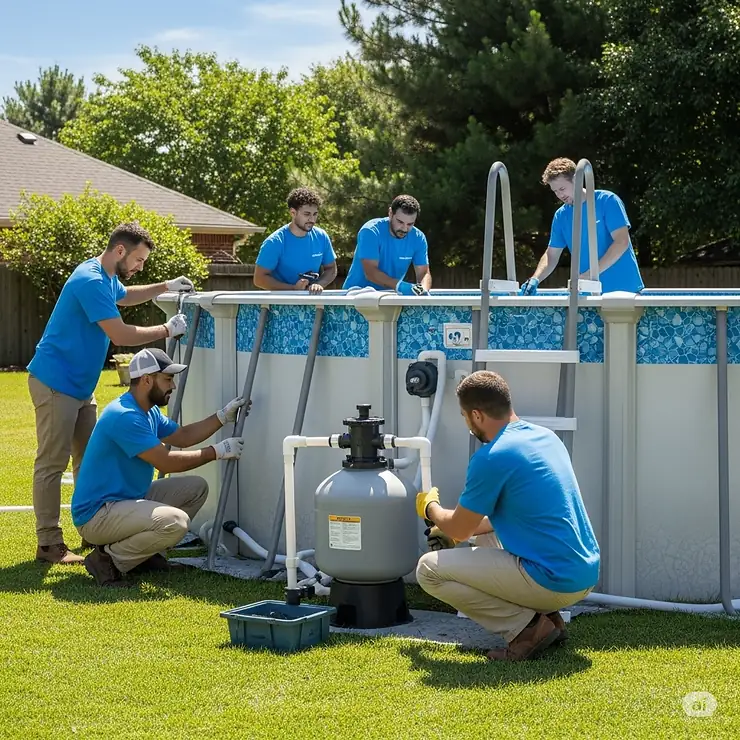
How to Choose an Above Ground Saltwater Pool
Quick answer: match the generator to your pool volume, confirm the pool tolerates salt, and check your pump. Here are the steps in order.
- Confirm the pool’s salt tolerance first. Read the pool manufacturer’s warranty for saltwater language. Some manufacturers explicitly warrant resin-based models for salt, while many steel-heavy pools are not. This single step prevents the most expensive mistake.
- Calculate your true water volume. Use the manufacturer’s gallon figure, not the label on the box art. Overestimating leads to buying a unit that’s too small.
- Buy a generator rated above your volume. One pool-care guide recommends a system rated about 1.5 times your pool size. The logic is simple: a unit running near its limit works harder and wears sooner.
- Check your pump’s flow rate. The Intex Krystal Clear 26669EG wants 800 to 3,000 GPH, and the Intex Krystal Clear 26667EG wants 700 to 3,000 GPH. A pump outside that window causes errors or poor output.
- Look at the outlet situation. The Hayward AquaTrol supplies a timer-controlled outlet, which helps when your pool has a single plug. Otherwise plan for a GFCI-protected outdoor circuit.
- Decide who services it. Dealer-backed brands help if you want local support. Big-box brands are cheaper but lean on phone and online support.
- Budget for the extras. Pool-grade salt, a test kit, and stabilizer all add to the first-season bill.
✨ Ready to Upgrade Your Backyard?
🔍 Take your pool to the next level with these carefully selected options. Click on any highlighted item to check current pricing and availability. A little planning now means clear, soft water for the whole season!
Above Ground Saltwater Pool vs Chlorine Pool: What Actually Changes
Many people assume a saltwater setup means “no chlorine.” That’s wrong. A salt system still produces chlorine; it just makes it on-site. Pool-care guides state this plainly: salt itself isn’t the disinfectant, chlorine is.
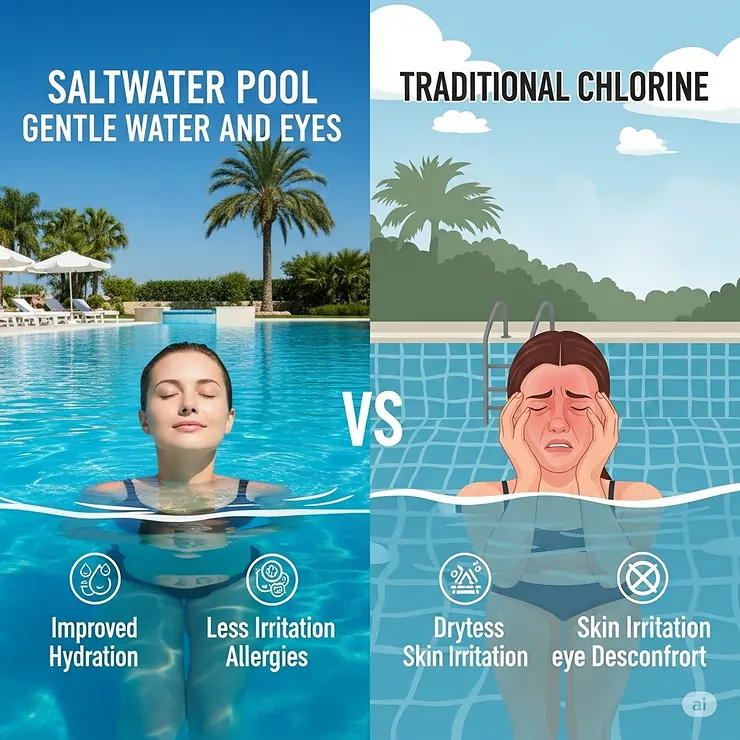
What changes is the experience. Salt generators produce steady, low-level chlorine, which tends to mean fewer harsh swings and fewer combined-chlorine byproducts. The CDC explains that chloramines form when chlorine binds to body waste, and these irritants, not chlorine itself, cause the strong “pool smell,” red eyes, and coughing. A well-run above ground saltwater pool can reduce that smell, but it can’t stop swimmers from bringing sweat and oils into the water. A quick rinse before swimming helps either way.
| Factor | Above Ground Saltwater Pool | Traditional Chlorine Pool |
|---|---|---|
| Upfront cost | Higher (generator and salt) | Lower |
| Ongoing chemicals | Mostly salt, balancers | Chlorine tablets or liquid, balancers |
| Water feel | Often described as softer | Can feel harsher |
| Corrosion risk | Higher for steel parts | Lower |
| Maintenance | Clean the cell, test water | Dose chlorine regularly |
| Best For | Owners wanting steady chlorine | Budget-first, steel-pool owners |
Reading this table honestly, the saltwater route wins on convenience and comfort, and loses on upfront cost and corrosion risk. Neither is universally better. If your pool has a steel wall and no salt warranty, a traditional chlorine setup may be the smarter, cheaper choice. If you’re buying new, an above ground saltwater pool paired with a resin-heavy design is the strongest long-term combination.
Features That Actually Matter (And Those That Don’t)
What matters. Rated capacity with headroom, because it governs cell life. A real warranty on the cell, since the cell is the expensive wear part. And a clear salt-level indicator, so you aren’t guessing.
What helps but isn’t essential. Self-cleaning modes, like the three on the Intex Krystal Clear 26667EG, reduce scale buildup. A built-in timer, like the one on the Hayward AquaTrol, saves wiring headaches. Smart controls sound fun, but they don’t change water quality.
What’s mostly marketing. Ozone or “boost” add-ons draw skepticism in pool forums, where experienced owners advise against ozone systems for this application. Take the intro-price claims that a system “pays for itself” with a grain of salt. Payback depends entirely on what you spent on chlorine before.
The corrosion debate deserves a straight answer. Some pool guides flatly say not to run a salt generator on steel or aluminum frames. Some forum owners report no obvious problems at moderate salt levels around 2,800 to 3,200 ppm. Both can be true: corrosion depends on pool materials, salt level, water balance, and age. The only reliable authority is your pool’s warranty. If the manufacturer won’t cover salt use, that’s your answer. For a pool built to handle salt, look at resin-heavy designs like the Wilbar Venture Salt 52 or the Magnus 54″ Hybrid Resin, which one retailer lists as salt-friendly only with an upgrade kit.
Long-Term Cost & Maintenance of an Above Ground Saltwater Pool
The sticker price only tells part of the story. Total cost of ownership has four pieces.
Equipment. A conversion system like the Intex Krystal Clear 26669EG sits in the mid-$300s range, while a dedicated unit like the Hayward AquaTrol runs several times that. Generators are wear items. Cells eventually lose efficiency, so plan for a replacement cell within several years rather than assuming a lifetime of use.
Consumables. Pool-grade salt is cheaper than packaged chlorine. Salt isn’t “used up” in the same way, because it cycles continuously and is only lost to splash-out, backwashing, and rain dilution. That’s the savings engine behind the whole concept.
Water balance. You’ll still buy pH adjusters, stabilizer, and test supplies. Salt chlorination tends to push pH upward, so expect regular acid additions. The Wikipedia entry on salt chlorination notes this hydroxide effect, so don’t skip routine testing.
Cell care. Check the cell on a schedule and descale when needed, since scale triggers many of the error codes owners report. Municipal and state health guidance for salt generators also stresses rinsing salt residue off decks, which prevents buildup around the pool. You can read a plain-language overview in this Indiana State Department of Health guide.
Put together, a small above ground saltwater pool can recover its extra upfront cost within a few seasons for heavy chlorine users, but not for light ones. Run your own numbers: add last year’s chlorine spend, subtract expected salt, and compare that to the generator’s price.
Common Mistakes When Buying an Above Ground Saltwater Pool
Here’s where buyers lose money, and why.
Mistake 1: Assuming any pool tolerates salt. Pool makers say it directly: many above-ground models aren’t compatible, and the ones that are tend to use resin parts. Check the warranty before the generator.
Mistake 2: Sizing to the minimum. Buying a generator rated exactly at your volume means it runs hard from day one. Size up.
Mistake 3: Ignoring pump compatibility. The Intex units specify flow windows. A mismatched pump produces errors that look like a defective generator.
Mistake 4: Using table salt. Pool-grade salt is the standard recommendation. Table salt can include additives that cause problems.
Mistake 5: Skipping the water test. Salt doesn’t excuse you from checking pH, alkalinity, and calcium hardness. Test weekly, and more often in peak season.
Mistake 6: Forgetting temperature. Many salt cells produce poorly in cold water, and one source advises keeping water above about 60°F. In shoulder seasons, you may need a backup plan.
Mistake 7: Buying the premium resin pool when a frame pool fits the budget. The Wilbar Venture Salt 52 is excellent for long-term owners, but if you want a two-or-three-season pool, a frame kit may be the more rational spend.
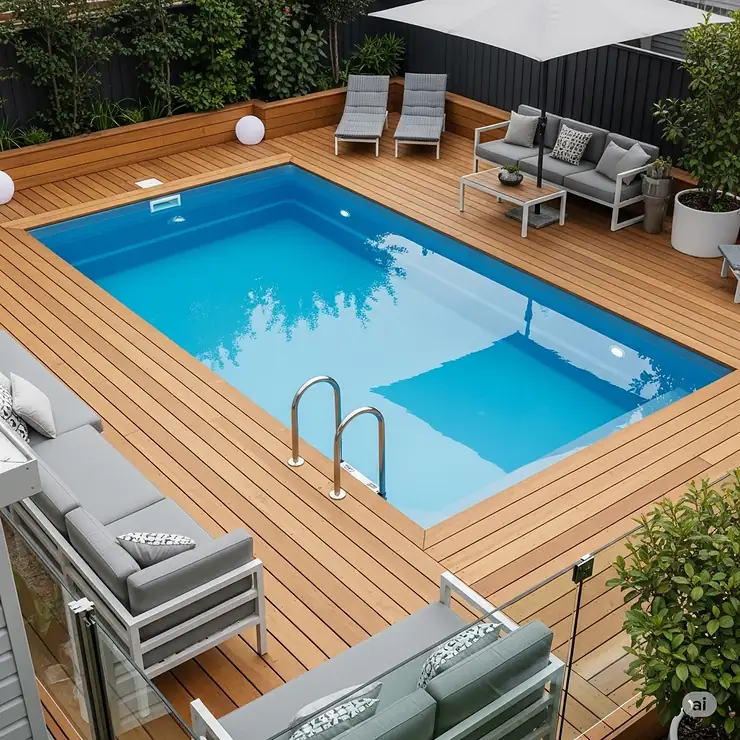
Setup Guide: Your First 30 Days with an Above Ground Saltwater Pool
This is where the Amazon listing stops and the real work begins. Use this as a checklist.
Day 1: Prepare and plan. Confirm your pool volume, then use a pool-salt calculator or the manufacturer’s chart to determine how many bags you need. Dissolving salt takes time, so add it gradually with the pump running. Brush the floor so salt doesn’t pile up.
Day 1-2: Install the generator. Connect after the filter, as the Intex Krystal Clear 26669EG instructions describe. For the Hayward AquaTrol, plug the pump into the timer outlet. For the Solaxx Saltron Retro Jet RJ, follow the return-jet installation. Always use a GFCI-protected outlet.
Day 2-3: Test and balance. Check pH, alkalinity, and calcium hardness after the salt has dissolved. Adjust before you switch the generator on. Starting with balanced water prevents scale and protects the cell.
Week 1: Watch the numbers. Aim for the salt range your unit specifies, such as the roughly 2,700 to 3,400 ppm window listed for the Hayward AquaTrol, or about 3,000 ppm for the Intex units. Check free chlorine daily at first.
Week 2-4: Settle into a rhythm. Test water weekly or more. Inspect the cell visually. If you get an error code, check salt level and cell scale before assuming failure.
Common first-30-day errors: adding salt without dissolving it first, running the pump too few hours, and ignoring pH drift. A simple log of dates and test results will catch problems early.
Real-World Scenarios: Which Above Ground Saltwater Pool Setup Fits You?
Scenario 1: The first-time family. You have two kids, a modest yard, and no pool equipment. You want one purchase and a fast start. The Intex Ultra XTR 26373EH bundles pool, pump, and salt system, so everything arrives matched. Budget for a ladder safety plan, a test kit, and a cover that won’t blow away.
Scenario 2: The owner of a small round pool. You’ve been hauling chlorine tablets for three summers and your pool holds around 6,000 gallons. The Intex Krystal Clear 26667EG handles that volume at a low price. Confirm your pool’s salt tolerance first, then convert.
Scenario 3: The big-pool entertainer. Your pool is large, you host often, and heavy bather loads mean your chlorine demand is high. The Solaxx Saltron Retro Jet RJ or Hayward AquaTrol gives you headroom that smaller units can’t. If you want dealer support, lean Hayward. If you want the highest rated capacity, lean Solaxx.
Scenario 4: The long-haul builder. You’re installing a pool you plan to keep for a decade. Pair the Wilbar Venture Salt 52 with a properly sized generator, and design for corrosion resistance from the start.
Problem → Solution Guide for Above Ground Saltwater Pool Owners
Problem: Error code for high or low salt. Retest the water with a reliable kit before touching the unit. Owners report that codes like 91 and 92 on Intex units often come from scale on the cell plates. Inspect and descale per the manual.
Problem: Cloudy water despite the generator running. Check pH first, since high pH cuts chlorine effectiveness. Then check filtration hours. The Hayward AquaTrol timer helps ensure consistent filtering.
Problem: Chlorine smell. A strong smell usually signals chloramines, not too much chlorine. The CDC notes that healthy pools don’t have a strong chemical smell. Shock according to your unit’s guidance and encourage pre-swim rinsing.
Problem: Rust spots near rails or screws. Wipe and treat promptly, keep salt in range, and keep pH from drifting. Consider resin upgrades if your pool supports them.
Problem: Low output in cool weather. Many salt cells reduce output in cold water. Plan for supplemental sanitizing in shoulder seasons.
Safety, Regulations & Compliance for an Above Ground Saltwater Pool
Salt changes your chemistry, but it doesn’t change drowning risk. The Consumer Product Safety Commission has long stressed that barriers and supervision prevent pool drownings, and it recommends that above-ground pool steps and ladders be secured, locked, or removed when the pool isn’t in use.
Its barrier guidance also says above-ground pools should have barriers, either the pool structure itself or a barrier mounted on top, and that fences should be at least 48 inches above grade. CPSC also announced a recall in 2025 covering roughly 5 million above-ground pools whose outer compression strap could act as a foothold for young children. If you own an older pool, check for recall status.
Local rules vary, so call your building or zoning office about permits, setbacks, electrical requirements, and fencing. Electrical safety matters too: use GFCI protection and follow manufacturer instructions. Store pool chemicals and salt out of reach of children and pets, and never mix chemicals.
FAQ
❓ Can I convert my existing above ground pool to saltwater?
❓ How much salt does an above ground saltwater pool need?
❓ Is an above ground saltwater pool cheaper to run than chlorine?
❓ Does salt damage above ground pool liners and frames?
❓ What size salt system should I buy for my above ground pool?
Conclusion
Choosing an above ground saltwater pool setup comes down to one question that most listings dodge: can your pool take the salt? Answer that first, and the rest gets easy.
If you want one box with everything, the Intex Ultra XTR 26373EH is the simplest path. If you already own a compatible pool, the Intex Krystal Clear 26669EG is the most sensible conversion, and the Intex Krystal Clear 26667EG covers small pools on a tight budget. The Intex QX2600 26679EG fits owners replacing an aging pump anyway. For big pools or dealer-backed confidence, the Hayward AquaTrol and Solaxx Saltron Retro Jet RJ offer capacity that the Intex units can’t match. And if you’re building for the long haul, the Wilbar Venture Salt 52 is the only pick here designed around salt from the pool up.
Whatever you choose, test your water, clean the cell, rinse off salt residue, and treat safety as non-negotiable. Do that, and you’ll spend your summer swimming instead of scooping, dosing, and arguing with a bucket of tablets.
✨ Ready to Make the Switch?
🔍 Compare current pricing and availability on your favorite pick, and give your backyard the soft, low-fuss water it deserves. Your future self, floating on a hot July afternoon, will thank you!
Recommended for You
- 7 Best Pool Steps for Above Ground Pool: Ultimate Safety & Comfort Guide 2025
- 7 Best Above Ground Pool Deck Systems That Transform Your Backyard in 2025
Disclaimer: This article contains affiliate links. As an Amazon Associate, I earn from qualifying purchases. If you purchase products through these links, we may earn a small commission at no additional cost to you.
✨ Found this helpful? Share it with your friends! 💬🤗
