

In This Article
A deck around above ground pool setups is a raised platform built beside or around the pool wall. It lets swimmers step onto a flat, stable surface at rail height instead of wobbling up a ladder. It adds lounging space, makes entry safer, and, when designed correctly, can double as part of your pool barrier.
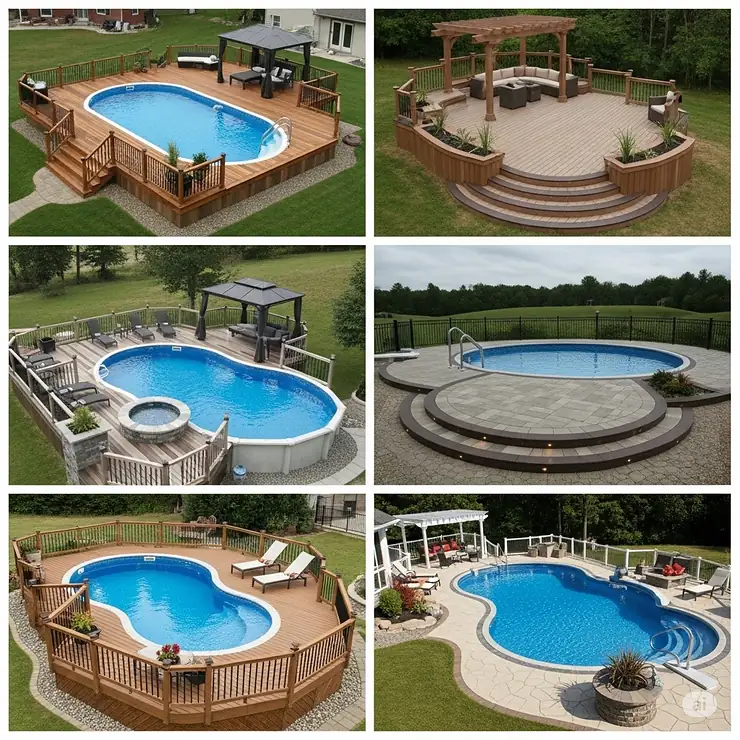
Picture the classic above ground pool with no deck: a big blue tub in the grass, a ladder that bounces under every step, and wet footprints trailing back to the lawn chairs. It works. It also feels like a temporary arrangement that somehow lasted nine summers. Add a deck and the whole thing changes. Suddenly there’s a place to set a drink, spread a towel, and watch the kids without standing in a puddle. If you want the basics of how pools are classified, this overview of swimming pools is a handy primer.
Here’s the catch. The market for a deck around above ground pool projects is a muddle of resin kits, entry stairs, lumber plans, and composite boards, and plenty of “best of” pages blur them together. A kit is not a lumber deck. A set of gated steps is not a platform. Part of this guide’s job is separating them, so you buy the thing that solves your problem.
I couldn’t test any of these products myself, and I won’t pretend otherwise. What follows is spec analysis, aggregated buyer sentiment where I could verify it, and building-code context. It’s the kind of reasoning that helps you avoid an expensive “oops.” As of October 2026, here are seven real products worth your attention, plus everything you need to choose between them.
Quick Comparison: Deck Around Above Ground Pool Picks at a Glance
| Product | Type | Best For | Approx. Price Range |
|---|---|---|---|
| VinylWorks 5×13.5 Resin Deck Kit | Full resin platform kit | Families who want lounging space | Premium (several thousand dollars) |
| VinylWorks 5×10 Resin Deck Kit | Platform + in-pool and ground steps | Best all-around kit | Upper mid-range to premium |
| VinylWorks 5×5 Resin Deck Kit | Compact platform kit | Small yards, entry-focused decks | Low-to-mid $2,000s |
| Aqua Select Anti-Slip Steps with Gate | Gated entry steps | Safety-first households | Around $900-$1,000 |
| Confer Plastics Step-1X | Entry stairs | Budget-conscious DIY decks | Budget to mid-range |
| Confer Plastics 9300 Roll-2-Guard | A-frame entry with barrier | Adjustable pool heights | Mid-range |
| Blue Wave Easy Pool Steps | Deck-mount steps | Wide, anti-slip entry | Low-to-mid $300s |
Notice how the table splits into two groups. The first three products are actual platforms. The other four are entry systems you’d pair with a deck you build yourself. If your goal is a wraparound lumber or composite deck, the second group is where your money goes. If you’d rather skip the carpentry, the first group is your shopping list.
Budget buyers should read the price column carefully. A resin kit costs several times what a good set of steps does, and the difference buys you a ready-made platform and fewer weekends with a circular saw. Prices move around, so check current pricing before you commit.
💬 Just one click — help others make better buying decisions too!😊
Top 7 Products for a Deck Around Above Ground Pool Projects: Expert Analysis
1. VinylWorks 5×13.5 Resin Deck Kit — largest platform in the lineup
The headline here is size. At 5 by 13.5 feet, this is the biggest platform I found in the resin-kit category, and that matters because above ground pool decks usually fail on space, not looks.
Per the manufacturer’s description, the kit pairs a rated platform with a pool ladder, deck stairs, and an integrated safety gate. The cantilevered design eliminates the gap between deck and pool rail, which is where flip-flops and phones go to die. One roundup lists a deck load capacity of 3,000 pounds, which in practical terms means a crowd of adults and a few loungers won’t strain it. Resin also shrugs off the rot that haunts pressure-treated pine around constant splashing.
Based on the spec comparison, this suits families who actually want to live on the deck: cooler, chairs, towels, a small table. If you only need an entry point, you’re paying for square footage you won’t use.
I couldn’t verify a meaningful sample of independent buyer reviews for this exact kit, so read the verified-purchase reviews on the product page. Look in particular for comments about assembly time and fit with your pool’s top rail.
Pros:
- ✅ Biggest platform area in this roundup
- ✅ Cantilever design closes the rail gap
- ✅ Resin avoids rot and splinters
Cons:
- ❌ Premium price for a pre-built platform
- ❌ Needs a properly leveled site and careful fitment check
Expect the price to land in premium territory, in the several-thousand-dollar range, so check current price. Value verdict: strong for entertainers, overkill for everyone else.
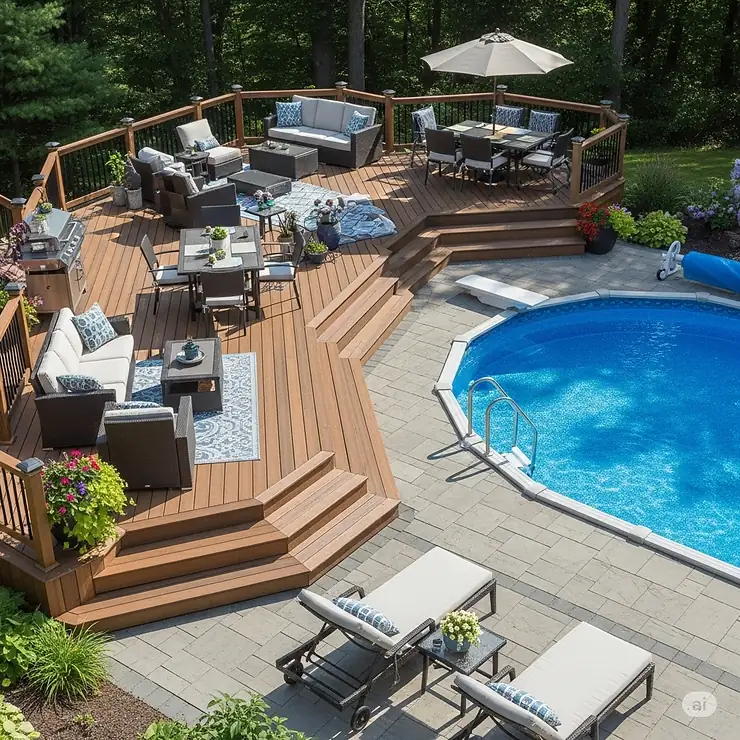
2. VinylWorks 5×10 Resin Deck Kit — the cantilever design that closes the rail gap
If I had to pick one kit for most households, this is the one I’d flag. It’s the “Goldilocks” size: big enough for two chairs and a cooler, small enough for a typical backyard.
What sets it apart is the cantilever deck design, which removes the awkward gap between the deck and the pool’s top rail. The kit is described as including both an in-pool step and a ground-to-deck step with a gate. In plain English, that’s the whole entry sequence handled in one box: you climb the deck stairs, pass through a gate, then step down into the water. The modular, UV-protected construction means the color shouldn’t chalk and fade the way cheap plastic does after a couple of summers.
On paper, this is the best balance of footprint, features, and cost for a 15- to 24-foot round pool. It also gives you a gated approach that supports safer pool access, though you still need to check your local barrier rules (more on that below).
Verified review sentiment was thin in my research, so I won’t summarize what I can’t confirm. Check recent verified-purchase feedback on assembly instructions and hardware quality before ordering.
Pros:
- ✅ Includes in-pool step, deck stairs, and gate
- ✅ UV-protected modular construction
- ✅ Right-sized for most backyards
Cons:
- ❌ Costs far more than DIY lumber
- ❌ Only one side of the pool gets a platform
Expect a price meaningfully above the 5×5, so check current price. Value verdict: the best “set it and forget it” choice here.
3. VinylWorks 5×5 Resin Deck Kit — compact platform for tight yards
Not every backyard is a resort. The 5×5 is the “landing pad” version: a small platform where you stand, dry off, and step into the pool.
The smaller footprint is a feature, not a limitation. A 5-by-5 deck covers the single most important job a pool deck does: it replaces the ladder with a stable entry. You still get the same family design logic, including a platform, pool-side steps, and a gate. It also costs less to ship and takes less ground prep, which matters if your yard slopes.
Where it falls short is lounging. Two chairs will crowd it. Think of it as a front porch for your pool, not a patio.
What the spec sheet won’t tell you is how it behaves on real ground. Resin platforms are only as stable as the base underneath, so plan on a compacted, level pad. Verified buyer feedback was too sparse for me to summarize responsibly, so check the review section for notes on leveling.
Pros:
- ✅ Smallest footprint, easiest ground prep
- ✅ Full entry sequence in one kit
- ✅ Resin construction resists rot
Cons:
- ❌ Too small for lounging or gatherings
- ❌ Price per square foot is steep
Retail listings put it in the low-to-mid $2,000s at the time of research, so check current price. Value verdict: great for entry safety, poor for entertaining.
4. Aqua Select Anti-Slip Steps with Gate — gated entry with a premium feel
Here the standout is the gate. This entrance system pairs anti-slip steps with a gate, which makes it a natural fit for homes with toddlers, grandkids, or curious dogs.
The listing describes pearl-white steps with anti-slip treads, and a related in-pool step variant is listed for 48-54 inch pool heights. Anti-slip treads matter because wet plastic is slick, and the gate matters because a deck without a lockable approach isn’t much of a barrier at all. For a deck around above ground pool builds that you make from lumber, this is the kind of entry hardware that completes the safety picture.
On paper, it’s a splurge. You’re paying roughly three times what you’d pay for standard steps, and the benefit is mostly about control: who gets in, and when. That’s a meaningful upgrade if you’re managing small children, and a luxury if you’re not.
I couldn’t verify enough independent buyer feedback to summarize it. Confirm fitment against your pool’s wall height before purchase.
Pros:
- ✅ Gate adds a lockable access point
- ✅ Anti-slip treads for wet feet
- ✅ Clean, upscale look
Cons:
- ❌ Costs several times basic steps
- ❌ Requires confirming wall-height compatibility
Expect around $900-$1,000 at the time of research, so check current price. Value verdict: worthwhile when child safety is a priority.
5. Confer Plastics Step-1X — best-value stairs for flat-bottom pools
This is the workhorse. The Confer Plastics Step-1X is repeatedly called a best-value entry system in recent roundups, and the logic holds up.
It fits flat-bottom above ground pools with deck heights from 48 to 60 inches, which covers a wide range of standard pools. The key word is “flat-bottom.” If your pool has a sloped or coved bottom, it won’t sit right, and that’s the number-one fitment trap with this style of step. Resin construction means no rust and no cracking from chlorine exposure.
My take: if you’re building a lumber or composite deck yourself and just need a solid way into the water, this is the efficient route. You save money on the entry system and put it into better decking boards. It’s a practical split of the budget, with the structure from lumber and the water-contact hardware from resin.
I couldn’t verify a robust pool of buyer reviews here, so check the product page for notes on stability and mounting.
Pros:
- ✅ Fits 48-60 inch deck heights
- ✅ Corrosion-proof resin construction
- ✅ Good price for the function
Cons:
- ❌ Flat-bottom pools only
- ❌ Doesn’t include a platform
Pricing sits in the budget-to-mid range, so check current price. Value verdict: the smartest low-cost entry for DIY builders.
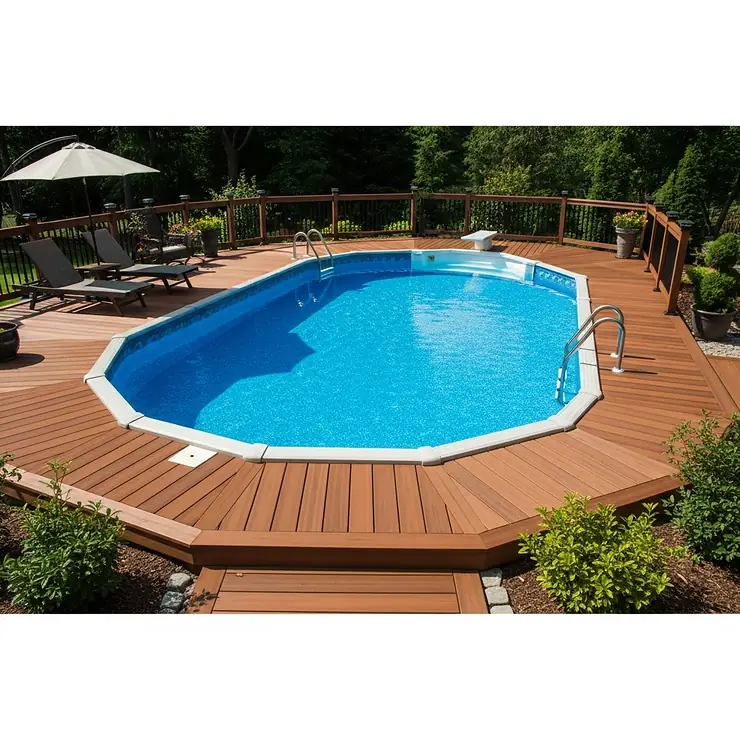
6. Confer Plastics 9300 Roll-2-Guard A-Frame — adjusts 48 to 60 inches without extension kits
The cleverness here is adjustability. Most pool ladders need separate extension kits to fit different wall heights. The Confer Plastics 9300 Roll-2-Guard is described as adjusting from 48 to 60 inches without any add-ons.
That helps in two situations. First, if you’re not entirely sure of your final deck height, you get wiggle room. Second, if you ever swap pools, the entry system can come with you. The modular, adaptable design also targets safety: a roll-style barrier can be secured to limit access when the pool isn’t in use, which lines up with the “secured, locked, or removed” language found in common barrier codes.
Frankly, it’s an A-frame, so it’s a freestanding unit and not a deck. But as a safety-focused ladder to pair with a deck, it’s one of the more sensible designs around.
Verified buyer feedback was limited in what I could access, so read recent reviews for notes on how smoothly the barrier operates.
Pros:
- ✅ Adjusts 48-60 inches without kits
- ✅ Barrier design supports safer access
- ✅ Modular and reusable
Cons:
- ❌ A-frame, so no platform
- ❌ More moving parts than fixed stairs
Expect mid-range pricing, so check current price. Value verdict: excellent insurance against measurement mistakes.
7. Blue Wave Easy Pool Steps — wide anti-slip treads with deck-mount brackets
Finally, the one most directly aimed at deck builders. Blue Wave Easy Pool Steps include deck-mounting brackets, which is rare at this price.
The listing describes anti-slip, wide stairs with handles, fitting 48-54 inch pools, with a 350-pound limit. White vinyl construction keeps it light and weather-resistant. Wide treads matter more than people expect. A narrow step forces a tentative, sideways shuffle, while a wide one lets you walk in like you own the place.
The 350-pound limit is the number to remember. Single-person use is fine, but you shouldn’t treat it like a bleacher. And since the fit range stops at 54 inches, a 52-inch pool is a great match and a 60-inch deck isn’t.
I couldn’t verify enough independent review data to summarize it. Check recent buyer notes on bracket fit with your specific decking.
Pros:
- ✅ Deck-mounting brackets included
- ✅ Wide anti-slip treads with handles
- ✅ Light, weather-resistant vinyl
Cons:
- ❌ Fits only 48-54 inch pools
- ❌ 350-pound limit is modest
Listings show it in the low-to-mid $300s, so check current price. Value verdict: a strong middle option for wooden or composite decks.
| Product | Wall Height Fit | Standout Spec | Best For |
|---|---|---|---|
| VinylWorks 5×13.5 Resin Deck Kit | Check listing | 3,000 lb deck load (per one roundup) | Entertainers |
| VinylWorks 5×10 Resin Deck Kit | Check listing | Cantilever design, in-pool + ground steps | Most households |
| VinylWorks 5×5 Resin Deck Kit | Check listing | Compact platform | Small yards |
| Aqua Select Anti-Slip Steps with Gate | 48-54 in (in-pool variant) | Gated, anti-slip entry | Child safety |
| Confer Plastics Step-1X | 48-60 in | Corrosion-proof resin | Flat-bottom pools |
| Confer Plastics 9300 Roll-2-Guard | 48-60 in | No extension kits needed | Uncertain heights |
| Blue Wave Easy Pool Steps | 48-54 in | Deck-mount brackets, 350 lb limit | Wood or composite decks |
The pattern is clear: the VinylWorks kits sell convenience, while the Confer Plastics and Blue Wave options sell flexibility. If you hate carpentry, you’ll lean toward the kits. If you’re building your own platform, the entry systems let you spend the savings on better boards.
Also note the fitment ranges. The Confer Plastics 9300 Roll-2-Guard and Confer Plastics Step-1X cover taller walls, while Blue Wave Easy Pool Steps and the in-pool Aqua Select variant top out at 54 inches. Measure first, then shop.
How to Choose a Deck Around Above Ground Pool Projects
What is the best way to choose a deck around above ground pool? Start with your pool’s wall height, then decide between a ready-made kit and a custom build, confirm barrier and permit rules, and match the material to your climate and budget.
- Measure the wall height and bottom shape. Fitment is the most common failure point. Steps rated for 48-54 inches won’t work on a 60-inch wall, and flat-bottom-only designs won’t sit right on a coved floor.
- Pick your path: kit or custom build. A resin kit trades money for speed. A lumber or composite deck trades time for size and customization.
- Decide how much deck you really need. Count the people who will use it at once. A platform for two is a very different project than one for twelve.
- Match the material to your climate. Hot, sunny regions punish dark composite and cheap wood. Wet, humid regions punish untreated softwood.
- Plan the entry system early. The steps and gate shape the layout. Deciding after the deck is built usually means awkward compromises.
- Check local rules before buying anything. Permits, barrier heights, and gate requirements vary by jurisdiction, and getting this wrong can mean tearing out finished work.
- Budget for the unglamorous stuff. Ground prep, hardware, sealant, and non-slip treatment add up, and they’re easy to forget until the invoice arrives.
Follow those seven steps in order and most of the common regrets disappear.
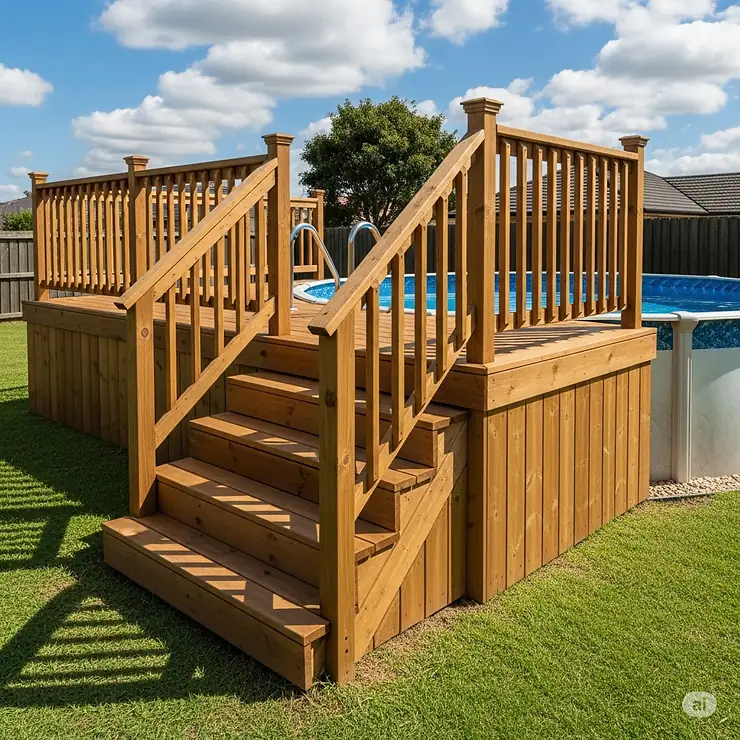
Wood vs Composite vs Resin: Choosing Materials for a Deck Around Above Ground Pool
Materials decide how your deck looks in year one and how it behaves in year ten. Here’s the honest breakdown.
Pressure-treated pine is the budget classic. It’s treated with chemicals to resist rot and insects, and one lumber source puts typical pool-deck life at roughly 15 to 20 years. The trade-off is upkeep. Carter Lumber notes that treated decks need regular washing and sealing, and that composites generally cost about twice as much as wood while demanding far less maintenance. Pine also splinters, which is no fun on bare feet.
Composite decking is the low-maintenance upgrade. Brands like Trex and TimberTech are commonly recommended for pool decks. One caution from the lumber-yard side: some composite boards are slipperier than others, and boards with embossed wood grain tend to grip better. Another complaint is sunscreen staining when guests spray themselves on the surface. That’s a care issue, not a dealbreaker, but worth knowing.
Resin kits, like the VinylWorks line, sit in a third category. You get a pre-engineered platform with the steps and gate included, and the material is designed to ignore water and UV. You give up customization, because you’re buying a rectangle.
On paper, composite wins for owners who want a custom shape and minimal maintenance, pressure-treated wood wins on price, and resin wins on simplicity. The right answer depends on whether you value your money, your weekends, or your design freedom most.
Kit vs DIY Deck: Which Route Wins?
| Factor | Resin Kit (e.g., VinylWorks 5×10 Resin Deck Kit) | DIY Wood or Composite |
|---|---|---|
| Upfront cost | Higher | Lower to higher, depending on boards |
| Build time | Short | Several days to weeks |
| Customization | Limited | Nearly unlimited |
| Maintenance | Low | Moderate (wood) to low (composite) |
| Best For | Simplicity seekers | Custom wraparound layouts |
Looking at the comparison, a kit like the VinylWorks 5×10 Resin Deck Kit makes sense when time is tight and the footprint is modest. DIY wins when you want to wrap the whole pool or tie the deck into the house.
The hidden variable is skill. A deck built at 4 to 6 feet off the ground needs proper bracing and footings, and a poorly built one is a safety hazard rather than a bargain. If you aren’t confident with framing, a kit or a hired builder is the safer path.
Features That Actually Matter (And Those That Don’t)
Marketing copy loves adjectives. Here’s what’s worth caring about.
Matters: anti-slip surfaces. Wet feet and smooth plastic are a bad pairing. Look for textured treads, like those on Blue Wave Easy Pool Steps and Aqua Select Anti-Slip Steps with Gate.
Matters: a lockable gate. For households with children, a gate turns a deck from a hazard into a controlled entry point.
Matters: the weight rating. The 350-pound limit on Blue Wave Easy Pool Steps is fine for individual users, while a 3,000-pound platform rating, as reported for the VinylWorks 5×13.5 Resin Deck Kit, gives you real headroom for groups.
Matters: wall-height fit. A great product that doesn’t fit is a bad product for you.
Doesn’t matter much: color. Taupe, gray, and white all work. Pick whatever matches your house trim.
Doesn’t matter much: fancy branding. A resin step from one brand and a resin step from another will often perform similarly, so judge by fit and safety features instead.
Doesn’t matter much: “maintenance-free” claims. Even composite needs periodic cleaning. Treat the phrase as marketing shorthand.
Long-Term Cost & Maintenance of a Deck Around Above Ground Pool
The sticker price tells only part of the story. According to Angi’s pool deck cost guide, material costs run roughly $5-$30 per square foot for pressure-treated wood, $4-$12 for composite, and $2-$12 for plastic. Other estimates put a deck for an above ground pool between $300 and $3,000, on top of the pool’s own cost, though projects with large custom platforms can climb well beyond that.
Here’s how I’d think about total cost of ownership. Wood is cheapest on day one and costs the most attention afterward: expect to clean and reseal on a regular schedule. Composite costs more upfront and then largely stays out of your way. Resin kits front-load the price and then ask for little beyond rinsing.
| Option | Upfront Cost | Upkeep | Typical Lifespan |
|---|---|---|---|
| Pressure-treated pine | Lowest | High | Roughly 15-20 years |
| Composite boards | Mid-range | Low | 25+ years per some manufacturers |
| Resin kit | Highest per square foot | Very low | Long, if installed on a stable base |
Over 15 years, the “cheap” wood deck can end up costing about as much as composite once you add sealant, labor, and replacement boards. If you plan to stay in the house for a decade or more, the long-term math tends to favor lower-maintenance materials. If you might move in three years, cheaper wood and a clear conscience are perfectly reasonable.
✨ Don’t Miss These Exclusive Deals!
🔍 Take your backyard pool to the next level with these carefully selected products. Click on any highlighted item to check current pricing and availability. These tools will help you create a safe, comfortable poolside space your family will love!
Practical Usage Guide: Installing and Maintaining Your Deck
Amazon listings won’t tell you what the first month looks like. Here’s a straightforward roadmap.
Before you build:
- Level the site and compact the base. Everything else depends on this.
- Confirm your pool’s wall height and bottom shape against every product you’re considering.
- Check local permit and barrier requirements before cutting a single board.
First-use tips:
- Test every step and gate latch before the first swim. A gate that doesn’t latch isn’t a gate.
- Keep deck-mounted steps free of toys and debris, because tripping hazards multiply quickly around water.
- Treat the deck as a no-diving zone. Resin kit manufacturers explicitly warn against diving or jumping from the deck into the pool.
Maintenance schedule:
- Weekly during swim season: rinse the surface and clear leaves.
- Monthly: check hardware, brackets, and gate hinges for loosening.
- Seasonally: inspect for movement, cracks, or soft spots, especially at post bases.
- Annually (wood): wash and reseal on the schedule your lumber supplier recommends.
Common first-30-day mistakes:
- Skipping the barrier check until after the build.
- Letting sunscreen sit on composite boards.
- Forgetting that steps with 350-pound limits aren’t meant for group sitting.
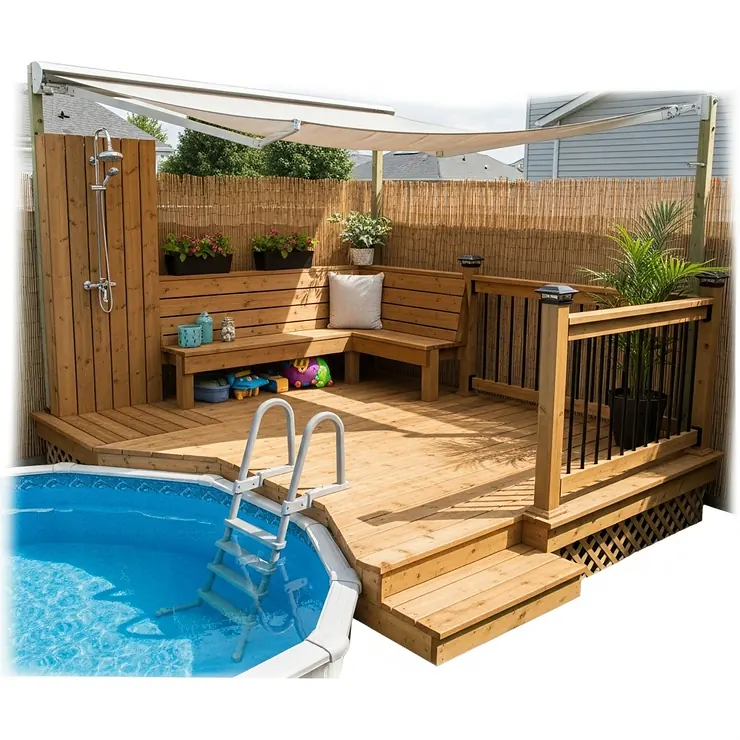
Real-World Scenarios: Matching a Deck Around Above Ground Pool to Your Life
Specs only help if they fit your actual household. Here are three buyer profiles and the logic behind each match.
Scenario 1: The family with two young kids and a 24-foot round pool. Safety dominates. The VinylWorks 5×10 Resin Deck Kit with its gated entry is the logical match, with a Confer Plastics 9300 Roll-2-Guard A-Frame as a backup for removable access. A moderate budget covers it, and daily use during summer means low maintenance matters.
Scenario 2: The DIY homeowner with a free weekend and a 15-foot pool. A custom lumber deck is realistic here. Pair Blue Wave Easy Pool Steps with pressure-treated boards for a budget build, or choose composite boards and the Confer Plastics Step-1X if you want less upkeep. Frequency of use is moderate, so spending the savings on a gate latch is smart.
Scenario 3: The retiree who hosts the grandkids on weekends. Entry confidence matters most. The Aqua Select Anti-Slip Steps with Gate offers wide, anti-slip footing and lockable access, which counts for a lot when mobility or supervision is a concern. A compact VinylWorks 5×5 Resin Deck Kit could add a landing platform without a large footprint.
Notice what drives each decision: who uses the pool, how often, and who needs protecting. The “best” product changes depending on the answers.
Problem → Solution Guide for a Deck Around Above Ground Pool
Problem 1: “My steps don’t fit my pool.” Measure the wall height and confirm whether your pool has a flat bottom. The Confer Plastics Step-1X is for flat-bottom pools, and the Confer Plastics 9300 Roll-2-Guard adjusts across a wider range.
Problem 2: “The deck feels slippery.” Choose textured boards, since embossed-grain composite tends to grip better than smooth versions, and pick steps with anti-slip treads like the Aqua Select and Blue Wave options.
Problem 3: “I’m worried about kids getting in unsupervised.” Add a self-closing, lockable gate, and consider a gated kit like the VinylWorks 5×10 Resin Deck Kit.
Problem 4: “My deck gets too hot to walk on.” Dark composite can heat up in strong sun. Lighter colors help, and a quick rinse before use cools the surface.
Problem 5: “I don’t know whether I need a permit.” Call your local building department before building. Rules vary, and some jurisdictions treat raised decks differently from ground-level work.
Safety, Barriers, and Regulations: What to Check Before You Build
This is the section nobody wants to read and everybody should. Pool barriers exist because drowning risk to small children is real, and decks change the safety equation.
The U.S. Consumer Product Safety Commission publishes barrier guidelines for residential pools. They are guidelines rather than a federal standard, but many states and localities build them into code. The key points: the top of a barrier should be at least 48 inches above grade, the bottom clearance shouldn’t exceed 4 inches, and above ground pools should have barriers that keep children from climbing in. Ladders or steps should be designed to be secured, locked, or removed, or surrounded by a barrier.
Here’s where decks get tricky. A deck can create a climbing route over the pool wall, which undermines the pool wall’s role as a barrier. Code guidance for above ground pools with decks says the deck setup must still meet barrier requirements, which often means a compliant railing and a lockable gate at the stairs. Treat any gated kit as a head start, not a guarantee of code compliance.
Two practical takeaways. First, a building permit is likely for raised decks in many places, so check before you start. Second, your local code controls, not a product page or a blog post. Ask your building department what they require.
Common Mistakes When Buying a Deck Around Above Ground Pool Setups
Mistake 1: Buying steps before measuring. The wall-height and flat-bottom issues are the top source of returns.
Mistake 2: Treating a step set as a deck. The Confer Plastics and Blue Wave products are entry systems. They don’t give you a platform.
Mistake 3: Ignoring the barrier rules. A beautiful deck that fails inspection is an expensive lawn ornament.
Mistake 4: Underbuilding the structure. Decks several feet off the ground need proper bracing. Cheap framing is a safety issue.
Mistake 5: Choosing on looks alone. Dark, smooth composite may feel slick and hot, so match the finish to your climate and household.
Mistake 6: Forgetting the pool cover. Even with a deck around the pool, you still need a cover for winter, so plan the layout so the cover can go on and off.
Mistake 7: Spending the whole budget on the deck. Reserve money for ground prep, hardware, and a quality gate latch.
Frequently Asked Questions About a Deck Around Above Ground Pool Projects
❓ How high should a deck around above ground pool walls be?
❓ Can you attach a deck directly to an above ground pool?
❓ Do you need a permit for a deck around above ground pool builds?
❓ How long does a deck around above ground pool last?
❓ Can I build a deck around above ground pool myself?
Conclusion: Choosing Your Deck Around Above Ground Pool Setup
So where does all this leave you? If you want a ready-made platform with minimal fuss, the VinylWorks 5×10 Resin Deck Kit is the best all-around pick. Step up to the VinylWorks 5×13.5 Resin Deck Kit if lounging space is the goal, or drop to the VinylWorks 5×5 Resin Deck Kit if your yard is tight. If you’re building your own platform, the Confer Plastics Step-1X is a strong low-cost entry, the Blue Wave Easy Pool Steps give you deck-mounting brackets, the Confer Plastics 9300 Roll-2-Guard forgives measurement errors, and the Aqua Select Anti-Slip Steps with Gate adds premium access control.
The thread running through every recommendation is the same: measure first, check local barrier rules, and match the product to who actually uses the pool. A deck around above ground pool setups should make swimming safer and the backyard better, so build with both goals in mind.
✨ Ready to upgrade your backyard? 🔍 Click through to check current pricing and availability on the products above, and turn your pool into the place everyone wants to be this summer!
Recommended for You
- Salt Water Above Ground: 7 Best Systems for 2026
- Decks for Above Ground Pools: 7 Best Picks Ranked for 2026
- 7 Best Above Ground Saltwater Pool Options for Ultimate Summer Relaxation in 2025
Disclaimer: This article contains affiliate links. As an Amazon Associate, I earn from qualifying purchases. If you purchase products through these links, we may earn a small commission at no additional cost to you.
✨ Found this helpful? Share it with your friends! 💬🤗
