
In This Article
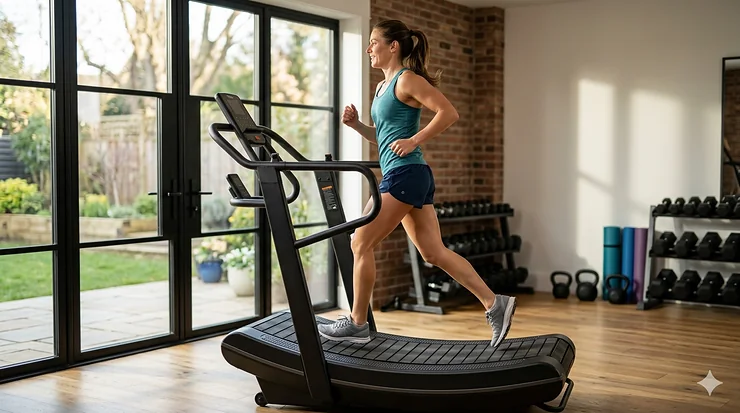
Let’s get one thing straight before you scroll an inch further: a manual treadmill for running is not your grandmother’s walking machine. It is not the dusty flat-belt contraption folded into the corner of a 1990s spare bedroom. What we’re talking about — particularly the curved, self-propelled machines dominating home gyms and CrossFit boxes in 2026 — is something altogether different. Visceral. Demanding. And, for a growing tribe of serious runners, absolutely irreplaceable.
Here’s the core idea: on a motorized treadmill, the belt moves for you. Your job is just to keep up. On a manual treadmill for running, you are the motor. The belt goes exactly as fast as your legs push it, which means no artificial ceiling on your sprint speed, no electricity bill, and — this is the kicker — a biomechanically richer workout that forces you to engage your hamstrings and glutes in ways a conveyor-belt machine simply doesn’t demand.
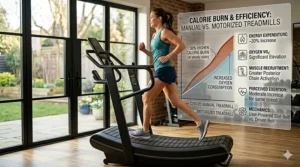
The science backs this up, too. Studies suggest that running on a non-motorized curved treadmill results in higher energy expenditure compared to motorized alternatives — meaning you torch more calories per session at the same perceived effort level. The exact number varies by body composition and intensity, but the consensus among coaches and exercise physiologists is consistent: the self-powered machine wins on calorie burn.
So whether you’re chasing sprint PRs, building HIIT capacity, or just tired of paying for electricity to run in place, this guide cuts through the marketing noise. We’ve researched seven real, currently available products on Amazon, dug into the specs that actually matter, and translated all of it into plain English for every type of runner — from the weekend jogger to the serious athlete who treats their home gym like a second office.
Let’s run.
Quick Comparison Table: Top Manual Treadmills for Running at a Glance
| Product | Type | Weight Capacity | Resistance Levels | Price Range | Best For |
|---|---|---|---|---|---|
| AssaultRunner Pro | Curved slat belt | 350 lbs | None (user-powered) | $2,500–$3,000 | Serious athletes, HIIT |
| AssaultRunner Elite | Curved slat belt | 400 lbs | None (user-powered) | $4,000–$4,500 | Elite training, longevity |
| Tru Grit Runner Elite | Curved belt | N/A | 6 levels | $900–$1,100 | Budget curved option |
| Sunny Health & Fitness SF-X7110 | Curved magnetic | 330 lbs | 8 levels | $700–$950 | Budget-conscious runner |
| Sunny Health & Fitness SF-T7878 | Flat belt magnetic | 300 lbs | 3 incline levels | $200–$300 | Beginners, casual use |
| Sunny Health & Fitness SF-T1407M | Flat belt compact | 220 lbs | None | $100–$180 | Entry-level walking/light jog |
| Xebex AirPlus Runner Smart Connect | Curved magnetic | 350 lbs | 8 levels | $2,000–$2,500 | Tech-forward training |
What this table tells you, and what it doesn’t: The price gap between budget and premium options is enormous — and deliberate. The AssaultRunner Pro costs ten times more than the SF-T1407M for a reason that goes beyond vanity. If serious running is the goal, the curved machines are in an entirely different performance category. The flat-belt options are honest workhorses for walking and light jogging, but calling them running machines is a stretch. More on that below.
💬 Just one click — help others make better buying decisions too! 😊
Top 7 Manual Treadmills for Running: Expert Analysis
1. AssaultRunner Pro — The Industry Gold Standard
If you’ve spent any time in a CrossFit gym or followed elite conditioning coaches on social media, you’ve seen this machine. The AssaultRunner Pro is the benchmark against which every other manual treadmill for running is measured — and for good reason.
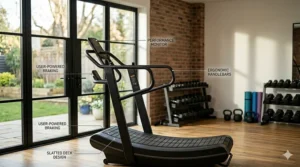
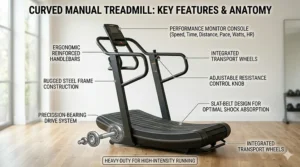
The curved slat belt design is the mechanical heart of the whole operation. The AssaultRunner Pro is a motor-free indoor running machine specifically designed for elite fitness training and High Intensity Interval Training, encouraging a toe or mid-foot strike and a heel pull that translates directly into better running mechanics. That’s not marketing copy — it’s the reason coaches pay premium prices for it. Speed, calories, pace, watts, and distance are all tracked in real time, and the machine connects via Bluetooth or ANT+ for seamless integration with apps like Zwift.
The 9-degree curve sits in what most experts consider the sweet spot: steep enough to build momentum on your drive, forgiving enough for sustained efforts. At around 350 lbs weight capacity and a steel-framed build that could survive a small apocalypse, this machine is built to last a decade of daily commercial use.
What most buyers overlook: the belt is on the heavier side compared to some competitors. That weight actually helps during high-speed efforts — it maintains momentum so you’re not fighting a dead belt at top sprint. For interval work where you’re toggling between all-out sprints and recovery jogs, this characteristic is genuinely useful.
Users consistently report that the AssaultRunner Pro changes how they think about treadmill running. The learning curve is real — the first session will feel awkward — but by week two, most runners describe it as the closest thing to outdoor sprinting they’ve found indoors.
✅ Bluetooth/ANT+ connectivity for app integration
✅ Unlimited speed — only your legs set the ceiling
✅ Heavy-duty steel frame built for commercial use
❌ 49-inch running surface is shorter than standard, limiting very tall runners
❌ Premium price point that requires serious budget commitment
Price range: $2,500–$3,000. An investment — but one that pays dividends for years.
2. AssaultRunner Elite — When You Want the Best, Period
The AssaultRunner Elite is a more rugged and durable machine than the Pro — it carries a max weight capacity of 400 lbs versus 350 lbs on the Pro, and comes with a more comprehensive warranty program including a lifetime frame warranty. Think of it as the Pro with the luxury package.
The monitor is genuinely excellent. It tracks the most relevant stats, includes built-in training programs, and the surrounding assembly includes two storage compartments for water bottles and cell phones — a surprisingly useful feature that not all curved treadmills offer. Two water bottle holders and a multifunctional center storage compartment round out the Elite’s feature set compared to the Pro.
Here’s the practical difference between the Pro and Elite: if you’re buying once and keeping it for a decade, if you weigh over 350 lbs, or if you want the peace of mind of an industry-leading warranty, the Elite justifies its premium. If you’re budget-constrained but still want Assault quality, the Pro delivers 90% of the experience at a lower price.
The Elite performs beautifully across all intensities. Max-effort sprints, tempo runs, recovery jogs — the curved deck handles all of it without complaint. The AssaultRunner Elite has become a top pick for most performance-oriented buyers according to experienced curved treadmill reviewers, particularly for varying intensities and max-effort sprints.
✅ 400 lbs weight capacity — highest in the category
✅ Lifetime frame warranty for ultimate peace of mind
✅ Excellent monitor with built-in programs and storage
❌ Larger footprint than some competitors — not ideal for tight spaces
❌ Highest price point of any consumer-accessible manual treadmill
Price range: $4,000–$4,500. Premium, but the most durable investment in this entire guide.
3. Tru Grit Fitness Runner Elite — The Budget Curved Entry Point
The Tru Grit Runner Elite exists to answer a specific question: “Can I get a curved manual treadmill running experience without spending $3,000?” The answer is mostly yes, with some asterisks you should read before clicking “add to cart.”
The Tru Grit Runner Elite is 100% athlete-powered, utilizing a motor-less belt design that promotes a more natural running form and balance, and is perfect for quick stride cadence, midfoot and toe strike training. The six resistance levels are genuinely versatile: levels 1–2 are designed for running, levels 3–4 for walking, while levels 5–6 simulate a push sled or uphill interval training — giving you a complete cardio workout in one machine.
The commercial-grade steel and aluminum frame is legitimately impressive for the price. The battery-powered LCD display tracks time, distance, pace, calories, and watts. It’s not the sophisticated monitor on the AssaultRunner, but it covers everything most runners actually look at during a workout.
Where it falls short: the 1-year warranty is noticeably thin compared to the lifetime frame guarantees you get from Assault and Tru Grit’s own higher-end models. Expert reviewers have flagged that buyers who want long-term confidence in their purchase may want to invest in a higher-quality alternative despite the tempting price. For home users who train 3–4 times per week and maintain their equipment, the Tru Grit Runner Elite represents solid value.
✅ Six resistance levels including sled-push simulation
✅ Commercial-grade frame at a fraction of premium prices
✅ No electricity required — truly self-powered
❌ Short 1-year warranty raises durability questions
❌ Weight capacity not prominently specified — verify before purchase
Price range: $900–$1,100. The most accessible route into curved manual treadmill running.
4. Sunny Health & Fitness SF-X7110 — The Smart Budget Curved Pick
The Sunny Health & Fitness SF-X7110 Smart Ultra Manual Treadmill features 8 levels of magnetic resistance powered by 14 strong magnets, adjustable via a tension control lever, with a 330 lbs weight capacity, superior shock absorption, and a durable rubber-coated belt combined with high-quality bearings and steel idlers for a smooth workout.
What’s genuinely clever about the SF-X7110 is the magnetic resistance system. On a pure curved treadmill like the AssaultRunner, resistance is purely a function of your effort and the belt’s inertia. Adding magnetic resistance levels lets lighter users or beginners find a comfortable starting point, and creates interesting training variation for experienced runners. The SunnyFit App offers FREE Bluetooth connectivity with thousands of trainer-led workouts and 10,000+ virtual scenic tours — a genuinely impressive software package at this price point.
The practical reality: the SF-X7110 sits in a sweet spot for runners who want the curved deck experience but aren’t ready to commit $3,000. The 330 lb capacity is solid, the shock absorption is legitimately good for joint-sensitive runners, and the 3-year structural frame warranty provides a level of reassurance that the Tru Grit Runner Elite can’t match.
Is it as good as the AssaultRunner? No. The belt feel is different, the frame less substantial. But for a home gym where you’re training 4–5 times per week on a real budget, the SF-X7110 punches well above its price class.
✅ 8-level magnetic resistance adds training versatility
✅ Free SunnyFit App with extensive workout library
✅ 3-year structural frame warranty — best in budget category
❌ Belt experience noticeably different from premium slat-belt machines
❌ 330 lb capacity lower than premium curved competitors
Price range: $700–$950. Exceptional value for the curved manual treadmill category.
5. Sunny Health & Fitness SF-T7878 — The Flat-Belt Workhorse
Here’s where honesty matters. The SF-T7878 is a flat-belt magnetic manual treadmill. It features a 300 lb weight capacity, two 11-pound flywheels that maintain running belt momentum, three incline levels via a manual recline adjuster, and a running surface of 47.5 inches long by 17.5 inches wide.
That running surface. Let me be direct: 17.5 inches wide is narrow. At walking pace, it’s fine. At a genuine running pace — the kind where your arms swing and your stride opens up — you’ll feel constrained. The SF-T7878 is most honestly described as a vigorous walking and light jogging machine, not a serious running platform.
That said, it earns its place in this guide for the right buyer. If you’re a beginner building a cardio base, if you want resistance training that mimics sled exercises (the SF-T7878 is genuinely good for this — its sled-like training exercises target muscles in your shoulders and improve speed), or if you’re recovering from injury and need controlled, low-impact movement, the SF-T7878 delivers reliable results at a fraction of curved-deck prices.
The dual flywheel system is the machine’s standout feature. Unlike budget flat-belt models with no momentum assist at all, the two 11-pound flywheels create a notably smoother running cadence. You notice the difference immediately coming from a no-flywheel compact machine.
✅ Dual flywheel design for smoother belt movement
✅ Three incline levels add workout variety
✅ Excellent for sled-style pushing exercises
❌ Narrow 17.5-inch deck limits true running stride
❌ Not designed for serious speed work or intervals
Price range: $200–$300. Honest value for casual use and cross-training.
6. Sunny Health & Fitness SF-T1407M — The Entry Door Into Manual Training
The SF-T1407M Manual Walking Treadmill is non-electric, foldable, and compact, featuring a digital monitor that displays time, distance, speed, and calories burned, with optional free SunnyFit App Bluetooth connectivity for additional workout tracking.
The SF-T1407M is the most honest product on this list because it makes no pretense of being something it isn’t. It’s a walking machine that can handle light jogging for smaller-framed users. It folds. It costs almost nothing. It requires no electricity. For someone building a new fitness habit or needing a low-barrier way to add movement to a work-from-home day, it serves its purpose beautifully.
For actual running — sustained aerobic effort with real speed — look elsewhere. The lack of flywheels means belt movement is purely friction-dependent, which creates a choppy, inconsistent stride feel at anything above a brisk walk. It also carries a lower weight capacity, which limits who can safely use it.
But here’s the thing: the SF-T1407M has introduced thousands of people to non-motorized movement who would never have justified a $3,000 curved machine. There’s genuine value in that. Start here, build the habit, then graduate to a curved deck when the commitment is clear.
✅ Ultra-affordable — lowest barrier to entry
✅ Folds down to minimal footprint, perfect for apartments
✅ No electricity required — move it anywhere
❌ Not suitable for serious running or speed work
❌ No flywheel means inconsistent belt feel at higher effort
Price range: $100–$180. The entry door. Not the destination.
7. Xebex AirPlus Runner Smart Connect — The Tech-Forward Alternative
The Xebex AirPlus Runner Smart Connect is a curved manual treadmill with eight levels of magnetic resistance that can be changed instantly, several handle options for sled movements, and SmartConnect Bluetooth functionality for app integration. It’s the most technologically sophisticated manual treadmill for running in this guide.
The SmartConnect functionality deserves real attention. The Bluetooth-enabled monitor can connect with more apps than most other manual options, though you sacrifice a few years of warranty coverage compared to some competitors.
Here’s the nuanced truth about the Xebex AirPlus: while the AirPlus is better for walking and sled movements than pure curved treadmills, the AssaultRunner is superior for running. The magnetic resistance, while excellent for controlled walking and cross-training purposes, creates a slight inconsistency in belt responsiveness at running speeds that pure-curve machines don’t have. For someone who wants a single machine for walking intervals, sled push simulation, and occasional running — the Xebex AirPlus is brilliant. For someone whose primary goal is running performance, the AssaultRunner edges it out.
That said, the Xebex occupies a unique position: more technologically capable than the Assault, more resistance-versatile than anything else in this guide, and substantially cheaper than the AssaultRunner Elite.
✅ 8 resistance levels including effective sled simulation
✅ Best-in-class app connectivity with SmartConnect Bluetooth
✅ Multiple handle configurations for varied training modes
❌ Not as pure a running experience as the AssaultRunner line
❌ Shorter warranty than some premium competitors
Price range: $2,000–$2,500. An excellent choice for cross-training athletes who also run.
How to Actually Run on a Manual Treadmill: A Setup and Technique Guide
Buying the machine is step one. Learning to use it without face-planting in week one is step two. The technique on a curved manual treadmill is meaningfully different from motorized running — different enough that most first-timers feel clumsy for their first two or three sessions. Here’s how to shortcut that learning curve.
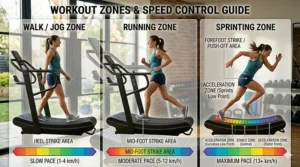
Your first session: go slower than you think you need to. Seriously. The most common mistake on a curved manual treadmill is stepping onto it at your normal motorized treadmill pace. The belt responds to your effort in real time, and until your proprioception adjusts to the cause-and-effect relationship between foot strike and belt speed, you’ll waste energy chasing an inconsistent rhythm. Start walking. Spend ten minutes just feeling how the belt responds to your weight placement. Then progress to a jog.
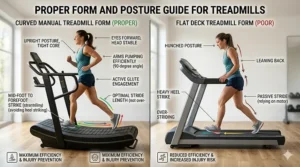
Foot strike is everything. The AssaultRunner, and curved manual treadmills generally, encourage a toe or mid-foot strike with a heel pull — the biomechanical pattern most coaches associate with efficient running form. This is the opposite of the heel-strike pattern many runners develop on motorized treadmills, where the moving belt essentially pulls your foot backward after initial contact. On a manual machine, you drive the belt — which naturally promotes a more forward-leaning, mid-foot running gait.
Position on the deck matters. Foot strikes should land slightly in front of the upright beams, not far behind them. Too far back and you’ll slow the belt unintentionally. Lean slightly forward when accelerating; stand tall when maintaining pace.
The first 30 days: Keep sessions under 20 minutes for the first two weeks. Longer isn’t better when you’re adapting to new mechanics. Build to your normal workout duration by week four.
Maintenance: Keep the belt tension consistent. For flat-belt manual models, a light monthly application of treadmill lubricant under the belt extends lifespan significantly. Curved slat-belt machines like the Assault models are largely maintenance-free — just wipe down the belt and check bolt tightness every few months.
Common first-month mistakes:
- Running too far toward the back of the deck (causes belt slowdowns)
- Not warming up — cold muscles and an unfamiliar machine are a recipe for strain
- Setting resistance too high too soon on magnetic models like the SF-X7110
Who Should Buy Which Manual Treadmill? A Real-World Scenario Guide
Shopping for fitness equipment is personal. The machine that transforms one person’s training routine might collect dust in another person’s garage. Here are three real buyer profiles — and exactly which machine each one should consider.
Profile 1: The Serious Home Gym Athlete Meet someone who runs 4–5 days per week, does HIIT two days, and wants a machine that genuinely challenges them. Their budget is flexible but not unlimited. This buyer wants to see meaningful fitness improvement, not just ticks on a step counter. For this person, the AssaultRunner Pro is the clear call. The unlimited speed, the biomechanically honest curved deck, and the commercial-grade durability make it the machine they’ll still be using in 2031. The price stings once; the quality pays off daily.
Profile 2: The Cross-Training Athlete Think someone who splits training between running, strength work, and conditioning. They want one machine that can do triple duty: running intervals, sled-push simulation, and walking recovery. The Xebex AirPlus Runner Smart Connect is built for this person. The eight resistance levels, multiple handle configurations, and app connectivity give them the training variety their mixed program demands. The running experience isn’t quite as pure as the Assault, but for someone who isn’t exclusively a runner, that’s an acceptable trade.
Profile 3: The Budget-Conscious Beginner Someone brand new to running who isn’t sure they’ll stick with it — and shouldn’t spend $3,000 until they know they will. Start with the Sunny Health & Fitness SF-X7110. It’s curved, it offers real resistance variety, it has the SunnyFit App for guided workouts, and it doesn’t demand a mortgage. If the habit sticks — and curved treadmill running tends to be engaging enough that it does — upgrading to the AssaultRunner Pro in a year or two is a logical next move.
Manual Treadmill vs Motorized Treadmill: The Honest Comparison
Every fitness writer has an opinion on this one. Here’s mine, based on what the research and real-world coaching experience actually show — not what treadmill companies want you to believe.
| Feature | Manual Treadmill (Curved) | Motorized Treadmill |
|---|---|---|
| Calorie burn | Higher (30–50% more per session) | Standard |
| Running form | Natural, mid-foot strike encouraged | Can promote heel-strike |
| Speed control | Instant, user-driven | Digital buttons, slight lag |
| Electricity cost | $0 | Ongoing |
| Maintenance | Minimal | Motor, belt, and electronics |
| Interactive content | Limited (improving) | Extensive |
| Price range | $700–$4,500+ | $500–$5,000+ |
| Best for | Serious runners, HIIT | Beginners, endurance, entertainment |
Manual treadmills not only facilitate a more natural stride and reduce impact on joints, but the absence of a motor means less maintenance and a smaller carbon footprint compared to motorized alternatives.
The argument for motorized treadmills is strongest for two groups: complete beginners who need the guardrails of a controlled, consistent belt speed, and runners who use treadmill sessions primarily as long, steady endurance efforts while watching content or following guided workout programs. If that’s you, motorized makes sense.
The argument for manual is strongest for everyone else. The performance gains from a self-powered curved deck are real and measurable. And once you’ve done a genuine sprint set on an AssaultRunner, the idea of pushing buttons on a motorized machine to change your speed will feel genuinely absurd.
According to research on running physiology discussed at Harvard Health, the higher energy expenditure of manual curved treadmills comes from recruiting the posterior chain — hamstrings, glutes, and calves — more aggressively than flat-belt running does. Your body works harder because it genuinely is working harder.
✨ Don’t Miss These Exclusive Deals!
🔍 Take Your Running to the Next Level
Click any highlighted product name in this guide to check current pricing and availability on Amazon. Prices shift constantly — what we’ve listed are ranges based on research, and the actual price on Amazon the day you click may be different. These machines sell out during promotional periods, so checking availability now is always worth doing.
How to Choose the Right Manual Treadmill for Running: 7 Criteria That Actually Matter
Skip the spec sheet rabbit holes. Here are the only seven things that actually determine whether a manual treadmill for running will serve you well or frustrate you into abandoning it.
1. Curved vs. flat belt — decide this first. Curved decks are for running. Flat belt models are for walking and light jogging. If your primary goal involves genuine running speed, a curved machine is not optional — it’s the baseline. Everything else on this list assumes you’ve made this call.
2. Weight capacity relative to your weight. Give yourself a buffer of at least 50 lbs. A 300-lb capacity machine used by a 280-lb runner is operating at its mechanical limit on every session. That’s how frames crack and warranties get voided. Check the capacity, add 50 lbs, and make sure you’re below that line.
3. Running surface length. The ACSM (American College of Sports Medicine) recommends a minimum of 54 inches of belt length for running. The AssaultRunner Pro’s 49-inch deck is slightly under that recommendation — fine for most people, potentially limiting for runners over 6’2″ with long strides.
4. Resistance levels. Pure curved treadmills (Assault line) have no adjustable resistance — your effort is the resistance. Magnetic resistance models (Xebex, SF-X7110, SF-T7878) add training variety. Neither is objectively better; it depends on what you want from your training.
5. Warranty. The lifetime frame warranties on the Assault line and the 3-year structural warranty on the SF-X7110 tell you everything you need to know about manufacturer confidence in their products. A 1-year warranty on a machine you’re going to run on 200 times a year is a yellow flag.
6. Connectivity and tracking. If you’re a data-driven athlete who wants Zwift integration or app-based coaching, Bluetooth connectivity isn’t optional. The Xebex and Assault models offer it. The budget Sunny flat-belt machines offer basic LCD tracking only (with some SunnyFit app exceptions).
7. Footprint vs. your available space. Curved machines are large. The AssaultRunner Pro is approximately 68 inches long by 31 inches wide. Measure your gym space before you fall in love with a machine that won’t physically fit. See the American Council on Exercise home gym setup recommendations for space planning guidelines.
Common Buying Mistakes: What to Avoid When Shopping for a Manual Treadmill
This section exists because I’ve seen too many people make expensive mistakes that a few honest paragraphs could have prevented.
Mistake #1: Buying a flat-belt machine expecting a running experience. The SF-T1407M is a fine walking machine. It is not a running machine. If you read “manual treadmill” in the listing and assumed it could replace a proper curved-deck machine for sprint training, that’s a costly misunderstanding that results in a product return and lingering frustration.
Mistake #2: Ignoring the learning curve entirely. Curved manual treadmills feel genuinely strange for the first few sessions. Runners who don’t know this often assume something is wrong with the machine — or wrong with them — and give up before the mechanics click. They don’t click immediately. Give it two weeks.
Mistake #3: Overweighting the monitor features. The most technically sophisticated monitor in this guide belongs to the Xebex. The best overall running machine is arguably the AssaultRunner. These are not the same thing. Don’t let feature lists distract you from the fundamental question: does this machine produce the running stimulus I need?
Mistake #4: Not checking Amazon’s return policy on large fitness equipment. Treadmills over a certain weight often ship freight and have different return logistics than standard Amazon packages. Read the return terms before purchasing — particularly for the premium curved models.
Mistake #5: Buying the cheapest option with the intention of “upgrading later.” The upgrade almost never happens. If you genuinely want the curved manual treadmill running experience, buy the curved manual treadmill now. The budget flat-belt machine will become an expensive clothes rack while you save up for the machine you actually wanted.
Long-Term Value and Maintenance: What Owning a Manual Treadmill Actually Costs
The sticker price is just the beginning. Here’s what experienced owners actually pay over five years:
AssaultRunner Pro (curved, slat belt): Near-zero maintenance costs. No motor to service, no electronics to replace. The occasional belt tension adjustment. At $2,500–$3,000 upfront, this machine costs roughly $1.50–$2 per session over five years at four sessions per week. By any fitness equipment ROI standard, that’s excellent value.
Sunny SF-X7110 (curved, magnetic): The magnetic resistance system requires minimal servicing. No lubricant needed. Possible bearing replacement around year 3–5 of heavy use. Budget approximately $50–$100 in minor maintenance over five years.
Flat-belt models (SF-T7878, SF-T1407M): These require periodic belt lubrication — every 150 miles or every 3 months. Lubricant costs roughly $10–$15 annually. Budget also for potential belt replacement around the 3–5 year mark if used regularly.
The electricity math: A motorized treadmill running one hour per day uses approximately 500–700 watts. At the average US residential rate of around $0.17 per kWh, that’s roughly $30–$40 per year in electricity. Over five years: $150–$200 in operating costs before you factor in motor maintenance. Manual treadmills cost $0.
For anyone on the fence about whether the manual premium is worth it: factor in the operational savings and the near-zero maintenance burden, and the true cost-of-ownership gap between a quality curved manual and a motorized machine narrows considerably.
FAQ: Manual Treadmill for Running
❓ Can you actually run at full speed on a manual treadmill?
❓ Is running on a manual treadmill harder than a motorized one?
❓ What is the best manual treadmill for running under $1,000?
❓ Are manual treadmills good for HIIT and sprint training?
❓ How long does it take to get used to running on a curved manual treadmill?
Conclusion: The Machine That Earns Every Calorie
A manual treadmill for running is not a compromise. It is not a cheaper substitute for the “real thing.” For serious runners — the ones who care about form, about calorie efficiency, about building a training tool that mirrors outdoor running biomechanics — it is the real thing.
The hierarchy is clear. If budget is no object and longevity is the priority: AssaultRunner Elite. If you want the industry standard at a more accessible premium: AssaultRunner Pro. If you want to enter the curved machine world without the full investment: Xebex AirPlus Runner or the Sunny SF-X7110. And if you’re brand new and just need a low-barrier way to start moving: the flat-belt Sunny options do exactly what they promise, even if they don’t promise the moon.
The common thread through all of them? No electricity. No moving belt dragging you along. Just you, your legs, and a machine that only goes as hard as you do. That honest feedback loop — the one where slowing down actually slows the belt, where pushing harder actually pushes you forward — is something no motorized machine can replicate.
Run hard. The belt will keep up.
✨ Don’t Miss These Exclusive Deals!
🔍 Ready to Choose Your Machine?
Click any highlighted product in this guide to check current pricing and availability on Amazon. Stock levels on premium curved machines fluctuate — especially the AssaultRunner line — so checking availability before you’re ready to commit is always a smart move.
Recommended for You
- Manual Treadmill vs Electric: 7 Best Picks for 2026 Revealed
- 7 Best Curved Manual Treadmills (2026): Burn More, Spend Smart
- Best Manual Treadmill 2026: 7 Top Picks Tested & Reviewed
Disclaimer: This article contains affiliate links. As an Amazon Associate, I earn from qualifying purchases. If you purchase products through these links, we may earn a small commission at no additional cost to you.
✨ Found this helpful? Share it with your friends! 💬🤗
