
In This Article
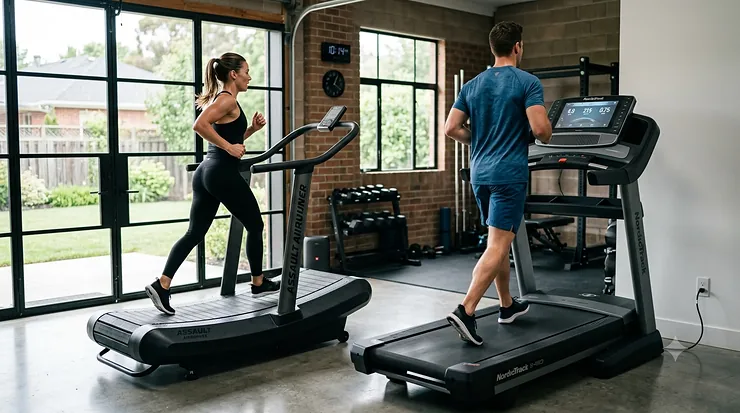
Here’s a question most buyers never think to ask before spending $500 to $3,000: who’s actually doing the work — you, or a motor? That single distinction is the whole heart of the manual treadmill vs electric debate, and it shapes everything from how many calories you burn to how big your electricity bill is at the end of the month.
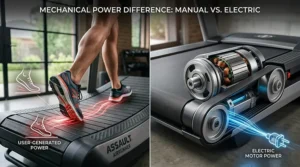
A manual treadmill is entirely self-powered. You push the belt backward with your feet; the belt moves because you move. No plug, no power cord, no monthly energy drain. Electric treadmills work the opposite way — a motor spins the belt at whatever speed you dial in, and your job is simply to keep up with it. In roughly 40–60 words, that’s the core comparison: manual treadmills demand more physical effort and cost nothing to run, while electric treadmills offer consistent speed control, tech features, and a lower physical barrier to sustained cardio.
But here’s what the spec sheets won’t tell you. Manual treadmills come in two totally different species. The cheap flat-belt models you see for under $150 are honestly best for slow walks; they’re awkward to run on and can feel like dragging your feet through wet cement. Then there are curved, non-motorized treadmills — the kind CrossFit boxes and serious runners use — which are a completely different beast: high-calorie, high-intensity, and built for people who want results, not entertainment.
Electric treadmills, meanwhile, range from basic folding walkers under $400 all the way up to $2,500+ connected machines with 16-inch HD touchscreens, automatic trainer control, and Netflix built in. Choosing between manual treadmill vs electric isn’t a simple either/or — it’s about figuring out who you are as an exerciser, what your home allows, and what you actually want out of the next five years of your fitness life.
This guide breaks down seven real, currently available Amazon picks across both categories — budget, mid-range, and premium — so you can walk away with a clear answer.
Quick Comparison: Manual vs Electric Treadmill at a Glance
| Feature | Manual (Flat-Belt) | Manual (Curved) | Electric |
|---|---|---|---|
| Calorie Burn | Moderate | Up to 30–40% more than electric | Standard |
| Speed Control | User-paced | User-paced | Motorized (consistent) |
| Electricity Use | None | None | Yes (~$10–$30/month) |
| Maintenance Cost | Low | Low–Medium | Medium–High |
| Running Experience | Awkward at speed | Outdoor-like | Smooth, controlled |
| Price Range | $80–$200 | $2,000–$4,000+ | $400–$3,000+ |
| Best For | Casual walkers | Serious athletes | Most home gym users |
| Incline Options | Fixed (usually) | Fixed | Motorized (adjustable) |
The table above tells a nuanced story: there’s no single winner. The flat-belt manual wins on budget and simplicity; the curved manual wins on intensity and calorie burn; the electric wins on versatility for the widest range of users. Your choice depends on which column lines up with your life.
💬 Just one click — help others make better buying decisions too! 😊
Top 7 Manual and Electric Treadmills: Expert Analysis
1. Sunny Health & Fitness SF-T1407M Manual Walking Treadmill — Best Budget Manual
If you want to try the manual treadmill experience without risking more than a modest amount of money, the SF-T1407M is the smartest starting point on Amazon. It’s a flat-belt manual with a fixed 13.5% incline — which is actually a clever design choice. That slight upward angle is what makes the belt move at all; without it, flat manual belts are nearly impossible to push.
The running surface measures 42 inches by 13 inches, which is genuinely narrow. You’re walking, not sprinting — and that’s completely fine for what this machine is. The max user weight is 220 lbs, and the digital LCD tracks speed, distance, time, and calories. Dimensions fold to 20″ × 23″ × 50″, making it small enough to tuck into a closet between sessions.
What most buyers overlook is the practical meaning of “no electricity required.” In an apartment with limited outlets, or in a garage that isn’t wired for gym equipment, this matters enormously. Just step on and go — no waiting for warm-up, no power strip juggling.
This is a machine for people who want to add daily movement, not crush interval sessions. Physical therapists recovering from knee injuries, remote workers hitting step goals during conference calls, older adults easing back into cardio — this is your tribe. Don’t expect to run on it. Do expect a solid, foldable, maintenance-light machine that costs less than a single month of gym membership.
Customers consistently praise how quickly it assembles (under 20 minutes) and how quietly it operates. The most common complaint is the narrow belt — fair criticism, though expected at this price point.
✅ No electricity needed — works anywhere
✅ Folds flat for compact storage
✅ 3-year structural frame warranty
❌ 13″ belt width limits natural stride
❌ Not suitable for jogging or running
Price range: Under $150. For casual walking fitness, this is extraordinary value.
2. AssaultRunner Pro — Best Premium Curved Manual Treadmill
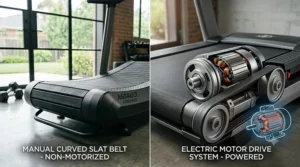
This is not a treadmill for people who want to “go a little easier today.” The AssaultRunner Pro is a self-powered curved treadmill that runs entirely on batteries (4 AAs for the display) and human effort — and the human effort part is considerable. The curved deck naturally forces you to strike with the ball of your foot and engage your core, essentially correcting bad running mechanics without a trainer in the room.
The specs are serious: steel powder-coated frame, 350 lb max user weight, dimensions of 69.9″ × 32.8″ × 64″, and a 150,000-mile belt warranty. The console shows watts, heart rate, speed, RPM, distance, time, and calories — plus Bluetooth/ANT+ connectivity for heart rate monitors. Built-in programming covers HIIT intervals (20/10, 10/20, custom), target modes, and a competition mode.
Here’s what the spec sheet won’t tell you: running on a curved manual treadmill feels dramatically different from any motorized machine you’ve ever used. Research published in peer-reviewed journals suggests curved manual treadmills can burn 30–40% more calories than motorized treadmills at equivalent perceived effort — because you’re generating every foot-strike of momentum yourself. There’s no coasting, no zoning out. The pace drops the second your focus does.
The AssaultRunner Pro is for athletes, CrossFitters, competitive runners, and anyone who has hit a plateau on traditional cardio. It’s also ideal for home gym owners who don’t have electrical outlets near their training area. Yes, it’s a significant investment in the $3,000+ range. But the math changes when you factor in zero electricity costs, virtually no motor maintenance, and commercial-grade durability that will likely outlast multiple electric treadmills.
Customers from Amazon report that the learning curve is real — expect 2–3 sessions before it feels natural — but the calorie burn and cardiovascular spike are unlike anything they’ve experienced on electric machines.
✅ Burns significantly more calories per session
✅ No electricity required — truly portable
✅ Promotes proper outdoor running mechanics
❌ High upfront cost (premium investment)
❌ Steep learning curve for new users
Price range: In the $3,000–$3,500 range. For serious athletes, this is a long-term gym replacement.
3. AssaultRunner Classic — Best Mid-Range Curved Manual
Think of the AssaultRunner Classic as the Pro’s more accessible younger sibling. Released as a leaner, more affordable entry into Assault Fitness’s curved manual lineup, it carries the same core DNA — curved deck, self-powered belt, human-paced resistance — but lands at a considerably lower price point, opening up the curved manual experience to a wider group of buyers.
The Classic still includes Assault Fitness’s signature training programs: quick start, intervals (20/10 and 10/20), target modes, and competition mode. The frame warranty for home use is solid at 5 years (frame) and 2 years (moving parts). Transport wheels and a built-in handle make it easy to reposition despite the machine’s weight.
What makes the Classic particularly compelling is the value equation. The curved manual category has historically been dominated by $3,000+ machines, effectively pricing out the serious amateur. The Classic punches into that gap. You’re getting the same biomechanically correct running experience — the ball-of-foot engagement, the core activation, the instant speed response — at a price that serious home gym builders can justify.
This is the right pick for intermediate fitness enthusiasts who’ve outgrown flat-belt manual treadmills and want to step into the curved world without committing to the full Pro price. College athletes training at home, personal trainers building a small studio, or anyone who’s been curious about why their CrossFit box uses nothing but curved treadmills — this is the on-ramp.
Buyers on Amazon note that assembly is straightforward and that the belt feels noticeably smoother than cheaper curved alternatives. A few users mention it’s loud during intense sprint intervals — which is honestly just physics, not a defect.
✅ Curved design at a more accessible price
✅ Same training programs as the Pro
✅ Excellent 5-year frame warranty
❌ Heavier than flat-belt options — less portable
❌ Still a significant investment vs. entry-level electrics
Price range: Mid-to-upper range, significantly below the Pro. Check current Amazon pricing for seasonal promotions.
4. Horizon T101 Electric Treadmill — Best Budget Electric
The Horizon T101 is quietly one of the most recommended sub-$1,000 treadmills in fitness circles, and with good reason. It’s the machine that delivers actual running capability without demanding a second mortgage. The 2.5 CHP motor handles speeds up to 10 mph — that’s a 6-minute mile pace — which covers the full range of walking, jogging, and moderate running for most users.
The 20″ × 55″ deck is the minimum you’d want for genuine running; anything shorter and you’re unconsciously shortening your stride. The T101 supports up to 300 lbs, folds for storage, and rolls on wheels. Bluetooth connectivity lets you stream audio from your phone, and the built-in programs include interval and calorie-burn modes that keep workouts from becoming stale.
What most buyers overlook is Horizon’s “Rapid Sync Motor” technology, which allows the treadmill to accelerate and decelerate faster than many competitors. During interval training — 30 seconds fast, 30 seconds slow — that responsiveness is the difference between a clean workout and stumbling at belt transitions.
The T101 is the default recommendation for someone who wants a real electric treadmill that folds, runs, and doesn’t make neighbors file noise complaints. It’s straightforward enough that someone’s grandmother could use it safely, and capable enough that a casual runner won’t outgrow it for years.
Amazon reviews are overwhelmingly positive on build quality and assembly ease. The most frequent note: it doesn’t have a fancy touchscreen — and honestly, most buyers say they don’t miss it.
✅ 2.5 CHP motor handles real running
✅ Folds and rolls for apartment-friendly storage
✅ Fast speed/incline response for interval training
❌ No built-in screen — bring your own device
❌ 10 mph top speed limits elite-pace runners
Price range: In the $700–$999 range. Excellent value for the first serious home treadmill.
5. Exerpeutic TF1000 Walk to Fitness Electric Treadmill — Best Electric for High-Capacity Walkers
The Exerpeutic TF1000 solves a problem that almost no other treadmill in its price range does: it supports up to 400 lbs, it runs quietly, and it’s built specifically for walking rather than pretending to be a running machine. That honest self-awareness is worth something. At 1.5 CHP with speeds maxing out at 4 mph, no one is going to mistake this for a performance machine — and that’s precisely the point.
The running surface measures 40″ × 20″, which is genuinely comfortable for walkers. The LCD display tracks time, speed, distance, calories, and heart rate via pulse-sensing handlebars. What’s notable is the Quiet Drive system, which keeps motor noise low enough for apartment use during a Netflix marathon. The machine folds when not in use and comes with a 5-year motor warranty and 1-year frame warranty.
Here’s the real-world interpretation of “400 lb weight capacity” that the spec sheet skips: this is one of the very few treadmills under $500 that a heavier individual can safely use without worrying about the frame flexing or the motor burning out after six months. For someone beginning a weight-loss journey, or recovering from surgery under a doctor’s supervised walking program, that structural integrity is not a luxury — it’s a prerequisite.
The TF1000 also lands in a practical sweet spot for seniors who want daily movement but not the complexity of a 16-button console and app subscriptions. Step on. Set a comfortable pace. Walk. Done.
Amazon buyers with higher body weights consistently highlight the stability and durability, often noting they’ve owned other treadmills that felt wobbly and weak by comparison. The 4 mph speed ceiling is the main trade-off, so if you ever plan to jog, you’ll need a different machine.
✅ 400 lb weight capacity — exceptional for the price
✅ Quiet Drive system — apartment-friendly
✅ Simple interface — genuinely easy for all ages
❌ 4 mph maximum — walking only
❌ Limited long-term growth for fitness progression
Price range: Under $500. Outstanding value for high-capacity daily walking.
6. Sole F63 Folding Electric Treadmill — Best Mid-Range Electric
If you’re a runner — not a jogger, a runner — and you need a home treadmill under $1,400 that won’t let you down, the Sole F63 is probably what you’re looking for. The 3.0 CHP motor is genuinely strong for this price tier, powering speeds up to 12 mph (a 5-minute-mile pace) without straining. The 20″ × 60″ deck is longer than what most competitors offer at this price point — and that extra length matters more than people realize. It allows taller runners to open their stride fully rather than subconsciously chopping it short.
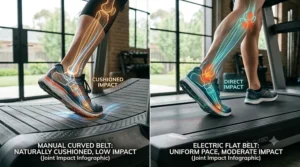
The Cushion Flex Whisper Deck technology reduces impact by roughly 40% compared to outdoor running, according to Sole’s testing — which translates to significantly less stress on knees, hips, and ankles over months of use. The incline range hits 15 levels, the console includes 10 workout programs (two of them user-customizable), and the frame comes with a lifetime warranty. Bluetooth audio and a cooling fan round out the package.
The spec sheet won’t tell you this: the Sole F63’s frame feels genuinely commercial-grade when you put your hands on it. The handrails don’t flex; the deck doesn’t rattle at speed; the folding mechanism clicks solidly into place. These are things you only notice when you’ve used flimsier machines — and then you notice them immediately.
The F63 is the right call for anyone who runs 20+ miles per week at home, weighs up to 325 lbs and needs structural confidence, or simply wants a machine that will be relevant five years from now without an expensive service call. The warranty alone — lifetime frame and motor — is worth highlighting. That’s an unusually generous commitment at this price level.
Amazon reviewers consistently call it the best treadmill they’ve ever owned at this price point, with high marks for durability and quiet operation.
✅ 3.0 CHP motor handles serious running speeds
✅ 60″ deck — rare at this price, great for tall runners
✅ Lifetime frame and motor warranty
❌ Heavy and harder to relocate once placed
❌ Basic console — no interactive touchscreen
Price range: In the $1,100–$1,300 range. Exceptional long-term value for dedicated runners.
7. NordicTrack Commercial 1750 Electric Treadmill — Best Premium Electric
This is the treadmill for people who want everything. The 2026 NordicTrack Commercial 1750 arrives with a 4.25 CHP motor, a −3% to 12% incline/decline range (yes, downhill training included), and a 22″ × 60″ running deck. The 16-inch swiveling HD touchscreen now streams Netflix and Spotify alongside the iFit platform’s library of 10,000+ trainer-led workouts filmed on seven continents. The SmartAdjust technology automatically shifts speed and incline to match virtual terrain or your heart rate — your trainer controls your treadmill in real time.
Here’s what that 4.25 CHP motor actually means in practice: it’s powerful enough to hold 12 mph consistently without any noise increase or belt hesitation, whether you weigh 150 lbs or are doing a weighted-vest walk at 300 lbs. The −3% decline function — often overlooked — lets you train the muscles used for actual downhill running, reducing the quad imbalance that flat treadmills create over time.
The iFit subscription runs about $39/month for a family plan (covering up to five profiles), so factor that into your total cost of ownership. Without the subscription, the machine works fine with standard programs; with it, the experience is legitimately closer to having a personal trainer than anything else in home fitness.
This is for the dedicated runner preparing for races, the fitness-obsessed home gym owner who wants gym-quality tech, or anyone who’s calculated that the cost of this machine plus iFit is still cheaper than an annual big-box gym membership in a major city — because in many markets, it is.
Amazon buyers frequently mention the setup requires two people (it’s heavy at 311 lbs boxed) and that the iFit subscription becomes habit-forming fast. The most common critique: they wish they’d bought it sooner.
✅ 4.25 CHP motor with decline training (−3%)
✅ 16″ HD swiveling touchscreen with Netflix/Spotify
✅ iFit auto-adjusts speed and incline to terrain
❌ iFit subscription adds ongoing monthly cost
❌ Requires two people for assembly
Price range: Around $2,499. For the ultimate connected home running experience, this is the benchmark.
How to Set Up and Get the Most From Your Treadmill in the First 30 Days
Buying a treadmill is the easy part. Actually using it consistently for 30 days straight — that’s where most people quietly fail. Here’s the practical setup and habit guide that no product listing will give you.
Week 1: Placement and Calibration
Flat-belt manual treadmills can go almost anywhere; electric treadmills need a dedicated outlet (ideally a 20-amp circuit if you’re running the NordicTrack 1750 or Sole F63 at high intensity). Place any treadmill on a mat — not just to protect the floor, but to reduce vibration and noise transmission to downstairs neighbors. A quality treadmill mat under $50 extends belt life by reducing friction heat.
For curved manual treadmills like the AssaultRunner Pro, spend your first two sessions at walking pace only. The biomechanics are different from what your body expects. Let your nervous system adapt before you start pushing hard.
Week 2: Building the Habit Before the Intensity
The most common mistake in the first 30 days: going too hard, too fast, getting sore or injured, then abandoning the machine forever. Cardiology research consistently shows that 20–30 minutes at moderate effort (where you can hold a conversation) provides significant cardiovascular benefit — you don’t need to sprint to get results. According to the CDC’s physical activity guidelines, adults need 150 minutes of moderate-intensity activity per week. Five 30-minute walks is all it takes.
Week 3–4: Progressive Loading
Once the habit is anchored, start adding: increase speed by 0.5 mph, raise incline by 2–3%, or add 5 minutes to your session. For electric treadmill users, begin exploring built-in programs — interval modes particularly are worth unlocking because they remove the decision-making and just tell you what to do next.
For manual curved treadmill users: add 10-second sprint intervals in week three. The self-regulating speed of a curved belt makes this safer than sprinting on a motorized machine — if you can’t sustain the pace, the belt simply slows with you.
Maintenance Checklist (Applies to All Treadmills)
- Monthly: Wipe down the deck and belt with a dry cloth. Check belt tension — a sagging belt causes motor strain on electrics.
- Quarterly: Lubricate the deck on electric treadmills (silicone lubricant, not WD-40). Check all bolts for loosening from vibration.
- Annually: Have a professional inspect the motor brushes on electric models over $1,000.
Who Should Buy What? Real-World Buyer Scenarios
Not everyone asking about manual treadmill vs electric is asking the same question. Here are four real buyer profiles and exactly what they should choose.
🏃♀️ Profile A: The Apartment Walker (Budget-Conscious)
Situation: Small apartment, no dedicated gym space, primarily wants daily step goals and light cardio. Budget: under $200.
Recommendation: Sunny Health & Fitness SF-T1407M. It folds to a closet-friendly size, requires no outlet, operates silently, and costs less than two months of most gym memberships. The 13.5% fixed incline makes even slow walks genuinely effortful.
💪 Profile B: The Serious Home Athlete
Situation: Has a dedicated home gym or garage space, runs regularly, wants maximum calorie burn and authentic running feel. Budget: $2,500–$3,500.
Recommendation: AssaultRunner Pro. The curved, self-powered belt burns dramatically more calories per session, corrects running mechanics, and never needs an electrical outlet or motor servicing. For someone running 4–6 days a week, the performance gap between this and any motorized machine is enormous.
👨👩👧👦 Profile C: The Family Fitness Household
Situation: Multiple family members with different fitness levels — some walking, some running, teens, parents. Need versatility and durability. Budget: $1,100–$1,400.
Recommendation: Sole F63. The 3.0 CHP motor handles everyone from a teenager jogging at 7 mph to a parent power-walking with incline. The 325 lb weight capacity, 60″ deck, and lifetime warranty make it genuinely future-proof for a busy household.
🖥️ Profile D: The Tech-Driven Fitness Enthusiast
Situation: Motivated by guided workouts, virtual races, interactive training data. Wants the “gym class” experience at home. Budget: $2,000–$2,600.
Recommendation: NordicTrack Commercial 1750. The iFit ecosystem — with trainer-controlled incline, 10,000+ on-demand classes, and Google Maps terrain simulation — is the closest thing to having a personal trainer on call 24/7 without leaving the house.
Manual Treadmill Benefits That Electric Machines Simply Can’t Match
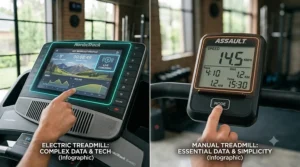
The fitness world has spent decades treating motorized treadmills as the default, with manual treadmills as the poor cousin. That framing misses something important. Here are five manual treadmill benefits that no electric machine — regardless of price — can replicate.
🔥 Higher Calorie Burn Without Higher Speed
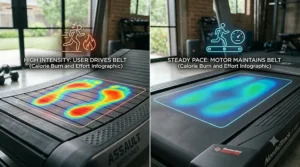
Because you’re generating every bit of momentum yourself on a manual treadmill, your body recruits more muscle groups per stride. Research from multiple peer-reviewed studies suggests curved manual treadmills can increase oxygen consumption, heart rate, and perceived exertion significantly compared to motorized machines at the same speed. You’re not running harder — you’re running more completely.
⚡ Zero Electricity Cost
An electric treadmill running 45 minutes daily at moderate intensity consumes roughly 0.5–1 kWh per session. At average U.S. electricity rates, that’s $10–$30 per month, or $120–$360 per year — in perpetuity. A manual treadmill’s lifetime electricity cost is exactly $0.00.
🎯 Instant Speed Response
On a motorized treadmill, when you punch the “increase speed” button, there’s a mechanical delay of 1–3 seconds. On a curved manual treadmill, your speed is your speed — the moment you push harder, the belt responds. This makes interval training more precise and eliminates the awkward stumble that sometimes happens during motorized speed transitions.
🛠️ Lower Long-Term Maintenance
Electric treadmill motors burn out. Belts stretch and need replacement ($100–$300). Control boards fail (often $200–$500 in parts alone). Manual treadmills have fewer moving parts, no electronics to fail except the display, and typically far lower lifetime maintenance costs.
🏠 Complete Placement Flexibility
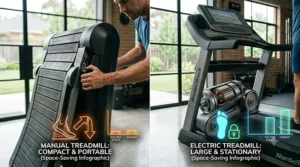
No outlet? No problem. Garage without dedicated wiring, rooftop terrace, living room corner, a hotel room during a long work trip — a manual treadmill goes wherever you do. The AssaultRunner Pro is designed with transport wheels precisely because that portability is a feature, not an afterthought.
Electric vs Manual Treadmill: Where Electric Wins
Fairness demands balance. For all the legitimate manual treadmill benefits, electric treadmills have real advantages that matter for a majority of buyers.
Controlled Speed for Interval Training Programs
When a fitness app or coaching program says “run at 6.2 mph for 3 minutes,” an electric treadmill delivers exactly that, without interpretation. Manual treadmills require you to self-calibrate. For beginners especially, that self-pacing can mean workouts that are too easy (your instinct slows the belt) or inconsistent from session to session.
Lower Physical Barrier to Entry
Starting a new fitness habit on a curved manual treadmill is like learning to ski on black-diamond runs. Possible, but unnecessarily hard. Electric treadmills remove the physical intimidation factor — you set a slow speed, hold the rails if you need to, and simply walk. This matters enormously for people returning from injury, managing chronic conditions, or just starting their fitness journey.
Decline Training
A motorized treadmill with decline settings (like the NordicTrack 1750’s −3% option) lets you train the anterior tibialis and hip flexors in ways that flat surfaces — manual or motorized — simply don’t engage. For runners preparing for hilly races, this is a genuine training advantage. Exercise science research from institutions like the American College of Sports Medicine supports the use of decline training for comprehensive lower-body preparation.
Entertainment and Motivation
This sounds trivial until you’re 25 minutes into a Tuesday morning treadmill session and motivation is a distant memory. A 16-inch HD touchscreen streaming a cooking show, a virtual run through Cape Town’s coastline, or a live group class with other users — these aren’t gimmicks. For millions of people, they’re the reason the treadmill gets used instead of becoming a very expensive clothes rack.
Features That Actually Matter (And the Ones That Don’t)
The fitness equipment industry is very good at making specs sound impressive. Here’s an honest filter.
✅ Features That Genuinely Matter
Motor CHP Rating (electric only): A 3.0 CHP motor handles running without burning out over time. Machines rated 1.5–2.5 CHP are fine for walking but will strain under sustained running. The “peak HP” rating that some brands advertise is marketing — the continuous duty (CHP) number is what matters in real use.
Deck Length: For running, you need at least 55 inches. Under that and you’re unconsciously shortening your stride. The Sole F63’s 60″ deck and NordicTrack 1750’s 60″ deck are both correct for runners up to about 6’3″.
Weight Capacity vs. Your Weight: Leave a 50–75 lb buffer. If you weigh 225 lbs, a 250 lb capacity treadmill is already operating near its limits. Choose something with at least 300 lb capacity for margin and longevity.
Warranty Terms: Lifetime frame and motor warranties (Sole F63, NordicTrack 1750) signal genuine confidence in build quality. One-year warranties on everything signal a machine designed to be replaced, not repaired.
❌ Features That Are Often Overhyped
“Peak HP” motor ratings: See above. Always ask for CHP (continuous horsepower), never peak.
Calorie counters: All treadmill calorie estimates are rough approximations. They typically don’t account for your actual body composition, metabolism, or fitness level. Use them for trend tracking, not precision nutrition.
Touchscreen size on budget models: A 7-inch screen on a $600 treadmill is usually a low-resolution display with laggy software. At budget price points, you’re often better off propping your own phone or tablet in the holder and streaming directly.
Fancy folding mechanisms with springs: “EasyLift” assisted folding sounds great — until the spring fails in year three and the mechanism binds. Simpler fold designs tend to outlast spring-loaded ones.
Long-Term Cost & Maintenance: The Real Price of Each Type
Most buyers calculate only the upfront price. The smarter calculation includes what you’ll spend over five years.
| Cost Factor | Flat Manual | Curved Manual | Budget Electric | Premium Electric |
|---|---|---|---|---|
| Purchase Price | $80–$200 | $2,000–$3,500 | $400–$1,000 | $1,500–$3,000+ |
| Electricity (5 yrs) | $0 | $0 | $600–$1,800 | $600–$1,800 |
| App Subscription (5 yrs) | $0 | $0 | $0 | Up to $2,340 (iFit) |
| Belt Replacement | Unlikely | $100–$200 | $150–$300 | $150–$400 |
| Motor Repair | N/A | N/A | $200–$500 | $200–$600 |
| 5-Year Total (est.) | ~$100–$250 | ~$2,100–$3,800 | ~$1,200–$3,600 | ~$2,500–$8,000+ |
The curved manual’s high upfront cost actually starts looking competitive over five years once you strip out electricity and subscription costs. The premium electric looks expensive — and it is — but for households where multiple people use it daily with iFit guidance replacing gym memberships and personal training sessions, the math can still favor it. Context is everything.
Common Mistakes When Buying a Treadmill (And How to Avoid Them)
❌ Mistake 1: Buying Based on Motor Peak HP
Always insist on the continuous duty horsepower (CHP). A machine advertised as “3.0 HP” often has a CHP of 1.75 — a very different piece of equipment.
❌ Mistake 2: Choosing a Manual Treadmill Assuming They’re All the Same
Flat-belt and curved-belt manual treadmills are practically different categories. Buying a $120 flat-belt model expecting a professional curved-belt experience is a setup for disappointment.
❌ Mistake 3: Ignoring the Subscription Math on Connected Machines
The NordicTrack Commercial 1750 with iFit is an exceptional machine. But $39/month for 5 years is nearly $2,340 in subscriptions — worth it for frequent users, potentially not worth it for people who plan to use 3 preset programs and nothing else.
❌ Mistake 4: Underestimating Assembly Complexity
Premium electric treadmills like the NordicTrack 1750 arrive in multiple boxes and require two people for 60–90 minutes of assembly. Budget an afternoon, not 20 minutes.
❌ Mistake 5: Skipping the Mat
A treadmill mat isn’t optional. It reduces vibration, protects your floor, extends belt life, and prevents the machine from “walking” across the room during intense use. Budget $30–$60 for one.
FAQ: Manual Treadmill vs Electric
❓ Is a manual treadmill harder to walk on than an electric one?
❓ Can you run on a manual treadmill?
❓ How much electricity does an electric treadmill use monthly?
❓ Are curved manual treadmills worth the price?
❓ What treadmill is best for seniors or beginners?
Conclusion: Which One Is Right for You?
The manual treadmill vs electric decision really comes down to three things: how hard you want to work, how much you want to spend long-term, and how much tech you want in your workout.
If you’re a casual walker, space-constrained, or budget-conscious — the Sunny Health SF-T1407M or Horizon T101 will serve you exceptionally well. If you’re a serious athlete chasing performance and maximum calorie burn, the AssaultRunner Pro is the most honest piece of cardio equipment you’ll ever own: it gives exactly as much as you put in, no more and no less. And if you want the full connected-gym experience at home, the NordicTrack Commercial 1750 is the benchmark against which all other premium home treadmills are measured in 2026.
The best treadmill isn’t the one with the most features. It’s the one you’ll actually use — consistently, enthusiastically, and without regret. Start there.
✨ Don’t Miss These Exclusive Deals!
🔍 Take your home fitness to the next level with these carefully selected treadmills. Click on any highlighted product to check current pricing and availability on Amazon. These machines will help you build real, lasting fitness — wherever you are in your journey!
Recommended for You
- 7 Best Curved Manual Treadmills (2026): Burn More, Spend Smart
- Best Manual Treadmill 2026: 7 Top Picks Tested & Reviewed
- Commercial Treadmill Warranty: 7 Best Picks for 2026
Disclaimer: This article contains affiliate links. As an Amazon Associate, I earn from qualifying purchases. If you purchase products through these links, we may earn a small commission at no additional cost to you.
✨ Found this helpful? Share it with your friends! 💬🤗
