
In This Article
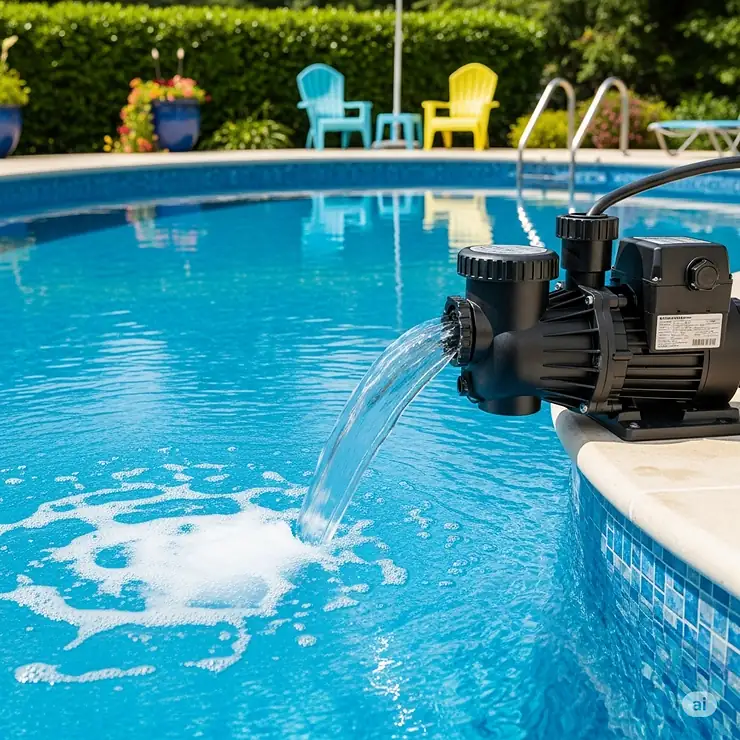
Every above ground pool arrives with a pump, and nearly every stock pump is the weakest link in the setup. It was sized to keep the box price friendly, not to wrestle a heat wave, a dozen cannonballs and a week of pollen. That’s why the search for the best above ground pool pump usually starts in the same unglamorous place: cloudy water, a motor that sounds like it’s climbing stairs, and a weekend eaten by test strips.
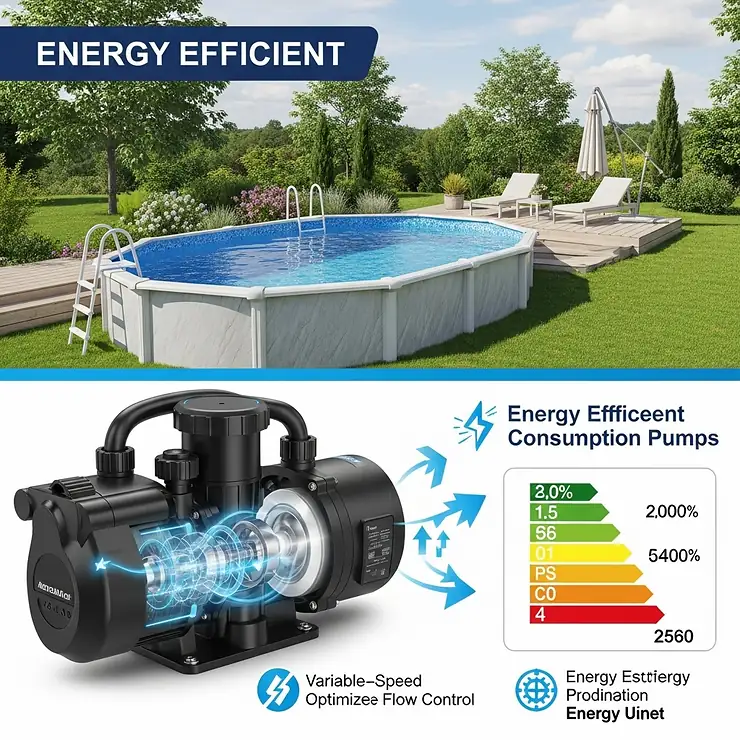
Here’s what most buyers discover too late. A pump isn’t just a motor. It’s a bundle of flow rate, filter media, energy draw, plumbing compatibility and even state law. The “biggest horsepower” label tells you almost nothing about how the whole thing will behave on your pool. The stakes are bigger than they look, too. NRDC points out that the U.S. has roughly 3.5 million above-ground pools, and that a pool pump can rank among the biggest energy hogs in a home.
A quick word on how this guide works. I haven’t run a single gallon through any of these pumps myself, and I won’t pretend otherwise. Instead, I dug into manufacturer spec sheets, ENERGY STAR listings, federal efficiency material and the patterns buyers repeat in public reviews, then translated it all into plain English. It’s mid-autumn, which makes this a calm moment to shop, with no green pool breathing down your neck. By the end, you’ll know which pump fits your pool size, your budget, your noise tolerance and your state’s rules.
Quick Comparison: Best Above Ground Pool Pump Picks at a Glance
| Pump | Type | Best For | Price Range* |
|---|---|---|---|
| Intex 2800 GPH Krystal Clear Sand Filter Pump | Pump + sand filter combo | Mid-size frame pools, easy upgrade | $225-$275 range |
| Intex 3,000 GPH Krystal Clear Sand Filter Pump | Pump + sand filter combo | Large pools up to 19,600 gallons | $250-$320 range |
| Hayward Power-Flo LX | Single-speed pump only | Owners with an existing filter | $350-$420 range |
| Hayward PowerFlo VS 300 | Variable-speed pump only | Lowest energy use, quiet operation | Premium tier; check current price |
| Speck E71-II VHV | Variable-speed pump only | Customizable speeds, dual voltage | Premium tier; check current price |
| Harris ProForce 1.5 HP | Single-speed pump only | Budget-minded pump replacement | Low-to-mid $200s for the 1 HP version |
| Intex Krystal Clear 1500 GPH Cartridge Filter Pump | Pump + cartridge filter combo | Small pools under 9,400 gallons | Under $100 range |
*Ranges reflect what I found at the time of research. Prices vary by seller and change often, so check current price before you buy.
Looking at the table, the two Intex sand-filter combos are the easiest path for most frame-pool owners, because pump and filter arrive as one plug-and-play package. The Hayward Power-Flo LX, Hayward PowerFlo VS 300, Speck E71-II VHV and Harris ProForce 1.5 HP are pump-only, so they assume you already own a filter. That’s a different shopping list entirely. Small-pool owners on a tight budget should look hard at the Intex Krystal Clear 1500 GPH Cartridge Filter Pump. Anyone planning long daily run times on a bigger pool should weigh the variable-speed options before defaulting to the cheapest sticker.
💬 Just one click — help others make better buying decisions too!😊
Top 7 Best Above Ground Pool Pump Options: Expert Analysis
Seven real pumps, ranked by how well they serve the typical above-ground owner. Every spec below is paired with what it means in practice, and every review note is aggregated sentiment, not a personal anecdote.
1. Intex 2800 GPH Krystal Clear Sand Filter Pump — best all-round upgrade for frame pools
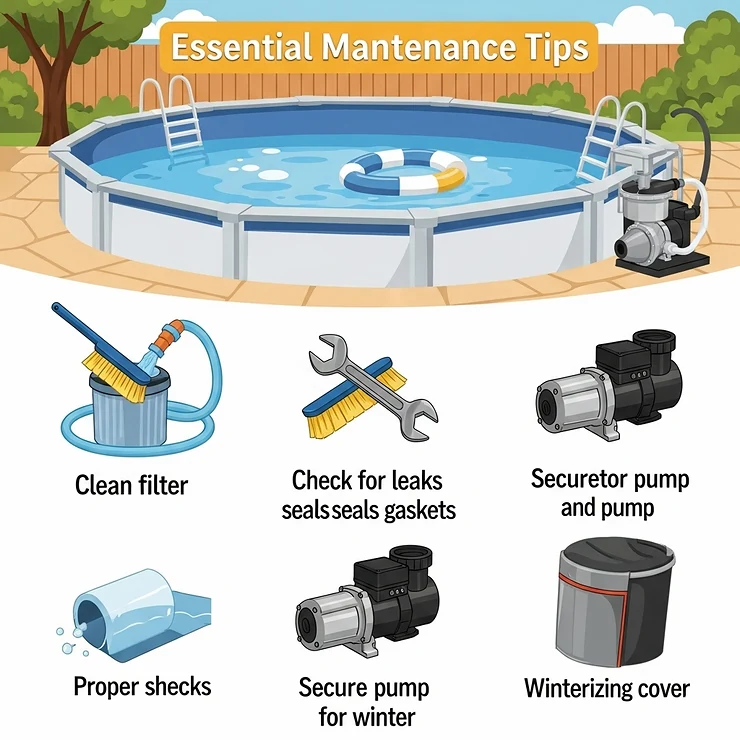
This pump swaps the flimsy cartridge setup that ships with many frame pools for a real sand filter, and that single change does more for water clarity than most chemical juggling.
Intex lists a 0.6 HP motor, 77 lb of #20 silica sand, a six-function valve (filter, backwash, rinse, recirculate, drain, closed) and a built-in 24-hour timer. The number to plan around is the 2,150 GPH system flow, which is the rate once water is pushed through the sand. Rated flow is 2,800 GPH. On a brimful 24-foot round pool holding roughly 14,700 gallons, 2,150 GPH works out to about seven hours per full turnover.
On paper, this is the sweet spot for 15-to-24-foot frame pools. Pump and filter arrive together, and reviewers report hooking straight into existing 1½-inch Intex hoses. Pools with 1¼-inch fittings need adapters.
Reviewers consistently praise how fast water clears and how simple assembly is. Common complaints include heavy backwashing during the first week while the sand settles, occasional leaks around connector fittings, and a few reports of sand reaching the pool.
Pros:
- ✅ Pump and sand filter arrive as one package
- ✅ Built-in timer and six-function valve
- ✅ Sand lasts about five years, per Intex
Cons:
- ❌ New sand means a messy first-week backwash routine
- ❌ Some owners report leaks at plastic fittings
Price: roughly the $225-$275 range. For the performance jump over a stock cartridge pump, that’s strong value.
2. Intex 3,000 GPH Krystal Clear Sand Filter Pump — most muscle in the Intex lineup
If the Intex 2800 is the sensible choice, this one is the “I’d rather overbuild than babysit” choice.
Intex lists a 0.75 HP motor, 3,000 GPH pump flow and 2,450 GPH system flow. It also carries 120 lb of sand, a 25-foot GFCI cord and a 24-hour timer, and it’s recommended for above-ground pools up to 19,600 gallons. That system flow is about 14% higher than the Intex 2800. On our 14,700-gallon example pool, a full turnover drops from roughly seven hours to about six.
Who is it for? Owners of 18-to-24-foot round pools or large ovals, plus anyone whose pool sits under trees. If your pool is smaller than 15 feet, you’re paying for flow you can’t use.
Review data is thinner here. One retailer shows about 4.1 out of 5 stars across 17 reviews, which is a small sample, though shoppers describe the power as ample for keeping water filtered and clear. The sand load is the practical catch: expect to buy roughly 2½ fifty-pound bags and heave them into the tank.
Pros:
- ✅ Highest system flow in the Intex combo range
- ✅ Rated for pools up to 19,600 gallons
- ✅ Includes 25-foot GFCI cord and timer
Cons:
- ❌ Heavy sand load makes swaps a real chore
- ❌ Overkill for pools under 15 feet
Price: around the $250-$320 range. Worth it for big pools, wasteful for small ones.
3. Hayward Power-Flo LX 1.1 HP (W3SP1580X15) — dependable single-speed workhorse
Think of this as the reliable pickup truck of above-ground pumps: no frills, plenty of pull.
The specs: 1.1 total horsepower, 115V, about 12 amps, 1½-inch female threaded ports, a stainless steel shaft and a heat-resistant double-sized seal. It also has a clear strainer lid, a drain plug (a gift at closing time) and a 25-lb shipping weight. Retailer listings describe it as easily adapting to most above-ground sand filters, and it’s pitched as a retrofit for the legacy 1.5 HP Power-Flo.
The efficiency number matters. Hayward lists a Weighted Energy Factor of 3.9, meaning about 3,900 gallons pumped per kilowatt-hour. That’s honest but unremarkable, and we’ll use it later for some cost math.
Two cautions. First, some retailers still label this model “1.5 HP,” so confirm the 1.1 HP spec. Second, one retailer notes that single-speed pumps of 1 total HP or more can’t be sold for residential pool filtration in California.
Per-SKU review data was thin in what I could access. Retailer Q&A mostly circles around cord length, twist-lock options and replacing older 1.5 HP units. Hayward’s own guidance is not to swap in a bigger motor, since the impeller is sized for the original rating.
Pros:
- ✅ Corrosion-resistant housing with clear lid
- ✅ Drain plug simplifies winterizing
- ✅ Made by an established US brand
Cons:
- ❌ Single speed means higher energy use
- ❌ Pump only, so you need a compatible filter
Price: observed in the $350-$420 range. Solid, but you pay for the name.
4. Hayward PowerFlo VS 300 — best for energy-conscious owners
Here’s where the story gets interesting for anyone who runs a pump daily.
This is an ENERGY STAR certified above-ground pump with a rated 1.1 HP, a hydraulic horsepower of 0.55 and a WEF of 10.851. Against the Hayward Power-Flo LX at 3.9, that’s roughly 2.8 times as many gallons per kilowatt-hour, or about 64% less energy per gallon moved under rating conditions. The default presets are 1,600, 2,600 and 3,400 RPM. Speed 3 drops back to Speed 1 after two hours and Speed 2 after 24, so the pump naturally settles into quiet, low-speed circulation.
Hayward says it can pay for itself within two seasons, which is a manufacturer claim worth testing against your own electric rate. Independent estimates for above-ground savings are more modest than the in-ground headlines, as we’ll see below.
The catch is availability. Hayward’s Q&A says this pump is an Expert Line product sold through local dealers, so don’t assume one-click shopping. The schedule is also preset-driven, and Hayward’s Q&A says the time settings are fixed.
I couldn’t find verifiable retail star ratings, so I won’t invent any.
Pros:
- ✅ ENERGY STAR certified with WEF of 10.851
- ✅ Low-speed circulation designed for quiet running
- ✅ Auto-reverts to low speed after high-speed bursts
Cons:
- ❌ Dealer-only sales limit availability
- ❌ Preset speed and time logic offers less control
Price: premium tier, so check current price. The value verdict depends on how many hours you run it.
5. Speck E71-II VHV — most adjustable variable-speed option
If the Hayward PowerFlo VS 300 is a smart thermostat with presets, the Speck E71-II VHV is the one with the manual dial.
It’s ENERGY STAR certified with a WEF of 10.3, a rated 1.0 HP, 0.524 hydraulic horsepower and a 1.1 THP motor. Retailer specs describe three adjustable power levels, from 50 W at 1,000 RPM up to 1,000 W at 3,500 RPM, in 10 W steps. The motor is a totally enclosed permanent-magnet brushless design, the keypad can be locked, and it auto-detects 115V or 230V. A horizontal/vertical discharge casing, included hose adapters and a lock-ring lid round out the practical touches.
On paper, that flexibility helps when your plumbing is picky, say with a pool heater needing a minimum flow. One buyer of a different variable-speed pump reported that low speed couldn’t satisfy their heat pump, so check your heater’s flow requirement before programming 1,000 RPM all day.
I couldn’t verify meaningful retail ratings for this model. One retailer lists a 12-month warranty, shorter than some competitors, so confirm coverage where you buy.
Pros:
- ✅ Fine-grained power levels from 1,000-3,500 RPM
- ✅ Dual-voltage auto-detection
- ✅ Lockable keypad prevents accidental changes
Cons:
- ❌ Short 12-month warranty at one retailer
- ❌ Limited verifiable owner review data
Price: premium tier; check current price. Great for tinkerers and heated pools.
6. Harris ProForce 1.5 HP — budget-friendly muscle replacement
The pitch here is simple: a lot of motor for not a lot of money.
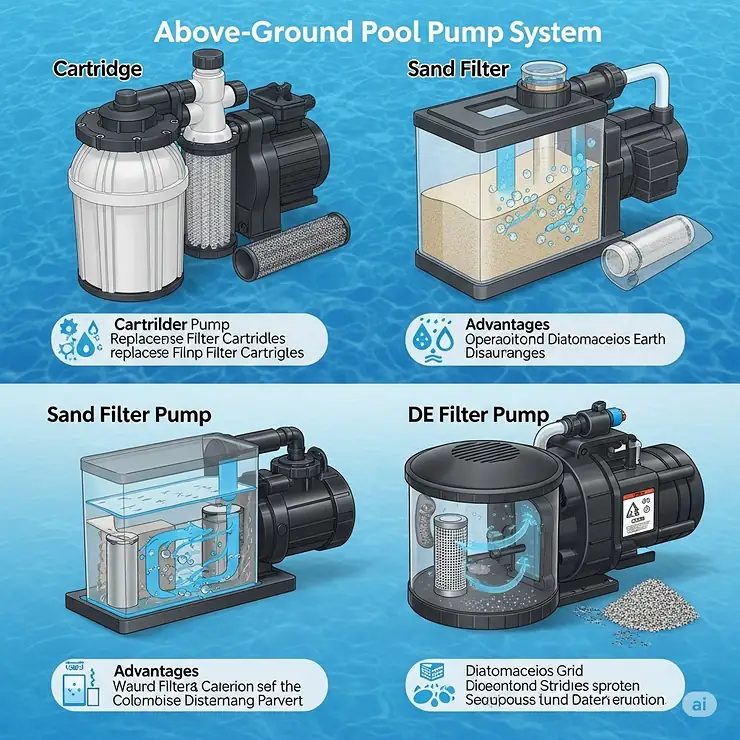
Listings describe a 115V pump with a stainless steel motor shaft, a reinforced thermoplastic body, a drain plug and CSA and ETL certification. Some versions include an on/off switch and others don’t, so read the listing. A manufacturer-style spec lists about 12 amps, which is easier on a 15-amp timer than older 1.5 HP motors.
Buyer sentiment is mixed but practical. Reviewers say it’s quiet, drops in for a Hayward in under an hour and generates enough flow to create a swirl in a 24-foot pool. Complaints include no on/off switch on some units (you unplug it), a motor that runs warm, and failures: one reviewer reports about four years of service, another reports a quick failure. One Walmart listing shows 3.6 out of 5 across just 11 ratings, so treat it as a rough signal. Intex owners should note it isn’t plug-and-play with Intex hoses, and adapters are required.
It’s also not sold in California.
Pros:
- ✅ Strong flow for the money
- ✅ Often described as quiet
- ✅ Common drop-in swap for older pumps
Cons:
- ❌ Mixed long-term reliability reports
- ❌ Hose adapters often needed, especially with Intex
Price: the 1 HP version sat in the low-to-mid $200s, so check current price for 1.5 HP. Value is good if you accept some risk.
7. Intex Krystal Clear 1500 GPH Cartridge Filter Pump — best bargain for small pools
Not every pool needs a sand filter and a nuclear reactor. This is the pump for the 10-to-15-foot crowd.
Intex lists 1,500 GPH pump flow and 1,180 GPH system flow, for pools up to 9,400 gallons. It includes a Type A cartridge (29000E), two 1½-inch hoses, an air release valve, a sediment flush valve and a Hydro Aeration inlet fitting. A 15-foot, 4-foot-deep pool holds roughly 5,300 gallons when brimful, so one turnover takes around four and a half hours. That’s comfortable.
Reviewers report it keeping 10-foot and 15-foot pools clean, and I found one buyer praising the easy cartridge swap. The flip side: some owners of larger pools say it feels marginal even with longer run times, and another planned to upgrade to sand. Anyone swapping it into a pool with smaller fittings needs hose converters.
Pros:
- ✅ Very affordable entry point
- ✅ Easy cartridge cleaning and replacement
- ✅ Right-sized for small frame and inflatable pools
Cons:
- ❌ Underpowered for pools above about 15 feet
- ❌ Cartridges are a recurring cost
Price: under $100 range at the time of research. Excellent value, provided your pool stays small.
Now, a spec-by-spec reality check:
| Pump | Motor | Flow Rating | Filter | Pool Size Guidance | Energy Note | Review Signal |
|---|---|---|---|---|---|---|
| Intex 2800 | 0.6 HP | 2,800 / 2,150 GPH (pump / system) | Sand, 77 lb | Up to roughly 17,200 gal per retail guides | Single speed | 1,500+ ratings at one retailer, mostly positive |
| Intex 3,000 | 0.75 HP | 3,000 / 2,450 GPH | Sand, 120 lb | Up to 19,600 gal | Single speed | About 4.1/5 on 17 reviews at one retailer |
| Hayward Power-Flo LX | 1.1 THP | See maker’s curve | Pump only | Pair with filter | WEF 3.9 | Thin per-SKU data |
| Hayward PowerFlo VS 300 | 1.1 HP rated | Up to 3,450 RPM | Pump only | Pair with filter | ENERGY STAR, WEF 10.851 | No retail ratings found |
| Speck E71-II VHV | 1.1 THP | 1,000-3,500 RPM | Pump only | Pair with filter | ENERGY STAR, WEF 10.3 | No retail ratings found |
| Harris ProForce 1.5 HP | 1.5 HP | Not stated | Pump only | Pair with filter | Not sold in California | 3.6/5 on 11 ratings at one retailer |
| Intex 1500 | n/a | 1,500 / 1,180 GPH | Cartridge | Up to 9,400 gal | Single speed | Positive for small pools; marginal on larger |
The table shows a clear divide. The two Intex sand combos win on convenience, while the two variable-speed pumps win on efficiency by a wide margin, with WEF scores roughly 2.6-2.8 times the Hayward Power-Flo LX. The Harris ProForce and Hayward Power-Flo LX sit in the middle: more flow than the Intex units, less efficiency than the variable-speed pair. Review data is thin across several models, so lean on the specs and your pool’s size more than star counts.
✨ Don’t Miss These Exclusive Deals!
🔍 Take your pool season to the next level with these carefully selected pumps. Click on any highlighted product to check current pricing and availability. The right pump will help you create the crystal-clear water your family will love!
Setup & First-30-Days Guide: Getting the Most From Your Above Ground Pool Pump
Buying the right pump is half the job. The other half is the first month, when most problems quietly begin.
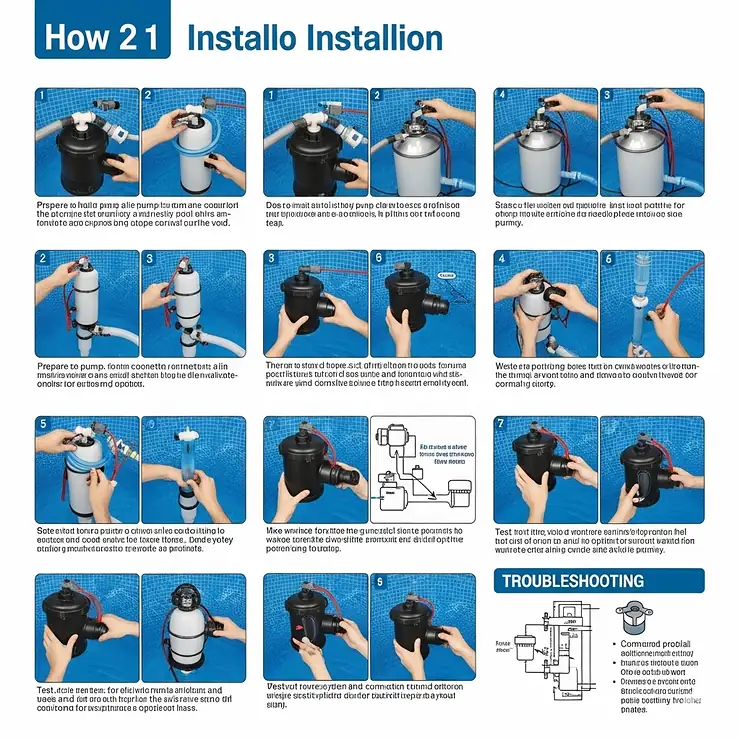
Start with fittings. Many frame pools use 1¼-inch hose fittings, while many pumps use 1½-inch. Plan for adapters and use PTFE tape on threaded joints. Most above-ground pumps are non-self-priming, so keep the pump below the water line and let it flood by gravity. Open the air release valve or lid until water flows, then close it. Never run it dry.
With a sand pump like the Intex 2800 or Intex 3000, load the correct #20 silica sand (about 77 lb or 120 lb), and expect to backwash and rinse repeatedly at first. One reviewer needed roughly seven backwashes in the first week while the water was cloudy.
Set the timer to about eight hours, then adjust after watching the water for a week. Empty the strainer basket weekly. Backwash when the pressure gauge climbs noticeably above its clean baseline. Plan to replace sand about every five years, per Intex. At season’s end, use the drain plug (the Hayward Power-Flo LX has one) and store the pump dry.
Common first-month mistakes include mismatched sand, skipping the rinse step after backwashing, and running the pump with the water level below the skimmer.
Real-World Scenarios: Matching the Best Above Ground Pool Pump to Your Backyard
Specs are abstract. Backyards aren’t. Here are three profiles.
Scenario 1: The weekend family, 15-foot pool, tight budget. A 15-foot, 4-foot-deep pool holds around 5,300 gallons at the brim. The Intex 1500 turns that over in roughly four and a half hours and costs less than a family dinner out. If the water keeps clouding, step up to the Intex 2800.
Scenario 2: The summer-long swimmer, 24-foot frame pool. That’s about 14,700 gallons brimful. The Intex 3000 manages a turnover in roughly six hours, with the Intex 2800 close behind at about seven. A leaf-heavy yard tips the choice toward the bigger unit.
Scenario 3: The bill-watcher with a heater or heat pump. Running pumps for many hours is where variable speed earns its keep. The Speck E71-II or Hayward PowerFlo VS 300 can circulate cheaply at low speed. But check your heater’s minimum flow first, since one buyer of a different variable-speed pump found 1,400 RPM too slow to run a heat pump.
Scenario 4: The California owner. One retailer notes that single-speed pumps of 1 total HP or more can’t be sold for residential filtration there, which makes the Hayward Power-Flo LX and Harris ProForce problematic. Variable-speed or sub-1-HP combos like the Intex units are the safer route. Confirm with your retailer.
Problem → Solution Guide: Fixing the Most Common Above Ground Pool Pump Headaches
Cloudy water despite constant running. Usually a flow or filtration mismatch. Upgrade from a small cartridge setup to a sand combo such as the Intex 2800, and give new sand a few backwash-and-rinse cycles.
Pump won’t prime or makes gurgling noises. Suspect air. Check water level, confirm the pump sits below the waterline, tighten fittings and use the air release valve on the Intex 1500.
Sand appearing in the pool. Stop and inspect. A few owners report sand escaping from Intex sand units, so check sand level, valve position and any damage before running again.
Leaks around fittings. Some owners report leaks at plastic connectors. Reseat gaskets, apply PTFE tape on threads and replace worn parts.
Pump runs hot or can’t be switched off. The Harris ProForce draws mixed notes here, with some units lacking an on/off switch. Buy a version with a switch or add a timer or switched outlet.
What Is the Best Above Ground Pool Pump?
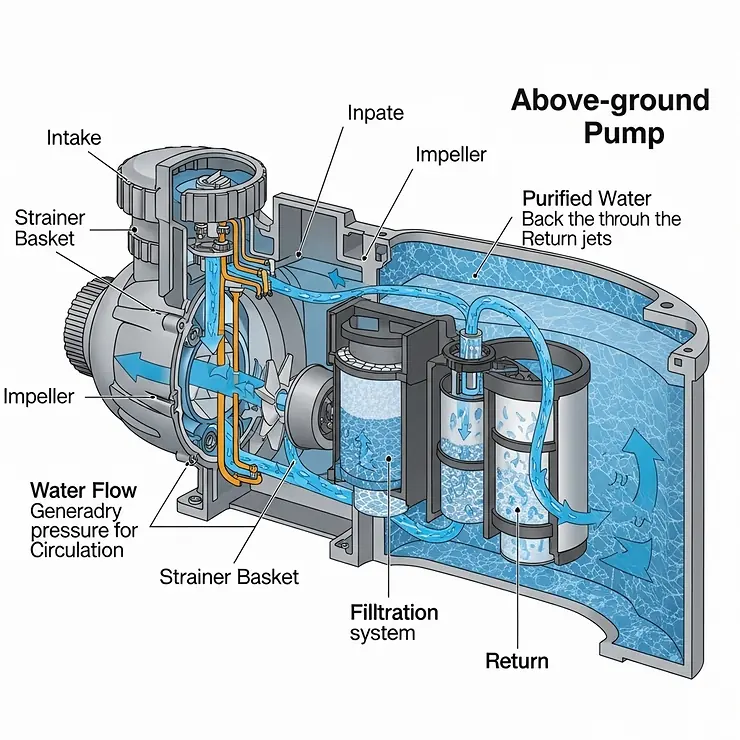
The best above ground pool pump is the one that circulates your pool’s full volume at least once per day at the lowest practical energy cost, fits your hoses or plumbing, matches your filter type and complies with local rules. For most owners, that means a pump-and-filter combo sized to pool volume or an ENERGY STAR variable-speed pump.
There’s no universal winner, only the right archetype. Small pools under roughly 9,400 gallons are well served by a cartridge combo like the Intex 1500. Mid-size and large frame pools usually do best with sand combos like the Intex 2800 or Intex 3000. Owners who already have a filter, or who run their pump long hours, should consider a pump-only unit such as the Hayward Power-Flo LX or one of the variable-speed models.
Think of it like buying shoes: the best one isn’t the fanciest, it’s the one that fits your foot and the terrain.
How to Choose the Best Above Ground Pool Pump (6 Steps)
- Calculate your pool volume. For a round pool, diameter squared × 0.785 × depth × 7.5 gives gallons. A 24-foot by 52-inch pool is roughly 14,700 gallons brimful.
- Decide your turnover target. Divide gallons by system flow (not rated flow) to see hours per turnover. Aim to complete at least one daily.
- Pick your filter path. Combos like the Intex 2800 are plug-and-play, while pump-only models like the Speck E71-II require a separate filter.
- Check efficiency. Look at WEF: Jandy’s DOE explainer notes that a WEF of 7.847 means 7,847 gallons per kilowatt-hour, and that above-ground “non-self-priming” pumps are held to lower minimums than in-ground ones. Higher is better.
- Confirm fittings and voltage. Match 1¼-inch or 1½-inch connections, and check 115V versus dual-voltage.
- Verify legal availability. California’s rules and any local requirements can rule out some single-speed pumps.
Single-Speed vs Variable-Speed vs Sand-Filter Combos
Single-speed pumps run flat out whenever they run. Variable-speed pumps adjust, trading RPM for savings. Combos bundle pump and filter into one box.
| Option | Energy Use | Noise | Upfront Cost | Best For |
|---|---|---|---|---|
| Single-speed pump only | Highest | Louder | Moderate | Hayward Power-Flo LX, Harris ProForce |
| Variable-speed pump only | Lowest | Quietest at low speed | Highest | Hayward PowerFlo VS 300, Speck E71-II |
| Sand-filter combo | Moderate | Moderate | Moderate | Intex 2800, Intex 3000 |
| Cartridge combo | Moderate | Moderate | Lowest | Intex 1500 |
Here’s the nuance. Advanced Energy says certified in-ground pumps can use up to 65% less energy, but certified above-ground pumps use around 17% less. Variable-speed still wins on efficiency and quiet, though the savings are smaller than headline numbers suggest, partly because above-ground pumps are smaller to begin with.
Combos win on simplicity and total package cost. If you run your pump four to eight hours a day on a modest pool, a combo is often the better value. If you run it twelve-plus hours or fight high electric rates, variable speed starts to justify its premium.
Features That Actually Matter (And Those That Don’t)
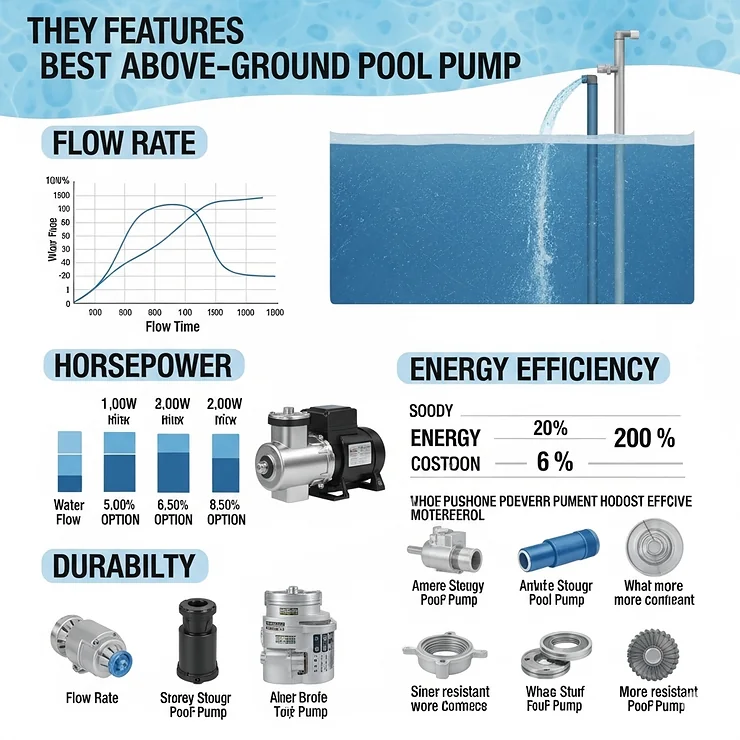
What matters. System flow beats rated flow because it reflects reality after the filter. WEF tells you gallons per kilowatt-hour. A drain plug saves you at closing. Easy-access strainer baskets save your weekends. Hose compatibility prevents a trip back to the store.
What doesn’t (as much). Horsepower on its own is a blunt number. The Hayward Power-Flo LX is rated 1.1 total HP, yet that tells you less than its performance curve and its WEF of 3.9. “Total HP” can include service factor, so compare hydraulic horsepower and WEF where available, as ENERGY STAR does for the Hayward PowerFlo VS 300 (0.55 HHP) and Speck E71-II (0.524 HHP).
A built-in 24-hour timer is genuinely useful on combos like the Intex 3000, but it isn’t a reason to overpay. Marketing buzzwords like “aeration technology” are a nice bonus but won’t rescue an undersized pump. A bigger motor also doesn’t automatically help: Hayward’s own Q&A warns against putting a larger motor on an impeller sized for the original.
Common Mistakes When Buying the Best Above Ground Pool Pump
- Buying by horsepower alone. Flow and efficiency matter more than a big number on the box.
- Ignoring hose size. Adapters are cheap, but a surprise trip mid-install isn’t. Several reviewers of the Harris ProForce and the Intex 1500 mention this.
- Forgetting the filter. Pump-only models like the Speck E71-II need a compatible sand or cartridge filter.
- Oversizing flow into a small filter. A cartridge filter can be overwhelmed by too much water.
- Skipping legal checks. California’s single-speed restriction can strand a purchase.
- Planning for a heater without checking flow. Variable-speed low settings may not satisfy a heater’s minimum flow.
- Trusting thin reviews. Several models here have small or unverifiable review pools, so read specs carefully.
Best Above Ground Pool Pump for Specific Audiences
Beginners and first-time owners: the Intex 2800 or Intex 1500, depending on pool size, because setup is plug-and-play and well documented.
Large-pool owners: the Intex 3000, rated for up to 19,600 gallons, or a pump-only setup with a properly sized separate filter.
Energy-conscious owners and heavy pump users: the Hayward PowerFlo VS 300 or Speck E71-II, thanks to ENERGY STAR certification and high WEF scores.
Budget replacers with an existing filter: the Harris ProForce 1.5 HP, with the caution about reliability and adapters.
Brand-loyal, long-haul owners: the Hayward Power-Flo LX, for its drain plug, corrosion-resistant housing and established parts availability.
Small inflatable or Easy Set pool owners: the Intex 1500, plain and simple.
Long-Term Cost & Maintenance
Sticker price is only the opening bid. Let’s do a back-of-envelope energy comparison using WEF and an illustrative $0.16 per kWh. Suppose a 15,000-gallon pool turns over twice a day for 150 days, which is 300 turnovers.
- Hayward Power-Flo LX (WEF 3.9): about 3.85 kWh per turnover, roughly 1,150 kWh per season, about $185.
- Hayward PowerFlo VS 300 (WEF 10.851): about 1.38 kWh per turnover, roughly 415 kWh per season, about $65.
That’s roughly $120 saved per season under those assumptions. Real-world results vary with plumbing, filter pressure and run time, so treat it as an illustration.
| Pump | Price Range | Ongoing Costs | Value Verdict |
|---|---|---|---|
| Intex 1500 | Under $100 | Cartridges | Best for small pools |
| Intex 2800 | $225-$275 | Sand every ~5 years | Best all-round value |
| Intex 3000 | $250-$320 | Heavier sand load | Best for large pools |
| Harris ProForce | Low-to-mid $200s (1 HP) | Replacement risk | Good if you accept risk |
| Hayward Power-Flo LX | $350-$420 | Higher electricity | Reliable but pricey |
| Hayward PowerFlo VS 300 | Premium tier | Lowest electricity | Pays off with long run times |
| Speck E71-II | Premium tier | Lowest electricity | Pays off with long run times |
Over several seasons, the premium variable-speed units can close the price gap, and some utilities offer ENERGY STAR rebates. One Louisiana utility advertised $275 at the time of research, but rebates vary by location and funding. Maintenance basics stay the same: weekly basket checks, timely backwashing, and a drain-and-store routine at season’s end.
Safety, Regulations & Compliance Guide
Plug your pump into a GFCI-protected outlet. The Intex sand units ship with 25-foot GFCI cords, and that isn’t just a convenience. Follow each manual’s guidance on placement, grounding and distance from the pool.
On the regulatory side, the federal Dedicated-Purpose Pool Pump rules use WEF to set minimum efficiency, and above-ground pumps are classed as non-self-priming with lower minimums than in-ground. Variable-speed units generally comply, while many single-speed pumps of 1 total HP or more do not. DOE also adopted pool pump motor standards in a 2023 final rule, and in April 2026 DOE announced it would delay enforcement for small-size motors made between September 28, 2027 and March 29, 2029. These rules mostly affect what retailers can sell, so choose a model that’s compliant in your state.
California adds its own wrinkle. One retailer notes that single-speed pumps of 1 total HP or more can’t be sold there for residential filtration. The Harris ProForce listings also carry a “not available in California” warning.
Finally, always check the model number. Several Hayward listings carry legacy labels, and compliance depends on the exact SKU.
FAQ: Best Above Ground Pool Pump
❓ How many hours a day should I run my above ground pool pump?
❓ Can I put a bigger pump on my above ground pool?
❓ What size pump do I need for a 24-foot above ground pool?
❓ Are variable-speed pumps worth it for above ground pools?
❓ Why won't my above ground pool pump prime?
Conclusion
The best above ground pool pump isn’t a trophy; it’s a good fit. For most frame-pool owners, that means a sand combo like the Intex 2800 for mid-size pools or the Intex 3000 for big ones. For small pools, the Intex 1500 is the sensible bargain. If you already own a filter, the Hayward Power-Flo LX is the dependable single-speed pick and the Harris ProForce is the budget gamble.
If your pump runs long hours, the Hayward PowerFlo VS 300 and Speck E71-II deserve a serious look. Their WEF scores of 10.851 and 10.3 dwarf the Hayward Power-Flo LX‘s 3.9, though above-ground savings are more modest than in-ground headlines, and availability and warranty terms deserve a check.
Before you click, measure your pool, calculate your turnover, check hose sizes and confirm your state’s rules. A few minutes of homework now beats a green pool next July.
✨ Ready to Upgrade Your Pool Water?
🔍 Compare the pumps above, check current pricing and availability, and pick the one that fits your pool, budget and backyard. Your future self (and your swimsuit) will thank you!
Recommended for You
- Deck Around Above Ground Pool: 7 Proven Picks for 2026
- Salt Water Above Ground: 7 Best Systems for 2026
- Decks for Above Ground Pools: 7 Best Picks Ranked for 2026
Disclaimer: This article contains affiliate links. As an Amazon Associate, I earn from qualifying purchases. If you purchase products through these links, we may earn a small commission at no additional cost to you.
✨ Found this helpful? Share it with your friends! 💬🤗
