
In This Article
So you want the spin-class-in-your-living-room experience, minus the four-figure hardware bill and the subscription that quietly renews itself every month like a houseguest who never leaves. You’re not alone. Search interest in peloton bike alternatives has climbed steadily as more riders realize the original isn’t the only game in town anymore — it’s just the one with the best marketing budget. Peloton bike alternatives are smart exercise bikes that replicate the interactive, instructor-led cycling experience — resistance tracking, touchscreens, app-based classes — often at a lower upfront cost or with more flexible subscription terms than the original. Some, like the ones below, actually beat Peloton on specific features: real incline simulation, bigger flywheels, or zero mandatory subscription at all. Whether you’re chasing something cheaper than peloton, hunting for peloton competitors with better warranties, or just want a bike similar to peloton bike hardware without the brand tax, this guide walks through seven real, currently available machines — researched, compared, and broken down without the fluff.
Quick Comparison Table
| Bike | Screen | Resistance | Standout Feature | Price Range | Best For |
|---|---|---|---|---|---|
| NordicTrack X24 | 24″ pivoting | 24 levels | Auto incline/decline | $2,200–$2,400 range | Hill-climb simulation |
| Bowflex VeloCore 22″ | 22″ HD | 100 levels | Leaning ride mode | $2,000–$2,300 range | Core-engaged cardio |
| NordicTrack S24 | 24″ pivoting | 24 levels | Big screen, lower price | $1,500–$1,800 range | Studio-style rides |
| Echelon EX-5s-22 | 22″ flip screen | 32 levels | Screen flips for floor workouts | $1,300–$1,800 range | Cross-training |
| MYX II Plus | 21.5″ swivel | Friction-based | Heart-rate + gear bundle | Around $1,600 | Data-driven riders |
| Schwinn IC4 | BYO tablet | 100 levels | Cheapest serious resistance | Under $900 | Budget buyers |
| CAROL Bike | 11″ display | AI-adjusted | 10-minute REHIT sessions | Premium, well above $2,500 | Time-crunched riders |
Looking at the spread above, the gap between the cheapest and priciest option here is enormous — and that’s the point. The Schwinn IC4 proves you don’t need a screen to get serious resistance training, while the NordicTrack X24 and CAROL Bike show what you’re paying extra for: either full terrain simulation or AI-tuned efficiency. Most riders land happiest in the middle, where the NordicTrack S24 and Echelon EX-5s-22 trade a bit of premium polish for real savings.
🎯 Ready to compare specs side-by-side before you buy? Bookmark this page and check current pricing before checkout — deals shift weekly.
Top 7 Peloton Bike Alternatives: Expert Analysis
We dug through spec sheets, manufacturer documentation, and aggregated reviews from outlets that put these bikes through real testing hours. Below is the honest breakdown — budget, mid-range, and premium — including where each one quietly beats Peloton and where it falls short.
1. NordicTrack X24 — auto incline/decline for real hill simulation
The headline feature here is the hands-free incline and decline range, running from -10% to 20%, which genuinely changes what “hill climbing” feels like on a stationary bike. A 24-inch pivoting HD touchscreen anchors the experience, paired with iFIT’s library of instructor-led and scenic rides.
On paper, the 24 levels of Silent Magnetic Resistance combined with automatic terrain adjustment means the bike itself steepens or eases up as the trainer on screen calls it — no manual fiddling with a knob mid-workout. That’s a genuine step beyond what Peloton’s hardware offers, since Peloton’s bikes don’t auto-adjust resistance at all.
Based on the spec comparison, this bike is built for riders who’ve outgrown flat-road spinning and want something that mimics actual outdoor terrain. Reviewers consistently note the incline mechanism is one of the smoothest in its category, though several flag that NordicTrack’s warranty terms require a climate-controlled room — a detail easy to miss at checkout.
Pros:
- ✅ Hands-free incline and decline up to 20%
- ✅ Massive iFIT content library with scenic rides
- ✅ Handlebar controls adjust gears without letting go
Cons:
- ❌ Warranty voids in non-climate-controlled spaces
- ❌ Full experience requires an ongoing iFIT subscription
Sitting in the $2,200–$2,400 range, the X24 is priced closer to Peloton’s higher-end hardware than its budget rivals — but for buyers who specifically want terrain simulation, it’s arguably the only bike on this list that delivers it convincingly.
2. Bowflex VeloCore 22″ — only bike with a leaning mode
The VeloCore’s signature trick is its lean mode: the entire bike frame tilts up to roughly 15 degrees side to side, simulating the way a real road bike shifts under you through turns. It’s a genuinely different physical sensation than any flat-frame competitor, Peloton included.
Underneath that, you’re getting 100 levels of magnetic resistance and a 33-pound flywheel — heavier than most rivals here, which translates into a smoother, more momentum-driven pedal stroke. The JRNY app layers in AI-adjusted workout intensity, and the bike is Bluetooth-compatible with Peloton’s own app and Zwift, so hardware ownership doesn’t lock you into one ecosystem.
What most buyers overlook about this model is that the lean mode isn’t just a gimmick — it recruits stabilizing core muscles you don’t typically engage on a stationary bike, which is a legitimate training benefit reviewers have flagged as unexpected but welcome.
Pros:
- ✅ Leaning frame engages core stabilizers
- ✅ Compatible with JRNY, Peloton app, and Zwift
- ✅ Heavier 33-lb flywheel for smoother pedal feel
Cons:
- ❌ Only a two-year warranty versus longer rival coverage
- ❌ 22″ console version pushes into premium pricing
Pricing spans roughly $1,700 for the smaller 16-inch console up to around $2,200 for the 22-inch version reviewed here — putting the top configuration close to X24 territory, so the lean mode needs to matter to you specifically to justify the jump.
3. NordicTrack S24 Studio Bike — biggest screen for the money
The S24 strips out the X24’s incline motor but keeps the 24-inch pivoting touchscreen and 24 resistance levels, landing at a noticeably friendlier price point. It’s the studio-cycling experience without the terrain-simulation premium.
SmartAdjust technology automatically matches your resistance to whatever the on-screen iFIT trainer calls for, and personalizes intensity to your fitness history — a feature Peloton’s base hardware doesn’t replicate without manual input. The Silent Magnetic Resistance system keeps noise down, which matters more than people expect once you’re riding above a condo or near a nursery.
Here’s what to weigh: if you don’t specifically want hill simulation, this is functionally very close to the X24 experience for several hundred dollars less. Reviewers who’ve tested both note the S24 belongs in the same conversation as the original Peloton Bike in terms of screen size, streaming quality, and touch responsiveness.
Pros:
- ✅ 24″ pivoting touchscreen at a lower price than X24
- ✅ SmartAdjust auto-matches trainer-led intensity
- ✅ Quiet Silent Magnetic Resistance system
Cons:
- ❌ No incline or decline simulation
- ❌ Same climate-control warranty restriction as the X24
At around $1,500–$1,800, the S24 is one of the strongest value plays among premium-feeling smart bikes, especially for anyone comparing it directly against a similarly priced Peloton bike similar to peloton bike hardware in almost every visible respect.
4. Echelon Connect EX-5s-22 — screen that flips for off-bike workouts
Echelon’s signature move on the EX-5s-22 is a 22-inch HD touchscreen that physically rotates 180 degrees, letting you step off the bike and follow strength, yoga, or HIIT classes without losing your instructor mid-flow. It’s a small mechanical detail that changes how the bike fits into a broader workout routine.
Specs-wise, you’re getting 32 resistance levels and 4-way adjustability on both the seat and handlebars, which accommodates a wider range of body types than some rigid competitors. The Echelon Fit app powers the content, and unlike the X24 or S24, this bike doesn’t require Wi-Fi-connected iFIT hardware to function in manual mode.
Reviewers consistently note that Echelon’s content library, while solid, doesn’t match iFIT’s or Peloton’s depth — fewer live classes, a smaller instructor roster. What the spec sheet won’t tell you is that this becomes less of an issue if you mostly ride the same handful of go-to formats anyway.
Pros:
- ✅ Screen flips 180° for off-bike workouts
- ✅ 32 resistance levels with 4-way adjustability
- ✅ Meaningfully cheaper than comparable NordicTrack models
Cons:
- ❌ Smaller content library than iFIT or Peloton
- ❌ No native streaming apps like Netflix on the touchscreen
Pricing runs from roughly $1,300 up to $1,800 depending on promotions, making this one of the more flexible mid-range peloton competitors on the list — especially for cross-training households.
5. MYX II Plus — most complete accessory bundle
MYX built its reputation on bundling more than just a bike. The Plus package ships with a heart-rate monitor, a workout mat, a set of dumbbells, a foam roller, and a resistance band — effectively a starter home gym alongside the cycling hardware.
The bike itself carries a 21.5-inch swiveling touchscreen and a built-in cadence sensor, so pedaling speed feeds directly into your workout metrics alongside heart rate. That data-forward approach is arguably its biggest differentiator from Peloton, which requires a separate heart-rate accessory purchase.
Based on the spec comparison, MYX is best suited to riders who want quantified feedback layered over the workout itself, not just a scenic ride. One thing worth flagging honestly: MYX now runs on a combined OpenFit/BODi platform after its Beachbody acquisition, and some reviewers find toggling between the two interfaces mildly confusing at first.
Pros:
- ✅ Ships with heart-rate monitor, dumbbells, and mat
- ✅ Built-in cadence sensor tracks pedaling speed automatically
- ✅ Multiple user profiles supported on one membership
Cons:
- ❌ Requires a separate monthly membership to unlock content
- ❌ Dual-app structure (OpenFit + BODi) takes adjustment
At around $1,600 for the Plus bundle, this is genuinely one of the more affordable interactive cycling packages once you account for what would otherwise be separate accessory purchases.
6. Schwinn IC4 — cheapest way into serious resistance training
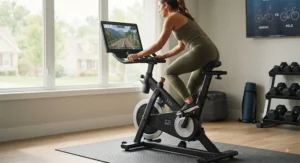
The IC4 has become something of a cult favorite among budget-conscious riders precisely because it skips the screen entirely and puts the savings into the mechanics: a 40-pound flywheel and 100 micro-adjustable levels of magnetic resistance.
That resistance range is unusually fine-grained for the price bracket — you can dial in intensity in small increments rather than jumping between a handful of preset levels. Bluetooth connectivity means the bike pairs with the Peloton app, Zwift, or JRNY on your own tablet, so you’re not locked into a single content provider the way screen-equipped bikes often are.
What most buyers overlook about this model is that skipping the built-in screen isn’t really a downgrade if you already own a tablet — you get the same resistance quality as bikes costing hundreds more, with the freedom to bring whatever workout app you actually enjoy. Reviewers who’ve logged serious hours on the IC4 report the saddle is the first thing worth upgrading, but the core mechanics hold up well over years of use.
Pros:
- ✅ 100 micro-adjustable resistance levels for the price
- ✅ Compatible with Peloton app, Zwift, and JRNY via Bluetooth
- ✅ Sturdy 40-lb flywheel built for durability
Cons:
- ❌ No built-in screen — requires your own tablet or phone
- ❌ Stock saddle is a common early upgrade for longer rides
At roughly $799–$899, the IC4 is the clearest answer to anyone specifically searching for something cheaper than peloton without sacrificing resistance quality — it’s the budget smart bikes benchmark this whole category gets measured against.
7. CAROL Bike — AI-tuned workouts in under 10 minutes
CAROL takes a completely different philosophy than the rest of this list. Instead of long, instructor-led rides, it’s built around REHIT — Reduced Exertion High-Intensity Interval Training — where the AI reads your effort in real time and adjusts resistance to maximize output in a fraction of the time.
The hardware includes an 11-inch 2K display, and a “Free Ride” mode lets you stream Peloton, Zwift, YouTube, or Netflix if you want a traditional longer ride instead. But the core pitch is efficiency: published research on REHIT protocols suggests short, AI-calibrated sprint intervals can deliver cardiovascular benefits comparable to much longer moderate-intensity sessions.
Here’s what to weigh: this isn’t a bike for people who enjoy long scenic rides or community leaderboard culture — it’s built for people who genuinely don’t have 45 minutes most days and want the most physiological return on 10 minutes of real effort. Reviewers consistently frame it as a productivity tool as much as a fitness one.
Pros:
- ✅ AI adjusts resistance in real time to your effort
- ✅ Full workouts possible in roughly 10 minutes
- ✅ 100-day home trial to test the format risk-free
Cons:
- ❌ Premium price bracket, well above most rivals here
- ❌ Thin content library if you want long-format rides
CAROL sits at the top of the price spectrum, but for busy parents or anyone who’s abandoned longer routines before, the time-efficiency math genuinely changes the value calculation.
Top 7 Bikes: Specs, Pricing, and Ratings at a Glance
| Bike | Flywheel/Resistance Type | Screen Size | Subscription | Price Range | Best For |
|---|---|---|---|---|---|
| NordicTrack X24 | 24-level SMR | 24″ | ~$39/mo iFIT | $2,200–$2,400 | Terrain simulation |
| Bowflex VeloCore 22″ | 100-level magnetic | 22″ | JRNY subscription | $2,000–$2,300 | Core-engaged riders |
| NordicTrack S24 | 24-level SMR | 24″ | ~$39/mo iFIT | $1,500–$1,800 | Studio-style value |
| Echelon EX-5s-22 | 32-level magnetic | 22″ | ~$40/mo optional | $1,300–$1,800 | Cross-training households |
| MYX II Plus | Friction-based | 21.5″ | ~$39/mo OpenFit/BODi | Around $1,600 | Data-driven riders |
| Schwinn IC4 | 100-level magnetic | BYO device | None required | Under $900 | Budget-first buyers |
| CAROL Bike | AI-adjusted magnetic | 11″ | Optional Free Ride apps | Above $2,500 | Time-crunched training |
This table makes the trade-off pattern obvious: subscription cost is almost as important as sticker price over time, and the Schwinn IC4 is the only bike here that lets you skip a mandatory monthly fee entirely. Meanwhile, the NordicTrack X24 and CAROL Bike justify their premium pricing through genuinely different mechanics — terrain simulation versus workout efficiency — rather than just a bigger screen.
🚀 Skip the buyer’s remorse — compare current prices on all seven before you commit.
How to Set Up Your New Smart Bike for Success
Getting the hardware right is only half the job — most buyer’s remorse with any of these bikes traces back to setup mistakes in the first 30 days, not the equipment itself.
Start with bike fit before you even touch a resistance dial. Seat height should put a slight bend in your knee at the bottom of the pedal stroke; too high and you’ll rock your hips, too low and you’ll strain your knees. Most bikes on this list, including the Schwinn IC4 and MYX II Plus, have quick-release levers for seat height and fore-aft position — take the two minutes to dial this in properly rather than eyeballing it.
Next, register the bike with its companion app immediately, even if you plan to use a third-party service like Zwift long-term. Manufacturer apps often unlock firmware updates and calibration tools you’ll want access to. For screen-free bikes like the IC4, mount your tablet securely and test your Bluetooth pairing with your chosen app before your first real session — troubleshooting connectivity mid-workout kills motivation fast.
Finally, build a maintenance rhythm early: wipe down the frame after sweaty sessions, check pedal and seat bolts monthly (vibration loosens them over time), and if your bike uses a belt drive, inspect tension every few months. A common early mistake is ignoring squeaks until they become expensive repairs — most resistance and flywheel issues are cheaper to fix in month two than month twelve.
Real Riders, Real Setups: Which Alternative Fits Your Life
Matching hardware to your actual life matters more than matching it to a spec sheet. Here’s how three common rider profiles map onto this list.
If you’re a budget-conscious beginner in a studio apartment who just wants to build a consistent habit without a big upfront commitment, the Schwinn IC4 paired with a free trial of the Peloton app makes sense — you get real resistance training and can decide later whether a bigger screen investment is worth it.
If you’re a former outdoor cyclist who misses the physical sensation of a real ride, especially climbing, the NordicTrack X24‘s incline simulation and the Bowflex VeloCore‘s lean mode both directly address what flat stationary bikes can’t replicate. Between the two, choose the X24 if hills are your priority and the VeloCore if cornering and core engagement matter more to you.
If you’re a busy parent squeezing workouts into small windows between school runs and meetings, the CAROL Bike‘s 10-minute AI-tuned sessions solve a real scheduling problem that no amount of content library depth can fix on a bike that demands 45 minutes to feel worthwhile.
How to Choose the Right Peloton Bike Alternative
Cutting through marketing claims comes down to seven honest questions, ranked by how much they actually affect day-to-day satisfaction.
- What’s your total monthly budget, not just the sticker price? Add subscription costs across a year — the gap between a $900 bike with no subscription and a $2,300 bike with a $39/month fee closes faster than you’d expect.
- Do you need a built-in screen, or do you already own a tablet? Screen-free bikes like the Schwinn IC4 save real money if you’re not attached to a single ecosystem.
- Does terrain simulation matter to you? Only the NordicTrack X24 on this list genuinely auto-adjusts incline and decline.
- How much space do you actually have? Measure your footprint before falling for a 24-inch screen you can’t comfortably view up close.
- Are you training for efficiency or enjoyment? The CAROL Bike‘s short AI sessions suit efficiency-minded riders; longer content libraries suit riders who want to disappear into a ride.
- What’s the warranty actually covering? Read the fine print — several bikes here have climate-control clauses or shorter coverage windows than expected.
- Will more than one person in your household use it? Multi-profile support, like MYX’s, matters more in shared households than solo ones.
Common Mistakes When Buying Peloton Bike Alternatives
The most expensive mistake buyers make is choosing based on screen size alone, ignoring resistance quality and flywheel weight — the parts that actually determine ride feel years down the line. A gorgeous touchscreen on a flimsy flywheel wears out its charm fast.
A second common trap is skipping the subscription math entirely. Reviewers consistently note that shoppers fixate on the hardware price and get blindsided later by a $39-$40 monthly fee that, over three years, can exceed the cost of the bike itself.
Third, buyers frequently underestimate delivery and assembly logistics. Several of these bikes, including the NordicTrack models, ship in single boxes well over 100 pounds and arrive roughly 70 percent pre-assembled — plan for a second set of hands or a paid assembly service rather than assuming a solo unboxing.
Smart Bikes vs Traditional Gym Memberships: What Actually Changes
It’s worth stepping back and asking whether a smart bike beats the alternative most people default to — a traditional gym membership or a standalone spin studio.
| Factor | Smart Bike at Home | Traditional Gym/Studio | Best For |
|---|---|---|---|
| Upfront cost | $800–$2,400 one-time | Usually $0 upfront | Gym: budget-first starters |
| Ongoing cost | $0–$40/month | $30–$200+/month | Bike: long-term riders |
| Time cost | Zero commute | Commute + class scheduling | Bike: busy schedules |
| Consistency | Available any hour | Limited to class times | Bike: irregular schedules |
| Social element | Leaderboards, community rides | In-person energy | Studio: motivation-by-crowd |
The financial crossover point matters here: according to widely cited industry estimates, a mid-range smart bike typically pays for itself against a $150/month studio membership within 12 to 18 months of consistent use, assuming three or more rides weekly. The trade-off isn’t purely financial, though — studios offer in-person accountability that home hardware, however smart, can’t fully replicate, so the right call depends on which kind of motivation actually keeps you coming back.
📊 See how these seven stack up against your current gym costs — check pricing before your next renewal!
Budget Smart Bikes for Beginners and Small Spaces
If you’re new to interactive cycling or working with a tight footprint, budget smart bikes solve two problems at once: lower financial risk while you figure out if the format sticks, and typically smaller frames than premium studio bikes.
The Schwinn IC4 remains the strongest entry point in this category — its 100-level resistance range means beginners aren’t stuck choosing between “too easy” and “too hard” presets, and its frame footprint is noticeably smaller than screen-equipped competitors like the NordicTrack S24 or X24. For apartment dwellers, that’s not a minor detail; several of the premium bikes here weigh well over 140 pounds and aren’t easily moved between rooms.
For beginners specifically, the Physical Activity Guidelines for Americans recommend building toward 150 minutes of moderate-intensity activity weekly, which lines up naturally with three or four shorter indoor cycling sessions rather than one marathon ride. Starting on affordable interactive cycling hardware — rather than the most expensive option on the market — also lowers the psychological stakes of quitting early, which matters more for long-term adherence than any single spec.
Long-Term Cost & Maintenance: Is It Actually Cheaper Than Peloton?
The upfront price tag is only one piece of the ownership equation, and it’s often the smaller piece over a multi-year horizon.
| Bike | Hardware Price | Monthly Subscription | 3-Year Estimated Total |
|---|---|---|---|
| NordicTrack X24 | $2,200–$2,400 | ~$39/mo | Roughly $3,600–$3,800 |
| NordicTrack S24 | $1,500–$1,800 | ~$39/mo | Roughly $2,900–$3,200 |
| Echelon EX-5s-22 | $1,300–$1,800 | ~$40/mo (optional) | Roughly $1,700–$3,200 |
| Schwinn IC4 | Under $900 | $0 (BYO app, often free tier) | Roughly $850–$950 |
| CAROL Bike | Above $2,500 | Optional Free Ride apps | Roughly $2,700–$3,000 |
Interpreting this table honestly: the Schwinn IC4 is the only bike here where “cheaper than peloton” holds true across every ownership year, not just at checkout, because it carries no mandatory subscription. The NordicTrack bikes and CAROL Bike, by contrast, front-load flashier hardware but accumulate subscription costs that narrow — or in some comparisons erase — their price advantage over Peloton’s own three-year cost of ownership.
Maintenance costs matter too, though they’re smaller. Belt-driven and magnetic-resistance bikes like the IC4 and Echelon models need essentially no part replacement for years; expect only occasional pedal or saddle swaps. Bikes with more mechanical complexity, like the VeloCore’s leaning mechanism, carry marginally higher long-term service risk simply because there are more moving parts to eventually wear.
Features That Actually Matter (And Those That Don’t)
Marketing copy loves to lead with screen size, but reviewers who’ve logged real hours consistently point to flywheel weight and resistance granularity as the features that determine whether a bike still feels good after year two. A 40-pound flywheel like the IC4’s holds momentum through pedal-stroke transitions in a way lighter flywheels simply can’t replicate, regardless of how sharp the touchscreen above it looks.
Auto-adjusting resistance — where the bike changes intensity to match an on-screen trainer without you touching a dial — is a genuinely useful feature, not just a gimmick, since it removes a common source of missed intervals during structured workouts. The NordicTrack bikes and CAROL Bike‘s AI system both deliver this meaningfully.
On the other hand, built-in streaming apps like Netflix access, while flashy in showroom demos, matter far less in practice than reviewers initially expect — most riders settle into one or two content sources within the first month and rarely explore beyond them. Similarly, dual water bottle holders and cosmetic LED lighting rings look good in marketing photos but have essentially zero impact on workout quality, according to the sober consensus across long-term stationary bicycle reviews and testing logs.
Frequently Asked Questions
❓ What's the cheapest real peloton bike alternative available right now?
❓ Do peloton competitors always require a monthly subscription?
❓ Can I actually use the Peloton app on a different bike?
❓ Are budget smart bikes as good as Peloton for serious training?
❓ Which peloton-style alternatives fit best in a small apartment?
Conclusion
There’s no single “best” peloton bike alternative — there’s only the best one for your specific mix of budget, space, and training goals. If cost is the deciding factor, the Schwinn IC4 remains the clearest winner for anyone chasing something genuinely cheaper than peloton without sacrificing resistance quality. If terrain realism matters most, the NordicTrack X24 and Bowflex VeloCore both offer mechanics Peloton’s own hardware simply doesn’t replicate. And if your real constraint is time rather than money, the CAROL Bike‘s AI-tuned short sessions might solve a problem no amount of screen size ever could.
Whatever you choose, the research above should make one thing clear: the interactive cycling category has matured well past being a single-brand conversation. Real competition now exists at every price point, and according to the American College of Sports Medicine’s exercise guidelines, consistency matters more for outcomes than which specific hardware gets you there — so weigh these options against what will actually keep you riding, not just what looks best in a showroom photo.
Recommended for You
- Peloton Bike vs Bike Plus: 7 Real Differences That Matter (2026)
- Peloton Bike Review 2026: 7 Real Models Compared
- Chain Driven Indoor Cycling Bike: 7 Top Picks for 2026
Disclaimer: This article contains affiliate links. As an Amazon Associate, I earn from qualifying purchases. If you purchase products through these links, we may earn a small commission at no additional cost to you.
✨ Found this helpful? Share it with your friends! 💬🤗
